React vs Angular: Key Differences & Which to Choose
React and Angular both support large, long-running applications, but they lead to very different development patterns that affect architecture, hiring, onboarding, and long-term maintenance.
One favors broad flexibility, while the other enforces structure from the start. Over time, that difference influences how teams build, scale, and operate their frontend.
Let’s compare React and Angular across architecture, performance, tooling, scalability, and real-world usage.
What Is React?
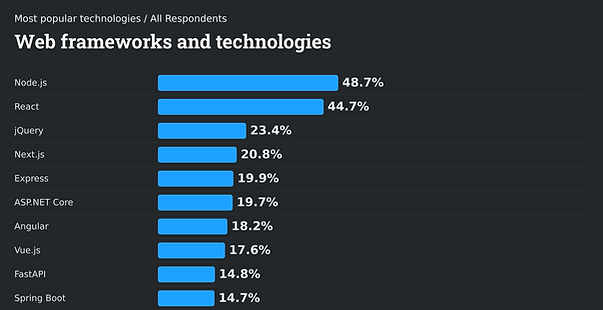
React is a JavaScript library for building user interfaces. Meta released it in 2013, and it remains the most widely used frontend tool today. According to the 2025 Stack Overflow Developer Survey, 44.7% of developers use React actively.
React focuses on one thing: the view layer. It does not include routing, state management, or HTTP services by default. You build the rest of your stack by selecting from the broader ecosystem.
React's Core Architecture (Component-Based + Virtual DOM)
React builds UIs as a tree of components. Each component manages its own state and renders based on that state. When something changes, React creates a new virtual DOM tree, diffs it against the previous one through a process called reconciliation, and applies only the minimum changes to the real DOM.
React 18 introduced concurrent rendering, which lets React pause and prioritize rendering work instead of blocking the main thread. React 19 added the React Compiler, which automatically handles memoization for components and reduces unnecessary re-renders without requiring manual useMemo or useCallback calls.
Functional components with hooks are now the standard. useState, useEffect, useReducer, and useContext handle most component-level logic. The model is composable and relatively easy to reason about once you understand how state flows through the tree.
React Ecosystem and Libraries
Because React only handles the view layer, most projects assemble additional tools around it:
- Routing: React Router or TanStack Router
- State management: Zustand, Jotai, or Redux Toolkit depending on complexity
- Data fetching: TanStack Query for server state
- Full-stack: Next.js with App Router and React Server Components
- Mobile: React Native for native iOS and Android
This modular approach gives you control over the stack. It also means more decisions upfront and more surface area to maintain over time.
What Is Angular?
Angular is a full-featured frontend framework developed and maintained by Google. Unlike React, Angular provides everything a large application typically needs out of the box: routing, forms, HTTP services, dependency injection, and a CLI-driven project structure. The 2025 Stack Overflow Developer Survey puts Angular usage at 18.2% of developers, with its strongest presence in enterprise environments.
Angular has been TypeScript-first since its rewrite in 2016. It is not just compatible with TypeScript - its architecture depends on it.
Angular's Full-Framework Architecture
Angular structures applications using components, services, and modules. Standalone components, made default in Angular 19, have significantly reduced module boilerplate. The Angular CLI generates consistent file structures, enforces naming conventions, and automates most of the setup work.
Two developers who have not worked together before will generally find each other's Angular code more immediately recognizable than the equivalent in React, because the framework enforces more conventions. For larger teams, that consistency is the core value proposition.
TypeScript and Dependency Injection in Angular
TypeScript is not optional in Angular. The framework's decorators, type inference, and tooling all depend on it. For large teams working on shared codebases, this reduces integration bugs and makes refactoring safer.
Angular's dependency injection system lets you declare services at different levels of the component tree and inject them where needed, without manually passing references through props. For applications with complex service layers - authentication, data access, logging - DI provides a clean, testable way to manage those dependencies across a large codebase.
React vs Angular: Core Differences Explained
These two tools differ more in philosophy than in raw capability. React offers flexibility at the cost of decision-making, while Angular offers structure at the cost of a steeper learning curve.
Library vs Full Framework
React is a library. Angular is a framework. That affects how much you configure versus how much comes pre-configured.
With React, you choose your routing library, your state management approach, your HTTP layer, and your folder structure. With Angular, those decisions are largely made for you. Neither approach is inherently better.
The React model works well when you have a team with clear architectural opinions. The Angular model works well when you need consistency across a large or distributed team.
Learning Curve
React's core API is small. Learning components, props, state, and hooks gets you productive quickly. The longer curve comes from assembling the full stack: which state management library to use, how to structure a Next.js application, when to use server components versus client components.
Angular's initial learning curve is steeper. Getting productive requires understanding TypeScript, the DI system, RxJS, and Angular-specific concepts like decorators, lifecycle hooks, and change detection. That upfront investment is real, but Angular's structure then reduces the number of open-ended decisions developers face daily.
Performance and Rendering
React uses reconciliation to determine which parts of the DOM need updating. Angular uses change detection. Earlier Angular versions relied on a Default strategy that checked large parts of the component tree on each update, which could become inefficient in larger applications.
The Signals API introduced in Angular 17 and stabilized in Angular 20 changed this. Signals track component dependencies and update only what changed. Combined with zoneless change detection, Angular’s rendering model now works much closer to React’s approach.
Neither framework is faster by default. In most systems, architecture matters more than framework choice.
Flexibility vs Convention
Area | React | Angular |
Architecture | Team-defined | Framework-defined |
Routing | Third-party | Built-in |
State management | Third-party | NgRx / RxJS (built-in patterns) |
HTTP | Third-party (fetch, axios) | Built-in HttpClient |
TypeScript | Optional (recommended) | Required |
File structure | Flexible | Enforced by CLI |
React gives you flexibility. Angular gives you convention. Teams with strong senior engineers who want control will often prefer React. Teams prioritizing consistency across many developers will often prefer Angular.
Tooling and CLI
Angular CLI is one of the framework's genuine strengths. ng generate, ng build, ng test, and ng lint handle the common development workflow without any custom configuration. It also manages code generation, lazy route setup, and library creation in a consistent way.
React does not have an equivalent official CLI. Create React App was deprecated, and most teams now use Vite with React or start with Next.js. These are capable tools, but they require more manual configuration and the setup varies across projects.
State Management Approaches
React's state management ecosystem is wide. Zustand and Jotai work well for most applications. Redux Toolkit remains popular for complex, auditable state. TanStack Query handles server state separately from client state, which is often the right separation.
Angular typically relies on RxJS for reactive state. NgRx, which follows the Redux pattern but uses Observables, is common in larger Angular applications. RxJS is powerful but has a steeper learning curve than the React state management alternatives. Angular's Signals API reduces that dependency for component-level state, but RxJS remains central to service-level reactive patterns in most Angular codebases.
React vs Angular: Performance Comparison
Both frameworks can deliver fast applications. The variables that matter most are bundle size, lazy loading strategy, and how efficiently components respond to state changes.
Bundle Size and Optimization
Angular's initial bundle has historically been larger than React's because it ships more framework code. Standalone components and improved tree-shaking in Angular 19 and 20 have reduced that gap. Angular 20's incremental hydration, now stable, lets apps hydrate components on demand rather than all at once, improving time to interactive for large server-rendered applications.
React's bundle size depends on which libraries you include. A minimal React setup is small. A full Next.js application adds up, but code splitting and lazy loading are well-supported and straightforward to configure.
Runtime Efficiency
React's concurrent rendering handles complex UI updates without blocking the main thread. The React Compiler reduces redundant renders automatically.
Angular's Signals API, stabilized in Angular 20, allows the framework to skip entire component tree branches when the signals they depend on have not changed.
Zoneless change detection removes Zone.js, reducing bundle size and eliminating the unnecessary detection cycles that Zone.js could trigger.
Both frameworks have made meaningful progress on runtime efficiency in recent releases. The performance gap in real-world applications is smaller in 2026 than it was a few years ago.
React vs Angular for Enterprise Applications
The enterprise conversation is where Angular has its strongest case. Large organizations, government systems, banking platforms, and internal tools benefit from Angular's built-in structure, CLI consistency, and TypeScript enforcement.
Scalability and Maintainability
As a React codebase grows, consistency depends on team discipline. Without strong conventions and code reviews, large React projects can develop inconsistent patterns across state management, routing, and data fetching.
Angular's enforced structure limits that drift. Every Angular developer knows where to find services, how components are organized, and how the DI tree works. That predictability has real value when a team grows or turns over.
Long-Term Project Stability
React is maintained by Meta with a large open-source contributor base. Angular is maintained by Google with a predictable major release cadence of approximately every six months. Both have strong organizational backing.
Angular's official migration tooling (ng update) makes major version upgrades more structured than the React ecosystem, where upgrading Next.js or switching state management libraries can require significant work.
React vs Angular for Startups and Fast Iteration
For early-stage products, speed to market and hiring flexibility matter more than long-term governance.
Speed of Development
React's lighter setup and smaller initial API let teams build and ship faster in early stages. Next.js provides SSR, routing, and API routes with minimal configuration. The trade-off is that architectural decisions accumulate as the product grows, and teams need to make and enforce those decisions themselves.
Angular's setup takes longer. The upfront investment in framework conventions can slow early momentum for teams iterating on an uncertain scope. For a well-defined product with a focused team, that same structure eventually pays off.
Hiring and Talent Availability
React has a significantly larger developer pool. According to the 2025 Stack Overflow Developer Survey, 44.7% of developers use React compared to 18.2% for Angular. For startups that hire frequently, that gap translates directly to faster recruiting and a wider candidate pool.
Angular developers are available, particularly in enterprise-focused markets, but the pool is narrower overall.
When to Choose React
React works well when ecosystem flexibility, hiring reach, and architectural control matter more than built-in conventions.
- Your team has experienced engineers who can define and enforce architectural patterns
- Mobile development (React Native) is part of your product roadmap
- You want to use React Server Components and Next.js for full-stack development
- You need to integrate with a diverse range of third-party services and libraries
- Hiring flexibility across a wide developer pool is important
- You are building a UI-heavy product that benefits from React's composability
When to Choose Angular
Angular fits better when consistency, enterprise governance, and long-term structure matter more than ecosystem breadth.
- You are building a large-scale application with a distributed team
- Strict TypeScript enforcement and a built-in DI system are priorities
- Your organization needs consistent codebases across multiple projects or teams
- You are in a regulated industry (finance, government, healthcare) where architectural predictability matters
- You want a framework where the major tooling decisions are already made
- Long-term upgrade predictability and CLI-driven development are important to your workflow
React vs Angular: Pros and Cons Summary
React provides a flexible foundation that relies heavily on ecosystem tools, while Angular delivers a more complete, opinionated platform with built-in structure.
Area | React | Angular |
Type | Library | Full Framework |
Language | JavaScript / TypeScript (optional) | TypeScript (required) |
Learning curve | Moderate (more from ecosystem) | Steeper upfront |
Built-in tooling | Limited (CLI via Next.js or Vite) | Comprehensive (Angular CLI) |
State management | Third-party (Zustand, Redux, etc.) | RxJS, NgRx, Signals |
Flexibility | High | Lower |
Convention | Team-defined | Framework-defined |
Mobile | React Native (strong) | NativeScript (limited) |
Ecosystem size | Very large | Smaller, more curated |
Enterprise adoption | Wide | Strong in structured environments |
React or Angular?
If your team is small to medium-sized, values architectural flexibility, needs access to a large hiring pool, or plans to build mobile alongside web, React is often the better fit. Next.js turns it into a full-stack platform, and the ecosystem covers most common use cases.
If your team is large or distributed, works in an enterprise or regulated environment, and values consistent structure over flexibility, Angular’s conventions, CLI, and TypeScript enforcement become meaningful advantages. The upfront investment in learning the framework often returns value through maintainability and predictable development patterns.
You can also connect with us for guidance on choosing between React and Angular, reviewing frontend architecture, and discussing custom development, staff augmentation, and team scaling.
Frequently Asked Questions
Is React better than Angular?
No. React provides more flexibility and a modular ecosystem, which suits teams that want control over architecture and tooling. Angular provides a structured, full framework with built-in patterns, which benefits large teams that prioritize consistency and standardized workflows. The better choice depends on how your team operates and what level of structure you want enforced.
Is Angular dying in 2026?
No. Angular remains actively maintained by Google and follows a predictable release cycle. Recent updates, including the Signals API and support for zoneless change detection, show continued investment in performance and developer experience. Angular remains common in enterprise environments where long-term stability matters.
Which is easier to learn: React or Angular?
React is easier to start with because its core API is small and focused on UI rendering. Angular requires understanding TypeScript, dependency injection, RxJS, and Angular-specific concepts such as decorators and change detection. Over time, Angular’s structure can reduce ambiguity, but the initial learning curve is steeper.
Which is better for enterprise applications?
Angular often fits enterprise environments well because it enforces architectural patterns, requires TypeScript, and includes integrated tooling through the Angular CLI. React can scale to enterprise level, but it requires deliberate architectural decisions and consistent standards across teams.
Which framework performs better: React or Angular?
Performance depends more on implementation than framework choice. React uses reconciliation to update the DOM efficiently. Angular’s Signals-based change detection enables fine-grained updates. When structured correctly, both can deliver high performance. Application design has a greater impact than the framework itself.
Should I learn React or Angular in 2026?
React provides broader job market exposure, especially in startups and product-focused companies. Angular remains strong in enterprise environments. Strong JavaScript and TypeScript fundamentals matter more than committing exclusively to one framework.
Is React faster than Angular?
React is not automatically faster. Angular’s modern rendering model, including Signals and improved change detection strategies, can achieve comparable efficiency. Real performance depends on component design, state management, and update patterns.
Does Angular use TypeScript?
Yes. Angular requires TypeScript. Its decorators, dependency injection system, and tooling rely on static typing and compile-time metadata.
Is React a framework?
No. React is a JavaScript library focused on building user interfaces. It does not include routing, state management, or HTTP services by default. Angular includes those capabilities as part of its core framework.
Can React handle large-scale applications?
Yes. React supports large-scale systems when paired with clear architectural standards, a defined state management strategy, and server-side rendering solutions such as Next.js. Many large organizations use React successfully in complex environments.