


.webp)


React vs Vue: A Complete Comparison for Modern Web Development
- Leanware Editorial Team

- Feb 25
- 10 min read
React and Vue are two of the most established platforms in modern frontend development. Both power large production systems and support teams working at serious scale. The differences between them are not about raw capability, but about priorities in workflow, structure, and long-term maintainability.
Let’s compare React and Vue across architecture, performance, ecosystem maturity, and practical application patterns, focusing on how these differences affect day-to-day development and long-term maintenance.

What Is React?
React is a JavaScript library for building user interfaces. Meta released it in 2013, and it has since become one of the most widely adopted technologies in frontend development.
React focuses exclusively on the view layer. It does not prescribe how you handle routing, state management, or data fetching. You bring those in yourself, and that decision shapes how React projects are structured over time.
Core Philosophy Behind React
React treats UI as a function of state: given a certain state, render this UI. It is a simple mental model that scales well when applied consistently. Components compose together, state flows down through props, and side effects are contained in hooks.
This flexibility also means React leaves many structural decisions to the team. As a result, different React codebases can vary in style and organization. This works well for teams with established standards. It can create friction when teams depend on built-in conventions to stay aligned.
React's Architecture and Rendering Model
React uses a virtual DOM to batch and optimize DOM updates. When state changes, React builds a new virtual DOM tree, diffs it against the previous one, and applies only the necessary updates to the real DOM.
React 18 introduced concurrent rendering, which lets React interrupt and prioritize rendering work. React 19 pushed this further with the React Compiler - a tool that automatically memoizes components and reduces unnecessary re-renders without manual useMemo or useCallback calls.
Hooks are the core API for managing state and side effects in functional components. useState, useEffect, useReducer, and useContext cover most use cases. For complex global state, teams typically reach for Zustand, Jotai, or Redux Toolkit.
The React Ecosystem
React's ecosystem is vast and largely community-driven:
Next.js - the de facto full-stack React framework with App Router, React Server Components, and built-in SSR/SSG
React Native - build native iOS and Android apps using the same component model
TanStack Query - server state management and data fetching
Zustand / Jotai - lightweight client state
Redux Toolkit - for teams that need predictable, auditable state at scale
The breadth of choice here is both a strength and a challenge. You will always find a library that does what you need. But you also have to evaluate, choose, and maintain those decisions over time.
What Is Vue?
Vue is a progressive JavaScript framework for building user interfaces. Evan You created it in 2014 after working at Google on AngularJS. Since then, Vue has developed into a widely adopted option for building modern frontend applications.
You can introduce Vue on a single page with a script tag, or use it to build a full single-page application with routing, state management, and server-side rendering. Vue adapts well as project requirements grow.
Core Philosophy Behind Vue
Vue favors structure and convention by providing more built-in guidance than React, including official routing, official state management, and single-file components. This reduces the number of architectural decisions teams need to make and allows them to focus more on building features.
This approach works well for small to medium teams where standardization matters more than flexibility, and it also leads to less variation between projects, which simplifies onboarding and code reviews.
Vue's Architecture and Reactivity System
Vue 3's reactivity system uses JavaScript Proxies to track dependencies automatically. When reactive data changes, Vue knows exactly which components depend on it and updates only those - a fine-grained approach that avoids unnecessary renders without manual optimization.
Vue supports two API styles:
Options API - organizes component logic by data, methods, computed, and watch. Easier to read for developers coming from class-based frameworks.
Composition API - introduced in Vue 3, groups related logic together using setup(). Works similarly to React hooks and is now the recommended approach for new projects.
Single File Components are Vue's defining structure. Each .vue file contains the template, script, and scoped styles in one place. This keeps related code together and simplifies tooling.
Vue 3.6 (currently in development) is focusing on reactivity performance improvements using a signals-based model internally, which should bring measurable gains in large applications.
The Vue Ecosystem
Vue's ecosystem is smaller but tightly curated:
Nuxt 4 - released mid-2025, now the full-stack Vue meta-framework (backed by Vercel after acquiring Nuxt Labs).
Pinia - the official state management library, lightweight and TypeScript-friendly.
Vue Router - official routing, deeply integrated.
Vite - not Vue-specific, but created by Evan You and offers the best native experience with Vue.
This level of cohesion helps in day-to-day development. Teams spend less time on dependency conflicts or library choices and can rely on tools that work well together.
React vs Vue: Key Differences Explained
When comparing these two, we must look past syntax and focus on the operational differences that impact long-term maintenance.
Feature | React | Vue |
Model | Component-based Library | Progressive Framework |
Rendering | Virtual DOM (Re-render focused) | Reactive Proxies (Dependency tracking) |
Data Binding | One-way | Two-way (v-model) & One-way |
Styling | CSS-in-JS, Tailwind, CSS Modules | Scoped CSS (built-in), Tailwind |
Learning Curve | Moderate (JSX + Ecosystem) | Low to Moderate (HTML-based) |
Learning Curve
React's mental model is simple: components, state, and props. But getting productive with React typically means learning JSX, hooks, and then picking routing and state management libraries - each with their own learning curve. A new developer joining a React project needs to understand not just React, but whichever stack that project has assembled.
Vue is more self-contained. The template syntax is close to plain HTML, the Options API is highly readable, and the official docs are excellent. Most developers with HTML/CSS/JavaScript knowledge can build something functional in Vue faster than in React. The Composition API adds a bit more complexity, but it still feels more structured than learning React hooks from scratch.
Performance
In real-world applications, the performance difference between React and Vue is minimal. Both are fast enough for the vast majority of use cases.
Where they differ is in how they optimize:
React 19's compiler handles memoization automatically, reducing the manual optimization burden that existed in earlier versions.
Vue 3's fine-grained reactivity means it naturally avoids unnecessary renders without any explicit optimization. Components update only when their specific dependencies change.
Application structure has a larger effect on performance than framework choice. State organization, data-fetching patterns, and render behavior matter more than whether you use React or Vue. Neither framework compensates for inefficient design.
Developer Experience
Vue provides a more standardized development environment. Single-file components, official tooling, and consistent conventions reduce setup work and make projects easier to understand. Vite integrates closely with Vue and supports fast feedback during development.
React's DX depends more on your setup. Next.js provides a strong baseline, but a custom React setup requires more deliberate decisions. TypeScript support in React is mature but requires more boilerplate (type definitions for props, event handlers, etc.) compared to Vue 3, which was designed with TypeScript in mind from the ground up.
Both have solid debugging tools - React DevTools and Vue DevTools are both capable and actively maintained.
Scalability for Large Applications
Both React and Vue support large applications. The difference lies in how teams manage complexity over time.
React scales through flexibility. Teams define architectural patterns, enforce standards through reviews and tooling, and adapt the stack as requirements change. This works well when technical leadership is strong.
Vue scales through convention. The framework provides more structure, which helps keep codebases consistent as teams grow. Nuxt adds server-side rendering, file-based routing, and integrated data fetching, supporting more standardized full-stack setups.
In larger organizations, React’s ecosystem and hiring market often make it easier to sustain long-running projects. For teams that prioritize consistency and predictable structure, Vue remains a strong option.
Flexibility vs Convention
One of the main differences between React and Vue shows up in how much structure they provide. React leaves most architectural decisions to the team, while Vue defines more of the stack upfront.
Area | React | Vue |
Architecture decisions | You make them | Mostly provided |
Routing | Third-party (React Router, TanStack Router) | Official (Vue Router) |
State management | Community-driven (Zustand, Redux, Jotai) | Official (Pinia) |
Styling | No opinion | No opinion |
File structure | Flexible | SFC enforced |
Learning overhead | Higher (more choices) | Lower (fewer choices) |
React vs Vue for Different Use Cases
The choice of framework should align with your business goals, team composition, and project timeline.
Startups and MVPs
For startups, speed and flexibility both matter - and they often pull in opposite directions. Vue gets you to a working product faster because the conventions are in place and you make fewer decisions. React gives you more flexibility to evolve the architecture as requirements change.
If you have a small team with strong JavaScript fundamentals and a well-defined product scope, Vue often leads to faster initial delivery. If you are planning for future scale and likely to hire more engineers (who will almost certainly know React), React reduces hiring friction down the line.
Enterprise Applications
React is more common in enterprise contexts, and the hiring pool reflects that. According to the 2025 Stack Overflow Developer Survey, 44.7% of developers use React, a direct advantage when scaling a team. Companies like Meta, Netflix, Airbnb, and Shopify run React in production at scale.
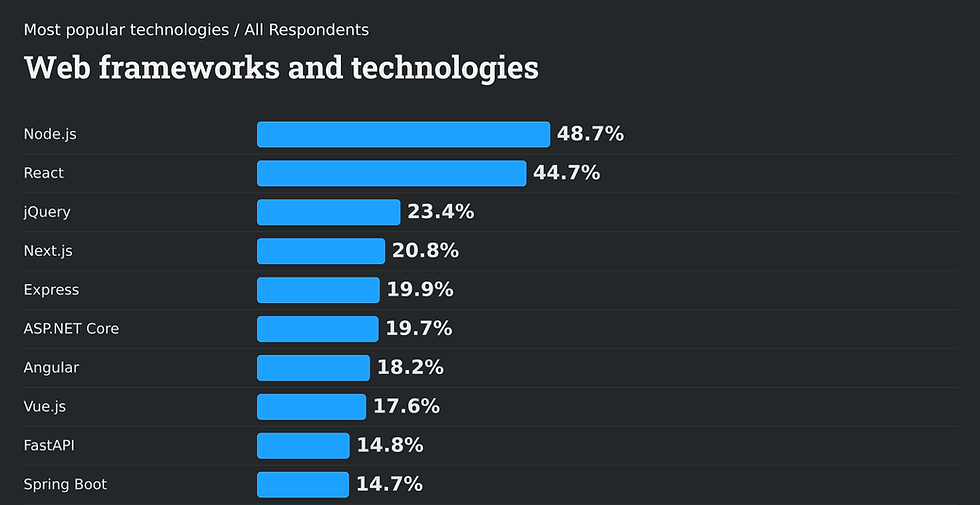
Vue is also used in enterprise settings, including at Alibaba, Xiaomi, and GitLab. However, the overall job market is smaller, especially outside Asia. For organizations that hire frequently or experience higher turnover, React’s larger community can make staffing and continuity easier to manage.
SaaS Platforms
For SaaS products where you are building for the long term, both frameworks work well. The more important question is how your team plans to maintain the codebase as it grows.
Vue's enforced structure and SFC format tend to produce more consistent codebases over time - less "legacy code that nobody wants to touch." React's flexibility means the codebase quality depends heavily on how well the team enforces its own conventions.
Next.js and Nuxt 4 are both capable full-stack meta-frameworks for SaaS. Both support SSR, SSG, API routes, and edge rendering. The choice between them is more about the underlying framework preference than capability.
Mobile and Cross-Platform Development
React Native gives React a strong position in mobile development. It allows teams to build native iOS and Android applications using the same component model and, in many cases, share a significant portion of code with their web applications. This reduces duplication and helps keep web and mobile teams aligned.
Vue does not have an official mobile framework. NativeScript with Vue is available, but adoption is limited and ecosystem support is smaller than React Native’s. When mobile development is a core part of the product roadmap, React usually provides a more reliable foundation.
Community, Job Market, and Long-Term Viability
React maintains a larger global user base and a broader job market. It appears more frequently in enterprise roles, agency work, and long-term product teams, which makes hiring and replacement easier over time.
Vue has a smaller but consistent community with strong retention. Many teams that adopt Vue continue using it across multiple projects, particularly in regions and ecosystems where it has long-standing adoption.
Both frameworks have stable organizational backing. React is maintained by Meta with extensive open-source contributions. Vue is maintained by Evan You’s core team, with continued investment in its surrounding ecosystem. Neither project shows signs of slowing down or losing long-term support.
When to Choose React
React works well when flexibility, ecosystem depth, and long-term hiring options matter more than having strong defaults from the start.
You need access to the largest frontend talent pool
Mobile development (React Native) is part of your roadmap
Your team has the experience to design and enforce architectural patterns without framework constraints
You are building a large, complex application where ecosystem maturity and breadth of tooling matter
You want to use React Server Components and the Next.js App Router for full-stack development
Long-term hiring flexibility is a priority
When to Choose Vue
Vue fits better when teams value consistency, faster onboarding, and a more guided development model.
You want faster initial development with less architectural overhead
Your team is smaller or has mixed experience levels - Vue's conventions reduce the blast radius of individual decisions
You are building a small-to-medium application where the full React ecosystem is overkill
Developer experience and documentation quality are high priorities
You are working in a region or industry where Vue has strong adoption (Europe, Asia, agencies)
TypeScript-first development matters and you want cleaner out-of-the-box integration
Can You Migrate Between React and Vue?
Moving between React and Vue usually means rewriting most of the frontend. Although both use components and reactive state, their rendering models, templates, and tooling differ enough that automated migration is not realistic.
Most teams approach this as a full rewrite, which involves parallel development, expanded testing, and more careful release coordination. Incremental approaches using micro-frontends are possible, but they increase system complexity and maintenance overhead.
Before starting a migration, it is worth asking what problem it solves. If the current application is stable and the team works well with it, switching frameworks mainly for ecosystem alignment often does not justify the cost.
React or Vue in 2026?
In 2026, React remains the default for many teams. Its ecosystem, hiring pool, and tooling maturity make it a lower-risk option for organizations planning to scale. React Server Components and the Next.js App Router have expanded its role as a full-stack platform.
Vue fits well when developer experience, onboarding speed, and workflow simplicity matter more than ecosystem size. It remains a solid choice, though the hiring market and tooling breadth are smaller.
You can also connect with us for guidance on architecture decisions or to discuss custom development work, staff augmentation, and scaling your engineering team.
Frequently Asked Questions
Is React better than Vue?
No. React offers a larger ecosystem, broader tooling options, and a deeper job market. Vue provides more built-in structure and clearer defaults, which can reduce early setup and coordination overhead. The better choice depends on your team’s experience, project complexity, and long-term hiring plans.
Is Vue easier to learn than React?
For many developers, yes. Vue’s template syntax maps closely to HTML, and its component structure is easy to read. React’s core concepts are simple, but building a complete React application usually involves learning additional libraries for routing, state management, and data fetching.
Which is faster: React or Vue?
In most production systems, performance differences are small. Vue’s fine-grained reactivity limits unnecessary updates by design. React’s compiler and memoization features reduce redundant rendering through optimization. In both cases, application architecture has a much larger impact than framework choice.
Is React more popular than Vue?
Yes. React has broader global adoption and appears more frequently in enterprise roles and long-term product teams. Vue has a smaller but stable community, with strong adoption in parts of Europe, Asia, and agency-driven environments.
What companies use React?
Large organizations such as Meta, Netflix, Airbnb, Shopify, and Walmart use React in production at scale.
What companies use Vue?
Vue is used by companies such as Alibaba, Xiaomi, and GitLab, as well as many organizations working within the Laravel ecosystem.
Should startups choose React or Vue?
Vue often supports faster early development with fewer setup decisions. React reduces hiring friction as teams grow and roles specialize. Both can work well for startups. Consistency and execution usually matter more than the initial framework choice.
Is React more scalable than Vue?
Both frameworks scale to enterprise-level systems. React’s flexibility gives experienced teams more control over architecture. Vue’s conventions help maintain consistency with less manual enforcement. With strong engineering practices, either approach can support large applications.
Can you use TypeScript with React and Vue?
Yes. React has stable, well-established TypeScript support. Vue 3 was designed with TypeScript in mind, and the Composition API provides strong type inference and cleaner integration in many cases.
Is Vue replacing React?
No. Both frameworks continue to evolve and serve different development styles. Vue continues to grow steadily, while React maintains a significant lead in adoption and hiring demand. Neither shows signs of being displaced in the near future.


