Real Estate Software Development Services | 2026 Guide

The PropTech market reached $40 billion in 2025 and is projected to hit $88 billion by 2032, growing at 11.9% annually according to Fortune Business Insights. This growth reflects a fundamental shift in how real estate operates: over 60% of property firms now use SaaS tools, and nearly 70% of consumers prefer digital transactions.
Let's explore what real estate software development involves, the solutions available, how development works, and what to expect from costs and timelines.
What Is Real Estate Software Development?
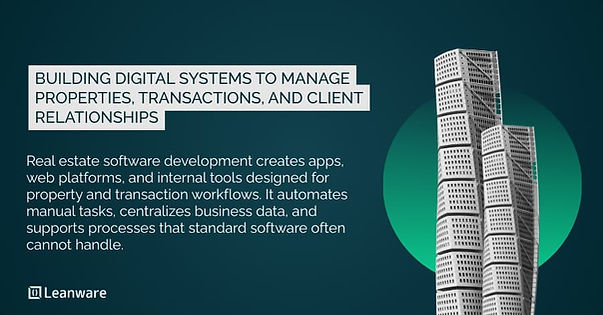
Real estate software development is the process of building custom digital solutions for property management, transactions, and customer relationships. This encompasses everything from mobile apps to enterprise platforms, with the core purpose of automating workflows, centralizing data, improving client experiences, and creating competitive advantages.
The shift from off-the-shelf to custom solutions happens when standard platforms cannot accommodate unique business processes or when SaaS subscription costs exceed the total cost of ownership for custom development.
Types of Real Estate Software
Real estate software supports different aspects of property operations, client interaction, and data management. The main types can be grouped by their primary function:
Category | Purpose | Examples |
Operational Tools | Property management, leases, accounting | Buildium, AppFolio |
Customer-Facing Platforms | Property search and listings | Zillow |
Analytical Systems | Client and transaction tracking | CRM, ERP |
Emerging Tech | VR tours, AI valuation | Matterport, AI tools |
Key Real Estate Software Solutions
Real estate software covers a range of solutions that support operational efficiency, client management, transaction handling, and strategic insights. Each type addresses specific workflows or business needs, from managing properties and tenants to providing search portals and enterprise analytics.
Property Management Software
Property management systems handle tenant and lease tracking, maintenance requests, and rent collection automation. Key capabilities include payment processor integration (ACH, credit cards), tenant communication tools, and accounting synchronization.
Market solutions like AppFolio and Buildium serve this segment, though larger portfolios often require custom solutions to handle specific workflows.
Customer Relationship Management (CRM)
Real estate CRMs differ from generic CRMs through property-specific fields, showing schedules, and commission tracking. Core functions include lead nurturing, pipeline management, automated follow-ups, and complete client history.
The difference matters because a real estate agent needs to track which properties a lead has viewed, schedule showings, and calculate commission splits, none of which generic CRMs handle natively.
Multiple Listing Service (MLS) Platforms
MLS platforms aggregate listings from different boards. Implementation requires:
- Handling region-specific data feeds
- Ensuring IDX compliance
- Supporting real-time synchronization
Custom solutions often merge multiple MLS sources while maintaining compliance.
Real Estate Accounting & Transaction Software
Transaction software handles commission calculations, escrow management, closing document generation, and financial reporting. Regulatory compliance with RESPA and state-specific requirements shapes feature requirements.
Construction & Development Management Tools
Development firms need project tracking, budget management, contractor coordination, and permit tracking. These requirements differ significantly from brokerage needs, with emphasis on timeline management and cost control across multiple projects.
Real Estate Portals & Search Platforms
Search functionality requires advanced filtering, map integration, saved searches, and property alerts. User experience expectations set by Zillow and Redfin mean that custom portals must match or exceed these standards.
Enterprise Resource Planning (ERP) for Real Estate
ERP systems unify financial management, HR, operations, and analytics for large real estate firms. Solutions like SAP Real Estate and Yardi serve enterprise-scale operations managing thousands of properties.
Custom Real Estate Software Development Services
Custom software development focuses on tailoring solutions to an organization’s workflow and technical requirements. This includes mobile and web platforms, third-party integrations, legacy system migration, and cloud infrastructure, ensuring functionality aligns with operational needs and scalability goals.
1. Mobile App Development
Mobile app development choices include native (iOS/Android separately) versus cross-platform (React Native, Flutter). Key features include property search, virtual tours, document signing, and push notifications.
React Native saves 30-40% on development costs compared to building separate native apps. Most real estate apps work well with cross-platform development, though high-end applications with AR/VR features may benefit from native development.
2. Web Platform Development
Modern web platforms use responsive design, progressive web app capabilities, and comprehensive admin dashboards. Frameworks like React and Next.js provide scalability and performance for property search at scale.
3. API Integration & Third-Party Services
Essential integrations include MLS data feeds, payment gateways (Stripe, PayPal), mapping (Google Maps API), document signing (DocuSign), and CRM connections (Salesforce). Reliable data flow between these services is critical for platform effectiveness.
4. Legacy System Migration
Outdated systems create operational friction. Migration strategies involve phased approaches, careful data mapping, and parallel operation periods. The goal is moving to modern architecture while preserving historical data and minimizing downtime.
5. Cloud Migration & Infrastructure
Cloud platforms like AWS, Azure, or Google Cloud provide:
- Scalability and reliability
- Security and cost efficiency
Infrastructure as code and DevOps practices support consistent deployments and scaling during high traffic periods.
Advanced Technologies in Real Estate Software
Modern real estate software increasingly integrates technologies that support automation, analysis, and immersive experiences. Adoption varies depending on cost, technical requirements, and operational goals.
1. Artificial Intelligence & Machine Learning
AI is applied in areas such as:
- Property valuation algorithms
- Price prediction models
- Investment risk analysis
Zillow’s Zestimate shows how automated valuations can work, though accuracy varies by market and property type. Model performance depends heavily on training data; markets with abundant transaction history produce better predictions than markets with limited data.
2. AR/VR for Virtual Tours
360-degree tours, virtual staging, and remote property visits accelerated post-COVID. Platforms like Matterport provide these services, though hardware and bandwidth requirements can be a factor. Browser-based solutions reduce some of these barriers.
3. Internet of Things (IoT) Integration
Smart building sensors enable predictive maintenance, energy monitoring, and security system integration. The data collection potential extends to tenant behavior analysis and operational optimization.
4. Blockchain for Secure Transactions
Smart contracts for escrow, tokenization of real estate assets, and transparent transaction records represent blockchain's promise. Propy provides practical examples. Adoption remains limited, partly due to evolving regulations.
5. Predictive Data Analytics
Market trend analysis combines MLS data, economic indicators, and demographic trends. Applications include demand forecasting for developers and portfolio optimization for investors.
Features of Effective Real Estate Software
Real estate software works best when it balances security, usability, and operational functionality. The main features to look for include:
Feature | Purpose |
Security & User Management | Protects sensitive financial and personal data |
Property Search & Listings | Supports efficient property discovery |
Documents & Contracts | Streamlines transactions and ensures compliance |
Alerts & Notifications | Keeps users informed and engaged |
User Management & Security
Secure access is essential because transactions involve sensitive financial and personal data. This includes:
- Role-based access control
- Two-factor authentication
- Audit logs
Property Search & Listings
Advanced filtering, saved searches, comparison tools, and map views form the foundation. Search performance at scale becomes critical as listing databases grow.
Document Storage & Digital Contracts
Handling documents digitally simplifies transactions. Cloud storage, e-signatures, version control, and compliance with GDPR or CCPA ensure documents are secure, organized, and easy to access when needed.
Automated Alerts & Notifications
Alerts help users stay on top of updates. Price changes, new listings, appointments, or maintenance reminders can be sent via email, SMS, or push notifications, keeping users informed without extra effort.
Reporting & Analytics Dashboards
Reporting and analytics are key for making informed decisions. Dashboards allow tracking of KPIs, creating custom reports, visualizing data, and exporting information as needed.
They make it easier to generate investor reports or performance summaries quickly, helping teams understand trends and act on insights without delays.
Benefits of Real Estate Software Development
Software adoption can bring some measurable improvements across operations, data management, and customer experience:
- Streamlining Operations: Automates repetitive tasks such as showing scheduling, document generation, and payment processing, reducing administrative time by 30-40%.
- Improved Data Management: Centralized databases reduce errors, prevent silos, and allow for actionable insights.
- Better Customer Experience: 24/7 access, self-service options, faster responses, and personalized recommendations support retention and referrals.
- Scalability & Competitive Advantage: Software allows growth without proportional staff increases, enables entry into new markets, and differentiates operations through technology.
Real Estate App Development Process
Every project has its unique requirements, but the overall development process usually follows the same phases. Using an agile approach helps you deliver iteratively, get continuous feedback, and avoid surprises down the line.
1. Idea & Concept Validation
First and foremost, it’s essential to validate the concept. This involves market research, talking to potential users, analyzing competitors, and defining the MVP. Doing this upfront prevents costly course corrections later.
2. UI/UX Design & Prototyping
Design starts with wireframes and mockups, then moves to user testing and building a consistent design system. Iterative feedback ensures the interface is intuitive and aligns with how people will actually use the app.
3. Development & Testing
Development runs in agile sprints with continuous integration and regular QA checks. Beta testing gives a preview of how the software performs in real-world conditions. Depending on complexity, this phase usually takes 3 to 9 months.
4. Deployment & Launch
Launching an app isn’t just about flipping a switch. It includes setting up the production environment, submitting to app stores, onboarding users, and coordinating the rollout. Careful planning here makes the transition smooth.
5. Maintenance & Feature Updates
After launch, work continues with bug fixes, security patches, performance monitoring, and adding new features. Typically, ongoing maintenance costs around 15-20% of the initial development budget each year.
Cost, Timeline & Pricing Factors
Costs vary widely depending on complexity, integrations, and whether you’re building custom features or using templates.
Development Cost Breakdown:
Complexity | Cost Range | Typical Scope |
Simple app | $50K-$100K | Basic listing search, contact forms |
Mid-complexity | $100K-$250K | CRM integration, payment processing |
Enterprise system | $250K+ | Multi-location operations, full ERP integration |
Cost drivers include feature complexity, number of integrations, and custom versus template design.
Factors Affecting Timeline
Scope clarity, third-party dependencies, regulatory requirements, team availability, and client feedback cycles all impact delivery. Typical timelines: 3-6 months for MVP, 6-12 months for full platforms.
Before committing to full development, consider validating your concept with a proof of concept to reduce risk.
Ongoing Support & Maintenance
Even after launch, software needs continued support:
- Hosting on cloud platforms like AWS or Azure
- Performance monitoring and security updates
- Feature enhancements and minor improvements
Budgeting 15-20% of the initial development cost annually is a reasonable guideline for ongoing maintenance.
Security Considerations
Security is critical in real estate software because transactions involve sensitive financial and personal data. Proper measures protect both the business and its clients.
Data Protection & Encryption
Data should be encrypted both at rest and in transit. Secure API communications and robust database security help prevent unauthorized access. Developers must actively guard against common vulnerabilities like SQL injection and cross-site scripting (XSS).
Compliance & Regulatory Standards
Real estate software must comply with regulations such as GDPR, CCPA, RESPA, and the Fair Housing Act. This includes designing audit trails, data retention policies, and secure handling practices into the system from the start.
User Access & Identity Management
Access control is essential. Authentication methods, single sign-on (SSO), session management, and strong password policies help manage user access. Following the principle of least privilege limits exposure if credentials are compromised.
Getting Started
Before approaching a development team, it helps to clarify a few key points. Ask yourself:
- What core functionality does the software need?
- Who will be using the system and in what roles?
- Which existing systems or third-party services need to integrate?
- What is the expected timeline and budget range?
When evaluating a development partner, focus on:
- Domain experience in real estate software
- Technical expertise and familiarity with required technologies
- Communication style and responsiveness
- Post-launch support and maintenance offerings
- Quality of previous projects in their portfolio
Watch out for red flags such as unrealistic timelines or skipping discovery phases. Careful selection ensures the development process runs smoothly and the resulting software meets your needs.
You can connect with our experts to plan a custom real estate software solution, drawing on experience with property management platforms, CRMs, and mobile apps for agencies of all sizes.
Frequently Asked Questions
How much does it cost to build a real estate app like Zillow?
Zillow spent hundreds of millions. Realistic alternatives: basic search platform ($150K-$300K), search plus CRM ($300K-$500K), full marketplace with advanced features ($500K+). Key cost drivers include data licensing, maps integration, scalability architecture, and recommendation algorithms. Timeline runs 12-18 months for MVP.
Should I build custom property management software or buy Buildium/AppFolio?
Buy if you manage under 500 units, have standard workflows, need immediate deployment, or have limited budget. Build if you have unique workflows, manage 1,000+ units where SaaS costs exceed custom TCO, need white-label capabilities, or require specific integrations. Break-even typically occurs at 1,000-2,000 units or 2-3 years of operation.
How long does MLS integration take?
Timeline runs 4-8 weeks per MLS. Requirements include MLS credentials, RESO/IDX compliance, technical documentation, and development environment access. The process breaks down into credential acquisition (1-2 weeks), development (2-4 weeks), and compliance review (1-2 weeks). Expect 10-20% of time handling edge cases and data inconsistencies.
What happens when MLS data feeds go down?
Common issues include feed outages, data inconsistencies, sync delays, and schema changes. Solutions involve caching layers, validation rules, monitoring alerts, and fallback to last-known-good data. Most feeds maintain 99%+ uptime. The real consequence: users see outdated listings until sync resumes.
Native iOS/Android vs React Native for real estate apps?
React Native works well for most real estate apps and saves 30-40% on development. Choose native for AR/VR tours, complex animations, or offline-first architecture. You can start with React Native and build native features later if needed. Exception: high-end luxury apps with immersive experiences benefit from native development.
Can custom software handle both commercial and residential properties?
Yes, with upfront data model planning. Key differences include lease structures (multi-tenant versus single-family), financial terms (NNN, CAM charges versus simple rent), property attributes (square footage types, zoning), and tenant management (businesses versus individuals). A flexible property type system with conditional fields accommodates both.
How do you migrate from Buildium/AppFolio to custom software?
The process involves API or CSV export, schema mapping, data cleansing (expect 5-10% manual fixes), a 30-60 day parallel run, then cutover. Timeline runs 6-10 weeks. Critical elements include preserving tenant and lease history, documents, permissions, and transactions. Keep read-only access to the old system for 6-12 months during transition.
Can I start with just property search and add features later?
Yes, with smart architecture planning. Start with core search and listings, then add CRM and management based on usage patterns. Critical: plan your database schema upfront because migrating data mid-growth gets expensive. Typical phases run search and listings (3-4 months), CRM (2-3 months), transactions (3-4 months). Validate each phase before expanding.
What are the top real estate software development companies in Latin America?
Top options for real estate software development in Latin America include:
- Leanware: Property management platforms, CRMs, and mobile apps.
- Cheesecake Labs: Brazil-based, custom apps and real estate tech.
- NaNLABS: Argentina-based, cloud and SaaS solutions.
- BEON.tech: Argentina-based, flexible real estate software development.
All are recognized for experience and reliability in the real estate sector.