Supabase vs Hasura: Which Backend-as-a-Service to Choose in 2025

Choosing the right backend-as-a-service shapes development velocity, operational burden, and long-term architecture. Supabase and Hasura are two popular choices that solve much of the heavy lifting for developers — auth, realtime, APIs, and hosting — but they come from different philosophies. Supabase is a Postgres-first platform that packages database, auth, storage and edge functions into a single developer experience.
Hasura is a powerful GraphQL engine that instantly exposes a GraphQL API over an existing database with fine-grained permissioning and real-time subscriptions. This article walks through how each platform is built, where they differ, and provides practical guidance for choosing one based on real project needs.
What are Supabase and Hasura?
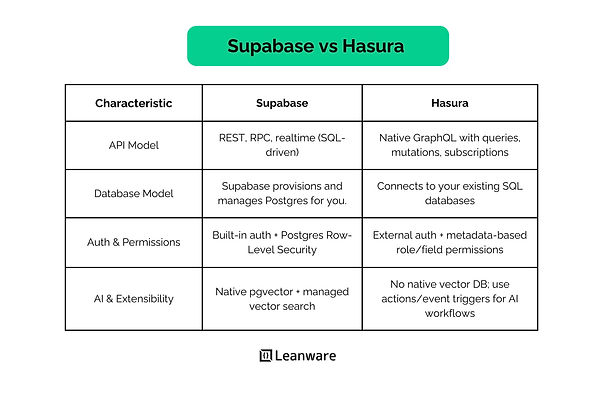
Both projects aim to speed backend development, but they do so at different levels of the stack and with different integration models. Supabase provides a managed Postgres instance plus opinionated services that sit on top of it. Hasura focuses on creating a rich GraphQL API surface over your database and lets you extend behavior via actions, remote schemas, and event triggers.
Pick Supabase when you want a tight, all-in-one Postgres experience. Pick Hasura when you want rapid GraphQL APIs over an existing or managed database.
Overview of Supabase
Supabase packages a hosted Postgres database with first-class services: GoTrue-based authentication, PostgREST for auto-generated REST endpoints, a real-time layer powered by Postgres replication, storage buckets for files, and edge functions for server-side logic.
It’s designed for teams who want direct SQL access and the flexibility of Postgres while getting a bundled developer experience that reduces wiring time.
Supabase’s strengths are its SQL-first model, straightforward dashboard, and a philosophy that leaves the database as the source of truth. Developers who want to use SQL, Postgres extensions, triggers, and stored procedures will find Supabase a natural fit.
Overview of Hasura
Hasura is a GraphQL engine that sits between your application and one or more databases. It introspects the schema and automatically generates a GraphQL API including queries, mutations, and subscriptions. Hasura’s metadata engine lets you declare permissions at a granular level, and you can extend the GraphQL schema with actions (webhook-backed resolvers) and remote schemas (federating other GraphQL services).
Hasura’s appeal lies in rapid API generation, field-level access control, and a schema-centric developer workflow that matches how many modern frontends are built.
Architecture and Core Concepts
Understanding architecture clarifies what you gain and where you take on responsibility.
Supabase Architecture
Supabase is opinionated around Postgres as the canonical store. Its architecture packages:
- Postgres as the primary database with extensions and logical replication.
- GoTrue for authentication and JWT lifecycle.
- Real-time service that emits change events.
- PostgREST for REST endpoints and RPCs.
- Storage service for file uploads.
- Edge functions for server-side code near your data.
The result is a cohesive developer experience: database-first operations, native SQL support, and a dashboard that exposes both data and operational controls.
Hasura Architecture
Hasura’s core is the GraphQL engine plus a metadata store that records permission rules, relationships, and remote schema configurations. Key parts are:
- A GraphQL query engine that compiles GraphQL into SQL using the underlying DB.
- A metadata layer that persists permissions and relationships declaratively.
- Event triggers and actions for integrating custom business logic.
- Optional Hasura Cloud control plane for managed deployments.
Hasura is database-agnostic in the sense that it can attach to existing Postgres, MySQL, and other SQL databases, and it treats that DB as the source of truth while abstracting the API layer.
Database and API Approaches
Here is where the user-facing differences are most visible.
Database provisioning: Supabase's Postgres vs Hasura's database-agnostic layer
Supabase provisions and manages Postgres for you. You get direct access to the database, can create functions, add extensions, and run SQL migrations from day one. That makes it very attractive when your domain logic lives in SQL or you want full control over schema evolution.
Hasura, by contrast, connects to an existing database (or a managed DB) and exposes a GraphQL API on top. That is ideal when you already own your database or when your workflow prefers API-first development and schema-driven evolution.
API layer comparison: REST, GraphQL, real-time subscriptions
Supabase automatically offers REST endpoints (via PostgREST) and supports real-time through Postgres changefeeds. You can also call RPCs (Postgres functions) and use edge functions for custom endpoints.
Hasura focuses on GraphQL as the primary API. Queries, mutations, and subscriptions are auto-generated and tightly typed. For teams building single-page apps or mobile clients, the GraphQL surface often simplifies client development and reduces over-fetching.
Authentication, Authorization & Security
Security model impacts how you implement access controls and multi-tenant systems.
Supabase's built-in Auth + Role/Row-level Security (RLS)
Supabase integrates GoTrue authentication and encourages the use of Postgres Row-Level Security (RLS). RLS policies run inside the database, making them robust and tamper-resistant. This is powerful for per-user data isolation and scenarios where policy logic benefits from SQL expressiveness.
Hasura's auth model: JWT, webhooks, and permission rules
Hasura expects auth to be provided via JWTs or webhook-based auth hooks. Its strong suit is field- and role-level permissioning declared in metadata. Hasura’s permission engine is expressive for GraphQL use cases, letting you define who can select, insert, update, or delete specific fields under certain conditions.
Both systems can be combined with external identity providers, but the practical difference is whether you want to centralize access decisions in the DB (Supabase) or the GraphQL layer (Hasura).
Developer Experience, Tooling, and Client Libraries
Developer UX influences onboarding speed and day-to-day productivity.
Supabase SDKs, UI, dashboard, and ecosystem
Supabase provides polished client SDKs for JavaScript/TypeScript, official guides, a neat dashboard, and an opinionated CLI. Because it is Postgres-first, backend engineers comfortable with SQL feel right at home. The community offers many templates and starter projects.
Hasura Console, GraphQL tooling, and ecosystem
Hasura includes a console that exposes metadata editing, permission configuration, and a GraphQL playground. The GraphQL developer workflow — introspection, schema generation, and client code gen — integrates well with modern frontend stacks and TypeScript.
Business Logic, Extensibility & Integrations
Both platforms provide ways to extend behavior beyond auto-generated APIs.
Supabase edge functions, storage, and managed services
Supabase edge functions let you run server-side code close to the data for custom endpoints or background tasks. Storage provides first-class file handling and signed URLs. For custom integrations or complex logic, you typically push functionality to edge functions or database functions.
Hasura actions, remote schemas, event triggers, and custom logic
Hasura’s actions allow you to add custom resolvers backed by any HTTP service; remote schemas let you compose other GraphQL services. Event triggers produce events on DB changes that you can handle with serverless functions. This gives Hasura a flexible composition model for mixing auto-generated APIs with custom microservices.
Hosting, Scalability & Deployment Options
Both can be self-hosted or consumed as managed services, but trade-offs matter.
Supabase managed cloud vs self-host
Supabase Cloud reduces operational overhead and is quick to start. Self-hosting is possible for teams that need full control, but then you shoulder upgrades and operations for Postgres and the additional services.
Hasura self-host vs Hasura Cloud and scaling considerations
Hasura can run anywhere with a supported DB. Hasura Cloud offers managed scaling, observability, and metadata backups. Hasura’s GraphQL engine is designed to scale with the database, but you must plan query performance and caching strategies for heavy workloads.
Use Cases and Fit: When to Choose Which
When Supabase is a stronger fit
Use Supabase for startups, simple CRUD apps, or teams that want rapid MVPs with full SQL control. It’s especially good when you want direct database access, use Postgres features, or prefer SQL migrations as the canonical source of truth.
Supabase is also a strong fit for AI-driven products thanks to its built-in pgvector support. In 2025, Supabase will offer fully managed vector search, letting teams store embeddings and run similarity queries directly inside Postgres.
This removes the need for a separate vector database and makes it easier to build chatbots, recommendation systems, and RAG pipelines. For startups building AI features into their MVP, Supabase’s native pgvector performance and simplicity are a major advantage.
When is Hasura the better choice
Choose Hasura for teams that prefer GraphQL-first development, need field-level permissioning, or already have a database they want to expose. It’s well-suited for complex client apps requiring precise queries, subscriptions, and typed contracts.
Hybrid or combined strategies
Some teams use Supabase for managed Postgres and storage while adding Hasura on top of that database to leverage GraphQL. This hybrid approach gives SQL control and a strong GraphQL API, but adds operational complexity and careful coordination of metadata and migrations.
Pricing, Licensing, and Ecosystem Considerations
Both projects are open source, but hosting and enterprise features differ.
Licensing and open-source status
Supabase and Hasura are both available with open-source components. Evaluate the exact licensing for components you rely on (enterprise add-ons may have different terms) and verify support options for mission-critical workloads.
Pricing comparison and typical cost implications
Managed services shift cost toward usage and convenience (monthly plans, per-request billing). Self-hosting shifts cost toward infrastructure and engineering time. Teams should model costs around expected traffic, storage needs, replication, and operational staff.
Final Thoughts: Choosing the Right Tool for Your Project
Summary of key trade-offs
- Supabase: Postgres-first, direct SQL control, built-in storage and auth, quicker for SQL-centric apps.
- Hasura: GraphQL-first, schema-driven API, fine-grained permissions, ideal when GraphQL is the primary integration surface.
Checklist for decision-making
Ask yourself:
- Do we want SQL as our primary workflow?
- Do we need GraphQL with typed client generation?
- Is minimizing ops a priority or do we prefer full control?
- Are field-level permissions and subscriptions important for your clients?
Answering those will make the choice obvious for most projects. You can also reach out to us to discuss your project needs and see how our approach can fit into your vision.
FAQs
Can I migrate from Firebase to Supabase without rewriting my entire app?
Migration requires changes: Firebase SDKs differ, and you’ll likely need to adapt auth flows and data modeling. However, Supabase provides similar primitives (auth, storage, and realtime) that make the migration path manageable with planning.
Does Hasura work with MongoDB or just SQL databases?
Hasura primarily targets SQL databases (Postgres, MySQL, SQL Server) but has been expanding its integrations. Check current docs for NoSQL connectors; in many cases, a relational layer remains the most mature and well-supported path.
What's the learning curve difference between Supabase and Hasura for a React developer?
React developers will find Hasura’s GraphQL schema and client codegen highly productive if they are comfortable with GraphQL. Supabase is approachable if the team prefers REST/SQL and direct DB patterns. Both have excellent docs and starter templates.
Can I use Supabase with an existing PostgreSQL database?
Yes. Supabase can connect to and manage existing Postgres instances in many setups, but inspect compatibility and migration steps carefully before handing over production data.
Can Hasura handle file uploads and storage like Supabase?
Hasura delegates file storage to external services; it doesn’t provide built-in storage like Supabase. You typically integrate an object store (S3, DigitalOcean Spaces) and expose signed URLs through actions or remote services.