Machine Learning Consulting Services: What Firms Do, Costs & How to Choose

Many companies start machine learning projects with good intentions, but end up with prototypes that never leave the lab. The gap between a working model and a deployed, business-impacting solution is wider than most expect. It's not about the algorithm. It's about aligning technical work with business outcomes, managing data at scale, and building systems that last.
Structured ML consulting helps close this gap. Instead of focusing only on code, it brings a repeatable and accountable process that turns AI into a core business capability. The right guidance ensures you invest in the right problems, use the right data, and avoid the common mistakes that waste time and budget. This guide also covers how to evaluate ML consulting firms, the engagement models they work under, and what they typically charge, so you can choose a partner with the same rigor you apply to the work itself.
Let's break down what consulting really means in machine learning and how it helps you focus on the problems that matter.
Why Choose Machine Learning Consulting Service
Not every machine learning project requires outside expertise. But when you're approaching AI for the first time, scaling a proof of concept, or integrating models into production workflows, consulting adds structure you may not have in-house.
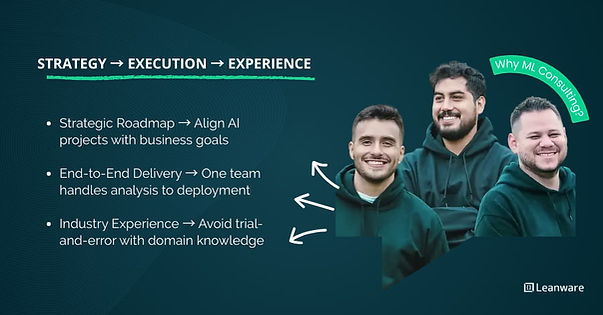
The value typically comes in three areas:
- A strategy that links AI work to measurable business outcomes.
- End-to-end ownership that reduces the overhead of managing multiple vendors or teams.
- Industry experience that shortens the learning curve and helps you avoid building solutions from scratch unnecessarily.
1. Strategic AI Roadmap Aligned with Your Business Goals
Many companies begin AI projects by picking algorithms or tools before defining the problems they want to solve. This often produces technical results that look strong but fail to drive measurable business outcomes.
A structured approach starts with the business. That means understanding the challenges, growth plans, and operational limits. For instance, a retail company might ask for a recommendation engine when the real issue lies in inventory optimization. A manufacturer may request predictive maintenance when upstream quality control would have a greater effect.
The roadmap process involves evaluating data readiness, selecting use cases with clear impact, and planning phased delivery. This way, each project adds value on its own while also contributing to broader objectives. Timelines and budgets stay realistic because the work is tied to specific outcomes.
2. End-to-End Solutions: From Business Analysis to Deployment
When different vendors handle separate phases of an AI project, gaps appear. One group prepares the data, another builds the model, and another manages deployment. These handoffs often create delays, increase costs, and produce systems that fail to integrate cleanly.
An end-to-end approach keeps the same team responsible throughout the lifecycle. The people who analyze requirements also design the pipelines, develop the models, and handle deployment. Decisions made early align with production needs, and continuity reduces the risk of rework later.
A single point of accountability also simplifies management. Instead of dividing responsibility across teams, one partner owns the full outcome. That focus keeps attention on building a working system rather than isolated deliverables.
Core Components of ML Consulting Process

A structured approach to machine learning projects reduces risk and increases the likelihood of successful outcomes. Here's how experienced consulting teams typically structure their engagements.
1. Business Analysis & Use Case Identification
The most effective machine learning projects solve business problems that traditional methods can't. This phase focuses on current processes, pain points, and where machine learning adds the most value.
Consultants avoid forcing AI where simpler fixes work better. For instance, a support team overloaded with tickets might benefit more from better documentation than a chatbot. But if the challenge is analyzing thousands of conversations, natural language processing becomes useful.
This step often includes reviewing existing data, mapping workflows, and talking with stakeholders to define success. The outcome is a clear view of where AI fits into operations.
2. Data Preparation, Feature Engineering & Quality Assessment
Data usually needs significant work before it can support models. Common issues include missing values, inconsistent formats, or biased samples.
Preparation involves cleaning and standardizing datasets, creating features that highlight useful patterns, and putting in place quality checks. For example, churn prediction models benefit from engineered features like "days since last purchase" or "average monthly spend," which give models more signal than raw transaction dates.
Feature engineering requires domain expertise to identify which data transformations will be most valuable for your specific use case. An experienced team can often improve model performance more through thoughtful feature engineering than by using more sophisticated algorithms on raw data.
Quality assessment sets baselines for completeness, accuracy, and consistency. These metrics are important not only at the start but also for ongoing monitoring as the business and its data grow.
3. Model Development, Integration & Deployment
The model development phase turns cleaned data and engineered features into working AI systems. This process involves selecting appropriate algorithms, training and validating models, and optimizing performance for your specific requirements.
But a good model in development is only the start. To deliver value, it must integrate with existing systems, handle production-level data, and provide results in the required time frame.
Modern deployment approaches use containerization and API-based architectures to make models accessible to other applications. For example, a fraud detection model might need to evaluate transactions within milliseconds and return a risk score that your payment processing system can use to approve or flag transactions.
Cloud platforms like AWS, Google Cloud, and Azure provide the infrastructure to scale, but they each have specific tools and practices that require experience. Consulting brings this expertise without forcing internal teams to learn every detail from scratch.
4. Maintenance, Monitoring & In-House Team Enablement (MLOps)
Machine learning models require ongoing maintenance to remain effective. Data patterns change over time, business requirements evolve, and model performance can degrade if not properly monitored.
MLOps practices cover monitoring, versioning, and automated retraining when performance falls. Strong consulting also includes knowledge transfer. Training, documentation, and phased handoff give your team the ability to maintain and extend systems without external dependency.
Advanced Machine Learning Techniques and Applications
Different industries require different technical approaches. You don't need every tool, but you need the right ones for your problem.
- Computer Vision & Automated Interpretation enables systems to analyze and understand visual information. Applications include quality control in manufacturing, medical image analysis, autonomous vehicle navigation, and retail inventory management. Recent advances in deep learning have made computer vision systems more accurate and easier to implement for specific use cases.
- Natural Language Processing & NLP Services help organizations extract insights from text data, automate customer communications, and improve information retrieval. Common applications include sentiment analysis, document classification, chatbots, and content generation. Large language models have expanded NLP capabilities while reducing the data requirements for many text-based applications.
- Predictive Analytics, Data Mining & Forecasting use historical data to predict future outcomes and identify hidden patterns. These techniques support demand planning, financial forecasting, maintenance scheduling, and risk assessment. Time series forecasting has become particularly important for supply chain optimization and capacity planning.
- Ethical AI & Responsible ML Practices ensure AI systems operate fairly, transparently, and in compliance with regulatory requirements. This includes bias detection and mitigation, explainable AI techniques, privacy-preserving methods, and governance frameworks for AI decision-making. Organizations increasingly recognize that responsible AI practices reduce legal risk and build customer trust.
Machine Learning Applications Across Industries
Different industries have unique data characteristics, regulatory requirements, and success metrics that influence ML implementation approaches.
1. Healthcare & Life Sciences
Healthcare organizations use machine learning for diagnostic imaging analysis, patient risk stratification, clinical trial optimization, and drug discovery acceleration. However, healthcare AI must meet strict regulatory requirements and integrate with existing electronic health record systems.
Common applications include radiology image analysis to detect abnormalities, predictive models for patient readmission risk, and natural language processing for clinical note analysis. Privacy regulations like HIPAA require specialized approaches to data handling and model deployment.
Clinical data often has unique characteristics like temporal dependencies, missing values, and complex interactions between variables. Successful healthcare AI requires understanding these domain-specific challenges and regulatory constraints.
2. Finance, Banking & FinTech
In finance, machine learning supports fraud detection, credit risk scoring, algorithmic trading, and customer segmentation. The need for explainability and auditability is high due to regulatory oversight.
Fraud detection systems must evaluate transactions in real time while keeping false positives low. Credit models need to comply with fair lending rules while remaining accurate. Segmentation techniques enable targeted product recommendations and marketing. Financial data is high-volume, fast-moving, and sensitive to market changes, so models must adapt to shifting conditions while maintaining stability.
3. Retail, E-commerce & Marketing
Retailers use machine learning for demand forecasting, pricing, recommendations, and predicting customer lifetime value. These applications aim to improve sales, optimize stock levels, and manage costs.
Personalization models recommend products, tailor marketing, and adjust website layouts. Forecasting helps balance inventory and reduce waste. Dynamic pricing models adjust based on demand, competition, and available stock. Retail data often reflects seasonal patterns, promotions, and external factors like weather, which models must account for.
4. Supply Chain, Manufacturing & Logistics
In supply chains and manufacturing, machine learning is applied to predictive maintenance, quality inspection, demand planning, and logistics optimization. These uses focus on reducing downtime, controlling costs, and improving throughput.
Predictive maintenance relies on sensor data to anticipate equipment failures. Computer vision systems support quality control by detecting defects more consistently than manual inspection. Demand forecasts inform production schedules and inventory planning. Route optimization models take into account constraints like capacity, lead times, and variable demand.
5. Education, Real Estate & Agriculture
Educational technology platforms use ML for personalized learning paths, automated grading, and student performance prediction. Real estate applications include automated property valuation, investment analysis, and market trend prediction.
Agricultural applications focus on crop yield prediction, pest and disease detection, and precision farming optimization. These models often incorporate satellite imagery, weather data, and soil sensor information to provide actionable recommendations.
Every domain has its own data, constraints, and success criteria. Models perform reliably only when these factors are considered in their design and deployment.
How to Choose a Machine Learning Consulting Firm
Knowing what a consulting engagement covers is half the decision. The other half is evaluating the firms themselves: the questions you ask before signing, the engagement model you agree to, and the trade-offs you accept between cost, quality, and timeline. The evaluation goes beyond technical capability. A firm can be excellent at model development and still be a poor fit for how your team works, how your budget is structured, or how much risk you can carry.
1. Key Questions to Ask Before Hiring
Group your due diligence into four areas: what the firm can build, how it works with you, how it charges, and what happens when things go wrong.
Technical capability. Ask what specific ML frameworks and technologies the team uses daily, and whether they can show detailed case studies of similar projects, ideally for companies at your stage and in your industry. Domain-specific challenges and regulatory requirements have a large impact on project success, so relevant experience matters more than a long generic portfolio. Ask how they approach model training, data management, and validation, how they handle data privacy and security for ML applications, and how they address ethics and bias mitigation. A firm doing responsible work will have concrete answers about fairness, transparency, and accountability rather than a policy slide.
Operational compatibility. Ask what timezone the core team works in and how that overlaps with yours. ML development is iterative, with frequent model adjustments and decisions that need input from both technical and business stakeholders, so real-time overlap shortens feedback loops considerably. Ask what project management methodology the firm uses, how it accommodates rapid iteration, and how it handles communication and reporting across a distributed team. It is also worth asking whether the firm uses AI tools in its own development process, since that tends to show up as faster delivery on your project.
Business model alignment. Ask what engagement models the firm offers beyond time and materials, and whether it is willing to tie part of its compensation to measurable outcomes. Ask how it handles scope changes and the feature pivots that are normal in evolving products, and how it scales the team up or down as your needs change. The answers tell you whether the firm expects a static contract or a working partnership.
Risk management. Ask what legal protections the firm provides, such as its corporate structure and errors and omissions insurance. Ask how it protects intellectual property and confidentiality for proprietary algorithms and data, what happens if key team members leave during your project, and what ongoing support and model maintenance it provides after delivery. Finally, ask for references from clients that have scaled with the firm, not just launched.
2. Understanding Different Engagement Models
How a firm charges shapes how it behaves, so treat the engagement model as part of the evaluation rather than a procurement detail.
Time and materials provides flexibility for discovery-driven projects where requirements evolve. It suits research-oriented initiatives and proof-of-concept work, but it puts the execution risk on you and requires strong internal project management.
Fixed price offers budget predictability for well-defined implementations with clear deliverables and acceptance criteria. It transfers execution risk to the firm, but it demands precise upfront specification, which is hard to produce for exploratory ML work.
Outcome-based agreements tie the firm's compensation to measurable business results. This aligns vendor incentives with your success and reduces your risk by limiting financial exposure if the solution misses its performance metrics. It also signals confidence: a firm willing to be paid on results believes it can deliver them. This model works best when the project has clear, measurable performance targets.
Hybrid models combine elements of the others, such as a fixed-price discovery phase followed by time-and-materials development, or outcome bonuses layered onto base pricing. They balance risk sharing with operational flexibility and are increasingly common for ML engagements where the early phase is uncertain but the build phase can be scoped.
3. Balancing Cost, Quality, and Timeline
The right trade-off depends on your stage, not on an abstract notion of best practice.
For reference, offshore providers generally bill $25-49 per hour, nearshore firms in Latin America $50-99, and US-based specialists $75-200. Those bands matter less than they look: scope, data readiness, and how many iterations the model needs move the total far more than the rate does.
Early-stage companies should prioritize speed and cost efficiency over perfect technical architecture. Nearshore partners with strong ML expertise and outcome-based models limit upfront risk while you prove market fit. Optimizing technical sophistication before you have validated demand is spending in the wrong order.
Growth-stage companies need partners that can scale technical complexity without sacrificing delivery speed. Look for firms with demonstrated experience taking clients from simple ML features to real production infrastructure, and that can provide strategic guidance alongside implementation.
Established or well-funded companies can afford to prioritize technical excellence and process maturity. Premium specialist firms deliver competitive advantage through superior implementation, and formal methodologies and comprehensive documentation matter more at this scale.
Time-sensitive projects should prioritize timezone alignment and communication efficiency over hourly-rate savings. For a critical initiative, the cost of slow feedback loops usually exceeds the savings from a cheaper offshore rate.
One caution applies at every stage: false economy in ML development often costs more than the initial premium. Poor data architecture or inadequate model design creates technical debt that becomes exponentially more expensive to correct as your user base grows.
Getting Started
Before starting with machine learning, review your data, goals, and constraints. Skipping this step often leads to pilots that never scale.
An assessment should check data quality, link projects to business priorities, and highlight the use cases with the most impact. This forms a roadmap that can be executed in phases and measured along the way.
Start with your own context. When you base decisions on your data and goals, the systems you build are more likely to work as intended.
You can also connect with our experts to review your data and roadmap, helping ensure your machine learning projects focus on the areas that deliver the most value.
Frequently Asked Questions
What are the benefits of hiring a machine learning consulting company?
A machine learning consulting company provides access to expertise without the cost of building internal teams. Experienced consultants apply best practices and lessons from other projects, helping you avoid common pitfalls. This often means faster results, lower risk, and flexible resource scaling compared to hiring full-time staff.
How much does machine learning consulting cost?
Rates vary by location, expertise level, and project complexity. Offshore providers typically charge $25-49 per hour, nearshore firms in Latin America range from $50-99 per hour, and US-based specialists charge roughly $75-200 per hour. Total project cost depends more on scope than on rate: simple AI integrations start around $25,000, while sophisticated ML platforms can exceed $200,000. Evaluate total value and outcomes rather than hourly rates alone.
How important is company size when choosing an ML consulting firm?
Company size shapes the attention and service quality you receive. Firms with roughly 10-100 employees typically offer the best balance: enough specialized ML expertise and project stability to handle complex work, yet small enough for direct client relationships, senior-level attention, and fast decision-making. Very small shops may lack depth or scalability, while large organizations often prioritize enterprise clients and add process overhead that slows smaller projects down.
What is an outcome-based agreement and why does it matter?
Outcome-based pricing means part of the fee depends on hitting agreed targets, for example a fraud-detection model reaching a defined precision level, or a demand forecast beating your current baseline by a set margin. Making one work takes three things: a metric both sides can compute from the same data, a baseline agreed before any work starts, and a review window long enough for the model to run on real traffic. It is a poor fit when success cannot be reduced to a number, or when results depend on data and systems you have not committed to providing on a fixed schedule.
Which industries utilize machine learning?
Healthcare applies ML to diagnostics and patient care, finance uses it for fraud detection and risk scoring, retail focuses on personalization and forecasting, and manufacturing emphasizes predictive maintenance and supply chain optimization. Even sectors like agriculture and real estate use ML for yield prediction and pricing models.
How do consulting firms choose the right AI strategy?
Building an AI strategy starts with your business goals, existing data, and how ready your organization is for implementation. Consultants look at these factors to identify use cases that bring the most value within your constraints.
If you want the assessment and the build done by the same engineer, see how Leanware runs AI integration and consulting as a fixed-fee engagement that starts with a readiness assessment of your systems.
Data readiness means checking whether your data is sufficient, clean, and accessible. Some applications need large datasets, while others work with smaller but higher-quality samples. The strategy has to reflect your actual data, not ideal conditions.
Use cases are then prioritized by business impact, feasibility, and strategic importance. The most effective strategies focus on a few high-value projects instead of spreading efforts across too many initiatives.
What is responsible AI and why does it matter?
Responsible AI is the operational side of fairness and transparency: documented bias testing on the data you actually train on, an explanation path for any decision that affects a customer, a retention and access policy for the data, and a named human who can override the model. Regulators increasingly ask for evidence of all four, so build them into the first release rather than retrofitting them after an audit.
What are the key trends in AI/ML consulting?
Key trends include generative AI for content and automation, small data techniques like transfer learning, and stronger AI governance frameworks. AutoML and MLOps tools streamline workflows, but strategy still determines whether these tools create real business value.