White Label AI Agency: How It Works, Business Models
Businesses want AI. Most don't have the engineering team to build it, the budget to hire for it, or the time to figure out which tools are actually worth using. That gap is where white label AI agencies operate. They source the technology, package it into a deliverable service, and sell the outcome - not the software. It's a simpler model than it sounds, and it's growing fast for exactly the reasons you'd expect.
Let’s explain what a white label AI agency actually is, how the model works, what services these agencies typically offer, and what to think through before starting one.
What a White Label AI Agency Actually Is
A white label AI agency sells AI-powered services to clients under its own brand, while using technology built by someone else. The agency doesn't build the AI. It sources it, packages it, and delivers it as part of a service offering.
The name comes from manufacturing. White label products are generic goods made by one company and rebranded by another before reaching the end customer. The same logic applies here - except the product is software, and the agency is the one doing the rebranding and service delivery.
How White Labeling Works in AI Services
The technology provider builds the platform. It could be a chatbot builder, a content generation tool, a marketing automation system, or an AI analytics product. That platform is made available to agencies through a reseller or partner program, usually with options to apply custom branding - agency logo, domain, color scheme, and sometimes custom UI configurations.
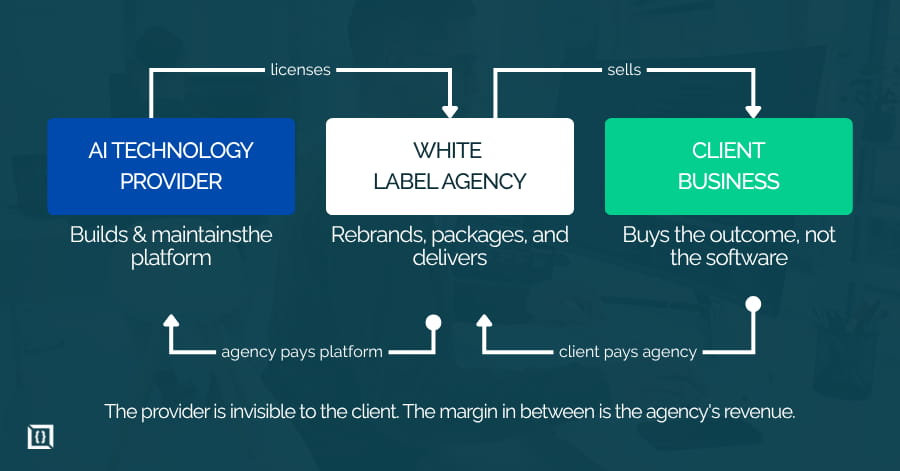
The agency then packages that technology into a service and sells it to clients. From the client's perspective, they're buying a service from the agency. The underlying technology provider is invisible.
White Label vs Private Label vs SaaS
These terms get used interchangeably, but they're not identical.
White label means the technology exists and is available to multiple resellers. Each reseller brands it differently, but the core product is the same across all of them. Private label typically implies more exclusivity - the product is developed specifically for one company.
SaaS is sold directly to end users by the company that built it. White label AI sits between SaaS and private label: you're reselling someone else's infrastructure, but under your own name.
How the White Label AI Agency Model Works
The model has three moving parts: a technology provider that builds and maintains the platform, an agency that licenses and rebrands it, and a client that pays for the outcome. Each layer has a distinct role, and understanding where one ends and the next begins matters, especially when something goes wrong.
Step 1: AI Technology Provider Builds the System
The foundation is always a technology platform. Providers like OpenAI, Anthropic, and a range of specialized SaaS companies build and maintain the core AI infrastructure. Some offer APIs that agencies integrate into custom setups. Others offer full white label platforms with built-in reseller tools.
The provider handles model training, infrastructure, updates, compliance, and uptime. That's what agencies are paying for when they subscribe to these platforms - the ability to stand on someone else's technical infrastructure without building it themselves.
Step 2: Agencies Rebrand the AI Platform
Once an agency has access to a white label platform, the customization layer comes next. This typically involves applying the agency's branding to the interface, configuring the tool around the client's use case, setting up workflows, and packaging it into a deliverable service.
The depth of customization varies by platform. Some allow full UI control, custom domains, and client-specific model tuning. Others are more limited - logo and color changes with restricted backend access. Agencies need to understand what they're getting before committing to a platform.
Step 3: Agencies Sell AI Services to Clients
The agency then goes to market. The service can be positioned as an AI content service, an AI-powered chatbot setup, marketing automation, or any number of deliverables depending on what the underlying platform actually does. Clients pay the agency. The agency pays the platform. The margin in between is the agency's revenue.
This works because clients aren't buying software - they're buying outcomes. A small business owner doesn't want to evaluate AI platforms. They want more leads, better customer support, or faster content production. The agency translates raw AI capability into a business result.
Why White Label AI Agencies Are Growing
The demand for AI services is real, but the ability to deliver them is unevenly distributed. That imbalance explains most of what's happening in this space right now and why the white label model is picking up the way it is.
AI Demand Is Outpacing Technical Talent
Businesses want AI solutions, but most don't have the engineering team to build them. According to Grand View Research, the global AI agents market was estimated at $7.63 billion in 2025 and is expected to reach $182.97 billion by 2033. That's the market backdrop. The gap between demand and internal capability is what white label agencies step into.
Agencies Want Recurring Revenue
Project-based work creates unpredictable revenue. A chatbot setup, an AI content subscription, or an automated marketing workflow billed monthly changes the cash flow model entirely. White label AI services lend themselves naturally to subscriptions, which is one reason agencies are adding them to their stack.
Businesses Prefer Buying Over Building
Building AI in-house requires engineers, data infrastructure, ongoing model management, and a clear technical roadmap. Most companies - especially SMBs - don't have any of that. White label agencies give them a shortcut: AI-powered results without the internal overhead.
Services White Label AI Agencies Typically Offer
The service mix varies by agency, but most offerings fall into a handful of categories. What unifies them is that the agency is delivering a managed outcome - not handing the client a software login and walking away.
AI Content Creation
Blog posts, social media content, ad copy, email sequences - these are the most common entry points. The agency uses an AI writing platform, applies it to the client's brand voice and brief, reviews the output, and delivers it as a managed content service. The tool does the heavy lifting. The agency adds quality control and strategy.
AI Chatbots and Customer Support Automation
Chatbots trained on a company's product documentation, FAQs, and support history can handle a significant portion of inbound inquiries without human involvement. Agencies build these systems, configure them for the client's use case, and often manage them on an ongoing basis.
According to a 2024 chatbot usage report, 62% of consumers now prefer engaging with customer service chatbots over waiting for a human agent.
AI Marketing Automation
This covers automated email sequences, lead nurturing workflows, audience segmentation, and campaign optimization. Agencies configure marketing automation platforms that use AI to personalize messaging at scale and reduce the manual work involved in running campaigns.
AI Data Analysis and Reporting
Some agencies use AI tools to pull insights from client data - website analytics, sales data, ad performance and turn that into structured reporting. The value isn't the data itself, it's the interpretation delivered as a regular service.
AI Video and Image Generation
Creative production at speed. Agencies use image and video generation tools to produce social content, ad variations, and marketing visuals faster than traditional production workflows allow. This is still an area where quality varies significantly by platform, so agencies need to vet output carefully before building a service around it.
Common White Label AI Tools and Platforms
No two agencies use exactly the same stack, but the platforms most commonly used fall into four categories. The right choice depends on what the agency is delivering and how much technical flexibility it needs.
AI Content Platforms
Tools like Jasper and Copy.ai are built specifically for marketing content and support agency white labeling. They're designed for non-technical users and can be configured around a client's brand guidelines.
Marketing Automation Platforms
Platforms like HubSpot and ActiveCampaign incorporate AI for lead scoring, content personalization, and campaign automation. Agencies that already use these tools can layer AI capabilities into their existing client workflows.
AI Workflow Automation Tools
Zapier and Make connect applications and automate repetitive processes. Neither is AI-native, but both support AI integrations that let agencies build intelligent automation workflows without custom development.
Custom AI API Integrations
For agencies with technical capacity, APIs from OpenAI, Anthropic, and similar providers allow custom implementations - chatbots with specific logic, content tools built around unique workflows, or AI features embedded directly into client software. This requires engineering work, but it's where real product differentiation lives.
White Label AI Agency Business Models
How an agency charges for its services matters as much as what it delivers. The business model determines cash flow predictability, client retention dynamics, and how the agency scales. Most agencies end up using more than one of these models depending on the client and the scope of work.
Monthly Retainer AI Services
The agency charges a fixed monthly fee to manage AI-powered services for the client. This could be content production, chatbot management, reporting, or marketing automation. The retainer model works well because the client's need doesn't go away after the first month.
AI-as-a-Service (AIaaS)
The agency packages AI capability as a product - a chatbot subscription, an AI content plan, a reporting service - with tiered pricing based on usage or output volume. The client buys access to the service. The agency manages delivery.
Done-For-You AI Marketing
The agency handles strategy, setup, and ongoing execution. The client provides the brief and the budget. Everything else - content, campaigns, optimization - runs through the agency's AI-powered workflow. This is the highest-touch model and typically commands the highest fees.
AI Consulting and Implementation
Some agencies focus on the advisory side: auditing a client's current processes, identifying where AI can reduce friction, selecting the right tools, and managing the implementation. This is more of a project-based model than a recurring one, but it often leads into ongoing retainers once systems are in place.
How Agencies Make Money With White Label AI
The business model explains the structure. The monetization explains the margins. There are three main ways agencies actually generate revenue with white label AI, and most successful agencies use a combination of all three.
Markup on AI Software Platforms
A platform that costs the agency $300/month might be packaged and sold to clients for $800-$1,200/month as a managed service.
The markup covers the agency's time, support, and service delivery. Platform margins of 30-70% are achievable depending on how the service is positioned.
Packaging AI Into Broader Marketing Plans
AI services don't have to be sold standalone. An agency doing SEO, paid ads, or content marketing can fold AI tools into the overall plan and charge accordingly. The client sees better results. The agency improves its margins without proportionally increasing headcount.
Selling AI Automation as Business Efficiency
Automation has a clear ROI story. An AI system that handles 60% of support inquiries or produces a month's worth of social content in a few hours saves the client real money. Agencies that can quantify those savings have an easier conversation when justifying their fees.
Benefits of Running a White Label AI Agency
The model has real advantages, particularly for agencies and founders who want to move fast without taking on the risk and cost of building AI infrastructure from scratch.
Faster time to market. A white label agency can be operational in weeks. There's no product development cycle, no infrastructure to build, and no engineering team to hire.
No need to build AI infrastructure. The technology provider handles training, maintenance, updates, and reliability. The agency focuses on client relationships and service delivery.
High-margin recurring revenue. Monthly subscriptions on services with low marginal delivery costs create predictable, scalable income.
Scalable delivery. AI tools don't get tired. Once a workflow is set up, it can serve one client or fifty without proportionally increasing the agency's workload.
Challenges and Risks of the Model
The benefits are real, but so are the structural risks. Most of them aren't unique to AI - they're the same risks that come with any service business built on third-party technology. Understanding them before you build is better than discovering them after a client relationship breaks down.
Dependence on Third-Party Technology
If the platform the agency is built on raises prices, changes its API, or shuts down a feature, the agency absorbs that disruption. There's no buffer. Agencies that depend on a single platform are exposed. Building across multiple providers reduces that risk.
Lack of Technical Differentiation
If two agencies in the same city are both reselling the same chatbot platform, what separates them? Not the technology. The differentiation has to come from service quality, industry focus, or the depth of implementation. Agencies that can't answer that question clearly will struggle.
AI Quality and Reliability Issues
AI outputs still need human review. Models hallucinate. Content generation tools produce mediocre output when briefed poorly. Agencies that pass AI outputs directly to clients without quality control will burn trust quickly.
Client Expectations vs Reality
AI can do a lot. It can't do everything clients imagine it can. An agency's job includes managing that gap - setting realistic expectations before the engagement starts, not explaining limitations after something goes wrong.
How to Start a White Label AI Agency
Getting started is genuinely accessible. The barriers are lower than most service businesses. But the agencies that survive past the first year are the ones that get the foundations right - niche, platform selection, service packaging - before worrying about growth.
Step 1: Choose Your Market Niche
The agencies that build durable businesses aren't trying to serve every industry. They pick one - real estate, legal, e-commerce, healthcare, professional services — and build deep familiarity with that vertical's specific problems. Niche positioning makes sales easier and service delivery more repeatable.
Step 2: Select White Label AI Platforms
Evaluate platforms on more than features. Look at white label terms specifically, some vendors allow full branding removal, others don't. Check pricing structures for overage costs, which can spike significantly as client usage grows. Test output quality before committing.
Step 3: Package AI Services
Clients don't buy software. They buy outcomes. Package services around what the client gets - "50 pieces of branded social content per month" or "automated customer support handling tier-1 inquiries" - not around what tool the agency uses to deliver it.
Step 4: Build Your Pricing Model
Three approaches work: flat retainers for predictable scope, usage-based pricing for variable output volume, and project fees for one-time implementations. Most agencies end up using some combination. Start simple and add complexity as the client base grows.
Step 5: Acquire Your First Clients
The first few clients usually come from existing relationships. Warm outreach, referrals, and direct conversations with businesses the founder already knows are more effective than inbound marketing at the start. Case studies built from those early engagements become the sales material for the next stage of growth.
Who Should Start a White Label AI Agency
The white label model works across a range of backgrounds. What they share is either an existing client base, industry expertise, or both - the technology is the easy part to acquire.
Marketing Agencies
Agencies that already have client relationships and delivery infrastructure can add AI services without starting from scratch. The client base is there. The AI layer adds margin and stickiness.
Freelancers and Consultants
A freelance content writer or marketing consultant who adds AI-powered delivery can serve more clients without working more hours. The model changes from trading time for money to packaging a repeatable service.
SaaS Founders
Founders who have built software products can extend into services by using AI platforms to deliver implementation support, managed services, or adjacent capabilities that complement their core product.
Entrepreneurs Entering the AI Market
The white label model is one of the lower-risk ways to enter the AI space. It doesn't require building models, managing infrastructure, or hiring ML engineers. The technical barrier is low. The execution barrier - building client relationships, delivering consistent quality, managing retention - is where most businesses either succeed or fail.
The Future of White Label AI Agencies
The model will keep evolving, and the agencies building sustainable positions now are doing it in ways that will be hard to replicate in two or three years. Three trends are worth paying attention to.
AI Services Becoming a Standard Offering
Two years ago, AI services were a differentiator. In 2026, they're becoming table stakes. Clients expect agencies to have AI in their workflows. The question isn't whether to offer AI services, it's whether the agency can deliver them reliably.
Agencies Becoming AI Integrators
The agencies building the most durable positions aren't just reselling platforms. They're connecting systems, integrating AI tools with CRMs, data sources, and existing software stacks. That integration work is harder to replicate and harder to walk away from.
Vertical AI Solutions
Generic AI tools are losing ground to vertical-specific solutions built for the workflows of a particular industry. Agencies that specialize in one vertical and build deep expertise around AI tools designed for that space will be harder to displace than generalist competitors selling the same platforms as everyone else.
Your Next Step
The white label AI agency model is accessible, but accessible doesn't mean automatic. The agencies that build something worth keeping are the ones that get the fundamentals right - a defined niche, a service model built around outcomes, and the discipline to manage quality and client expectations from day one
.
The technology is the easy part. Anyone can license a platform. What separates a real agency from a reseller with a logo is how well the service is packaged, delivered, and retained over time.
If you're looking to build AI-powered services into your product or explore how AI implementation fits your business, connect with us to find the right approach for your team and goals.
Frequently Asked Questions
What is a white label AI agency?
A white label AI agency sells AI-powered services to clients under its own brand while using technology built by a third-party provider. The agency handles positioning, client relationships, and delivery. The technology provider handles the infrastructure.
How does a white label AI agency work?
A technology provider builds and maintains the AI platform. The agency licenses it, applies its own branding, and packages it into services it sells to clients. The client pays the agency. The agency pays the platform. The gap between those two is the margin.
Is starting a white label AI agency profitable?
It can be. Margins on white label AI services typically run between 30% and 70% depending on the platform and how the service is packaged. Monthly retainers create predictable income. The agencies that struggle are usually the ones that compete on price rather than on service quality or specialization.
Do you need coding skills to run a white label AI agency?
For most white label platforms, no. The tools are designed for non-technical users. Agencies that want to build custom integrations or work with raw APIs will need engineering support, but that's optional rather than required to get started.
What services can a white label AI agency offer?
Content creation, chatbot setup and management, marketing automation, AI-generated reporting, and creative production are the most common. The right mix depends on the niche the agency serves and the platforms it works with.
What is the difference between white label AI and SaaS?
SaaS is sold directly from the company that built it to the end user. White label AI is licensed to a reseller - the agency - who rebrands it and sells it as their own service. The end client typically doesn't know what platform sits behind it.
How much does it cost to start a white label AI agency?
Platform subscriptions typically run $100-$500/month at the entry level for most white label tools. Add branding, a basic website, and early marketing spend, and most agencies can be operational for under $2,000. The larger cost is time, building the service model, finding the first clients, and iterating on delivery quality.
Who should start a white label AI agency?
Marketing agencies, freelancers, consultants, SaaS founders, and entrepreneurs who want to offer AI services without building AI infrastructure. The model is particularly well-suited to anyone who already has client relationships in a specific industry.
What industries use white label AI services?
Marketing and advertising, e-commerce, real estate, legal, healthcare, and professional services are among the most active. The common thread is that these industries have high content volume, repetitive customer interactions, or data-intensive reporting, all areas where AI delivers measurable value.
What are the risks of running a white label AI agency?
Platform dependency is the main one. If the technology changes, the agency's service changes with it. Beyond that: lack of differentiation if competitors use the same tools, quality control issues if AI outputs aren't reviewed, and client expectation gaps if the agency oversells what AI can deliver.