Software Development Contract Models
Most companies that hire a software development partner spend more time evaluating the partner than evaluating the engagement model. The partner matters, but the contract structure determines how work gets scoped, how changes are handled, who owns delivery, and how risk is distributed between the two sides. A strong partner working under the wrong model will still produce misaligned outcomes.
Let’s explore the four most common contract models, when each one fits, and how to match the model to your project's actual constraints: scope clarity, budget flexibility, team ownership, and how involved your internal team needs to be.
Why Choosing the Right Software Development Contract Model Matters
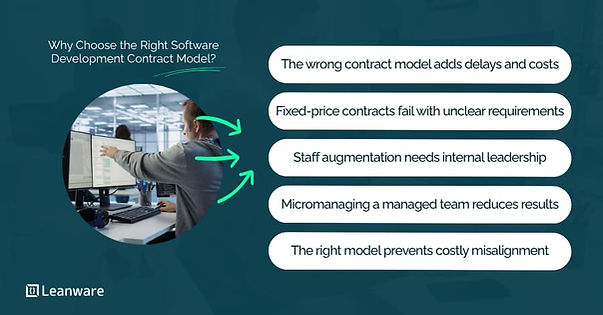
The wrong contract model creates problems that surface weeks or months into the engagement. A fixed-price contract on a project with unclear requirements leads to constant change requests and renegotiations.
A staff augmentation model without internal engineering leadership leaves developers without direction. A managed team engagement where the client micromanages execution undermines the model's core value.
These are not hypothetical risks. They are the most common reasons software development partnerships underperform. Getting the model right at the start prevents the structural misalignment that makes projects expensive to course-correct later.
The 4 Most Common Contract Models in Software Development
Each model distributes cost, control, risk, and flexibility differently. No model is universally better. The right choice depends on the project context.
Fixed Scope (Fixed Price) Contracts
The deliverables, timeline, and total cost are defined before development begins. The development partner commits to delivering a specified set of features by a specific date for an agreed price.
This model works when requirements are stable and well documented. Both sides know what will be built, and the primary risk is execution, not discovery. The client gets cost predictability. The vendor prices in risk, which means fixed-price contracts often carry a premium to account for unknowns.
The limitation is flexibility. If requirements change during development, every adjustment requires a formal change request and contract amendment. For products that are still evolving, this creates friction that slows the project down and erodes the cost predictability the model was supposed to provide.
Managed Team Model
A dedicated external team takes responsibility for delivering the product or a defined product area. The team typically includes developers, QA, a tech lead, and sometimes a product manager. The vendor manages execution, coordination, and technical decisions. The client sets the product direction and reviews progress.
This model works well for long-term product development where the company wants a partner that owns delivery rather than individual contributors who need daily direction. The managed team builds institutional knowledge over time, makes architecture decisions, and operates with the autonomy of an internal engineering team.
It requires trust. The client needs to be comfortable delegating execution decisions to the external team. Companies that want direct control over every engineering task are better served by staff augmentation.
Fixed Budget With Controlled Scope
The budget is predetermined, but the scope is flexible. Instead of committing to a fixed set of features, the team continuously prioritizes the most valuable work within the budget constraint. Features are delivered iteratively, and the backlog is reprioritized as the product evolves.
This model aligns naturally with agile development. The client knows exactly how much they will spend. The team delivers the highest-priority features first, and lower-priority items are deferred or dropped if the budget runs out. The client gets financial predictability without locking in requirements that may change.
The risk is that the budget may not cover everything the client originally envisioned. This requires disciplined prioritization and honest conversations about what fits within the financial constraint.
Staff Augmentation
Individual developers join the client's existing team and work under the client's management. The vendor provides the talent, handles employment logistics, and may support onboarding. The client assigns tasks, runs code reviews, and manages delivery.
This model works when the company already has strong internal engineering leadership, established processes, and a clear technical direction. The augmented developers extend the team's capacity without changing how the team operates.
It requires internal management capacity. Without a tech lead or engineering manager directing the work, augmented developers lack the context and oversight they need to be productive. Staff augmentation does not include built-in leadership. The client provides it.
A Practical Framework for Choosing the Right Contract Model
Five questions help narrow the decision. Work through them in sequence, and the right model becomes clear.
Step 1: How Clearly Defined Is Your Project Scope?
If the requirements are documented, stable, and unlikely to change significantly during development, a fixed scope contract provides cost predictability and a clear delivery timeline.
If the product is still being discovered, if user feedback will influence feature decisions, or if the technical approach needs exploration, a flexible model (managed team or fixed budget with controlled scope) avoids the renegotiation cycles that fixed contracts create.
Step 2: How Much Flexibility Do You Need During Development?
Products that ship iteratively and evolve based on user data need models that accommodate change. Fixed budget with controlled scope handles this by letting the team reprioritize continuously.
Managed teams handle this through ongoing collaboration with the client's product leadership. Fixed scope contracts handle change poorly because every adjustment requires formal contract modification.
Step 3: Do You Need Strategic Ownership or Execution Support?
If you need a team that manages its own delivery, makes architecture decisions, and operates with autonomy, a managed team is the right model.
If you have internal leadership and need engineers to execute against a defined roadmap, staff augmentation provides capacity without adding management overhead from the vendor side.
Step 4: What Level of Budget Control Is Required?
Fixed scope and fixed budget models provide the most financial predictability. Managed teams and staff augmentation are typically billed monthly, which provides flexibility but requires ongoing budget management. If the organization requires a hard cap on total project cost, fixed scope or fixed budget with controlled scope are the models that enforce it.
Step 5: How Involved Does Your Internal Team Want to Be?
Companies with strong internal engineering leadership often prefer staff augmentation because they want direct control over technical decisions. Companies that prefer to delegate execution and focus on product strategy are better served by a managed team. The level of internal involvement should match the model. Misalignment here is one of the most common reasons engagements underperform.
Decision Flow: Which Software Development Contract Model Fits Your Situation?
Scenario 1: Clear Requirements and Fixed Deliverables
The project has a defined specification, stable requirements, and a known timeline. Examples include building a system to a predefined design, migrating an existing platform to a new stack, or developing a feature with clear acceptance criteria.
Recommended Model: Fixed Scope Contract
Fixed scope provides cost predictability and structured milestones. Both sides know what will be delivered and when. The model works because the primary risk is execution quality, not scope discovery.
Scenario 2: You Need a Product Team to Own the Development
The company wants an external team responsible for delivery, coordination, and technical decisions. The internal team sets product direction but does not manage day-to-day engineering work. The engagement is expected to last months or longer.
Recommended Model: Managed Team
The managed team provides continuity, ownership, and the ability to make architecture decisions that hold up as the product scales. This model works best when the relationship is long-term and the external team builds deep context about the product.
Scenario 3: Budget Is Fixed but Scope Can Adapt
The company has a defined budget and a backlog of features, but the priority and feasibility of those features may shift during development. The most important work needs to ship first, and lower-priority features can be deferred.
Recommended Model: Fixed Budget With Controlled Scope
Agile prioritization ensures the budget is spent on the highest-value work. The client maintains financial control while the team has the flexibility to adapt the feature set based on what is learned during development.
Scenario 4: You Need Extra Developers to Join Your Internal Team
The company has established processes, a tech lead or engineering manager, and a clear roadmap. The constraint is engineering capacity, not leadership or direction.
Recommended Model: Staff Augmentation
Augmented developers integrate into the existing team and contribute immediately within established workflows. The client retains full control over technical decisions while increasing the team's output.
Comparing the Four Contract Models
These models vary in how they handle scope definition, budget control, and team ownership. Selection depends on project clarity, desired level of control, and how teams are expected to collaborate.
Factor | Fixed Scope | Managed Team | Fixed Budget / Controlled Scope | Staff Augmentation |
Flexibility | Low | High | Medium | High |
Budget Predictability | High | Medium | High | Medium |
Team Control | Vendor | Vendor (with client input) | Shared | Client |
Scope Clarity Required | High | Low to Medium | Medium | Medium to High |
Built-In Leadership | Yes | Yes | Yes | No (client provides) |
Best For | Defined projects, migrations | Long-term product development | Budget-constrained agile projects | Scaling internal teams |
Pros and Cons of Each Software Development Contract Model
Advantages and Limitations of Fixed Scope Contracts
Advantages: Total cost is known upfront. Deliverables and timelines are clearly defined. Both sides have aligned expectations from the start. Works well for projects with stable, documented requirements.
Limitations: Changes require formal amendments. Vendors price in risk, which can make fixed-price contracts more expensive than flexible models. Poorly defined requirements lead to scope disputes. The model discourages experimentation and iterative discovery.
Advantages and Limitations of Managed Teams
Advantages: The team builds deep product knowledge over time. Architecture decisions are informed by long-term context. The vendor manages execution, reducing coordination burden on the client. Works well for ongoing product development.
Limitations: Requires trust in the vendor's delivery process. Monthly costs are less predictable than fixed-price contracts. The client must provide clear product direction even though execution is delegated.
Advantages and Limitations of Fixed Budget Controlled Scope
Advantages: Financial predictability with development flexibility. The team prioritizes the most valuable work within the budget. Aligns naturally with agile methodology. The client controls spending without locking in requirements.
Limitations: The budget may not cover the full original feature set. Requires disciplined prioritization and regular backlog grooming. Can create tension if the client expects all features to be delivered within the budget.
Advantages and Limitations of Staff Augmentation
Advantages: Developers integrate directly into the internal team. The client maintains full control over technical decisions and workflows. Easy to scale up or down. Works well for companies with strong internal engineering leadership.
Limitations: Requires internal management capacity. Without a tech lead directing the work, augmented developers may lack context and direction. The vendor provides talent, not delivery ownership.
Real-World Examples of When Each Contract Model Works Best
Contract models align with how clearly the work is defined and how much ownership the external team takes.
Startup MVP Development
Startups building an MVP rarely have fully defined requirements. The product evolves based on user feedback, investor input, and market discovery. A managed team or fixed budget with controlled scope allows the team to iterate without the overhead of formal change requests. The managed team model is particularly effective here because the external team brings architecture and delivery leadership that most early-stage startups do not have internally.
Scaling an Existing Product
Companies with a working product and a growing roadmap often need more engineering capacity than their internal team can provide.
Staff augmentation adds developers who integrate into the existing team's workflows and contribute to the established codebase. If the company needs to spin up a new product area or feature track, a managed team can own that workstream independently.
Enterprise Software Modernization
Large-scale modernization projects (migrating a legacy system, rebuilding a monolith into microservices, moving to the cloud) often have well-defined requirements and structured delivery phases.
Fixed scope contracts work well for the phases with clear specifications. Managed teams work well for the phases that require ongoing decision-making and architectural judgment.
Filling Temporary Skill Gaps
When a company needs a specialized skill (DevOps, security, data engineering) for a defined period, staff augmentation provides that expertise without a permanent hire. The developer joins the team, contributes to the specific initiative, and the engagement ends when the work is complete.
Common Mistakes Companies Make When Choosing a Contract Model
Companies often select a contract model without fully considering project complexity, team structure, or how requirements may change during development. This can create inefficiencies and increase costs over the project lifecycle.
Choosing Based Only on Price
The cheapest engagement model is rarely the most cost-effective over the full project lifecycle. Fixed-price contracts that seem affordable upfront become expensive when scope changes trigger renegotiations.
Staff augmentation that looks inexpensive per hour becomes costly when the lack of internal leadership slows delivery.
Underestimating Scope Uncertainty
Using a fixed scope model for a product that is still being defined leads to constant change requests and contract friction. If the requirements are likely to evolve during development, the contract model must accommodate that. Fixed budget with controlled scope or a managed team handles uncertainty far better than fixed price.
Misaligning Team Ownership
Hiring a managed team and then micromanaging every technical decision undermines the model. Choosing staff augmentation without internal leadership to direct the work leaves developers without context. The ownership model in the contract must match how the company actually wants to operate.
How Leanware Helps Companies Choose the Right Development Model
Leanware evaluates the project context before recommending a contract model. The recommendation is based on scope clarity, team structure, budget constraints, and how much flexibility the product requires.
Evaluating Project Scope and Technical Complexity
Leanware runs a technical discovery process to assess how well-defined the requirements are, what technical risks exist, and what infrastructure decisions need to be made before development begins. This assessment directly informs which engagement model will work best.
Aligning Team Structure With Business Goals
The engagement model should support the company's long-term product strategy. Leanware helps clients determine whether they need a team that owns delivery or engineers who extend internal capacity, and structures the engagement accordingly.
Building Flexible Engagement Models
Projects evolve. A company might start with a managed team during product discovery and transition to staff augmentation once internal engineering leadership is in place. Leanware supports these transitions without disrupting delivery.
Your Next Step
The contract model is the operating system of the client-vendor relationship. It determines how decisions get made, how changes are handled, and how risk is shared. Choosing the right one requires an honest assessment of scope clarity, budget constraints, internal leadership capacity, and how much flexibility the product demands.
No model is universally right. The best engagements are the ones where the model matches the project's actual constraints rather than the client's default preference or the vendor's preferred way of working.
If you are evaluating engagement models for a software development project, connect with us to structure a partnership that fits your product stage, team setup, and growth plans.
Frequently Asked Questions
What are the most common contract models for software development projects?
The most common models are Fixed Scope (Fixed Price), Managed Team, Fixed Budget with Controlled Scope, and Staff Augmentation. Each distributes responsibilities, financial risk, and flexibility differently. Fixed scope works when requirements are clearly defined. Managed teams and staff augmentation work better for evolving products and long-term development.
How do I choose the right contract model for a software development project?
The choice depends on scope clarity, flexibility needs, team ownership, and budget control. Projects with clearly defined deliverables typically use fixed scope contracts. Evolving products require managed teams or flexible budget models. Companies with strong internal leadership often prefer staff augmentation.
What is a fixed scope contract in software development?
A fixed scope contract defines the project deliverables, timeline, and price before development begins. It provides strong cost predictability and works well when requirements are stable and documented. It becomes less effective when requirements change during development.
What is a managed team model in software development?
The managed team model involves a dedicated external team that takes responsibility for delivering the product. The vendor manages execution, development processes, and team coordination. The client focuses on product direction and business strategy.
What is staff augmentation in software development?
Staff augmentation adds external developers to an internal engineering team. The client manages the developers directly while the vendor provides talent and administrative support. It works well for companies with strong technical leadership that need to scale capacity.
What is a fixed budget with controlled scope contract?
This model sets a predetermined budget while allowing flexibility in feature prioritization. Teams continuously prioritize the most valuable features within the budget limit. It is commonly used in agile development environments where requirements evolve during the project.
Which contract model is best for startups building an MVP?
Startups building an MVP often benefit from managed team models or fixed budget contracts because product requirements frequently evolve during early development. These models allow teams to adapt features based on user feedback while maintaining delivery momentum.
When should companies use staff augmentation instead of outsourcing a project?
Companies should use staff augmentation when they already have an internal product team and need additional developers or specialized expertise. It is ideal for scaling development capacity without outsourcing product ownership.
What are the risks of choosing the wrong software development contract model?
Choosing the wrong model can lead to budget overruns, delivery delays, poor collaboration, and misaligned expectations. Using a fixed scope model for a highly uncertain project often results in frequent change requests and contract renegotiations.
Can companies change contract models during a software project?
Yes. Companies can transition between models as projects evolve. A company might start with a managed team during product discovery and switch to staff augmentation once internal engineering leadership grows. Flexible partners support these transitions.