AI App Development Services for Custom Solutions

The mobile revolution fundamentally changed user expectations, suddenly everyone expected the internet at their fingertips. Today, we're witnessing another pivotal shift, users now anticipate applications that understand their preferences, predict their needs, and continuously improve through interaction.
This transformation is already underway and organizations that recognized the mobile-first opportunity early gained significant competitive advantages throughout the past decade. Also, similarly positioned today are companies integrating AI-powered capabilities into their applications.
The evidence is clear: users increasingly expect adaptive, intelligent experiences online. But what's driving this shift? Businesses are discovering that AI integration doesn't merely add features, it fundamentally transforms how users interact with digital products. Applications are evolving from reactive tools to proactive systems that anticipate needs and continuously enhance their capabilities.
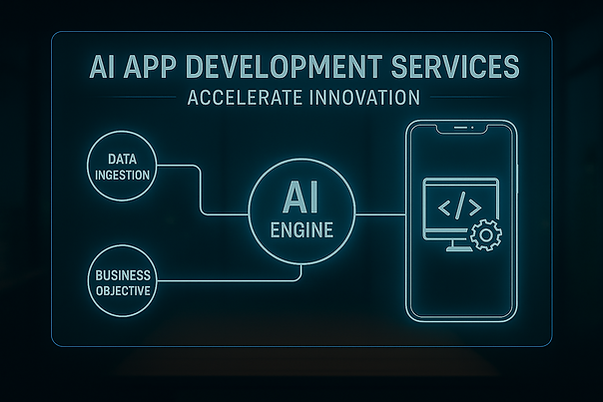
Understanding AI App Development Services
AI app development services encompass the comprehensive process of integrating artificial intelligence and machine learning capabilities into applications. From strategic planning through deployment and optimization, these specialized services focus on creating intelligent systems that can learn, adapt, and make autonomous decisions.
The fundamental shift involves moving from applications that simply execute commands to systems that analyze, learn, and respond intelligently. That’s why applications equipped with AI capabilities can interpret user behavior, adapt to evolving requirements, and make informed decisions independently.
This represents a significant evolution: traditional software becomes intelligent through capabilities that enhance performance over time.
Core Capabilities of AI Applications
Contemporary AI applications offer capabilities that were impractical just a few years ago. Computer vision enables applications to process visual information, recognize objects in images, extract text from documents, and perform facial recognition with consistent accuracy.
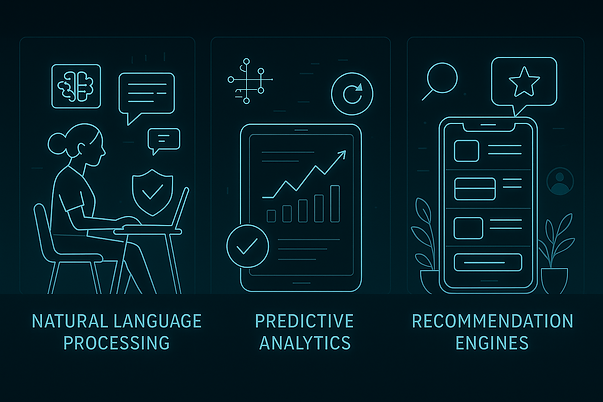
Natural language processing allows applications to interpret human communication effectively, this includes conversational interfaces that maintain context, systems that analyze lengthy documents and extract key insights, and translation capabilities that eliminate language barriers.
Predictive analytics transforms complex data into actionable intelligence, applications can identify emerging market trends, predict customer requirements with precision, and forecast operational challenges with sufficient lead time for proactive response.
Advanced recommendation systems and automated decision-making processes can analyze complex scenarios and provide solutions in real-time.
AI's Impact on Development Processes
The transformation extends beyond the applications themselves to fundamentally change development methodologies.
Development teams now collaborate with AI-powered coding assistants like GitHub Copilot, which function as sophisticated programming tools. These systems suggest optimized code, identify potential issues early, and convert time-intensive manual processes into efficient guided development.
Automated testing systems operate as comprehensive quality assurance tools that identify bugs regardless of complexity. Additionally, no-code AI platforms have democratized application development, enabling business professionals to create sophisticated applications through intuitive interfaces, accelerating the journey from concept to deployment.
The results demonstrate measurable improvements: development cycles previously requiring months now complete in weeks. Prototyping phases that once took months now finish in days, allowing innovative concepts to reach users while maintaining relevance and timeliness.
AI-powered design tools have significantly improved prototyping efficiency. These systems generate user interfaces automatically, suggest optimal user flows, and create content on demand. This acceleration enables businesses to deploy AI-powered features more rapidly, test concepts efficiently, and iterate based on actual user feedback.
Benefits of AI Integration in Applications
Integrating artificial intelligence into mobile and web applications delivers measurable benefits that extend beyond simple automation. These advantages create substantial value propositions for organizations seeking differentiation while improving operational efficiency and user satisfaction.
Enhanced User Experiences
AI-powered personalization creates applications that adapt to individual user preferences. The system learns from every interaction, clicks, swipes, and navigation patterns to create tailored experiences. Interfaces reorganize based on user preferences, shortcuts appear for frequently used features, and information displays precisely when and where needed.
Modern AI assistants engage in natural conversations, understanding context and nuance rather than following scripted responses. Search functionality becomes predictive, anticipating user intent to improve efficiency.
Applications adapt their complexity based on user expertise. New users receive simplified interfaces with guided assistance, while experienced users access advanced tools and streamlined workflows. This adaptive approach reduces learning curves and improves feature adoption.
The outcome is increased user engagement, deeper feature utilization, and improved user satisfaction with the learning process.
Improved Productivity and Efficiency
AI-powered automation handles repetitive processes, allowing teams to focus on strategic, creative work that advances business objectives.
Real-time decision support systems function like instant data analysis, processing complex information and delivering insights that would typically require extensive manual analysis. Behind the scenes, AI continuously optimizes infrastructure, adjusting server capacity, optimizing databases, and predicting issues before they occur.
Intelligent workflow systems operate like sophisticated project management tools, automatically routing tasks to appropriate team members, flagging urgent items, and handling routine processes independently. The result is reduced operational costs, faster product launches, and teams focused on innovation rather than execution.
Strategic Data Utilization
AI transforms data from static information into actionable intelligence. Machine learning algorithms identify patterns in user behavior, market trends, and operational metrics that would require extensive manual analysis to uncover. These insights inform decision-making, from individual user experience optimization to strategic planning.
Predictive analytics converts historical data into forward-looking business intelligence. Organizations can anticipate demand changes, identify potential issues before they impact operations, and allocate resources for maximum impact. Real-time processing ensures decisions are based on current information rather than historical snapshots.
Process Automation
AI can manage complete business processes from initiation to completion. Customer onboarding becomes an intelligent experience where AI verifies documents instantly, assesses risk automatically, and creates personalized user journeys. Support systems gain enhanced capabilities—AI handles routine inquiries, escalates complex issues appropriately, and identifies potential problems before they become customer complaints.
Operational processes benefit from AI optimization. Systems continuously adjust inventory levels based on demand patterns, optimize logistics routing, and predict maintenance requirements before equipment failures occur.
The results include reduced errors, improved consistency, and teams focused on strategic growth initiatives rather than operational maintenance.
Personalized Marketing and Customer Engagement
AI enables sophisticated customer segmentation and personalized communication strategies. Customer relationship management systems become more intelligent, automatically segmenting customers based on behavioral patterns, predicting high-value prospects, and suggesting optimal engagement approaches for each segment.
Integration with marketing platforms like HubSpot or Mailchimp delivers enhanced results. Content adapts to individual preferences, communications are timed for optimal engagement, and continuous testing improves performance over time. The outcomes include improved conversion rates, increased customer satisfaction, and stronger customer loyalty.
Our Comprehensive AI Development Process
Effective AI application development requires a structured approach that connects technical capabilities with business objectives. Our methodology ensures every AI feature delivers reliable, scalable results with measurable business impact.
From initial consultation through deployment and ongoing optimization, clients maintain visibility into how their AI investment creates tangible business value.
Consultation and Strategic Planning
Successful AI implementation begins with comprehensive analysis. Before development starts, we conduct thorough assessments of current business processes, user requirements, and technical infrastructure. We map existing workflows, identify optimal opportunities for AI integration, and ensure proposed features align with broader strategic objectives. Additionally, we develop robust data strategies that support AI models while maintaining security and compliance standards.
We establish realistic timelines, define resource requirements, and create clear success metrics to measure implementation effectiveness. This planning phase prevents scope creep while ensuring new AI capabilities integrate seamlessly with existing systems and processes.
AI Model Selection and Integration Strategy
Model selection involves careful evaluation of available options, considering whether pre-trained models meet requirements or whether custom development is necessary. Our assessment process examines accuracy requirements, response time needs, and ongoing maintenance considerations.
We focus on integrating existing AI models from leading providers including OpenAI, Anthropic, and Google (Gemini) through their APIs. We also leverage specialized models from HuggingFace and other providers, all accessed through API integrations rather than custom model development. This approach ensures reliable performance, ongoing updates, and cost-effective implementation.
When integrating existing models, we emphasize proper data preparation, parameter optimization, and comprehensive testing to ensure optimal performance in production environments. We pay particular attention to bias mitigation and fairness considerations, as AI systems that work well for some users but fail others represent both technical and business risks.
Custom Application Design and Prototyping
Effective AI features integrate seamlessly into user interfaces without drawing attention to their complexity. We begin with rapid wireframing to explore multiple approaches for incorporating AI capabilities into natural user workflows. Interactive prototypes allow stakeholders to test AI features before full development, enabling feedback when modifications are still cost-effective.
Our prototyping process includes extensive testing of AI behavior in edge cases and error conditions. We explore different user interaction patterns, experiment with various response styles, and deliberately test failure scenarios to ensure graceful degradation.
The objective is AI that functions as a helpful tool rather than a complex system, providing users with enhanced capabilities while maintaining full control over their experience.
Development and Integration
The technical implementation phase encompasses both frontend user interfaces and backend AI processing pipelines. Our development approach emphasizes modular architecture and scalability, ensuring AI components can be updated or replaced without disrupting core application functionality. API integrations connect AI models with existing systems and third-party services, creating seamless data flows that support intelligent features.
Performance optimization ensures AI features respond quickly enough to maintain smooth user experiences while managing computational costs effectively. We implement comprehensive monitoring and logging systems that provide visibility into AI model performance and enable rapid issue resolution.
Testing, Deployment, and Monitoring
AI applications require specialized testing approaches that address unique challenges including bias detection, edge case handling, and preventing AI hallucinations that could mislead users.
Our continuous integration and deployment pipelines enable confident rollout of improvements while maintaining system stability. Once AI features are deployed, comprehensive monitoring begins, we track performance metrics in real-time, analyze user feedback, and watch for model drift that can gradually reduce AI effectiveness over time.
Regular model updates and optimization ensure AI features remain sharp and responsive, evolving alongside user needs and changing data patterns.
AI Technologies and Integration Approaches
Our technical expertise encompasses the full spectrum of artificial intelligence technologies, from established machine learning approaches to advanced generative models. This comprehensive knowledge enables us to select optimal solutions for each client's specific requirements while ensuring implementations remain current with rapidly evolving industry standards.
Machine Learning Models
Traditional machine learning provides reliable, interpretable solutions for common business challenges. Regression models predict numerical outcomes like sales forecasts, pricing optimization, and resource demand. Classification algorithms categorize customers, detect fraud, and route support tickets with high accuracy.
Clustering techniques uncover hidden patterns in customer behavior and market segments that inform strategic decisions. Our implementations use industry-standard frameworks like TensorFlow and PyTorch, ensuring models can be easily maintained, updated, and scaled as businesses evolve.
Natural Language Processing Integration
Language understanding capabilities enable applications to interact with users through natural conversation, process unstructured text data, and generate human-like content. Our NLP implementations power intelligent conversational interfaces that handle complex customer inquiries, content analysis tools that extract insights from lengthy documents, and real-time translation services.
Advanced text analysis performs sentiment analysis, entity recognition, and topic modeling that provide deep insights into customer feedback, market trends, and content performance. These capabilities transform unstructured text data into actionable business intelligence.
Computer Vision Implementation
Visual intelligence enables applications to understand and analyze images, videos, and real-world scenes. Our computer vision solutions include image recognition systems that identify products, detect defects, or classify visual content automatically. Object detection algorithms locate and track items in real-time video streams, enabling applications from security monitoring to augmented reality experiences.
Optical character recognition extracts text from images and documents, while facial analysis can detect emotions, verify identity, or measure engagement. These capabilities create new possibilities for user interaction, content analysis, and automated quality control.
Integration with Leading AI Providers
Our approach emphasizes integration with proven AI models from established providers rather than custom model development. We work extensively with models from OpenAI, Anthropic, and Google (Gemini) accessed through their respective APIs. Additionally, we integrate specialized models from HuggingFace and other providers that offer specific capabilities for particular use cases.
This integration strategy provides several advantages: access to continuously updated models, reduced development time and costs, proven performance and reliability, and ongoing support from leading AI research organizations.
Large language models power conversational AI that understands context, maintains coherent discussions, and provides helpful responses across diverse topics. Advanced generative models create realistic content that enhances user experiences and supports creative workflows.
Hybrid AI Systems
The most robust AI solutions often combine multiple technologies to create comprehensive intelligent systems. By integrating computer vision with natural language processing, applications can analyze images and describe them in natural language. Combining machine learning with rule-based systems ensures both accuracy and explainability in critical business decisions.
Practical examples include customer service systems that combine conversational AI with visual recognition to help users troubleshoot products, or content management platforms that use both text analysis and image recognition to automatically categorize and tag multimedia content.
Why Partner with Our AI Development Team?
Selecting the right AI development partner requires finding a team that understands both technical implementation and business strategy, with a commitment to long-term support and collaboration.
Our approach is specifically designed for early-stage startups and growing businesses. You gain access to enterprise-grade solutions without the complexity or costs typically associated with such implementations. Consider us your dedicated AI team, ready to scale alongside your business growth.
Enterprise-Grade Implementation
Our AI implementations are architectured for future growth, scalable, secure, and performant from initial deployment. This approach ensures applications can expand alongside business growth without requiring expensive rebuilds.
Security is fundamental to our approach, with robust protection for sensitive data and AI models against unauthorized access. Our compliance frameworks support regulations including GDPR, CCPA, and industry-specific requirements, allowing you to focus on growth rather than regulatory concerns. Performance optimization ensures AI features remain responsive under varying load conditions, while comprehensive monitoring and alerting systems provide early warning of potential issues.
Custom Conversational AI Development
Conversational interfaces have become standard user expectations rather than luxury features. Our custom conversational AI solutions move beyond simple keyword matching to deliver intelligent, context-aware experiences that remember past interactions, understand user intent, and provide personalized, genuinely helpful responses.
These solutions integrate seamlessly with existing customer support systems, knowledge bases, and business processes. Users receive consistent experiences across all touchpoints, while organizations benefit from reduced support costs and faster response times.
Seamless System Integration
Effective AI enhances existing systems rather than requiring complete replacement. Our integration approach works within current workflows and systems, connecting seamlessly with CRM, ERP, analytics tools, and other business-critical applications.
Users access AI capabilities within familiar interfaces they already know, minimizing disruption, reducing training requirements, accelerating adoption, and maximizing return on investment.
Dedicated Consulting and Support
Our AI consultants serve as genuine partners throughout the entire process, from initial strategy through implementation and ongoing optimization. They bring strategic insight, technical expertise, and continuous support that transforms concepts into sustainable competitive advantages.
Our approach begins with understanding actual business challenges rather than pursuing technology for its own sake. This business-centered methodology ensures AI solutions address real problems and create lasting value that evolves with your business.
Mobile-Optimized AI Solutions
Mobile devices present unique opportunities and challenges for AI implementation, from working within processing constraints to handling privacy-sensitive data appropriately. Our mobile optimization includes edge AI implementations that perform processing directly on user devices, resulting in faster responses and enhanced privacy protection.
On-device processing ensures AI features remain responsive even with limited network connectivity, while intelligent caching and compression techniques minimize battery drain and data usage without compromising functionality.
AI Development Best Practices
These practices reflect insights gained from numerous AI implementations and help organizations avoid common pitfalls while maximizing the value of their AI investments.
User Experience-Focused Design
The most sophisticated AI technology delivers minimal value if users find it confusing, intrusive, or unreliable. Our UX-first approach ensures AI features integrate naturally into user workflows, enhancing rather than complicating the user experience. We design AI capabilities that feel intuitive and helpful rather than showcasing technical complexity.
Successful AI integration makes intelligent features feel like natural extensions of applications, not awkward additions that require special training or lengthy explanations. Users should benefit from AI capabilities without needing to understand or consider the underlying technology.
Security and Privacy by Design
AI applications often process sensitive personal or business data, making security and privacy fundamental requirements from the outset. Our security-by-design approach implements data encryption, access controls, and audit trails from initial architecture through ongoing operations.
Privacy protection includes techniques such as differential privacy, federated learning, and data minimization that enable AI functionality while protecting user information. Compliance with regulations such as GDPR and CCPA requires careful attention to data collection, processing, and retention practices that respect user rights and regulatory requirements.
Agile Development and Continuous Delivery
AI development works most effectively as an ongoing process rather than a one-time project. Through iterative, agile methodology, we can experiment, test, and refine quickly, guided by real user feedback. Our process includes regular sprint reviews, stakeholder check-ins, and continuous integration, allowing features to evolve naturally as new requirements and insights emerge.
Continuous delivery pipelines enable rapid deployment of improvements while maintaining system stability and reliability. The result is AI that grows alongside your business, adapting to changing requirements and user expectations without lengthy development cycles.
Scalability and Future-Proofing
AI solutions should support growth rather than constrain it. We design applications to handle expanding data volumes, user growth, and increasing feature complexity without requiring costly rebuilds. Modular architecture allows each AI component to be upgraded, replaced, or scaled independently, facilitating evolution as requirements change.
Multi-cloud deployment strategies provide flexibility and resilience, while automated retraining pipelines ensure models continue improving as new data becomes available. This future-proof approach protects AI investments and ensures systems become increasingly intelligent, robust, and adaptable over time.
Connect with us now and get the best practices tailored for your business that are appealing, user-friendly, reliable, and secure, thus helping you achieve your business goals.
Frequently Asked Questions About AI App Development
How much does it cost to develop an AI app?
Cost depends on AI model complexity, data requirements, system integration needs, and customization level. Simple features like basic conversational interfaces cost less than advanced computer vision or natural language processing implementations. Integrating existing models through APIs requires less investment than developing custom solutions from scratch.
Are there AI tools for app development?
AI tools like GitHub Copilot, Tabnine, and CodeT5 assist with code generation, bug detection, and routine development tasks. AutoML platforms enable non-technical users to work with machine learning models. However, these tools support rather than replace developers, especially for complex projects requiring domain expertise and strategic thinking.
Is AI replacing app developers?
AI enhances rather than replaces developers. While AI handles repetitive coding and testing tasks, developers remain essential for architecture, problem-solving, user experience design, and strategic decisions. The future involves partnership: AI manages routine tasks while developers focus on creativity and complex problem-solving.
How should I approach using AI in app development?
Begin by clearly defining the problem and ensuring alignment with business objectives. Choose appropriate solutions—existing models for common tasks or custom development for specialized requirements. Focus on seamless integration through intuitive interfaces, thorough testing, and performance monitoring. Start with simpler implementations, then expand based on user feedback and business needs.