OpenAI Acquires OpenClaw: The Complete Story | 2026

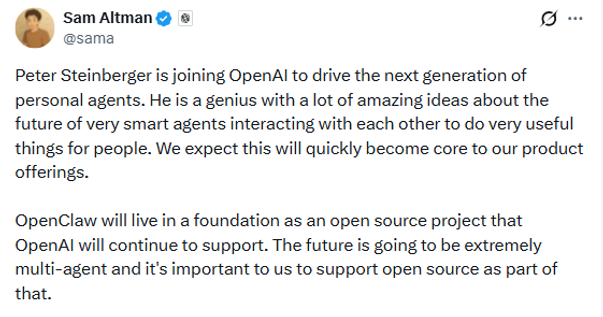
On February 15, 2026, OpenAI CEO Sam Altman announced on X that Peter Steinberger, the creator of OpenClaw, was joining the company to lead the development of next-generation personal agents. The open-source project would move to an independent foundation, with OpenAI as a financial sponsor.
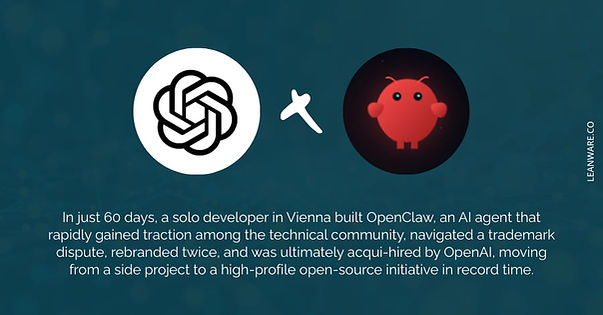
What makes this noteworthy is the speed of the project’s growth. In roughly 60 days, a solo developer in Vienna built a personal AI agent as a side project, gained rapid attention from the technical community, navigated a trademark dispute with Anthropic, rebranded twice, and ultimately joined OpenAI through an acqui-hire.
Here is the full sequence of events, what happened technically and strategically, and what it means if you are building in this space.
The Birth of Clawdbot: A Solo Dev's Viral AI Assistant
Peter Steinberger is not a first-time builder. He spent 13 years growing PSPDFKit, a document processing SDK used on over a billion devices. After a strategic investment from Insight Partners in 2021, he stepped back and spent roughly three years away from tech, dealing with burnout.
In April 2025, he started coding again. He began experimenting with AI tools, dragging files into Gemini and Claude Code to see what they could build. By November 2025, he had a prototype: a simple relay that connected WhatsApp to Claude Code. He built the first version in about an hour, stitching together existing tools rather than building from scratch.
The project, initially called Clawdbot (a pun on Anthropic's Claude combined with a lobster claw), did something that most AI assistants at the time did not. It ran locally on the user's own hardware and took autonomous action through messaging apps the user already had installed.
Why It Went Viral Overnight
The core pitch was simple: this is an AI that actually does things.
Most AI assistants in early 2026 lived in browser tabs. You typed a prompt, got a response, and then had to go do the work yourself. Clawdbot worked differently. It ran as an always-on process on your machine, connected to WhatsApp, Telegram, iMessage, Discord, or Signal, and could independently execute tasks. It read emails, managed calendars, organized files, ran shell commands, and even replied to messages on your behalf.
Steinberger shared an example from his own experience that illustrates why the project resonated. While traveling in Morocco, he sent a voice message to his agent through WhatsApp, even though voice support had not been explicitly implemented. The agent recognized the OGG file format, used FFmpeg to convert it, located his OpenAI API key on his machine, sent the audio to OpenAI's transcription endpoint, and returned the text. It resolved a need Steinberger had not anticipated by leveraging tools already available on his system.
On January 25, 2026, after several months of private development and community testing, Steinberger publicly launched the project. It quickly attracted attention from the technical community and saw rapid adoption.
A few factors contributed to its adoption:
- Local-first architecture: All data stayed on the user's hardware. No conversation history went to third-party servers. For privacy-conscious developers, this was a major draw compared to cloud-hosted alternatives.
- Messaging-app interface: Instead of requiring a dedicated app or terminal session, users communicated with their agent through chat apps they already used daily. This made it feel less like a tool and more like a capable colleague you could text.
- Extensible skill system: The community built ClawHub, a registry of installable skills (similar to npm for AI agents). By February 2026, ClawHub hosted over 5,700 community-built skills covering everything from Gmail integration to smart home control to Spotify management.
- Moltbook: Entrepreneur Matt Schlicht launched Moltbook, a social network designed exclusively for AI agents. Humans could observe but not post. The agents posted reflections, commented on each other, and voted on content. It was strange, compelling, and generated enormous media coverage.
- Mac Mini effect: The community adopted Apple's Mac Mini as the default always-on host for running OpenClaw. This drove enough hardware demand to create noticeable stock shortages at retailers, with delivery times for high-memory configurations stretching to six weeks.
Former Tesla AI director Andrej Karpathy described it as “one of the most remarkable recent developments I’ve seen in AI.”
The Anthropic Trademark Clash
Three days before the rename, Steinberger appeared on the "Insecure Agents" podcast and said he had checked for trademark conflicts. He believed the name was clear.
On January 27, 2026, Anthropic's legal team contacted him. The name "Clawd" was phonetically too close to "Claude," and the project's lobster mascot bore visual similarities to Anthropic's own branding for Claude Code. Anthropic asked him to change the name. Steinberger was not allowed to keep any variation, including "Clawbot" with the "d" removed.
From a pure trademark law perspective, this was standard enforcement. U.S. trademark law requires owners to actively police their marks, or they risk weakening them through dilution. "Clawd" and "Claude" were phonetically near-identical, operating in the same industry, targeting the same audience. Anthropic's lawyers had a defensible position.
The timing and optics, though, stung. Clawdbot was one of the most visible promoters of Claude's capabilities. Every user who installed the agent was, by default, configured to use Anthropic's Claude Opus 4.5 as the reasoning engine. Every installation was a paying Anthropic API customer. Steinberger was, functionally, Anthropic's biggest unpaid evangelist.
Steinberger complied immediately. He did not fight it or negotiate publicly. But on his personal X account, he was direct about what happened: he was forced to rename.
Trademark enforcement does not care about intent or whether you are helping the other company's business. If your brand creates a likelihood of confusion in the same market, the trademark holder has both the right and the legal incentive to act.
Rebranding Under Pressure: Clawdbot → Moltbot → OpenClaw
The first rebrand happened within hours of Anthropic's request. On January 27, 2026, the project became Moltbot. The name came out of a 5 AM Discord brainstorm with the community. "Molt" refers to what lobsters do when they outgrow their shell, a fitting metaphor for the forced evolution. The mascot was renamed Molty.
In the roughly ten seconds between releasing the old GitHub organization name and X handle and claiming the new ones, bad actors hijacked both accounts. A fake $CLAWD token appeared on Solana and briefly hit a $16 million market cap before collapsing. Steinberger had to publicly distance himself from his own former project name and ask crypto traders to stop harassing him.
Three days later, on January 30, 2026, Steinberger renamed again. Moltbot became OpenClaw. As he explained in the announcement post, "Moltbot never quite rolled off the tongue." This time, the team did more preparation: trademark searches, domain purchases, and migration code were all ready before the switch.
The "OpenClaw" name captured three things: it was open source, it preserved the crustacean identity, and it was legally defensible. Before finalizing the name, Steinberger checked with Sam Altman to make sure "OpenClaw" would not conflict with OpenAI's branding. Altman gave the green light.
Three names in five days. Each rebrand only accelerated public attention.
If you build a project that gets traction fast, your brand infrastructure needs to be defensible from day one. Domain names, social handles, trademark searches, and transition plans are not things you want to figure out under pressure at 5 AM while scammers are snapping up your old accounts.
OpenAI's Acqui-Hire: What Actually Happened
Steinberger spent the first two weeks of February in San Francisco, meeting with every major AI lab. Mark Zuckerberg reached out via WhatsApp. They got on a call, argued for ten minutes about whether Claude Code or Codex was better, and Zuckerberg tested OpenClaw himself. Satya Nadella also made contact. Sam Altman called personally.
On February 14, 2026, Steinberger published a blog post announcing his decision. He was joining OpenAI.
He had already built and sold a company over 13 years and didn’t want to repeat that experience. Running OpenClaw was costing him $10K-20K per month in infrastructure and API expenses, and the operational workload was increasing with the growing user base. His goal was to build agents that anyone could use, including, as he put it, his mother.
The terms of the deal:
- Steinberger joins OpenAI to lead the development of next-generation personal agents.
- OpenClaw moves to an independent foundation, remaining open source. OpenAI committed to sponsoring the project financially and dedicating Steinberger's time to maintaining it.
- No acquisition price was disclosed. This follows the acqui-hire pattern: OpenAI hired the talent and committed to supporting the community, rather than buying and closing the project.
In his X announcement, Altman described the hire in the context of multi-agent systems: "The future will be heavily multi-agent, and supporting open source is an important part of that."
What OpenAI gains from this deal:
What OpenAI Gets | Why It Matters |
Peter Steinberger’s talent | Built a billion-device SDK and a widely adopted AI agent largely solo |
Community and ecosystem | Thousands of ClawHub skills, active Discord, and an engaged developer community |
Competitive positioning | Developer who initially built on Claude now works for OpenAI |
Open-source credibility | Foundation-backed OpenClaw reinforces support for open-source development |
For the OpenClaw community, the foundation model means the project remains open and model-agnostic. Developers can still use Claude, GPT, DeepSeek, or local models through Ollama. The project's identity does not become an OpenAI product. Whether that independence holds long-term is something the community will watch closely.
Strategic Implications for Founders
This acquisition signals a few things that matter if you are building in the AI space right now.
Autonomous agents are the current competitive frontier. The chatbot phase of AI is maturing. The companies with the largest war chests are now competing specifically on agents that can take action, not just generate text. OpenAI hiring Steinberger, Anthropic launching Claude with computer use, Google investing in Gemini agent capabilities, and Meta courting Steinberger directly all point in the same direction. The next generation of AI products will be judged on what they can do, not just what they can say.
Big Tech consolidation is happening fast. Steinberger went from solo developer to acqui-hire target in under 60 days. The speed at which OpenAI, Meta, and Microsoft all reached out shows that these companies are watching the open-source ecosystem constantly and are willing to move fast when they see traction. For founders, this means your competitive window may be shorter than you expect.
Open source is both a growth engine and a strategic asset. OpenClaw's open-source licensing drove its viral adoption. It also made it valuable enough that OpenAI committed to keeping it open as part of the deal. If you are building tools in this space, open source can accelerate community adoption in ways that closed-source products cannot match. But it also means your innovations are visible to everyone, including the companies that might want to hire you or compete with you.
Building adjacent to a major platform carries trademark and strategic risk. Steinberger named his project after Claude because he genuinely admired the model. That admiration turned into a trademark dispute that forced two chaotic rebrands in five days. If you are building on top of a major AI platform, keep your brand identity clearly distinct from day one.
The talent market for agent builders is extremely competitive. Steinberger had Altman, Zuckerberg, and Nadella all reaching out within days. OpenAI has been aggressively hiring from Tesla, xAI, Meta, and Instacart throughout 2025 and 2026. If you are building an agent-focused startup, your team is a target. Plan for retention accordingly.
For founders deciding how to position in this market, the OpenClaw story suggests a few concrete approaches. Find a vertical or workflow where you have deep domain expertise that a general-purpose agent cannot replicate easily. Invest in community and ecosystem early, as it becomes a defensible asset. And make sure your brand, infrastructure, and IP strategy are solid before you need them, not after something goes viral.
Building in the AI Agent Space
The OpenClaw story compressed years of startup events into weeks, moving from product-market fit and viral growth to legal disputes, competitive interest, and acquisition. This pace illustrates the current AI market and shows no signs of slowing.
Execution speed and community engagement play a key role, and the window between building a viral project and being acquired can be measured in weeks rather than years.
You can also connect with us to get support for fast-moving AI projects, to help make sound architectural and strategic decisions under tight timelines.