AI-Augmented ERP Systems: Benefits, Features & Use Cases

Enterprise Resource Planning systems have evolved considerably since their early days as basic inventory management tools in the 1960s. Today, ERP platforms sit at the operational core of many organizations, connecting finance, supply chains, human resources, and customer operations within a single system.
The global ERP software market was valued at USD 64.83 billion in 2024 and is expected to grow at a compound annual growth rate of 11.7% from 2025 to 2030, driven in part by cloud adoption and modular deployment strategies.
One of the most significant changes in recent years is the integration of AI and machine learning into ERP workflows. The shift to AI‑augmented ERP reflects a practical change in how businesses manage data and support decisions, rather than a dramatic transformation.
Let’s explore what AI‑augmented ERP is, how it differs from traditional systems, its main benefits, use cases, key features, challenges, and future trends.
What Are AI-Augmented ERP Systems?
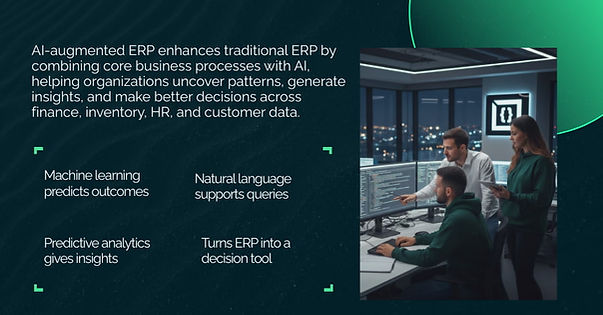
AI-augmented ERP systems combine traditional enterprise software with machine learning, natural language processing, and predictive analytics, enhancing the capabilities of standard ERP platforms. An ERP system integrates business processes - finance, procurement, inventory, human resources, and customer data - into a single platform instead of maintaining separate silos.
AI-augmented ERP builds on this foundation in three ways: machine learning analyzes historical data to detect patterns and generate predictions; natural language processing lets users query the system using conversational language; and predictive analytics turns data into forward-looking insights for planning and resource allocation.
Together, these features transform ERP from a system of record into an active decision-support tool.
How They Differ from Traditional ERP Systems
Traditional ERP systems operate on rules. You define business logic, set thresholds, and the system executes accordingly. If inventory drops below 100 units, generate a purchase order. If an invoice exceeds $10,000, route it for approval.
These rules work well for known scenarios but struggle with complexity and edge cases. AI-augmented systems learn from data patterns rather than relying solely on predefined rules. They recognize that a 15% demand spike in March might be normal for one product category but unusual for another.
They detect subtle correlations between supplier lead times and quality issues. Most importantly, they improve over time as more data flows through the system without requiring manual rule updates.
Key Benefits of AI-Augmented ERP Systems
AI-augmented ERP systems deliver measurable value across planning, operations, and finance.
Benefit | How It Works | Impact |
Forecasting | AI analyzes multiple data streams | Cuts errors 20-50%, reduces stockouts |
Automation | Automates tasks and processes data | Frees staff, improves accuracy |
Real-Time Insights | Dashboards and anomaly detection | Faster decisions, lower risk |
Cost & Efficiency | Optimizes inventory, reduces manual work | Lower warehousing/admin costs, better capital use |
Scalability | Modular cloud and adaptive AI | Expands with business, adapts to data |
Enhanced Forecasting and Planning
Traditional forecasting methods using spreadsheets and statistical averages often produce errors of 30-50%. AI-driven forecasting changes this dynamic substantially. According to McKinsey research, applying AI-driven forecasting to supply chain management can reduce errors by 20-50%, which translates into a reduction in lost sales and product unavailability of up to 65%.
The technology achieves this by analyzing multiple data streams simultaneously: historical sales, seasonal patterns, promotional calendars, economic indicators, and external factors like weather data. For production planning and financial projections, AI models continuously recalibrate based on actual outcomes.
Automation of Routine Tasks
Data entry, invoice processing, and report generation consume significant staff hours in most organizations. AI-augmented ERP automates these tasks with high accuracy. Invoice matching algorithms compare purchase orders, receipts, and invoices to flag discrepancies automatically.
Natural language processing extracts relevant data from unstructured documents like contracts and emails. Automated report generation delivers insights to stakeholders without requiring manual queries. These automations free finance and operations teams to focus on analysis and strategic work rather than repetitive data processing.
Real-Time Decision Support
Traditional reporting shows what happened. AI-enabled systems show what is happening and what will likely happen next. Live dashboards update as transactions process, giving managers current visibility into key performance indicators.
Anomaly detection flags unusual patterns the moment they appear, whether that is a sudden spike in returns for a specific product or an unexpected variance in production costs. This real-time awareness enables faster course corrections before small issues become major problems.
Cost Reduction and Efficiency
Better forecasting and automation directly impact operating costs. Warehousing costs can fall by 5–10% through optimized inventory levels. Administration costs can decrease by 25–40% when manual data processing is automated.
AI‑enabled ERP systems also help reduce working capital requirements by improving inventory accuracy and planning, allowing companies to manage resources more efficiently.
Scalability and Customization
Cloud-based AI ERP platforms offer modular architectures that scale with business growth. You can start with core financials and inventory management, then add procurement intelligence or analytics modules as needs evolve. AI models adapt to your specific data patterns, effectively customizing themselves to your business without extensive configuration.
Use Cases by Industry
AI-augmented ERP supports different industries by applying machine learning and analytics to critical operations.
Industry | AI Use Cases | Benefits |
Manufacturing | Predictive maintenance, supply chain | Reduces downtime, balances inventory |
Retail | Forecasting, restocking | Maintains stock, adapts to demand |
Finance | Fraud detection, reconciliation | Flags anomalies, improves liquidity |
Healthcare | Planning, inventory, compliance | Optimizes staffing, tracks inventory |
Manufacturing
Predictive maintenance is one of the most valuable AI applications in manufacturing. Equipment failures can halt production lines at costs reaching $260,000 per hour. AI systems analyze sensor data from machinery to detect early warning signs before breakdowns occur. McKinsey research shows that predictive maintenance can reduce overall maintenance costs by 10-40% and decrease downtime by up to 50%.
Supply chain optimization is another area where AI adds value. Systems can balance inventory across facilities, anticipate demand fluctuations, and suggest alternative suppliers during disruptions, helping manufacturers maintain production continuity and reduce operational risk.
Retail and Supply Chain
Retailers face the ongoing challenge of maintaining product availability without tying up capital in excess inventory. AI-powered demand forecasting analyzes sales velocity, promotional impacts, and external factors to predict store-level demand.
Smart restocking systems generate purchase orders when inventory approaches optimal reorder points, taking supplier lead times into account. These capabilities help retailers maintain stock levels more efficiently and respond to changes in customer demand.
Finance and Accounting
AI-powered fraud detection systems analyze account behavior and flag transactions that deviate from established patterns. Beyond fraud prevention, AI streamlines account reconciliation by matching transactions across systems.
Cash flow forecasting models help treasury teams optimize liquidity by providing more accurate predictions of payment timing and financial needs.
Healthcare
Healthcare organizations operate under strict regulatory requirements while managing complex supply chains. AI-augmented ERP helps with resource planning by predicting patient volumes and optimizing staffing schedules.
Inventory management tracks expiration dates for medications. Compliance tracking monitors regulatory requirements across jurisdictions, flagging potential issues before they result in violations.
Features to Look for in AI-Augmented ERP Solutions
When evaluating solutions, focus on capabilities that address your specific operational challenges. Look for AI-based inventory tracking with predictive stock alerts that analyze consumption patterns and lead times.
Smart billing should handle complex pricing rules and adapt payment reminders based on customer history. Procurement features should analyze vendor performance across price, quality, and delivery metrics. The analytics layer should provide trend analysis and KPI forecasting through natural language queries.
Challenges and Considerations
Implementing AI‑augmented ERP requires careful planning around cost, compliance, adoption, and vendor selection.
Challenge | Key Points |
Implementation | $150K-$750K; 6-18 months; legacy integration |
Privacy & Compliance | GDPR, HIPAA, SOC 2; secure data handling |
Change Management | Staff training; trust AI; augmentation focus |
Vendor & Costs | Total cost, support, and verify capabilities |
Implementation Complexity
ERP implementations require substantial investment. Mid-sized businesses typically spend $150,000 to $750,000 on implementation, including licensing, data migration, and training. Timelines range from 6 to 18 months depending on complexity.
Cloud-based ERP deploys faster, but even cloud implementations require careful planning. Legacy system integration often presents unexpected challenges.
Data Privacy and Compliance
AI systems require substantial data volumes to function effectively. GDPR, HIPAA, SOC 2, and industry-specific regulations impose requirements on data handling.
Organizations must ensure AI models do not expose sensitive information. Vendor selection should include evaluation of security certifications and data residency options.
Change Management
Staff must learn new workflows and develop trust in AI-generated recommendations. Resistance is common, particularly when employees feel their expertise is being replaced.
Successful implementations invest in training programs that help staff understand how AI tools augment rather than replace human expertise.
Vendor Selection and Costs
Evaluating ROI requires understanding both direct costs and total cost of ownership over multiple years. Subscription fees, implementation services, customization, and ongoing support all factor into the calculation.
Understand how pricing changes as user counts grow and what features require additional fees. Reference checks with similar organizations provide insight into actual versus promised capabilities.
Strategic Implications for Modern Businesses
AI-augmented ERP has strategic implications across decision-making, operational agility, and organizational preparedness.
Area | Key Points |
From Automation to Intelligence | Supports decisions instead of just processing data |
Competitive Advantage | Faster market response, better service, improved efficiency |
Organizational Readiness | Needs data maturity, leadership support, and staff training |
Shifting from Automation to Intelligence
Early ERP systems automated data entry and transaction processing. The current generation moves beyond automation to intelligent decision support.
Rather than simply recording what happened, AI-augmented systems provide guidance on what to do next. The manager's role evolves from data processor to decision maker.
Creating Competitive Advantage
Organizations that leverage AI-augmented ERP can respond more quickly to market changes, improve customer service, and operate more efficiently.
By automating routine processes and providing real-time insights, these systems support workflow improvements and enable a level of operational agility that traditional ERP alone cannot achieve.
Organizational Readiness
Successful AI-ERP adoption requires more than technology investment. Internal data maturity determines whether AI models have quality inputs. Leadership buy-in ensures adequate resources.
Upskilling programs prepare staff to work effectively with new systems. Assess readiness honestly before committing to implementation.
Future Outlook of AI in ERP Systems
Looking ahead, AI in ERP is set to improve adaptability, cloud integration, and how users interact with data.
Area | Key Points |
Emerging Trends | Autonomous features, explainable AI shift to modular ERP |
AI and Cloud ERP | Scalable compute, automatic updates, lower upfront costs |
Generative AI | Simplifies reporting, clarifies data, supports conversational analysis |
Emerging Trends
ERP platforms are gradually moving toward more flexible and adaptable designs. Autonomous ERP is starting to appear in limited scenarios, where systems can handle routine decisions based on AI-generated recommendations, reducing manual effort in everyday operations.
Explainable AI is also becoming more relevant, as teams look for clearer insight into how recommendations are produced.
Hyperautomation brings together AI, workflow automation, and system integration to support end-to-end processes across functions. In parallel, analysts, including Gartner, point to a steady shift away from monolithic ERP systems toward more modular and composable architectures, which allow organizations to evolve their ERP environments incrementally as business needs change.
AI and Cloud ERP Integration
Cloud-native platforms have inherent advantages for AI deployment. They access computational resources for model training without on-premise infrastructure. Updates deploy automatically. SaaS pricing reduces upfront investment, making advanced capabilities accessible to smaller organizations.
Role of Generative AI
Generative AI is expected to play a larger role in how users interact with ERP systems over the next few years. Rather than changing core transaction processing, its impact will center on interpretation and usability. ERP platforms are beginning to use generative models to produce narrative explanations of reports, clarify complex data in plain language, and support ad-hoc analysis through conversational queries.
As these capabilities mature, generative AI is likely to reduce dependence on specialized reporting skills and make ERP insights more accessible across business functions.
Is Your Business Ready for AI-Augmented ERP?
AI-augmented ERP changes how organizations manage operations and make decisions. Benefits can include more accurate forecasting, lower operational costs, improved customer service, and quicker response to changes.
Achieving these outcomes requires a clear look at organizational readiness. Evaluate your data infrastructure, identify where AI can add value, and consider your team’s ability to adapt to new workflows. Plan a realistic timeline and budget.
You can also reach out to our team for guidance on evaluating AI-ERP solutions, identifying high-impact use cases, and planning a smooth implementation that fits your organization’s needs.
Frequently Asked Questions
What does AI-augmented ERP cost for a mid-sized company (500-1000 employees)?
Implementation typically costs $250,000 to $1 million, including licensing, data migration, integration, and training. Ongoing costs include annual subscription fees (often per user), support contracts, and periodic customization. AI features may be included in base licensing or offered as premium add-ons.
How long does implementation take from start to go-live?
Timelines range from 6 to 18 months depending on complexity, data migration requirements, and customization extent. Cloud-based systems deploy faster. Organizations with clean data move more quickly than those requiring significant cleanup.
Can AI-augmented ERP integrate with legacy systems like AS/400?
Yes, through middleware, custom APIs, or ETL processes. Complexity depends on legacy architecture and data formats. Assess integration requirements early in vendor evaluation. Budget for integration as a separate line item.
What team size and skills are needed to manage the system?
A lean team with an ERP administrator, data analyst, cloud engineer, and business process owners is typically sufficient. Many companies supplement with vendor-managed services for technical support.
Which vendors are best for specific industries?
Manufacturing: Epicor, Infor CloudSuite Industrial, Katana. Retail: NetSuite, Microsoft Dynamics 365, Brightpearl. Healthcare: SAP S/4HANA, Workday, MediTech ERP. Best fit depends on specific operational needs and existing technology.
Does AI-augmented ERP work for seasonal businesses?
Seasonal businesses benefit significantly from AI forecasting that identifies seasonal patterns. The systems help with demand forecasting, staffing optimization, and inventory planning. Many cloud vendors offer scalable pricing, aligning costs with activity levels.
How do you train employees unfamiliar with AI?
Use role-based training focusing on features each employee will use daily. AI explainability builds trust by showing the reasoning behind recommendations. Emphasize how AI augments rather than replaces human expertise.
What if your vendor goes out of business or discontinues support?
Evaluate vendor financial stability during selection. Contract terms should address data portability and standard export formats. Open APIs allow integration with alternatives. Some organizations negotiate software escrow agreements.