AI Consulting for Small Businesses

Can AI actually help your 10-person team compete with companies ten times your size? Over the past few years, more small businesses have started to answer yes.
As of 2025, nearly 39% of small and midsize firms report using AI tools to automate work, improve customer experiences, and make faster decisions.
With accessible software and affordable cloud services, AI is no longer reserved for enterprises with massive budgets.
TL;DR: There’s a gap between early adopters and those waiting. Large companies invest heavily to build AI in-house. Small businesses can engage AI consultants to define use cases, plan a roadmap, and access advanced capabilities without incurring a significant investment in-house.
This guide explains what AI consulting provides, where it’s effective, and how you can implement it within a reasonable budget.
Why AI Matters for Small Businesses
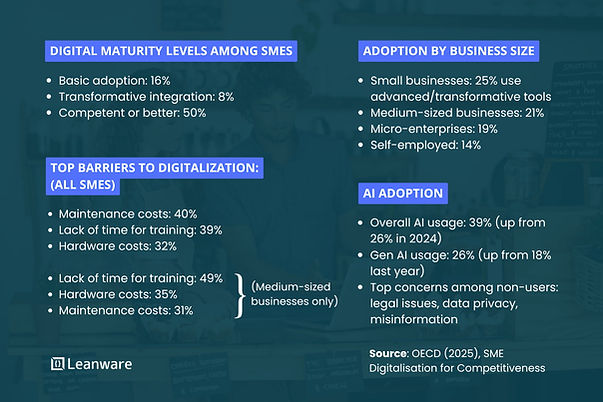
Small businesses often have to do more with fewer resources. Limited staff, tight budgets, and constant demands can push teams to their limits. AI offers a practical way to handle these pressures without adding extra headcount or overhead.
It doesn’t replace people - it takes over repetitive tasks and helps you make faster, better decisions.
For example, AI can predict which products are likely to sell next month or reply to customer questions outside business hours.
AI consulting helps avoid that by offering planning, technical guidance, and implementation support that fits how small businesses work. This keeps projects focused, cost-effective, and easier to manage.
Efficiency & Productivity Gains
AI enables small businesses to operate more efficiently by automating routine, time-consuming tasks. According to McKinsey, AI could automate 60-70% of work activities across many roles, including data collection, scheduling, and basic communication.
For a small team, this means less time spent on manual updates, repetitive reports, or back-and-forth coordination.
Even small automations - like AI-generated summaries or auto-filled forms - compound over time. They reduce errors, save hours each week, and let teams focus on work that actually moves the business forward.
Enhanced Customer Experience
Fast, reliable support has become a baseline expectation. AI allows small businesses to respond to customers around the clock with consistent, accurate information.
Chatbots can answer common questions, manage orders, and help customers navigate issues without waiting for a person to be available.
AI also supports personalization, recommending products or sending follow-up messages based on prior behavior. When implemented carefully, these systems improve engagement and retention while reducing the workload on human teams.
Data-Driven Decision Making
Many small businesses already collect useful data but lack the time or tools to analyze it thoroughly.
AI makes it possible to process large datasets quickly and spot trends that are hard to see manually. For example, you can forecast demand based on historical sales or identify patterns in customer behavior that signal churn risk.
Having evidence-based insights supports better decisions - whether you’re planning inventory, refining marketing, or setting pricing strategies. The result is fewer guesswork-driven choices and more confidence in day-to-day operations.
Common AI Use Cases for Small Businesses
You don’t need a data science team to benefit from AI today. Here are a few practical ways small businesses are already putting AI to work.
1. AI-Driven Customer Support & Chatbots
AI is steadily changing how customer support operates. Instead of relying only on human agents, many companies now combine chatbots, automation, and analytics to handle common requests more efficiently.
AI chatbots can answer frequently asked questions, check order status, or process simple changes without involving staff.
For example, Klarna, a global payments platform, uses an AI assistant that has managed over 2 million customer conversations. On average, it resolves inquiries in under two minutes and has reduced repeat questions by about 25%.

Beyond chat, AI systems can also:
- Route support tickets to the right team automatically.
- Detect sentiment in messages to flag urgent cases.
- Translate conversations in real time for multilingual support.
- Assist with voice interactions through speech recognition and call routing.
These systems help teams respond faster, reduce manual errors, and maintain service levels around the clock. For smaller businesses, AI can provide similar capabilities without requiring large in-house teams.
Solutions can be built on language models like ChatGPT or other modern LLMs, depending on the requirements and constraints of the business.
2. Sales & Marketing Automation
AI helps simplify repetitive work in sales and marketing. Many teams use it to generate content, sort customer data, and track campaign results with less manual effort.
For example, IBM applies AI to analyze historical sales records and market trends. This allows teams to rank leads and plan outreach based on evidence rather than assumptions.
Lemonade built an AI assistant that guides users through buying insurance or handling claims, reducing the steps customers need to complete tasks.

L’Oréal Paris Beauty Genius - a generative AI tool that recommends products and builds personalized routines. It combines diagnostics, customer data, and goal tracking to keep recommendations relevant over time.
Common applications include:
- Predictive models that estimate demand or forecast sales.
- Automated content creation for email and advertising.
- Lead scoring to rank prospects by likelihood to buy.
- Image recognition to categorize products in digital catalogs.
- Conversational systems that answer questions or qualify leads.
3. Predictive Analytics for Sales & Inventory
AI-driven predictive analytics uses past data to estimate what is likely to happen next. In sales and inventory management, this can help businesses plan more accurately and reduce uncertainty.
Large companies already rely on these approaches. Walmart applies predictive models to forecast product demand and adjust stock levels across its stores. This helps avoid both shortages and excess inventory.
DHL uses predictive analytics in its supply chain to improve planning and raise productivity. In warehouses, AI-powered picking robots assist workers by locating and moving products, combining automation with human supervision to improve productivity.

In healthcare, the Mayo Clinic analyzes patient records to assess disease risks and guide treatment decisions.
For smaller businesses, similar techniques can estimate sales trends, set reorder points, and plan promotions based on seasonality or customer behavior. Typical use cases include:
- Forecasting demand to align purchasing with expected sales.
- Identifying slow-moving inventory to adjust pricing or promotions.
- Predicting customer churn or repeat purchase likelihood.
- Estimating the impact of discounts on overall revenue.
4. Workflow & Task Automation
AI helps streamline internal operations by automating tasks that usually require manual effort. This includes organizing information, routing requests, and tracking work across teams.
Companies combine machine learning, natural language processing, and business process automation to improve everyday processes. For example, Toyota uses AI to predict maintenance needs, cutting downtime and reducing breakdowns.
Camping World integrated AI workflows to improve customer response times and reduce wait periods.
Common applications of AI in workflow automation include:
- Summarizing meeting notes and extracting action items.
- Assigning tasks based on workload or priority.
- Automating data entry and validation across systems.
- Routing approvals or requests to the right teams.
- Recognizing and processing documents with optical character recognition.
You can also use tools like Apollo.io, ChatGPT, Claude, Gemini, IBM watsonX, and Zapier for daily workflow automation.
5. AI Agents & Co-Pilots
AI agents and copilots assist with defined tasks rather than replacing people. A copilot suggests actions, like drafting emails or generating code, while an agent can handle full workflows, such as processing orders or routing requests.
GitHub Copilot helps developers write code faster. Salesforce Einstein recommends next steps in customer interactions. These tools learn over time from how they’re used.
Some companies use agents for more specialized needs. IBM’s AskHR automates standard HR questions, while Azure AI Foundry offers infrastructure to build and deploy agents at scale.
Common examples include:
- Onboarding support agents.
- Order processing and fulfillment agents.
- RFP and document preparation assistants.
- Customer service follow-up bots.
- Internal knowledge retrieval tools.
- Maintenance scheduling or alerts.
You can also build your own AI agent to fit specific workflows if you have the right data and engineering support, or you can partner with an experienced team to handle development and integration.
What AI Consultation Services Include
AI consultants help small businesses plan, build, and improve AI systems in a structured way. Rather than offering broad recommendations, effective consulting focuses on turning specific goals into practical solutions.
1. Strategy Development and Roadmapping
Every project starts with a clear strategy. Consultants work with you to identify which problems to address first, define success criteria, and choose tools that fit your budget and capacity.
Early plans usually prioritize smaller pilots or minimum viable products, so you can test ideas and see results without committing to large investments up front.
2. Technical Expertise and Implementation
The implementation phase covers selecting platforms, configuring models, and integrating systems. For example, you might connect your CRM to an AI assistant or set up a forecasting dashboard.
Consultants handle the technical details like API connections and data pipelines, so you don’t have to learn every piece of the stack yourself.
3. Change Management and Staff Training
Adoption depends on people as much as technology. Training, clear documentation, and structured support during rollout help teams feel confident using new tools. This step often includes workshops and check-ins to address questions and reduce friction.
4. Ongoing Monitoring and Optimization
AI systems require regular review. Consultants help set up monitoring to track performance and capture feedback. Over time, these insights guide updates, improve accuracy, and ensure the solution stays relevant as your business changes.
How Much Does AI Consulting Cost?
The cost of AI consulting depends on the scope of work, complexity, and where the consultants are based. In the U.S., common arrangements look like this:
- Hourly Rates:Typically range from $100 to $300 per hour, depending on experience and specialization. Work in regulated industries or custom development often costs more.
- Fixed Projects:A defined project, like building a chatbot or setting up predictive reporting, can range from $6,000 to $50,000, depending on complexity and integration requirements.
- Retainers: Monthly retainers cover ongoing support, monitoring, and incremental updates.
- Nearshore and Offshore Options:Some businesses work with nearshore consultants in Latin America or offshore teams in Eastern Europe or Asia. These options can reduce costs while still providing access to experienced professionals. However, time zones and coordination should be considered.
For small businesses, combining subscription-based AI tools with targeted consulting is often the most practical starting point.
How to Choose the Right AI Consultant

Selecting an AI partner comes down to compatibility, proven expertise, and a clear process. The following are a few points to consider:
Defining Clear Goals and Objectives
Establish concrete outcomes before you start evaluating vendors. Examples include automating lead qualification, reducing manual reporting hours, or improving demand forecasts. Clear goals keep discussions focused and help avoid scope drift.
Provider Reputation and Experience
Review detailed case studies, check independent references, and verify credentials. Look for evidence of successful delivery in your industry or with similar operational constraints.
Experience with comparable environments often means faster implementation and fewer integration issues.
Small-Scale Pilots and Scalable Solutions
Starting with a pilot or proof of concept allows you to validate assumptions and confirm fit without major commitments. A phased approach also shows technical dependencies early, which can prevent rework later.
Fostering a Culture of Innovation
Even well-designed systems underperform if teams don’t adopt them. Leadership support, clear expectations, and openness to process changes are essential to sustain any AI initiative.
Measuring ROI and Iterative Improvement
Rely on measurable business outcomes rather than subjective impressions. Metrics like reduction in turnaround times, decreased error rates, or improved conversion rates provide a grounded view of impact over time.
The Future of AI Consulting for Small Businesses
AI adoption among small and mid-sized companies will continue to grow as solutions become more practical and budgets remain under pressure. A few trends are:
- Open-source frameworks and subscription-based APIs have lowered entry costs. Small teams can build and deploy AI without investing in expensive infrastructure or proprietary tools.
- Vertical solutions are maturing. Vendors now offer AI products tailored to specific industries - legal, retail, healthcare, etc. These systems are built with domain logic already in place, so implementation requires less customization and fewer internal resources.
- Governance and responsible use are getting attention. Even small companies now face expectations around data privacy, explainability, and compliance. As tooling improves, it’s getting easier to adopt policies that used to be limited to enterprise environments.
Getting Started
Going forward, AI won’t be something only “tech-first” startups implement. It’ll become a standard part of tooling like CRMs or analytics platforms - used to remove friction, allocate time more efficiently, and handle repetitive decisions with more consistency.
Start small, focus on clear use cases, and build incrementally. With the right guidance and tools, any small business can enable the power of AI to grow and evolve.
You can also contact our team if you’d like to discuss how these approaches might apply to your own processes or explore options for a pilot project.
Frequently Asked Questions
How can AI help a small business ?
AI consulting typically covers strategy development, technical implementation, staff training, and ongoing optimization. Consultants help identify use cases, select appropriate tools, integrate systems, and provide support for successful adoption.
How much does AI consulting cost?
Consulting rates range from hourly rates ($100-$300) to fixed-scope projects starting around $6,000. Subscription tools often cost $20-$500 per month, depending on scale.
How long does AI implementation take for small businesses?
Simple implementations like chatbots or workflow automation typically take 2-8 weeks. More complex projects involving custom development or multiple system integrations can take 3-6 months. Phased approaches allow faster initial results.
What's the difference between AI tools and AI consulting?
AI tools provide specific capabilities like chatbots or analytics. AI consulting includes strategic planning, tool selection, integration, training, and ongoing optimization.
Consultants help maximize tool value and ensure successful adoption.
Do small businesses need technical expertise to work with AI consultants?
No technical expertise is required. Good consultants translate business requirements into technical solutions and provide training for tool usage. They handle the technical complexity while focusing on business outcomes.
How can small businesses measure AI ROI?
Track business metrics like time savings, cost reductions, revenue increases, and efficiency improvements. Compare before and after measurements for processes that AI has automated or enhanced. Focus on outcomes rather than technical metrics.
What are the biggest risks of AI implementation for small businesses?
Common risks include data privacy concerns, integration challenges, staff resistance, and unclear ROI. These can be mitigated through careful planning, proper consultant selection, and phased implementation approaches.
Should small businesses build AI solutions in-house or hire consultants?
Most small businesses benefit from consultant expertise initially. Building in-house capabilities requires significant investment in hiring, training, and infrastructure. Consultants provide faster results and lower risk for initial implementations.