Hire a Dedicated Development Team on Retainer Guide
Software products constantly evolve. Roadmaps change, features expand, and technical decisions build on each other over time. At the same time, hiring and retaining strong engineers remains costly and time-consuming, especially in competitive markets.
Because of that, many companies look for stable development capacity without scaling their in-house team too quickly. Hiring a dedicated development team on retainer is one structured way to do that.
Let’s break down how the model works, how it compares to other hiring approaches, and what drives cost.
What Does Hiring a Dedicated Development Team on Retainer Mean?
The term combines two parts: a dedicated development team and a retainer agreement. One defines how the team works. The other defines how you pay for that work.
What Is a Dedicated Development Team?
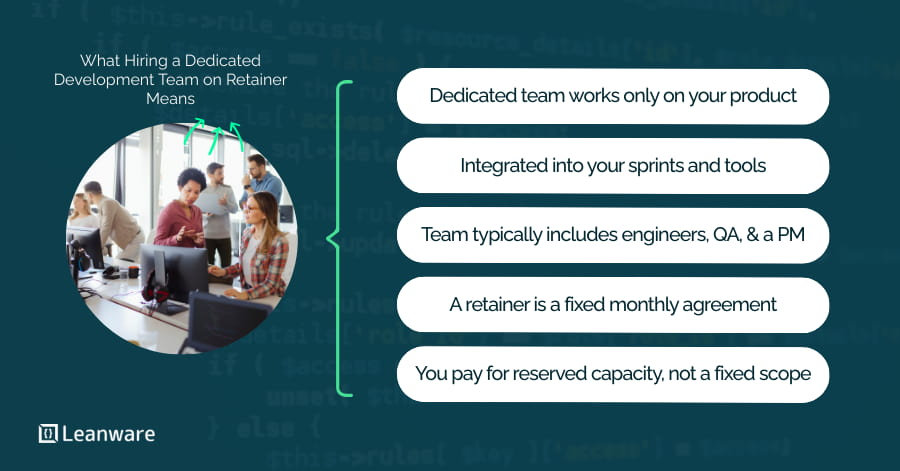
A dedicated development team is a group of engineers, often including QA and a project manager, assigned to work exclusively on your product. They do not split time across multiple unrelated projects. Your codebase becomes their primary focus during the engagement.
They typically integrate into your existing workflows. They join sprint planning, use your project management tools, follow your development standards, and build familiarity with your system over time. The difference from in-house hiring is simple: they are contracted through a vendor, not employed directly by your company.
What Does On Retainer Mean in Tech Contracts?
A retainer is a fixed monthly agreement that reserves a team’s working capacity. You pay a consistent monthly fee, and in return the team commits a defined amount of time to your product.
This differs from hourly billing, where payment depends on logged time, and from project-based contracts, which tie payment to a fixed scope. A retainer focuses on reserving capacity rather than delivering a single predefined outcome.
How Does the Retainer Model Work?
Under a retainer, you pay a fixed monthly fee for a defined team capacity. Work runs in ongoing sprint cycles. You prioritize the backlog, and the team delivers within the agreed allocation. The contract reserves people, not a fixed scope, so priorities can change without renegotiating the agreement.
Team Structure and Roles
Team composition depends on your product stage and the type of work you need. A typical structure for a SaaS product in active development might look like this:
- MVP or early-stage: 2 full-stack engineers + 1 part-time QA + 1 part-time PM
- Growth-stage product: 3-4 engineers (split between frontend/backend/mobile) + 1 dedicated QA + 1 PM + optional DevOps
- Enterprise platform: 5–6 engineers across specializations + QA + PM + DevOps + tech lead or solutions architect
The PM role matters more than it might seem. Without someone coordinating requirements, sprint scope, and communication between your product team and the engineers, the engagement produces slower output and more rework. Many companies understaff the coordination layer and then attribute the friction to the team.
Monthly Pricing Structure
Retainer pricing scales with team size, seniority mix, and the geographic location of the team. Rather than citing a single number, it is more useful to understand the underlying logic:
- Each role carries a monthly rate based on the market where the engineer works
- Senior engineers and tech leads cost more than mid-level engineers
- Larger teams obviously cost more, but the per-person rate sometimes decreases slightly at scale due to vendor margin optimization
- Management overhead (PM, QA, account management) is sometimes bundled into the retainer and sometimes itemized separately
A five-person dedicated team typically runs $25,000 to $70,000 per month, with Eastern European engineers ranging $35-75/hr, Latin American engineers $25-65/hr, and Southeast Asian engineers $20-45/hr.
Compare that to internal hiring: the average senior software engineer in the US earns $202,053 per year as of early 2026, roughly $16,800 per month in base salary alone, before benefits, payroll taxes, equipment, and recruiting costs.
Contract Terms and Minimum Commitments
Most retainers require a minimum of three to six months. Teams need time to understand the codebase and become productive. Short engagements rarely justify the ramp-up effort.
Contracts usually allow:
- Scaling team size at defined intervals
- Structured offboarding
- Limited flexibility for pauses
A three-month pilot followed by renewal is a common and reasonable structure.
Dedicated Team on Retainer vs Other Hiring Models
Each model has situations where it works well. The choice depends on your product stage, team structure, and how defined your requirements are.
Model | Flexibility | Management Overhead | Product Knowledge |
Retainer Team | High | Medium | Very High |
Project-Based | Low | Low | Low |
Staff Augmentation | Medium | High | Medium |
In-House | Low | Very High | Maximum |
Retainer Team
A retainer team provides a stable group of engineers under a fixed monthly agreement. It works well when development is continuous and priorities change over time.
Flexibility is higher than in fixed-scope projects because you can adjust backlog items without rewriting the contract. Management overhead is moderate since the vendor typically includes coordination and QA. Product knowledge increases as the same team remains on the codebase.
Project-Based Outsourcing
Project-based outsourcing works when scope, deliverables, and timelines are clearly defined upfront. The vendor delivers against an agreed specification, and the engagement ends.
This model fits well for one-time builds or tightly scoped initiatives. It becomes less efficient when requirements change frequently, since adjustments require re-estimation and contract updates.
Staff Augmentation
Staff augmentation adds individual engineers to your internal team. They work under your direction and processes.
This works best when you already have strong internal technical leadership. Management overhead remains high because your organization handles planning, quality control, and coordination. Product knowledge depends on how long individual contributors stay engaged.
In-House Hiring
In-house hiring provides direct control and long-term team continuity. Internal engineers build deep familiarity with your systems and business logic.
However, recruiting takes time and fixed employment costs remain even if development slows. Scaling down is also more complex than adjusting an external contract.
When to Use a Retainer Model?
A retainer model works best when development is ongoing rather than time-bound. If your product requires continuous iteration and you need stable engineering capacity across multiple months, this structure tends to fit well.
Startups Building a Product Long-Term
Early-stage startups often cannot hire a full internal team fast enough to match their development needs, nor do they have the budget to staff five senior engineers in a major tech market.
A retainer team provides technical continuity across sprints without the lead time of a full recruiting effort. The team builds product knowledge over time, which compounds into faster execution as the engagement progresses.
Companies Without Strong Internal Engineering Capacity
Some companies, particularly those scaling a digital product for the first time, do not have the internal engineering structure to absorb staff augmentation effectively.
A dedicated team brings its own PM, QA process, and coordination layer, which means you do not need to provide all of that yourself. You provide product direction; the team handles execution.
Businesses Requiring Continuous Feature Releases
SaaS products, fintech platforms, marketplaces, and consumer apps all share a need for ongoing development. There is no project end date.
Features ship continuously, bugs need fixing, performance requires tuning, and the codebase needs maintenance. A project-based outsourcing model structurally cannot support this. A retainer can.
Benefits of Hiring a Dedicated Team on Retainer
The benefits of a retainer model are operational. They relate to cost predictability, continuity, and execution stability over time.
Predictable Monthly Costs
A fixed monthly retainer makes engineering spend a known budget line. You can plan quarters, allocate resources, and avoid the variance that comes with hourly billing. This matters for financial planning as much as for engineering management.
Deep Product Knowledge Over Time
The longer a team works on your codebase, the faster they move. They know why architectural decisions were made, what edge cases exist, which integrations are fragile, and how new features connect to existing ones.
This knowledge does not accumulate on project-based or staff augmentation contracts at the same rate. A retainer team that has worked on your product for six months will outpace a new team six months into a fresh engagement, consistently.
Faster Iteration and Reduced Friction
Without re-scoping, contract renegotiation, or team transitions between sprints, the team moves directly from one priority to the next. Sprint velocity stabilizes and increases over time rather than resetting after each project.
Built-In Scalability
You can scale a retainer engagement up or down by adding or removing team members at defined contract intervals. This is structurally simpler than hiring and terminating internal employees, and faster than sourcing new contractors.
Potential Drawbacks and Risks
A retainer locks in capacity for a defined period. That structure improves stability, but it also limits flexibility if budget or direction changes.
Risk | Impact | Mitigation |
Financial Commitment | Fixed monthly spend even if development slows | Align contract length with funding runway |
Vendor Dependency | Transitioning teams can interrupt delivery | Maintain clear IP ownership and documentation standards |
Strategy Misalignment | Unclear priorities lead to wasted cycles | Keep a defined roadmap and active product ownership |
How to Choose the Right Dedicated Development Partner
Choosing a dedicated team is not just about comparing rates. You need to assess whether the team can work inside your stack, follow a structured delivery process, and operate under clear contractual terms. Since this is a multi-month engagement, mistakes at the selection stage are expensive to fix later.
Technical Expertise and Stack Alignment
Evaluate whether the vendor has engineers with hands-on experience in your technology stack. General engineering capability is not enough if your product runs on a specific framework, cloud provider, or infrastructure pattern.
Ask for concrete examples of similar products they have built, and assess whether those examples reflect genuine technical depth or surface-level work.
Communication and Process Transparency
Time zone overlap matters for sprint planning, standups, and incident response. For LATAM and Eastern European vendors working with US clients, there is usually enough overlap to maintain synchronous communication during core working hours.
Ask specifically how sprint reviews, backlog refinement, and escalations are handled, and what KPIs or velocity metrics they report.
Team Stability and Retention
Ask the vendor what their engineer retention rate is and whether the team assigned to your account changes over time. High turnover means repeated knowledge loss, which undermines the entire value proposition of the model.
A vendor with strong internal retention and clear career development paths is less likely to swap engineers on active accounts.
Legal Clarity and IP Ownership
Before signing anything, confirm that your contract explicitly assigns full IP ownership of all code and work product to your organization. Include an NDA covering your product details, roadmap, and data.
Verify that the engineers are employed or contracted by the vendor in a way that does not create any joint IP claims. These are standard provisions with reputable vendors, but they must be in writing.
What Influences the Monthly Retainer Fee?
A monthly retainer is calculated by multiplying each team member’s market rate by their level of involvement. The total changes based on how many people are assigned, where they are located, and their seniority.
Team Size and Composition
Total cost increases with headcount. However, the mix of roles also affects pricing.
A team made up entirely of senior engineers will cost more than a team that combines senior and mid-level developers. Adding a dedicated PM or DevOps engineer raises the monthly fee, but it may reduce coordination work on your side.
The appropriate structure depends on your product phase and how much internal oversight you can provide.
Geographic Location
Location significantly affects hourly rates.
Onshore U.S. teams generally have the highest rates. Nearshore teams in Latin America or Eastern Europe often offer lower rates with manageable time zone overlap. Offshore teams in Southeast Asia typically have lower rates but operate with less real-time collaboration.
Location | Approximate Developer Rate |
US / Canada (Onshore) | $100-$180/hr |
Eastern Europe (Nearshore) | $35-$75/hr |
Latin America (Nearshore) | $25-$65/hr |
Southeast Asia (Offshore) | $20-$45/hr |
Seniority Levels
Seniority influences both rate and level of autonomy.
Junior engineers cost less but usually require more supervision. Senior engineers cost more and can handle complex tasks with less oversight. Mid-level engineers typically cover most feature development work.
Many teams combine different seniority levels to balance cost and capability.
Is Hiring a Dedicated Development Team on Retainer Worth It?
It depends on your stage and needs. The model fits best when development is ongoing, the roadmap is reasonably clear, and you can commit budget for at least three to six months.
It fits less well for one-time, fixed-scope projects, for companies that only need a single engineer, or for teams still defining what they are building.
If your product requires continuous iteration and you need stable engineering capacity with predictable monthly cost, a retainer can be a practical structure. It still requires clear priorities and active collaboration to work effectively.
Your Next Step
A dedicated development team on retainer is a long-term capacity model. It works best when your product requires continuous development and you can commit to a stable monthly budget.
Review your roadmap, assess your internal management capacity, and determine whether you need ongoing team support or a time-bound project solution. If your needs are continuous and predictable, a retainer structure may be the right fit.
You can connect with us to discuss your product roadmap and evaluate whether a dedicated retainer structure fits your development plans.
Frequently Asked Questions
What is a dedicated development team on retainer?
A dedicated development team on retainer is a group of engineers and tech specialists hired under a fixed monthly agreement to work exclusively on your product. Unlike project-based outsourcing, the team operates continuously and integrates into your workflows across ongoing sprints.
How does a retainer model work in software development?
You pay a fixed monthly fee for a reserved team capacity. The team works in ongoing sprint cycles focused on continuous product development rather than a single predefined project scope. Billing is predictable, and capacity is guaranteed within the agreed hours.
How much does it cost to hire a dedicated development team on retainer?
It depends on team size, seniority, and geographic location. A five-person dedicated team typically runs $25,000 to $70,000 per month, with significant variation based on where the engineers are based and how senior the team is.
What is the difference between a dedicated team and staff augmentation?
Staff augmentation involves hiring individual developers who join your internal team under your direct management. A dedicated team provides a cohesive, self-managed unit that includes project coordination and QA, working together as a functional group rather than as individual contributors.
Is hiring a dedicated team better than project-based outsourcing?
For long-term product development with an evolving roadmap, a dedicated team is generally the better fit. Project-based outsourcing works for clearly scoped, time-bounded initiatives. Most ongoing software products have requirements that change too frequently for a fixed-scope contract to support well.
Who owns the code when hiring a dedicated development team?
In most professional agreements, the client retains full intellectual property rights to all code and work product. This should always be explicitly stated in the contract before the engagement begins.
How long are retainer contracts typically?
Most retainer agreements require a minimum commitment of three to six months, with renewal terms negotiated from there. Three months is a practical minimum to allow the team to ramp and produce meaningful output.
Can you scale a dedicated team up or down?
Yes, typically at defined contract intervals. Most vendors allow team size adjustments monthly or quarterly based on your roadmap needs and the terms of your contract.
Is a dedicated development team suitable for startups?
Yes, particularly for startups building a long-term product. The model provides technical continuity, a cross-functional team, and predictable costs without the recruitment timeline and overhead of building an internal engineering org.
What industries benefit most from hiring a dedicated development team?
SaaS, fintech, healthtech, marketplace platforms, and enterprise software products benefit most because they all require continuous iteration rather than one-time builds.