AI for Permits & Ordinances: Smarter Regulatory Compliance

In many industries, compliance is a simple checklist. But in real estate and urban planning, it is a moving target. Reviewing municipal codes and zoning ordinances is usually a manual process where important details are easily missed.
A project lead might spend weeks vetting a parcel, only to find an obscure local ordinance that limits height or density. This fragmentation is a major bottleneck in development timelines.
AI for permits and ordinances is growing as a decision-support layer to solve this. It is not a legal replacement, but a technical framework that interprets and monitors the rules governing a project.
Let's see in this guide how this shift from manual PDF review to structured logic is changing the industry.
What Is AI for Permits & Ordinances?
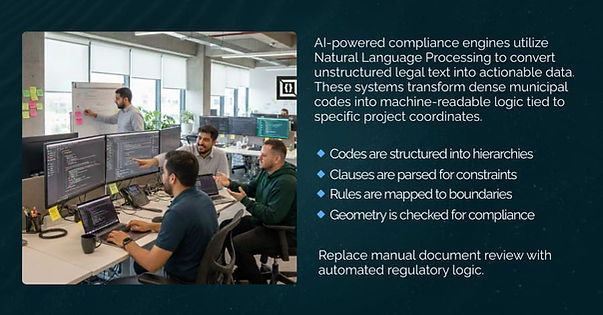
AI for permits and ordinances is a technical framework that uses Natural Language Processing and machine learning to convert dense, unstructured legal text into actionable data. It acts as a translation layer between written regulations and the physical permit application.
By ingesting thousands of pages of municipal codes and zoning maps, the technology identifies specific constraints - such as setbacks, density limits, or fire codes and organizes them into a machine-readable format.
When you query the system about a specific parcel, it goes beyond keyword matching; it interprets the regulatory intent and applies it directly to the project’s specific geometry and location.
Why Permits and Ordinances Are So Complex
The complexity stems from three main factors:
- Fragmentation: There are over 19,000 municipal governments in the U.S. alone, each with its own unique "rulebook."
- Jurisdictional Variance: A project that crosses city or county lines must often adhere to two conflicting sets of building codes.
- Legal Ambiguity: Ordinances are often written in legalese that is open to interpretation. Terms like "sufficient landscaping" or "appropriate setback" are subjective, leading to back-and-forth negotiations that stall projects.
The Difference Between Traditional Compliance and AI-Driven Compliance
Traditional compliance relies on "manual forensic review." An architect or land-use attorney reads the code, looks at the site plan, and makes a judgment call. This is slow, expensive, and prone to human error.
AI-driven compliance uses "semantic extraction." The system reads the code once, maps the rules to a digital twin of the parcel, and provides a real-time validation of the site plan. The result is a shift from reactive corrections - fixing errors after a permit is rejected - to proactive validation, where you know the project is compliant before you even hit "submit."
How AI Works in Permit and Ordinance Management
The effectiveness of these systems relies on a structured pipeline that converts static documents into actionable data. It is not about simply scanning a document; the architecture must normalize information so it can be queried against a project's specific geometry and location.
Ingesting and Structuring Regulatory Data
The process begins with data ingestion. AI systems connect via APIs to municipal portals or scrape publicly available repositories to gather PDFs, GIS (Geographic Information System) maps, and historical permit data.
This raw data is often "noisy" - formatted poorly or containing scanned images. The AI uses Optical Character Recognition (OCR) and document layout analysis to structure this information into a searchable database.
Natural Language Processing for Legal Texts
Legal language is notoriously difficult for machines because of its nested logic and conditional clauses. NLP models specifically trained on regulatory corpora are used to parse these texts.
For example, if an ordinance says, "Structures exceeding 30 feet in height shall require a 15-foot rear setback, unless the parcel is adjacent to a commercial zone," the NLP identifies:
- Subject: Structures > 30ft.
- Constraint: 15ft rear setback.
- Exception: Adjacency to commercial zone.
Mapping Regulations to Locations and Jurisdictions
An ordinance is meaningless without a location. These systems integrate with GIS data to link rules to specific parcels (APNs). This ensures that if a city updates its flood zone map, the AI immediately understands which specific properties are now subject to new elevation requirements. This "parcel-level logic" is what enables developers to perform feasibility studies across entire regions in seconds.
Rule Extraction and Machine-Readable Ordinances
Once the AI understands the "intent" of a sentence, it converts that intent into "if/then" logic. This creates a "machine-readable ordinance." By turning free-text laws into a logic engine, the system can automatically flag when a proposed building footprint violates a local setback rule, treating the law as code rather than just text.
Continuous Updates as Regulations Change
Municipal codes are not static; they are updated via council votes and amendments. Static rulebooks become obsolete within months. AI platforms monitor these changes in real-time.
By version-controlling the regulations, the system can tell a developer, "Your current design was compliant yesterday, but a new amendment passed last night regarding permeable surface area."
Key Use Cases of AI for Permits & Ordinances
Deploying AI within the project lifecycle allows teams to move from reactive troubleshooting to proactive compliance management. This shifts the focus from "finding information" to "validating requirements" at every critical milestone.
1. Zoning and Land Use Validation
Before committing capital, a developer needs to verify site feasibility. AI can instantly cross-reference a proposed use, such as multi-family residential - against zoning maps and municipal codes to confirm permitted uses, density limits, and parking ratios. This reduces the due diligence phase from weeks of manual research to a high-speed preliminary analysis.
2. Building Code Compliance Checks
Automated pre-screening tools compare BIM (Building Information Modeling) files or CAD drawings against local building codes. If a staircase width or fire egress path violates local regulations, the system flags it during the design phase. This "shift-left" strategy identifies technical oversights before they reach the city's review desk, preventing the most common reasons for permit rejection.
3. Permit Pre-Screening and Risk Detection
By analyzing historical permit data within a specific jurisdiction, AI can identify high-risk application types. If a city has a high rejection rate for Accessory Dwelling Units (ADUs) due to obscure drainage requirements, the system flags this risk early. This allows you to adjust the submission or include supplemental documentation proactively.
4. Automated Permit Checklists and Workflows
Rather than relying on generic submission lists, AI generates dynamic, site-specific requirements. If a parcel sits within a historic district or a flood zone, the system automatically adds the necessary board approvals and environmental studies to the workflow. This ensures that no gatekeeper agency is missed, avoiding mid-cycle project stalls.
5. Regulatory Q&A and AI Compliance Assistants
These tools serve as an expert reference for project teams. A designer can query specific technical requirements - such as lighting standards for an industrial parking lot and receive an answer paired with direct citations from the municipal code. This transparency ensures that every design decision is grounded in the current law.
AI for Permits in Real Estate and Construction
For the private sector, the primary value proposition is the reduction of "unproductive time."
Traditional Process | AI-Assisted Process | Impact |
Manual due diligence (14-30 days) | Instant parcel-level analysis | Faster acquisition decisions |
Design iterations based on rejection | Pre-submission compliance check | Reduced architecture fees |
Multiple resubmissions | One-and-done submissions | Faster "time to revenue" |
Fragmented legal advice | Centralized rule engine | Higher consistency across sites |
Pre-Acquisition Feasibility Analysis
In a competitive market, speed is everything. A developer using AI can analyze 50 potential sites in the time it takes a competitor to analyze one.
By identifying the sites with the "path of least resistance" (fewer restrictive ordinances), they can allocate capital more effectively.
Faster Project Approvals and Fewer Rejections
Every day a project sits in "permit limbo" is a day of carrying costs and lost rent. By ensuring that 100% of technical requirements are met before submission, AI helps projects move through the "review" phase without getting kicked back for minor revisions.
Reducing Costly Design Iterations
When a building is designed without a full grasp of local ordinances, the architect often has to "go back to the drawing board" after a city review. AI provides "guardrails" during the design process, ensuring the first version is the compliant version.
AI for Permits in Government and Smart Cities
Public-sector agencies face their own challenges: limited staff, growing backlogs, and pressure to deliver consistent, transparent decisions.
1. Digital Permitting Platforms
AI acts as an intelligence layer on top of legacy "e-government" systems. It helps organize the influx of digital applications, automatically categorizing them and checking for document completeness before a human reviewer even opens the file.
2. Improving Review Speed and Consistency
A common complaint among developers is that "Reviewer A" and "Reviewer B" interpret the same code differently.
AI provides a standardized baseline for review. By automating the objective checks (e.g., "Is the height below 40 feet?"), human reviewers can focus their limited time on the subjective, discretionary parts of the code.
3. Transparency and Auditability in Decisions
Public trust is built on consistency. AI systems maintain a clear audit trail of why a decision was made, with direct links to the relevant code. If a permit is denied, the applicant can see the exact rule that was violated, making the process feel less like a "black box."
Reducing Backlogs in Planning Departments
Many cities are currently facing 6-month backlogs for simple residential permits. By automating 80% of the routine compliance checks, AI allows departments to clear their backlogs and improve their "service level" to the community without hiring more staff.
Benefits of Using AI for Permits & Ordinances
While the primary technical goal is data accuracy, the operational impact is measured by how effectively these systems remove the traditional friction from the development pipeline. By automating the mechanical aspects of code review, project teams can achieve higher throughput with a significantly lower margin for error.
Benefit | Impact |
Faster Permitting Cycles | Tasks that took weeks happen in days or hours |
Reduced Regulatory Risk | Early detection prevents costly surprises during construction |
Cost Savings | Fewer rejections, less rework, reduced professional fees |
Better Pre-Submission Decisions | Validate compliance before investing in detailed design |
Improved Applicant Experience | Clear guidance, immediate feedback, transparent determinations |
Challenges and Limitations of AI in Regulatory Compliance
While the technology provides a significant efficiency gain, it is not a perfect solution.
Inconsistent or Outdated Ordinance Data
An AI is only as good as its training data. If a city hasn't digitized its records or maintains them in non-searchable formats, the AI will struggle. Data quality remains the #1 risk factor in implementation.
Ambiguity in Legal Language
Algorithms are good at interpreting "hard rules" - parameters with clear numerical thresholds, such as a 50-foot height limit.
However, they struggle with "soft rules" that involve subjective qualitative judgment. Phrases like "design must be harmonious with the streetscape" require human interpretation. Discretionary approvals remain a human-led process.
Human Oversight and Legal Accountability
Ultimately, a machine cannot be held legally liable for a building collapse or a zoning violation. AI must be framed as a decision-support tool. A human professional - whether an engineer, architect, or city planner - must still sign off on the final decision.
AI vs. Human Review: Where Each Excels
The goal of modern permitting isn't to replace the human reviewer, but to optimize the division of labor. By offloading objective data processing to AI, the human expert is free to focus on complex, discretionary tasks.
Task Type | Best Handled By | Reason |
Data Extraction | AI | Processes thousands of pages instantly. |
Rules Validation | AI | Consistent, doesn't get tired, identifies conflicts. |
SME Interpretation | Human | Handles legal ambiguity and intent. |
Negotiation | Human | Complex problem solving and community relations. |
Final Approval | Human | Maintains legal and ethical accountability. |
Key Features to Look for in AI Permit Platforms
If you are evaluating these tools, look for:
- Jurisdiction-Aware Rule Engines: Correctly identify and apply rules for specific jurisdictions, including overlay districts and local amendments.
- Location-Based Intelligence: Parcel-level precision through GIS integration and address geocoding.
- Explainable AI with Citations: Every determination should cite specific code sections; black-box answers are not acceptable.
- Integration Capabilities: Connect with GIS, BIM, and existing permit management systems.
- Security Standards: Data encryption, access controls, and audit logging for sensitive development information.
Implementation Strategy
Start with processes that have clear pain points: long review times, high rejection rates, or repetitive manual work. Before selecting a platform, assess whether it covers your jurisdictions with sufficient accuracy. Request validation data and test against known outcomes.
Begin with pilots that test technology against real workflows without betting the organization on immediate success. Learn from pilot results before expanding. Invest in training and demonstrate how AI enhances rather than replaces professional work.
The Future of AI for Permits & Ordinances
We are moving toward a future of dynamic regulation. In this model, zoning evolves from a static, document-based map into a responsive digital layer. This shift allows municipalities to adjust regulatory parameters - such as density bonuses for affordable housing - in real-time, providing developers with immediate updates to their project feasibility models.
This "Predictive Permitting" capability enables cities to simulate the impact of proposed regulatory changes before they are enacted.
By modeling these outcomes, planning departments can transition to a more data-driven approach to urban development, ensuring that new ordinances align with long-
term infrastructure and housing goals.
Final Thoughts
Integrating AI into the permitting process addresses the structural friction that has slowed the construction industry for decades. Converting static document review into structured logic enables planners, architects, and developers to focus on high-value design and community impact rather than administrative verification.
As regulatory environments become more intricate, adopting these logic-based frameworks will transition from a competitive advantage to an operational necessity for maintaining project schedules and budgets.
Connect with our experts today to transform your regulatory workflow from manual document review to high-precision, structured logic.
Frequently Asked Questions
Is AI for permits and ordinances a replacement for land-use attorneys or planners?
No. AI functions as a decision-support system, not a legal authority. It automates data extraction, rule validation, and risk detection, but final interpretation, negotiation, and sign-off must still be handled by qualified professionals who carry legal accountability.
How accurate is AI when dealing with complex or ambiguous zoning language?
AI excels at interpreting objective, rules-based requirements like height limits, setbacks, and density ratios. However, it struggles with subjective or discretionary language such as aesthetic judgments or contextual design requirements. These cases still require human review and judgment.
Can AI keep up with frequent changes in municipal codes and ordinances?
Modern AI permit platforms are designed to monitor regulatory updates continuously. By version-controlling ordinances and tracking amendments, they can alert teams when a rule changes and immediately show how it impacts a specific parcel or project.
What types of projects benefit most from AI-driven permit compliance?
Projects with high regulatory complexity - such as multi-family developments, mixed-use projects, ADUs, and developments spanning multiple jurisdictions—see the biggest gains. AI is especially valuable during early feasibility analysis and pre-submission compliance checks.
What data is required to implement AI for permits and ordinances effectively?
Successful implementation depends on access to digitized municipal codes, zoning maps, GIS parcel data, and historical permit records. Poor data quality or outdated records can limit effectiveness, making jurisdiction coverage and data validation critical when selecting a platform.