Future of Retail Software Platforms: Trends, Architecture & AI

Retail operates differently than it did five years ago. Software that once supported operations now drives them. The platforms running modern retail handle everything from real-time inventory synchronization to AI-powered demand forecasting.
The retail management software market has grown rapidly, projected to rise from $24.97 billion in 2025 to $28.33 billion in 2026 at a 13.5% CAGR. Growth reflects increasing multi‑store complexity, demand for accurate inventory, expansion of organized retail, POS‑integrated software adoption, and focus on operational efficiency.
Let’s explore what future‑ready retail platforms really are, why they matter, and how they change the way retailers engage customers and run their operations.
What Is The Future of Retail Software Platforms?
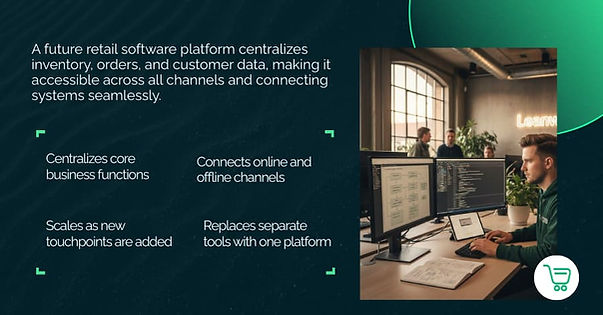
A retail software platform is a unified, extensible ecosystem that centralizes core business logic such as inventory, orders, and customer identity and makes those functions available to any channel via APIs.
Unlike a standalone tool such as a basic POS or a simple web cart, a platform acts as a single source of truth. It is designed for interoperability, meaning it does not just store data but enables it to flow between physical stores, e-commerce sites, mobile apps, and third-party marketplaces.
For the business-savvy operator, this turns technology from a set of isolated digital silos into a cohesive engine that scales as new touchpoints are added.
From Traditional Retail Systems to Intelligent Platforms
Traditional retail used separate systems for POS, ERP, and CRM, each with its own data. This caused discrepancies in inventory, fragmented customer histories, and manual coordination for promotions.
Feature | Legacy Systems (Before) | Intelligent Platforms (After) |
Data Flow | Batch processing (often 24-hour delays) | Real-time streaming and synchronization |
Architecture | Monolithic (hard to change) | Composable/Microservices (modular) |
Intelligence | Reactive reporting | Predictive and prescriptive AI |
Connectivity | Siloed (In-store vs. Online) | Unified (Omnichannel by design) |
Modern platforms centralize data and connect all touchpoints through APIs. Online purchases update inventory everywhere, returns reflect immediately across systems, and the platform maintains a single version of truth.
Why "Platforms" Matter More Than Standalone Tools
Platforms enable ecosystems. Instead of replacing your entire technology stack, you connect best-in-class components through APIs. Your payment processor, fraud detection, tax calculation, and shipping systems all integrate with the core platform.
This architectural approach delivers three advantages. First, you can adopt new technology without ripping out existing systems. Second, you choose specialized tools for each function rather than accepting whatever your ERP vendor offers. Third, you maintain flexibility as requirements change.
Why Retail Is Being Rebuilt Around Software
Software has moved beyond a supporting role to become the backbone of retail operations. In 2026, a retailer's competitiveness depends on the strength of its underlying systems, data architecture, and the ability to leverage them for real-time decision making.
Changing Consumer Expectations in a Digital-First World
Customers expect consistency regardless of channel. They check inventory online, buy in-store, and return via mail. They want personalized recommendations based on their full purchase history, not just what they bought in one channel.
Meeting these expectations requires systems that track customer behavior across touchpoints, maintain accurate real-time inventory, and process transactions seamlessly. Software that can't do this creates friction customers notice.
The Limits of Legacy Retail Technology
Legacy systems struggle with omnichannel retail. They batch-process data instead of updating in real-time. They require manual intervention for automated tasks. They can't scale elastically during peak periods.
Maintenance costs compound. Older systems need specialized knowledge to modify. Integrating them with modern tools requires custom development. Eventually, the cost of maintaining legacy technology exceeds replacement cost.
Data as the New Core of Retail Operations
Retail generates enormous amounts of data: transaction histories, inventory movements, customer interactions, pricing changes, promotional performance. This data powers better decisions when systems can actually use it.
Software platforms make data accessible and actionable. They aggregate information from all channels, apply analytics to identify patterns, and surface insights that drive strategy. Retailers using data effectively optimize inventory levels, adjust pricing dynamically, and personalize customer experiences at scale.
Core Components of Future-Ready Retail Software Platforms
Modern retail platforms integrate commerce, customer data, in-store operations, AI, and supply chain processes.
Component | Key Function |
Omnichannel Commerce | Connects channels, syncs inventory, enables seamless transactions |
AI & Analytics | Forecasts demand, optimizes pricing, supports personalization |
Customer Data Platforms | Unifies customer data, enables targeted experiences |
Intelligent POS | Manages inventory, processes transactions, supports mobile checkout |
Supply Chain Optimization | Predicts demand, automates replenishment, improves forecasts |
Omnichannel Commerce Infrastructure
Omnichannel infrastructure unifies physical and digital commerce. Customers start transactions on one device and complete them on another. Inventory shows accurate availability across channels. The technical requirement is real-time data synchronization through event-driven architectures.
AI-Powered Analytics and Decision Engines
AI analyzes patterns in massive datasets. It forecasts demand more accurately than traditional methods, identifies likely customer churn, and optimizes promotions.
Modern platforms embed AI throughout operations for demand forecasting, dynamic pricing, personalization, and fraud detection.
Customer Data Platforms (CDPs) in Retail
CDPs create unified customer profiles by aggregating data from every interaction: website visits, store purchases, email engagement, customer service contacts. This single view enables personalization across channels. When customers call support, agents see complete history.
Intelligent POS and In-Store Technology
Modern POS acts as a data collection and experience layer. Associates access customer profiles, check inventory across locations, process complex transactions, and fulfill online orders from store inventory. Mobile POS eliminates checkout lines.
Supply Chain and Inventory Optimization Software
Supply chain software predicts demand, optimizes stock levels, and automates reordering. Advanced systems use machine learning to improve forecasts continuously, factoring in seasonality, promotions, weather, and local events.
The Role of Artificial Intelligence in the Future of Retail
AI is transforming retail by enabling smarter decisions, personalized experiences, and more efficient operations.
AI Application | Function |
Demand Forecasting | Improves inventory accuracy and reduces stock issues |
Personalization | Provides relevant recommendations to increase conversions |
Dynamic Pricing | Adjusts prices in real time to optimize margins |
Fraud Detection | Flags suspicious activity while preserving customer experience |
Predictive Demand Forecasting
Traditional forecasting relies on historical averages and manual adjustments. AI-based forecasting incorporates hundreds of variables: past sales, seasonal trends, promotional impact, weather patterns, local events, and economic indicators.
Better forecasts reduce markdowns from overstock and lost sales from stockouts. Inventory turns increase when you stock what customers want when they want it.
Personalization at Scale
Personalizing experiences for millions of customers requires automation. AI analyzes purchase history, browsing behavior, and demographic data to predict what each customer wants next.
Effective personalization increases conversion rates and average order values. Customers see products they're interested in rather than generic recommendations.
Dynamic Pricing and Promotion Optimization
Dynamic pricing adjusts prices based on demand, inventory levels, competitor pricing, and customer willingness to pay. AI-driven systems update prices continuously across thousands of SKUs, identifying when to discount slow-moving inventory and when to hold prices on high-demand items.
AI-Driven Fraud Detection and Loss Prevention
Fraud detection systems identify suspicious patterns: unusual purchase amounts, mismatched addresses, rapid transaction sequences. Machine learning models adapt as fraud tactics evolve, balancing security with customer experience by scoring transactions rather than blocking outright.
Composable and Headless Retail Architectures
Modern retail platforms are built to be flexible and adaptable. Composable and headless architectures let retailers update, swap, or extend components without disrupting the entire system.
What Is Composable Retail?
Composable retail assembles platforms from modular components connected through APIs. Instead of a single vendor providing everything, you select best-of-breed solutions for each capability: commerce, content, search, payments, analytics.
This modularity lets you replace individual components without rebuilding everything. If a better search engine emerges, you swap it in. If your payment processor raises rates, you switch providers. The core platform remains stable while components evolve.
Headless Commerce Explained
Headless commerce separates the customer-facing frontend from the backend systems handling business logic. The backend exposes APIs that any frontend can consume: web, mobile app, kiosk, voice assistant, IoT device.
The headless commerce market grew from $1.74 billion in 2025 and is projected to reach $7.16 billion by 2032, reflecting rapid enterprise adoption.
This separation delivers practical benefits. You can redesign your website without touching backend systems. You can launch mobile apps that share the same product catalog, inventory, and customer data as your website. You can test new customer experiences quickly because frontend changes don't require backend deployment.
Why API-First Retail Platforms Scale Faster
API-first platforms expose all functionality through well-documented APIs, making integration straightforward. Third-party developers can build on your platform, partners can connect their systems, and internal teams can create custom tools.
Speed matters when launching new capabilities. Frontend and backend teams can work simultaneously rather than sequentially, reducing delays and accelerating rollout of new digital experiences.
How Future Retail Platforms Transform Customer Experience
At the end of the day, all this technology serves one goal: making the customer life easier.
- Unified Customer Journeys: A customer can start a search on their phone, continue it on a laptop, and finish the purchase in a store without ever feeling like they are starting over.
- Real-Time Relevance: Customers receive offers that actually matter to them at the moment they are most likely to use them, reducing digital noise.
- Frictionless Checkout: Whether using Just Walk Out technology or one-click mobile payments, the goal is to remove the work from shopping.
Operational Benefits for Retailers
Modern platforms don't just feel better for customers; they perform better for the business.
Cost Reduction Through Automation
Automation handles repetitive tasks: inventory counts, price updates, reordering, report generation, basic customer service. This frees staff for higher-value work requiring judgment. A system automating reordering for 10,000 SKUs eliminates hours of daily manual work.
Faster Decision-Making With Real-Time Insights
Real-time dashboards show current performance: sales by location, inventory levels, promotional effectiveness, customer acquisition costs. This visibility enables faster course correction rather than reacting to yesterday's problems.
Scalability Across Markets and Channels
Platforms designed for multi-region, multi-channel operation handle expansion through configuration rather than custom development. You add markets by configuring tax rules, currencies, and languages. You add channels by connecting frontends to existing backend APIs.
Challenges and Risks of Adopting Future Retail Software Platforms
Implementing a modern retail platform requires careful planning to address technical, security, and organizational challenges.
- Integration With Legacy Systems: Most retailers cannot replace everything at once. New platforms must integrate with existing systems, which can be complex and costly, especially when multiple legacy systems are involved.
- Data Privacy and Security Concerns: Centralized customer data is a high-value target. Platforms must use encryption, access controls, audit logs, and intrusion detection. Security lapses can erode customer trust even more than they incur fines.
- Organizational and Cultural Change: Technology only works if teams use it effectively. Employees need training and workflows must adapt. Clear communication about the purpose and benefits of changes is essential for adoption.
How Retailers Can Start Building a Future-Ready Software Stack
Building a future-ready software stack is a strategic process. Retailers need to start by assessing current systems to identify gaps and inefficiencies, then prioritize initiatives that provide clear business value without overextending resources.
Finally, they must decide for each capability whether to buy a standard solution, build a custom one, or selectively customize existing tools to support long-term flexibility and scalability.
Step | Focus |
Assess Technology Gaps | Identify system limitations and manual workarounds causing friction |
Prioritize Use Cases | Select achievable initiatives with measurable business impact |
Buy, Build, or Customize | Buy standard platforms, build for unique needs, customize selectively |
Future Trends Shaping Retail Software Platforms
Retail software is evolving to support more autonomous operations, smarter stores, and data-driven business decisions. Current trends include:
- Autonomous Operations: Systems handle routine tasks such as inventory reordering, pricing adjustments, and promotion rotation. Human teams set guidelines and focus on strategic decisions and exceptions.
- AI-Driven Stores: Computer vision monitors shelf inventory and signals restocking, while automated checkout systems reduce manual steps. These approaches are being implemented selectively in operational stores.
- Retail as a Platform: Retailers increasingly use customer and transaction data to improve experiences and inform business decisions, including revenue models, technology investments, and supplier interactions.
Getting Started
Software determines how efficiently products, inventory, and customer interactions are managed across channels. Modern platforms let retailers update processes, integrate new tools, and coordinate data in real time.
Starting with a clear assessment of existing systems and gaps helps prioritize which capabilities to implement first, making the transition manageable while maintaining day-to-day operations.
Connect with our experts today to discuss building a future-ready retail software strategy and explore how to optimize operations, data, and customer experiences.
Frequently Asked Questions
What is a future of retail software platform?
A future of retail software platform is an integrated system that combines commerce, customer data, and AI to manage sales, operations, and experiences across both physical stores and digital channels. Unlike standalone tools, it centralizes information in real time, enabling coordinated inventory, pricing, and promotions, and giving retailers a single source of truth across their operations.
How are future retail platforms different from traditional retail software?
Traditional software handles individual functions—like POS, inventory, or CRM—mostly in isolation. Future retail platforms are modular, data-driven, and AI-enabled. They connect channels, automate routine decisions, and deliver personalized customer experiences at scale, all while remaining flexible enough to adapt as business needs evolve.
Why is software becoming the foundation of modern retail?
Software is now central to retail because customer expectations, omnichannel complexity, and the need for real-time decision-making require systems that operate continuously and accurately. Platforms today manage inventory, pricing, promotions, and personalization directly, rather than supporting these functions indirectly, making them critical to everyday operations.
What role does artificial intelligence play in retail software platforms?
AI supports faster and more accurate decision-making across the retail ecosystem. It enables predictive demand forecasting to reduce overstock and stockouts, personalizes offers at scale, optimizes pricing and promotions dynamically, and flags potential fraud or operational risks. AI acts as a tool for augmenting human judgment rather than replacing it.
What is composable retail architecture?
Composable retail architecture is a modular approach in which retailers assemble best-in-class components through APIs. This structure allows faster integration of new technologies, easier experimentation, and the flexibility to update or replace parts of the system without overhauling the entire platform.
What is headless commerce in retail platforms?
Headless commerce separates the frontend customer experience from backend systems. This enables retailers to update interfaces independently, deliver consistent experiences across web, mobile, and in-store channels, and integrate new touchpoints without disrupting core backend operations.
Are future retail software platforms only for large retailers?
No. While larger retailers adopt these platforms at scale, cloud-based and modular architectures make them accessible to mid-sized and growing retailers. Implementation usually starts with high-impact use cases, allowing smaller teams to gain value without overhauling the full technology stack.
How do retail software platforms improve customer experience?
These platforms create unified customer journeys, enabling real-time personalization, consistent pricing, and faster checkout across channels. By connecting online and in-store data, customers encounter fewer friction points and receive more relevant interactions regardless of how or where they shop.
What business benefits do retailers gain from future-ready platforms?
Retailers see improvements in operational efficiency, including lower costs, better inventory accuracy, and faster decision-making. Platforms also support margin optimization and make it easier to expand into new channels or markets without adding unnecessary complexity.
What are the main challenges of adopting modern retail platforms?
Key challenges include integrating with existing legacy systems, managing data privacy and security, aligning teams around new workflows, and fostering organizational adoption. Effective transformation requires phased implementation, clear governance, and attention to people and processes - not just technology.