Best AI Development Companies in 2026 | Top Firms & Agencies

Businesses shopping for an AI partner search under a dozen different labels: AI development company, artificial intelligence development firm, AI agency, AI dev shop, generative AI development company. They all point at the same decision: which team should build your custom AI system, and how do you tell a strong firm from a slide deck?
This guide compares the top AI development companies in 2026 across pricing, verified Clutch ratings, specialization, and engagement models. It covers full-service AI development firms, generative AI specialists, and smaller AI dev shops, plus the selection criteria, engagement models, and red flags to check before you sign.
Key Summary Points:
- This guide compares 35+ AI development companies, with Leanware, Simform, and Tezeract leading the core list for 2026.
- Essential services: ML models, data analytics, chatbots, and predictive modeling.
- Select partners based on expertise, industry knowledge, and pricing.
- Generative AI specialists are compared separately in their own section.
How We Selected These Companies
Every company in this guide was evaluated against a twelve-criteria framework calibrated for the operational realities of businesses and startups hiring outside AI expertise, weighted toward factors that predict a working production system rather than marketing claims.
The framework looks at cost-to-value ratio (pricing relative to delivered outcomes), team size (firms with roughly 10 to 100 engineers tend to combine capability depth with real client attention), timezone compatibility for real-time collaboration, billing flexibility, and willingness to work under outcome-based agreements. Technical capability is assessed through AI-focused delivery practices, full-stack coverage, and verified client satisfaction ratings on third-party platforms. Business maturity signals such as legal structure, errors and omissions insurance, and years of operating history round out the risk picture.
The core list also holds to hard minimums:
- A strong base of verified client reviews on Clutch or an equivalent third-party platform.
- A 4.0+ Clutch rating with no pattern of unresolved negative feedback.
- Five or more years delivering AI or software projects with a documented portfolio.
- An agile, iterative delivery process.
- Teams that include AI engineers, data scientists, and software architects, not generalists relabeled.
Firms in the extended lists further down were included when they cleared most of these bars and bring a specialization the core list lacks (conversational AI, industrial AI, document intelligence, or a specific regional or platform strength). Where a vendor's numbers come from a source other than Clutch (Gartner, Glassdoor), the table says so.
What is an AI Development Company?
An AI development company designs, builds, and deploys AI-based solutions to enable businesses to make smarter decisions, streamline tasks, and improve their efficiency. They are experts in domains such as machine learning, deep learning, and NLP and develop customized AI systems that address industry-specific issues.
Greater than mere software developers, AI companies collaborate with you to integrate AI into your current operations, streamline procedures, and improve customer experiences.
Their teams include data scientists, machine learning engineers, and industry experts who develop AI systems that analyze data, recognize patterns, and support intelligent automation.
AI vs. Traditional Software Development
Traditional software development follows predefined rules and linear processes: design, code, test, and deploy. AI software development produces systems that learn, so the build process is iterative by nature: models are trained, validated, and refined against real data rather than programmed once.
Traditional Development | AI Software Development |
|---|---|
Static programming logic | Dynamic, learning-based algorithms |
Manual rule implementation | Automated pattern recognition |
Limited adaptability | Continuous self-improvement |
Deterministic outcomes | Probabilistic and adaptive outcomes |
AI models require iterative training, validation, and optimization. A recommendation engine, for instance, continuously ingests data to refine personalization. AI systems also demand strong infrastructure for handling large datasets and GPU-intensive computation, which is why most production builds run on cloud platforms like Microsoft Azure or Google Vertex AI.
Role of an AI Development Agency
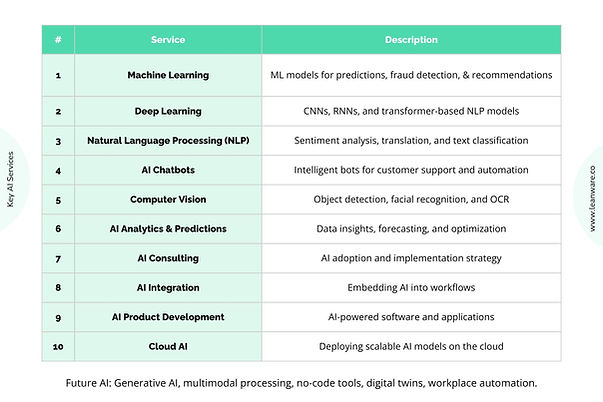
Some of the major roles of an AI development agency include:
- Building AI-powered applications for automation and decision-making
- Developing machine learning models to analyze large datasets
- Creating conversational AI like chatbots and virtual assistants
- Computer vision for image recognition and quality control
- Optimizing workflows with AI-driven automation
These agencies also offer AI strategy consulting. They develop custom models for use cases like fraud detection or demand forecasting and integrate AI with existing systems.
Many agencies are also focusing on ethical AI and security, adding bias detection and real-time risk analysis to their solutions.
AI Development Company, Agency, or Dev Shop: What's the Difference?
In practice the three labels describe the same category of vendor at different sizes. An AI dev shop is a smaller, specialized software team focused on creating and integrating AI-driven systems using machine learning, natural language processing, and predictive analytics. These teams employ data scientists, software developers, and domain experts who manage the full AI lifecycle, from initial strategy and prototyping through model fine-tuning, deployment, and ongoing support.
What separates any of them from a traditional development team is the center of gravity. Traditional teams build applications with standard languages, databases, and front-end frameworks; they may add basic automation, but advanced ML capability is not their core skill. AI-focused teams embed machine learning models directly in application workflows, build adaptive interfaces, design modular AI system components, and generate real-time predictive insights. They also maintain specialized infrastructure, such as GPU capacity and MLOps environments, and track emerging model releases so your system does not ship a year out of date.
If you see "AI development company," "AI agency," or "AI dev shop" on a shortlist, evaluate them all with the same criteria in this guide. Size affects pricing and process maturity, not whether the vendor belongs in the comparison.
Best AI Development Companies in 2026
The following AI development companies are recognized for their expertise, innovation, and efficiency, without sponsorships or paid placements. If you're looking for top AI solutions in 2026, these are the ones to watch.
Here is the core list at a glance:
# | Company | Headquarters | Pricing | Rating |
|---|---|---|---|---|
1 | Leanware | Bogotá, Colombia | $25 - $49/hr | 5.0 (Clutch) |
2 | Simform | Orlando, FL | $25 - $49/hr | 4.9 (Clutch) |
3 | Tezeract | Karachi, Pakistan | $50 - $99/hr | 4.9 (Clutch) |
4 | Plavno | Warszawa, Poland | $25 - $49/hr | 5.0 (Clutch) |
5 | Blue Label | New York, NY | $100 - $149/hr | 4.8 (Clutch) |
6 | InData Labs | Vilnius, Lithuania | $50 - $99/hr | 4.9 (Clutch) |
7 | LeewayHertz | Gurugram, India | $50 - $99/hr | 4.4 (Clutch) |
8 | C3 AI | Redwood City, CA | Enterprise ($500K+ pilots) | 5.0 (Gartner) |
9 | Palantir | Denver, CO | Enterprise pricing | 3.8 (Glassdoor) |
10 | Veritone | Denver, CO | Custom pricing | 4.0 (Gartner) |
11 | Mercury Labs | London, England | $100 - $149/hr | 5.0 (Clutch) |
12 | Accubits | Vienna, VA | $25 - $49/hr | 4.4 (Clutch) |
13 | Moogle Labs | Mississauga, Canada | $50 - $199/hr | 5.0 (Clutch) |
Generative AI specialists are compared separately in their own section below, and a further set of startup- and SMB-focused firms follows the five detailed profiles.
1. Leanware
Feature | Details |
|---|---|
Founded | 2020 |
Headquarters | Bogotá, Colombia |
Team Size | 10 - 49 employees |
Pricing | $25 - $49/hr |
Min. Project Size | $25,000+ |
Average Rating | 5.0 / 5 (Clutch) |
Leanware is an AI-driven development company with specialties in scalable, high-performance digital products. Their expertise spans AI development, software integration, and IT staff augmentation, delivering AI-powered solutions customized to your needs.
With operations in Colombia and a US-registered presence, they offer cost-efficient AI solutions while maintaining regulatory compliance. Their expertise covers AI-powered analytics, NLP applications, and enterprise AI integration.
Services: AI Development & Integration, AI Consulting, Custom Software Development, IT Staff Augmentation, Mobile App Development, UI/UX Design, Web Development.
Industries: FinTech, HealthTech, IT, E-commerce, SaaS.
What Customers Value: High-quality AI solutions, clear communication, strong project management, transparency, and cost-effective, adaptable development.
2. Simform
Feature | Details |
|---|---|
Founded | 2010 |
Headquarters | Orlando, FL |
Team Size | 1,000 - 9,999 employees |
Pricing | $25 - $49/hr |
Min. Project Size | $25,000+ |
Average Rating | 4.9 / 5 (Clutch) |
Simform is a digital engineering company with expertise in AI/ML, cloud solutions, and data engineering. They provide end-to-end AI development and enterprise solutions, focusing on scalable, high-performance software for tech-driven businesses.
Their AI services range from AI-powered product engineering, cloud AI solutions, and enterprise AI integration to industries that include fintech, healthcare, retail, and supply chain.
Services: AI Development, Custom Software Development, Cloud Consulting, Application Testing, Enterprise App Modernization, Mobile App Development.
Industries: FinTech, HealthTech, Retail, Supply Chain & Logistics, E-commerce, Professional Services.
What Customers Value: High-quality AI solutions, effective communication, strong project management, flexibility, and reliable execution within budget and timelines.
3. Tezeract
Feature | Details |
|---|---|
Founded | 2021 |
Headquarters | Karachi, Pakistan |
Team Size | 10 - 49 employees |
Pricing | $50 - $99/hr |
Min. Project Size | $1,000+ |
Average Rating | 4.9 / 5 (Clutch) |
Tezeract is an AI-driven development and automation company that provides services in Computer Vision, NLP, Machine Learning, and predictive analytics. With their focus on AI-driven business efficiency, they provide customized solutions for industries including sports, fintech, healthcare, and e-commerce.
Their portfolio includes 180+ completed AI projects and recognition, including Clutch's Top ML Company in Pakistan and Top AI Company, along with recognition from GoodFirms as a top AI service provider.
Services: AI Development, Custom Software Development, Mobile App Development, Web Development, Product Design.
Industries: FinTech, HealthTech, Retail, E-commerce, Education, Sports, Automotive, Beauty & Wellness, Entertainment.
What Customers Value: AI expertise, timely delivery, strong communication, professional approach, and deep industry knowledge.
4. Plavno
Feature | Details |
|---|---|
Founded | 2007 |
Headquarters | Warszawa, Poland |
Team Size | 50 - 249 employees |
Pricing | $25 - $49/hr |
Min. Project Size | $25,000+ |
Average Rating | 5.0 / 5 (Clutch) |
Plavno is a software development company with expertise in AI-driven solutions across industries like fintech, e-commerce, healthcare, and logistics. Their dedicated teams focus on providing high-quality AI and software products customized to specific business domains.
Their portfolio includes AI/AI agent development, e-government solutions, and enterprise-grade digital platforms. They are recognized for strong project management, clear communication, and deep industry expertise.
Services: Custom Software Development, E-Commerce Development, AI Development, Mobile App Development, Web Development, AR/VR Development.
Industries: FinTech, HealthTech, E-Commerce, Logistics, Travel & Hospitality, Media & Entertainment, E-Government, E-Learning.
What Customers Value: Strong project management, industry expertise, clear communication, high-quality solutions, and a professional approach.
5. Blue Label
Feature | Details |
|---|---|
Founded | 2009 |
Headquarters | New York, NY |
Team Size | 50 - 249 employees |
Pricing | $100 - $149/hr |
Min. Project Size | $75,000+ |
Average Rating | 4.8 / 5 (Clutch) |
BlueLabel builds custom generative AI solutions, working with mid-market and enterprise companies to integrate AI into business operations. Their team focuses on multi-agent AI systems, automation, and AI-powered tools that go beyond standard off-the-shelf solutions.
With over 13 years of experience, they have worked with companies like Brinks, The 1916 Company, Mayo Clinic, and Koch, developing AI-driven workflows.
Services: Generative AI, AI Consulting, AI Development, Mobile App Development, Product Design.
Industries: Healthcare, FinTech, Security, Logistics, Enterprise Solutions.
What Customers Value: High-quality AI solutions, strong project management, clear communication, expertise in complex AI workflows, and well-structured development processes.
More AI Development Firms Worth Evaluating
The five companies above are the strongest all-around picks, but the market is deep. The firms below each earn a place on a shortlist for a specific reason: enterprise platform scale, a regional cost advantage, or a narrow specialization done well.
InData Labs (Vilnius, Lithuania; founded 2014; $50 - $99/hr). A data science and AI consultancy focused on custom machine learning models, predictive analytics, NLP, computer vision, and big data engineering, with 150+ projects across AdTech, eCommerce, supply chain, and FinTech and a certified AWS partnership. Best for companies with complex data analysis requirements that need sophisticated algorithms more than full product builds.
LeewayHertz (Gurugram, India, with a San Francisco presence; founded 2007; $50 - $99/hr). Delivers custom AI, generative AI application development, and LLM fine-tuning alongside blockchain and AR/VR work, with a 250+ person team and Fortune 500 client history. Best for SMBs that want enterprise-grade AI capability at offshore rates and can manage the broader, multi-technology service portfolio.
C3 AI (Redwood City, CA; founded 2009; enterprise pricing, production pilots around $500,000). An enterprise AI platform company rather than a services shop: model-driven architecture for predictive maintenance, supply chain, and energy optimization at scale. Best for large organizations standardizing AI across manufacturing, energy, healthcare, finance, or government workloads.
Palantir (Denver, CO; founded 2004; enterprise pricing). Builds data-integration and AI platforms (AIP, Gotham, Foundry, Apollo) used in defense, finance, healthcare, and manufacturing for large-scale analysis and high-stakes operational decisions. Best for enterprises and public-sector buyers with massive datasets and platform budgets, not custom app projects.
Veritone (Denver, CO; founded 2014; custom pricing). Its aiWARE platform applies machine learning to unstructured audio, video, and document data, serving media, government, education, and finance with content management, compliance monitoring, and predictive analytics. Best for organizations whose core problem is processing large volumes of unstructured media.
Mercury Labs (London, England; founded 2018; $100 - $149/hr). A small AI engineering consultancy that takes concepts through proof-of-concept, MVP, and production, serving finance, healthcare, IT, and retail. Best for teams that want senior AI attention on an early-stage build and can pay UK rates.
Accubits (Vienna, VA, with delivery centers in India, Australia, and Hong Kong; founded 2012; $25 - $49/hr). Develops AI and blockchain solutions for enterprises and government agencies, with most projects under $50,000 and larger engagements past $1M. Best for cost-sensitive buyers who want a US-headquartered vendor with offshore delivery scale.
Moogle Labs (Mississauga, Canada; founded 2020; $50 - $199/hr, most projects $10,000 - $49,999). Covers AI and ML development, generative AI, blockchain, and DevOps managed services across IT, real estate, education, manufacturing, and retail. Best for mid-sized projects that need a North American timezone without US pricing.
Goji Labs (Los Angeles, CA; founded 2014; $100 - $149/hr, $25,000 minimum). A design-first product firm whose AI work centers on strategy, UX research, and custom ML applications in healthcare, education, and FinTech; its startup clients have collectively raised over $1 billion. Best for well-funded startups that value product strategy and design quality as much as engineering.
DataRoot Labs (Kyiv, Ukraine; founded 2016; $50 - $99/hr, $10,000 minimum). A boutique AI R&D center known for rapid prototyping, an 8 to 12 week MVP timeline, and startup venture support including fundraising help. Best for early-stage startups that need a fast AI proof of concept; it also appears in the generative AI comparison below.
Master of Code Global (Seattle, WA, with European operations; founded 2004; $50 - $99/hr). Specializes exclusively in conversational AI, with 400+ chatbot and voice projects for brands including T-Mobile and Burberry, plus LLM fine-tuning and NLP implementation. Best for conversation-centric products; less suited to teams whose roadmap will outgrow chat interfaces.
Osedea (Montreal, Canada; founded 2011; $100 - $149/hr, $50,000 minimum). Focuses on industrial AI: manufacturing automation, computer vision quality control, and predictive maintenance, starting engagements with an AI audit and proof-of-concept validation, delivered under SOC 2 practices. Best for manufacturing and construction companies; not a fit for consumer or SaaS startups.
Zfort Group (Kharkiv, Ukraine; founded 2000; $50 - $99/hr). Two decades of full-cycle development experience with AI feature integration across healthcare, fintech, travel, and e-commerce, including dedicated team engagements. Best for cost-conscious buyers who need reliable execution on standard builds with AI features rather than research-heavy ML work.
Haptik (Mumbai, India; founded 2013; platform pricing). A conversational AI platform backed by Jio Platforms with OpenAI and Microsoft partnerships, offering no-code tools and pre-built integrations for multi-channel chatbots. Best for companies that want standard conversational functionality fast and can live within a platform's customization limits.
SenseTime (Hong Kong; founded 2014; enterprise contracts only). One of Asia's largest AI companies, licensing world-class computer vision platforms for facial recognition, smart city, and autonomous driving applications. Best for large enterprises adopting proven vision platforms with minimal customization; the platform model and timezone gap make it impractical for most startups and SMBs.
Qubika (Austin, TX; founded 2007; $50 - $99/hr). A data engineering and AI firm with SOC 2 and ISO 27001 certifications, AWS Advanced Tier status, and partnerships with Databricks and Snowflake. Best for data-intensive AI projects in regulated industries that need security compliance baked in.
Dualboot Partners (Charlotte, NC; founded 2018; $50 - $99/hr, $75,000 minimum). Founder-led product development with AI and ML integration, framed around business outcomes rather than technology novelty. Best for growing startups with validated business models undertaking a substantial build.
Sparq (Atlanta, GA; 250 - 999 employees). Data-driven digital product development with an AI-first design approach and a Scrum-as-a-Service model that gives predictable monthly pricing with elastic team scaling. Best for companies that need data strategy alongside AI development and want budget predictability.
STX Next (Poland and Mexico, with US and UK offices; founded 2005; $50 - $99/hr). Nearly two decades of Python expertise applied to AI, data engineering, and generative AI implementation; its merger with Brainhub created a 600+ person engineering organization. Best for Python-heavy AI projects that need mature process and large-team capacity.
Brainhub (Poland, with a Miami office; founded 2015; $50 - $99/hr). Highly selective engineering (about 1.4% of applicants hired) in JavaScript and .NET with newer AI integration capability, now merged with STX Next. Best for teams that need premium web engineering talent with AI features, on European hours.
Kingsmen Digital Ventures (Irvine, CA; founded 2017; $150 - $199/hr). A boutique, fully US-based shop building custom software and AI for regulated industries such as medical aesthetics and pharmaceuticals. Best for buyers in heavily regulated sectors who will pay onshore premiums for direct senior access.
Cinnamon AI (Tokyo, Japan, with global R&D centers; founded 2012; custom enterprise pricing). Sells mature document intelligence products (Flax Scanner, Super RAG, AI-OCR) used by Toyota, Mitsubishi, and major Japanese financial institutions. Best for enterprises with high-volume document processing needs who prefer implementing a proven product over a custom build.
Top Generative AI Development Companies
Generative AI refers to artificial intelligence systems that create new content (text, images, audio, video, or code) by learning patterns from existing data. These systems rely on deep learning, neural networks, and large language models to generate output that closely resembles human-created work.
A generative AI development company builds and deploys these systems: AI-driven marketing tools, chatbots, design applications, content pipelines, and predictive products, turning current research into practical, scalable software.
Demand for these specialists comes from two directions. Businesses want to automate work while maintaining quality, and models like GPT, Claude, and their image and audio counterparts make that possible. At the same time, most firms lack the in-house expertise to fine-tune, evaluate, and deploy generative models safely, so partnering with a specialist buys access to engineers, frameworks, and delivery practices that would take years to build internally.
Several companies already profiled above (Leanware, Blue Label, LeewayHertz, DataRoot Labs) do substantial generative AI work. The firms below are additional specialists worth comparing for generative-AI-first projects:
Company | Headquarters | Founded | Pricing | Rating (Clutch) |
|---|---|---|---|---|
Alltegrio | Lewes, DE (Poland & Ukraine) | 2012 | $50 - $99/hr | 5.0 |
TechAhead | Agoura Hills, CA (India) | 2009 | $25 - $49/hr | 4.9 |
NineTwoThree | Danvers, MA | 2013 | $100 - $149/hr | 4.9 |
Linnify | Cluj-Napoca, Romania | 2016 | $50 - $99/hr | 5.0 |
Apriorit | Poznań, Poland | 2002 | $100 - $149/hr | 4.9 |
Cloudforce | Oxon Hill, MD | 2010 | Undisclosed | 5.0 |
TechMagic | Kraków, Poland | 2014 | $50 - $99/hr | 4.8 |
Stepwise | Warszawa, Poland | 2016 | $50 - $99/hr | 4.9 |
Alltegrio runs a 250+ expert team across Poland, Ukraine, and the USA, covering AI strategy consulting through full-scale generative AI and ML builds, with depth in supply chain, real estate, and e-commerce.
TechAhead brings 15+ years and 240+ engineers to AI-driven mobile, web, and cloud products, with brand experience that includes Audi, Disney, and American Express.
NineTwoThree has delivered 160+ projects, including large-scale conversational AI and predictive analytics for clients like Consumer Reports, Experian, and SimpliSafe; minimum project sizes start at $100,000.
Linnify builds end-to-end digital products with generative AI capability, with 60+ projects across health, education, sustainability, and business services.
Apriorit pairs 20+ years of cybersecurity-grade software engineering with generative AI, chatbot development, and ML fine-tuning, backed by a 400+ expert team.
Cloudforce specializes in Microsoft cloud environments, delivering generative AI alongside cloud consulting, migration, and security for business and government clients.
TechMagic focuses on HealthTech and FinTech, with 300+ engineers covering generative AI, data engineering, test automation, and security testing on stacks like Node.js, React, and AWS.
Stepwise works with OpenAI, Google, and open-source models, building AI solutions in Kotlin, Python, and Terraform on Google Cloud; engagements typically start at $100,000.
Services Offered by Generative AI Companies
Generative AI companies develop and implement AI solutions, with services from custom model development to AI integration.
Service | What It Covers |
|---|---|
Custom Model Development | Designing AI models for specific business needs |
AI Consulting | Helping you assess and plan AI adoption |
LLM Fine-Tuning | Optimizing large language models for better accuracy |
AI Integration | Embedding AI into your existing software |
Custom model development ensures AI systems are built to solve your real challenges, including structuring neural networks, preparing datasets, and tuning performance. AI consulting helps you figure out where AI fits into your workflow, assess feasibility, and create a structured roadmap. LLM fine-tuning trains models on your domain so outputs match industry-specific needs, and AI integration connects those models with your business software, automating tasks and improving data-driven decisions.
AI Development Services Offered by Top Providers
The following are the top AI development services offered by leading dev companies:
1. Machine Learning Solutions
Machine learning models process large datasets, identify patterns, and automate decisions. Companies develop supervised learning for classification, unsupervised learning for pattern discovery, and reinforcement learning for optimization.
AutoML platforms further speed up development. Such solutions power fraud detection, recommendation systems, and predictive maintenance.
2. Deep Learning and Neural Networks
Deep learning models enable advanced AI applications by processing complex, unstructured data. Providers develop:
- Convolutional neural networks (CNNs) for image recognition
- Recurrent neural networks (RNNs) for sequential data tasks
- Transformer-based models for natural language understanding
- Custom neural architectures optimized for specific business needs
3. Natural Language Processing (NLP)
NLP solutions allow machines to process and analyze human language for various applications:
- Sentiment analysis and text classification
- Machine translation and document summarization
- Named entity recognition and information extraction
- AI-driven customer support with intent recognition
4. AI-Powered Chatbots & Virtual Assistants
Conversational AI simplifies interactions and saves money. Contextual chatbots, voice-enabled assistants, and sentiment-aware AI improve engagement across industries. By handling routine queries and automating the response, businesses get more efficient without compromising on customer experience.
5. Computer Vision & Image Recognition
Computer vision enables machines to interpret images and video. Object detection, facial recognition, optical character recognition, and automated quality control support industries like security, healthcare, and retail. AI-powered vision systems improve accuracy and speed in real-time analysis.
6. AI-Driven Data Analytics & Predictive Modeling
AI-driven analytics converts raw data into insights. Predictive modeling helps businesses forecast trends, anomaly detection prevents fraud and recommendation engines improve personalization.
Optimization algorithms refine resource planning so companies can make data-driven decisions faster and better.
What a Modern AI Dev Shop's Stack Looks Like
The service list above describes what gets built; the stack below is how current teams build it, and it is a useful currency check when you evaluate a vendor's technical depth. Ask a shortlisted firm how they use these pieces and listen for specifics:
- LLM APIs and integration: building on models from OpenAI, Anthropic, and open-source providers for classification, summarization, and conversational interfaces, rather than training everything from scratch.
- Fine-tuning with proprietary data: applying domain-specific datasets to off-the-shelf models so outputs reflect your business, not a generic baseline.
- RAG (retrieval-augmented generation): combining retrieval systems with generative models so answers draw on your current documents and data, essential for chatbots, document summarizers, and knowledge systems.
- Vector databases: tools like Pinecone or Weaviate that store information as dense vectors to power semantic search, recommendations, and RAG pipelines.
- Orchestration frameworks: LangChain and similar libraries for composing pipelines, data ingestion, and model coordination in maintainable, swappable modules.
- Third-party AI services: image recognition, sentiment analysis, or recommendation APIs integrated where building in-house adds no advantage.
A vendor whose services page still stops at "machine learning and NLP" without any of the above is describing a 2022 practice.
How to Choose the Right AI Development Agency
When choosing an AI development agency, focus on their expertise, industry experience, scalability, security posture, and pricing to make sure they're the right fit.
- Look for technical expertise in AI, machine learning, and deep learning. Evaluate their experience through case studies, research contributions, certifications, and open-source involvement.
- The agency should have industry knowledge relevant to your sector. Review previous projects to assess their understanding of industry challenges, regulations, and data structures.
- Assess scalability by reviewing their approach to model maintenance, cloud deployment, and AI advancements.
- Consider costs by requesting a clear breakdown, including maintenance and long-term investment.
- Verify data security and compliance. The firm should follow strong data protection practices and the regulations that apply in your region, and a certification like ISO 27001 is a reliable signal that they meet recognized security standards.
An 8-Step Process for Partnering with the Right Firm
The five criteria above tell you what to look for. This is the sequence for actually running the evaluation:
- Research and shortlist. Build a candidate list from search, industry communities, and referrals. Prioritize firms with verifiable reputations and hands-on delivery in machine learning, NLP, or computer vision.
- Evaluate technical expertise. Review past projects in industries similar to yours, and confirm the team works with current frameworks and can justify their tool recommendations for your specific goal.
- Assess industry experience. A firm with a track record in your field already understands your data shapes, regulations, and failure modes, which shortens delivery and reduces rework.
- Test communication and customization. Look for a partner who explains decisions in plain terms throughout the project and adapts their solution to your business rather than reselling a template.
- Check scalability and integration. The models they build should keep performing as usage grows, and they should integrate with your existing systems instead of forcing a parallel stack.
- Verify data security and compliance. Examine how they handle data preparation, cleaning, and integration, and confirm they meet the standards that apply to you, such as GDPR or HIPAA.
- Collect reviews and references. Read third-party reviews and ask for references from past clients to gauge professionalism and delivered results, not just proposals.
- Compare proposals and costs. Judge each proposal on approach, timeline, and concrete deliverables, and make sure the price fits your budget without stripping out the quality controls.
Key Questions to Ask Before Hiring
Bring these into the first serious conversation with any shortlisted firm.
Technical capability:
- What specific AI frameworks and model architectures does your team actively work with?
- How do you approach model training, validation, and deployment in production environments?
- What experience do you have with our industry's data privacy and compliance requirements?
- Can you demonstrate previous implementations of similar AI functionality?
Operational alignment:
- What are your standard communication protocols and meeting schedules?
- How do you handle scope changes and iterative development requirements?
- What project management methodology do you use for AI projects?
- Do you offer engagement models beyond traditional time-and-materials contracts?
Partnership commitment:
- Are you willing to work under outcome-based agreements or shared-risk models?
- What ongoing support and maintenance do you provide after launch?
- How do you handle intellectual property ownership and data security?
- What references can you provide from companies at our growth stage?
Risk management:
- What legal protections and insurance coverage do you maintain?
- What happens if key team members leave during the project?
Understanding Different Engagement Models
Time and materials provides maximum flexibility for exploratory AI projects where requirements may shift as you learn. It suits research-heavy initiatives and proof-of-concept work, but it requires strong project management on your side to control cost.
Fixed price offers budget predictability for well-defined AI implementations with clear success criteria. It works for specific feature additions or established use cases, but it can limit adaptation when development surfaces something the spec did not anticipate.
Outcome-based agreements tie the partner's compensation to business results, which shares risk and signals genuine confidence in their own delivery. They fit performance-critical AI applications where measurable improvement is the objective, though they require clear metric definitions and a longer evaluation period. For a startup with limited capital, a partner willing to accept outcome-based terms is also accepting downside protection on your behalf.
Red Flags to Avoid
The strongest negative signals when comparing AI vendors:
Red Flag | What to Watch For |
|---|---|
Overpromising claims | Be wary of unrealistic guarantees |
Unclear metrics | Ensure performance is measurable |
Black-box development | Demand transparency and collaboration |
Weak data governance | Check for strong security practices |
Poor testing | Look for thorough, real-world validation |
No ethical safeguards | Ensure they address bias and risks |
Any single row is a reason to ask harder questions. Two or more together are a reason to walk.
Top Industries Using AI Development
AI is increasingly applied in many industries to improve efficiency, automate tasks, and improve decision-making. Some of them are:
Industry | Key AI Applications |
|---|---|
Healthcare | Medical imaging, predictive diagnostics, remote monitoring |
Finance | Fraud detection, algorithmic trading, credit scoring |
Retail | Personalized recommendations, demand forecasting, inventory optimization |
Logistics | Route planning, warehouse automation, predictive maintenance |
Manufacturing | Quality control, AI-powered robotics, digital twins |
How Much Do AI Development Companies Cost?
Most AI development expense is staffing, and rates depend on location, expertise, and demand. In the United States, senior developers typically charge $75 to $150 per hour, while nearshore locations such as Colombia run $40 to $55 for comparable seniority.
Here is a sample role-level comparison:
Role (Avg. Exp) | Hourly (USD) - Colombia | Hourly (USD) - US |
|---|---|---|
Senior Dev (5+ yrs) | $45 - $65 | $90 - $200 |
Mid-level Dev (2-5 yrs) | $25 - $35 | $65 - $100 |
Project Manager (Var.) | $25 - $35 | $40 - $100 |
QA Specialist (Var.) | $25 - $65 | $40 - $100 |
Nearshore options can cut cost substantially, but language fluency, timezone overlap, and AI-specific expertise matter as much as the rate for a collaboration that actually works.
Beyond rates, several factors drive the total price of an AI project:
- System complexity. A vision system processing thousands of images per day needs specialized infrastructure and pipelines; a simpler chatbot costs far less.
- Data volume and quality. Large datasets add time and budget for gathering, cleaning, and labeling.
- Custom vs. pre-trained models. Domain-specific models built or heavily tuned for you take more resources than solutions assembled on pre-trained models.
- Integration scope. Connecting to multiple systems or specialized hardware raises complexity and expense.
- Ongoing operations. Retraining, feature updates, and performance monitoring add long-term cost after launch.
Building In-House vs. Hiring an AI Development Company
Forming an in-house AI team is a major investment. You need data scientists, machine learning engineers, and DevOps specialists on staff, and you also have to establish the processes, standards, and culture that make them productive, which takes time and cross-functional alignment. Recruiting and onboarding those specialists delays time-to-market; an established AI firm already has the roles filled, the workflows proven, and the vendor relationships in place, which usually means faster delivery.
The in-house route still makes sense for companies planning continuous AI experimentation or frequent model updates, where owning the capability compounds. The decision comes down to budget, strategic goals, and how central AI capability is to what your company sells.
Future Trends in AI Development
Here are the areas most likely to shape what AI development firms build over the next few years:
Generative AI Everywhere
Generative systems now produce text, images, audio, and video at production quality, and they are moving from standalone tools into features embedded across ordinary software. The open problems are accuracy, bias, and misuse risks such as deepfakes, which is why vendor governance practices matter more each year.
AI-Powered Automation and Robotics
AI-driven automation and robotics are changing manufacturing and service industries. In industrial settings that means production optimization, predicted maintenance, and better quality control; in customer service, healthcare, and education it means service robots and automated agents handling more interactive, personalized work.
Advances in Natural Language Processing
Large language models keep pushing the boundary on understanding and generating human-like language, with efficiency and scaling as the active engineering problems. Expect steadily more capable conversational systems that hold context, act on requests, and provide genuinely personalized help.
AI in Decision-Making and Predictive Analytics
Predictive models are getting better at reading complex data to forecast trends and outcomes, and decision-support systems increasingly deliver those insights in real time. For buyers, that turns AI from a reporting tool into an operational one that guides strategic choices and cuts risk.
Wrapping Up
Whoever adapts early will have the edge. Generative AI is reshaping content creation and software development, multimodal AI is making interactions more personalized, and AI democratization is enabling non-technical users to build intelligent solutions.
Digital twins are optimizing operations, and workplace AI is automating repetitive tasks.
These advancements aren't just trends. They're fundamental shifts in how work gets done. The next move is yours.
Frequently Asked Questions
Which companies are the best for AI development?
The right AI development company depends on your needs. If you're looking for industry-leading expertise, Leanware, Simform, and Tezeract are among the top choices on the core list, with enterprise platforms like C3 AI and Palantir suiting large-scale deployments and the generative AI specialists above suiting GenAI-first products.
How much does AI development cost?
Project totals range from roughly $5,000 for small builds to more than $500,000 for complex enterprise systems, and an MVP built on generative AI typically starts between $50,000 and $100,000. Hourly rates run from about $25 to $199 depending on geography, seniority, and specialization, and most reputable firms set minimum project sizes between $10,000 and $75,000. The main cost drivers are project complexity, data preparation requirements, integration scope, and ongoing maintenance, so a simple AI feature integration might start around $25,000 while a comprehensive AI-powered application lands between $100,000 and $500,000.
How do I choose the best AI firm for my business?
Look at their experience and knowledge in your area of business, verify their technical expertise in the AI technologies your project needs, and confirm they can tailor solutions to your requirements rather than reselling a template. Also check their privacy and security practices, pricing structure, and post-launch support to make sure they align with your business objectives.
How important is company size when selecting a development partner?
Company size directly affects resource allocation, client attention, and agility. Teams of roughly 10 to 100 employees usually offer the best balance: enough expertise and capacity for complex projects while keeping you close to senior technical talent. Smaller firms may lack specialized capabilities, while very large organizations often prioritize enterprise clients and add bureaucratic overhead.
What's the advantage of working with a company that offers outcome-based agreements?
Outcome-based agreements tie the vendor's compensation to your business results, which turns a vendor relationship into a shared-risk partnership. Partners who accept these terms typically provide more strategic guidance and proactive problem-solving, because their success depends on measurable outcomes rather than billed hours, and the model reduces your upfront financial exposure if the project underperforms.
How does AI-enhanced development benefit my project?
Firms that use AI in their own delivery process (automated code generation, intelligent testing, optimized deployment) can reduce development time by roughly 20 to 40 percent while improving code consistency and quality. For buyers, that shows up as faster iteration cycles, fewer defects, and more cost-effective, maintainable software, which matters most when budgets and timelines are tight.
Why is timezone alignment important for software development projects?
Real-time overlap enables agile collaboration, immediate problem resolution, and tight feedback loops; large timezone gaps force asynchronous communication that stretches every cycle and adds management overhead. AI projects feel this more than most because model training, validation, and refinement are iterative and need frequent stakeholder input and quick decisions.
What does a generative AI development company do?
A generative AI development company builds systems that create new content (text, images, audio, video, or code) using deep learning, neural networks, and large language models. Typical services include custom model development, AI consulting and adoption roadmaps, LLM fine-tuning on domain data, and integrating generative capabilities into your existing software.
How much do AI developers get paid?
Salaries range depending on experience, location, and area of specialization. In North America, AI engineers generally earn $120,000 to $220,000 annually, with those specializing in generative AI and reinforcement learning commanding higher salaries.
In Colombia (Latin America), AI engineers make approximately $25,200 annually, with hourly wages ranging from $12.10 to $49, depending on their level of expertise and position. Pay also varies depending on the company that hires and the complexity of AI projects.
What does an AI developer do?
AI engineers build smart systems through designing and training machine learning models, data preparation and processing, performance optimization, and AI solution deployment.
Their tasks range across several applications, such as predictive analytics, natural language processing, and computer vision. They also keep models up-to-date and scalable while adapting to new AI methods.