Boutique AI Development Firm: A Complete Guide for Founders and Technical Leaders
Most AI projects fail not because the tech doesn't work, but because teams build the wrong thing or run out of runway before shipping. The development partner you choose directly affects both outcomes. Boutique AI firms operate differently from large consultancies and generalist dev shops.
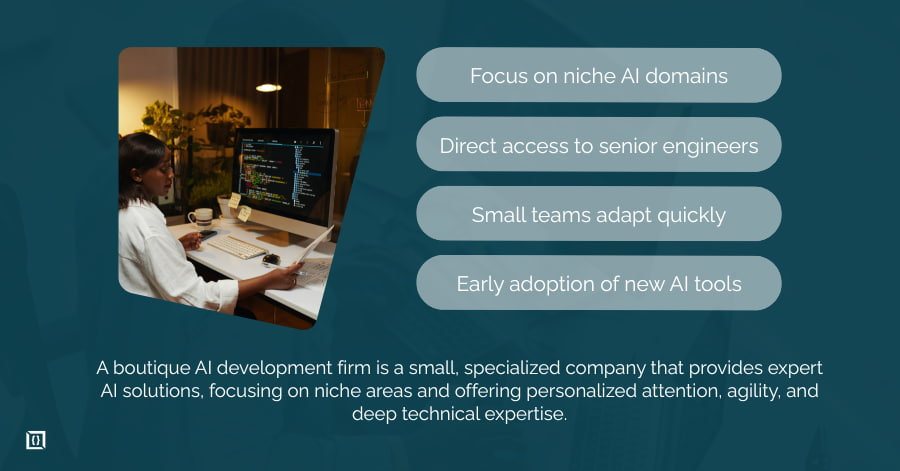
They run smaller teams, hire senior engineers who do the actual building, and focus on specific AI domains rather than everything at once.
Let’s break down where boutique AI firms deliver value, where they fall short, and how to evaluate whether one makes sense for your project.
What Is a Boutique AI Development Firm?
A boutique AI development firm is a small, specialized agency focusing primarily on artificial intelligence and machine learning projects. Unlike large consultancies such as Accenture or Deloitte, these firms typically employ between 5 and 30 engineers, with most holding senior or principal-level expertise.
The defining characteristic is depth over breadth: rather than offering every service available, boutique firms concentrate on specific AI domains like natural language processing, computer vision, or recommendation systems.
Large consultancies operate on volume, staffing projects with a mix of junior and senior engineers while following standardized methodologies. Generalist development shops take on web apps, mobile apps, and AI projects equally, but their AI expertise often runs shallow. Boutique AI firms differ fundamentally: they've deliberately constrained their focus to build genuine technical depth in machine learning.
Agility, Specialization, and Deep Collaboration
Three traits consistently define boutique AI firms. First, small team size enables rapid decision-making. When a project needs to pivot from a transformer-based approach to gradient boosting, that decision happens in a single meeting rather than filtering through layers of project managers.
Second, specialization means engineers have likely solved similar problems before. They understand training data quality nuances, model drift, and production deployment challenges from repeated experience.
Third, direct access to senior talent changes collaboration entirely. Founders and CTOs work directly with principal engineers building the system, not account managers relaying messages.
Why Choose a Boutique AI Development Firm?
Choosing a boutique AI development firm means working with specialized experts who bring deep domain knowledge, direct access to senior engineers, and the agility to build custom solutions without the overhead of large consultancies.
Deep Specialization and Niche Expertise
Boutique AI firms often build practices around specific technical domains. One firm might focus exclusively on NLP applications, having built dozens of document processing systems. Another might specialize in computer vision for manufacturing quality control.
This concentration produces engineers who understand not just general ML principles, but specific domain gotchas. They know which architectures work for certain data types, which preprocessing steps matter, and where research papers diverge from production reality. For clients, this translates to fewer false starts and faster time to working solutions.
Faster Execution and Agility
Small teams move faster. There's no complex resource allocation process or standardized gate reviews adding weeks to timelines. When requirements change mid-project, a boutique firm adjusts course in days rather than initiating formal change requests.
This agility matters for AI projects, where initial assumptions frequently prove wrong. You might discover unexpected data quality issues or that users interact with the system differently than anticipated. Quick iteration beats rigid adherence to outdated project plans.
Personalized Approach and Strong Client Relationships
In a boutique engagement, you communicate directly with engineers building your system. This eliminates the telephone game plaguing larger engagements, where business analysts translate requirements to project managers who relay them to offshore teams.
Direct communication reduces misunderstandings and accelerates problem-solving. Many boutique firms structure relationships as partnerships rather than vendor arrangements, investing time to understand your business context, competitive landscape, and long-term goals.
Innovation and Cutting-Edge Solutions
Boutique AI firms adopt new tools and techniques faster than larger organizations. When a new model architecture shows promise, they evaluate and integrate it without navigating enterprise approval processes.
A firm that experimented with LangChain early developed practical knowledge about its strengths and limitations before it became mainstream. This willingness extends to prototyping, building quick proof-of-concepts to validate feasibility before committing to full development.
Cost-Effectiveness for Specific Engagements
Boutique firms are not always cheaper on an hourly basis. Senior AI engineers charge similar rates regardless of company size. The difference often shows up in the overall project cost. Focused expertise reduces trial and error, smaller teams spend less time coordinating, and direct communication cuts down on meeting overhead.
For scoped efforts like MVPs or a single machine learning feature, this can translate into better value compared to larger vendors.
When a Boutique Firm Might Not Be Ideal
A boutique AI firm may not be ideal when a project demands extensive scalability, massive resource allocation, or a wide array of non-AI, cross-functional services. Large-scale enterprise transformations, projects requiring integration with complex global legacy systems, or those needing consistent, on-site international support might be better suited for larger consultancies that offer a broader range of services, greater risk mitigation resources, and established global footprints that most boutique firms lack.
1. Scalability Limitations
If your project requires scaling from 5 engineers to 50 within months, most boutique firms can't accommodate that growth. Their bench strength is limited by design.
Large consultancies maintain pools of available talent specifically for rapid scaling scenarios. If unpredictable staffing needs are a core requirement, larger vendors offer more flexibility.
2. Limited Breadth of Services
Boutique AI firms focus on AI. They typically don't offer comprehensive UX design, enterprise architecture, change management, or organizational training at scale.
If your project needs all components delivered by a single vendor, a full-service consultancy provides that integration. Working with a boutique firm often means coordinating multiple vendors.
3. Resource Depth and Redundancy Concerns
In a team of 10 engineers, departure of a key technical lead has significant impact. Boutique firms manage this through documentation, knowledge sharing, and overlapping responsibilities, but smaller teams have less redundancy. For mission-critical, long-running engagements, this concentration risk deserves consideration.
4. Brand Recognition and Established Methodologies
Enterprise procurement processes sometimes favor established names. If you need to justify a vendor selection to a board or procurement committee, "Accenture" requires less explanation than an unknown boutique. Similarly, large consultancies bring documented methodologies satisfying audit requirements and governance frameworks.
5. Geographical Reach and Time-Zone Challenges
Some boutique firms operate regionally with teams concentrated in a single time zone. If you need overlapping working hours across global offices or on-site presence in multiple locations, distributed consultancies offer practical advantages.
Remote collaboration tools have reduced this friction, but it remains a factor for organizations with strict co-location requirements.
How to Evaluate and Choose the Right Boutique AI Development Firm
To select the right boutique AI firm, prioritize specialization and a proven track record in your industry. Scrutinize the technical depth of the specific team members you will work with and their agile development methodology. Finally, ensure clear communication practices, data security protocols, and a strong cultural alignment to guarantee a successful and collaborative partnership.
1. Technical Depth and Implementation Capability
Marketing materials don't reveal technical capability. Instead, examine public technical artifacts. Review their GitHub repositories if available. Read engineering blog posts looking for depth of understanding rather than surface-level overviews.
A firm publishing detailed write-ups about solving specific ML challenges demonstrates genuine expertise.
2. Consultative Approach and Flexibility
Observe how they engage during initial conversations. Do they ask probing questions about your business problem, or jump straight to proposing solutions? Quality firms invest time understanding context before recommending approaches. They should demonstrate a willingness to challenge assumptions and explore alternatives.
3. Industry Specialization and Domain Experience
AI implementation varies significantly across industries. Healthcare AI requires understanding of HIPAA compliance and clinical workflows. Financial services involves regulatory considerations and risk management. A firm with experience in your vertical brings domain knowledge that accelerates development. Ask for relevant case studies and speak with references from similar industries.
4. Proven Methodology and Track Record
Request detailed case studies going beyond feature lists. Understanding how a firm handled challenges, pivots, and setbacks reveals more than polished success narratives. Ask about projects that didn't go as planned. Inquire about repeat business ratio: returning clients signal satisfaction with previous work.
5. Focus on Measurable Business Outcomes
The best partners understand that code delivery isn't the goal. Evaluate whether the firm discusses outcomes in business terms: improved conversion rates, reduced processing time, increased prediction accuracy. A partner tying technical work to metrics like activation, churn, or revenue impact makes better decisions throughout the project.
Choosing the Right Fit
There is no single right choice. It depends on what you need to build and how you plan to build it.
If the goal is a focused AI feature or MVP that needs close involvement from senior engineers, a boutique firm often fits well. If the work spans multiple systems, teams, and service areas, a larger consultancy may handle coordination more easily.
Also consider the long term. Many AI systems need ongoing iteration. A team that already understands your data and constraints usually moves faster over time.
At a minimum, weigh:
- Scope of the work
- Speed versus scale
- How closely you want to work with the engineers
- Whether working styles align
That’s usually enough to make a clear call without overthinking it.
Getting Started
Boutique AI firms offer focused expertise and agility that larger consultancies often cannot. For startups or teams adding machine learning, they provide skill and close collaboration in a small, senior-led team.
The key is finding the right fit by being clear on your goals, understanding constraints, and evaluating firms on real work and references rather than marketing claims. Teams that ask good questions before proposing solutions often make the best partners for building AI that works.
You can also connect with us to explore your AI project, get expert guidance, and start building solutions that meet your goals efficiently.
Frequently Asked Questions
How much does a boutique AI development firm charge per project or hour?
Hourly rates typically range from $75 to $300, depending on location, specialization, and team seniority. US-based firms charge at the higher end ($150 to $300/hour), while nearshore teams in Latin America (Mexico, Argentina, Colombia, Brazil) often range from $75 to $150/hou,r with timezone overlap for US clients. European firms fall somewhere in between. MVPs start around $50,000; production implementations range from $150,000 to $500,000 or more, depending on data complexity and integration requirements.
What's the typical team size at a boutique AI firm vs a large consultancy?
Boutique firms employ 5 to 30 engineers total, with project teams of 2 to 6 people. Large consultancies might staff similar projects with 5 to 15 people, including project managers, business analysts, and QA specialists. The practical difference: boutique firms provide more senior engineering time relative to coordination overhead.
How long does it take to build an MVP with a boutique AI firm?
Most AI MVPs take 8 to 16 weeks, including data assessment, model development, basic integration, and initial deployment. Variables extending timelines include data quality issues requiring cleanup, complex system integrations, and regulatory approval processes. Simpler MVPs using pre-trained models can ship in 6 weeks.
What happens if my boutique AI firm goes out of business mid-project?
Protect yourself contractually. Include code escrow provisions where a third party holds source code available under specified conditions. Ensure contracts grant full ownership of work product and specify explicit handover procedures. Maintain documentation throughout so another team could continue if necessary.
Do boutique AI firms own the IP/code they develop for clients?
Standard practice is client ownership of custom code and models developed during engagement. Firms typically retain rights to pre-existing tools, frameworks, and methodologies. Read contracts carefully, paying attention to model ownership, training data handling, and usage of anonymized learnings.
What specific AI frameworks and tools do boutique firms typically use?
Common frameworks include PyTorch and TensorFlow for deep learning, scikit-learn for traditional ML, and HuggingFace Transformers for NLP tasks. For LLM applications, firms work with LangChain, OpenAI APIs, and Anthropic's Claude API. MLOps tooling includes MLflow and Weights & Biases for experiment tracking.
How do I vet a boutique AI firm's actual expertise vs marketing?
Review public GitHub contributions and open-source work. Read technical blog posts for depth of understanding. Request technical interviews where your engineers assess their knowledge. Ask for detailed case studies with specific technical decisions explained. Speak with former clients about delivery quality.
Can boutique AI firms handle enterprise compliance such as SOC2 and HIPAA?
Capability varies significantly. Some firms have invested in compliance certifications and regularly work with regulated industries. Others focus on early-stage startups with minimal requirements. Ask about compliance experience, request security documentation, and verify certifications. For HIPAA, confirm they can sign a Business Associate Agreement.
What's the minimum budget needed to work with a boutique AI firm?
Expect floor prices of $30,000 to $50,000 for proof-of-concept projects or technical assessments. MVP development typically starts at $50,000 to $75,000. Production-ready systems with testing, monitoring, and documentation generally require $100,000 or more. Some firms offer advisory retainers at lower price points.
How many AI engineers does a typical boutique firm have?
Most boutique AI firms employ 5 to 20 engineers with ML expertise. The key metric isn't headcount but seniority and specialization. A firm with 8 principal-level ML engineers may deliver more effectively than one with 25 junior generalists. Ask about specific team members who would work on your project.