ChatGPT Ads 2026: All You Should Know & People's Reactions

On January 16, 2026, OpenAI made a significant shift in how ChatGPT will be monetized and experienced by millions of users around the world. The company said it will begin testing advertisements for users on its free tier and its newly expanded ChatGPT Go subscription (about $8 per month) in the United States in the coming weeks. This is one of the first major moves to introduce ads directly into ChatGPT’s interface while keeping paid tiers like Plus, Pro, Business, and Enterprise free of sponsored content.
The ads won’t influence the chatbot’s answers and will be clearly labeled and separated from organic responses. OpenAI says the change will help support broader access to the technology without selling user conversation data to advertisers.
Among marketers and digital strategists, this announcement sparked immediate debate. Reactions on social platforms like X show a mix of frustration, skepticism, and pragmatic takes as users try to understand how this will change their workflows and trust in AI.
Let’s go through the announcement details, how ads will work, what ChatGPT Go offers, privacy safeguards, user sentiment from X, and what this may mean for the AI industry.
OpenAI’s Monetization Shift
OpenAI is under pressure. Despite reaching a $20 billion annualized revenue run rate by late 2025, the company faces operational costs that dwarf its income. Reports indicate OpenAI could burn through $115 billion in cash by 2030, driven primarily by the computing infrastructure required to run its AI models. The company has committed to $1.4 trillion in AI infrastructure spending over the next eight years, creating an urgent need for sustainable revenue beyond subscriptions.
Here's what the announcement covers:
- Who sees ads: Free-tier and ChatGPT Go users in the U.S. (logged-in adults only)
- Rollout timing: Testing begins "in the coming weeks" (late January to early February 2026).
- Protected tiers: Plus ($20/month), Pro ($200/month), Business, and Enterprise remain ad-free.
- OpenAI's promise: Ads won't influence responses, conversations stay private, and data won't be sold to advertisers.
CEO Sam Altman wrote on X that "a lot of people want to use a lot of AI and don't want to pay," positioning ads as a way to fund accessibility. The company maintains this move aligns with its mission to ensure AGI benefits all of humanity, with "user trust first" as a stated priority.
How Ads Will Appear
OpenAI outlined five principles governing how ads will work in ChatGPT. These aren't vague commitments; they're specific guardrails the company claims will protect user experience.
OpenAI's advertising principles:
- Responses remain independent: Ads don't influence what ChatGPT says. Answers are optimized based on what's most helpful to you, not what benefits advertisers
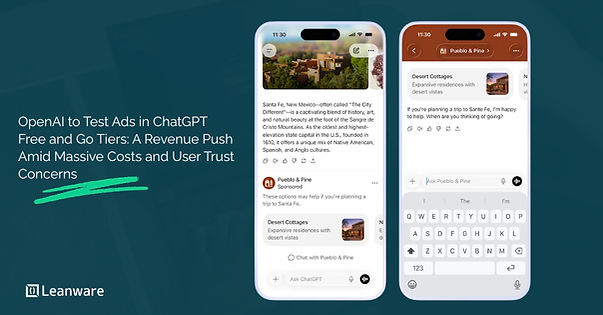
- Ads are clearly labeled and separated: Ads will appear at the bottom of responses in a distinct box marked "Sponsored." They won't be woven into the text itself.
- Conversations stay private: Your chat history won't be sold to advertisers. OpenAI says targeting will be contextual (based on your current query) rather than based on selling your data.
- You control personalization: Users can opt out of personalized ads. There's also the option to dismiss ads and provide feedback.
- Exclusions for sensitive topics: Ads won't appear for users under 18 (determined by OpenAI's AI age-estimation system). They also won't show up near conversations about politics, health, or mental health.
Format example: If you ask ChatGPT for keto dinner recipes, you might see a sponsored link to a meal delivery service at the bottom of the response. The ad sits in its own box, separate from ChatGPT's actual answer.
Sam Altman and Fidji Simo (OpenAI's CEO of Applications) have both emphasized that ads won't dictate responses. Simo wrote on X: "Ads will not influence the answers ChatGPT gives you."
The New $8/Month ChatGPT Go Tier
ChatGPT Go launched globally on January 16, 2026, expanding from its initial rollout in 171 countries since August 2025. At $8 per month in the U.S., it's positioned between the free tier and ChatGPT Plus ($20/month).
What ChatGPT Go includes:
- Access to GPT-5.2 Instant (OpenAI's latest fast model)
- Higher message limits than the free tier
- Expanded image generation capabilities
- Longer conversation memory
- File upload and image analysis support
The consideration: Go users will see ads. This tier is designed for people who want more than the free version offers but aren't ready to pay $20/month for Plus or $200/month for Pro.
ChatGPT's pricing now breaks down like this:
Tier | Price | Ads? | Key Features |
Free | $0 | Yes | Basic access, limited messages |
Go | $8/month | Yes | GPT-5.2 Instant, higher limits, memory |
Plus | $20/month | No | GPT-5.2 Thinking, legacy models, Codex agent |
Pro | $200/month | No | GPT-5.2 Pro, maximum memory/context |
OpenAI reported that only about 5% of ChatGPT's 800 million users pay for any subscription. Go is meant to capture users who want premium features without jumping to the $20 tier, while ads offset the cost for those who choose to stay free.
Privacy, Trust & Influence Concerns
OpenAI insists its approach is different from traditional digital advertising. The company promises contextual targeting without selling user data, and they've excluded politically sensitive topics from ad targeting. But trust depends on more than stated principles.
OpenAI's protections:
- Ads are contextual (based on your current query) rather than profile-based
- No data sales to third parties
- Responses won't prioritize sponsored products
- Users can opt out of personalized targeting
- No ads for minors or on sensitive topics (politics, health, mental health)
The risks people see:
Even with these safeguards, there's concern about long-term influence. Google and Meta both started with strong privacy principles, and both faced criticism as revenue pressures grew. Introducing ads creates a tension between serving users and meeting advertiser goals, and that gap could widen over time if revenue pressure increases.
The question isn't just whether ads influence today's responses. It's whether they'll subtly shape recommendations months or years from now. Will ChatGPT still suggest the best product, or the one that pays the most?
OpenAI's exclusions for sensitive topics are meaningful. The company won't serve ads to users it believes are under 18, using AI to estimate age based on conversation patterns. This adds a layer of protection, though it also raises questions about how accurately an AI can determine a user's age.
Reactions and People’s Sentiments on X Right Now
As of late January 16 and early January 17, 2026, sentiment on X toward ChatGPT ads is overwhelmingly negative. OpenAI's announcement post garnered over 10.4M+ views within hours, with reply threads dominated by skepticism and frustration.
The overall tone: Many viewed ChatGPT as a clean, ad-free experience, and the introduction of ads - even with stated protections - feels like a broken promise. Some accept it as inevitable given OpenAI's costs, but acceptance doesn't equal enthusiasm.
Frustrations with Ads in Conversations
The core frustration centers on the idea that ads will intrude into what many consider a sacred space: the response box where ChatGPT provides answers.
Key themes from X reactions:
Strong criticism and frustration: Many posts call it the end of the clean ChatGPT experience, with comparisons to “Google 2.0.” Users worry ads will appear even in personal or serious conversations and predict a shift to ad-free alternatives like Claude or Gemini.

Cynicism about OpenAI’s motives: Users point to past statements from Sam Altman criticizing ads and question the “user-first” framing. There’s skepticism around privacy assurances and doubts that ads will stay fully separate from responses over time.

Pragmatic acceptance: A smaller group sees ads as a practical trade-off given infrastructure costs. Some argue it’s better than higher prices and say the current placement and labeling seem manageable.
Opportunistic takes: Marketers already speculate about how ChatGPT recommendations might work, while others note ads could push more users toward paid, ad-free tiers.

Broader context: Reactions tie into ongoing trust issues around past changes and commercialization. Some users joke about blockers or plan to avoid the free tier entirely.
Skepticism Toward "No Influence" & Privacy Claims
Trust is fragile, and OpenAI's promises aren't landing with everyone. Several users on X drew comparisons to Google's early days, when the company famously promised not to prioritize ads in search results.

Skeptical takes from X:
- "Remember when Google said they wouldn't do evil? How'd that work out?"
- "These promises always get broken eventually. Give it a year."
- "The moment ads enter, integrity takes a hit. It's just math."
Users pointed to the history of platforms like Facebook and Meta, which started with strong privacy commitments and later faced scrutiny over data practices. The concern isn't that OpenAI is lying now; it's that revenue pressures will force compromises later.
Some users also raised conflict-of-interest worries. If a brand pays for ad placement, will ChatGPT subtly favor that brand in future recommendations? Even if OpenAI's systems are designed to prevent this, users question whether those safeguards will hold under financial pressure.
Minority Pragmatic or Positive Takes
Not everyone is outraged. A small but notable group of users accepts ads as a necessary trade-off to fund free access and future development.

Pragmatic and lighter reactions:
- "Honestly, it doesn't look that bad from the example. Just at the bottom."
- "If this funds more features, I'm okay with it."
- "This is an intent marketing goldmine. Brands are gonna line up."
- "It's like Instagram ads. You scroll past them. Life goes on."
Some users even found humor in the situation. Memes circulated imagining ironic ad scenarios, like ChatGPT suggesting therapy apps after a vent session or promoting dating services after relationship advice. One user joked about the "Netflix-ification" of AI, predicting tiered pricing with ads at every level eventually.
The pragmatic crowd recognizes that running ChatGPT at scale is expensive. OpenAI's $1.4 trillion infrastructure commitment isn't trivial, and with only 5% of users paying, ads may be the only path to sustainability. These users would rather have ads than see ChatGPT shut down or drastically limit free access.
Still, pragmatism doesn't mean excitement. Even those who accept ads acknowledge they'd prefer not to see them.
Future Implications for AI Users & the Industry
OpenAI's move into advertising sets a precedent. If it works, other AI companies will follow. If it fails, it could accelerate a shift toward paid-only AI services.
Possible outcomes:
Revenue impact: Advertising could become a meaningful new revenue stream for OpenAI. It can generate low‑billion‑dollar revenue in 2026 from ads and related monetization, helping offset infrastructure costs and support continued investment in more advanced models.
User exodus: If ads feel intrusive or degrade the experience, users may switch to competitors. Anthropic's Claude, Google's Gemini, and X's Grok all offer ad-free experiences (for now). A migration could hurt OpenAI's market position even as it gains revenue.
Trust erosion: This is the long-term risk. Once users believe ChatGPT prioritizes advertisers over accuracy, the brand loses credibility. Trust is hard to rebuild, and competitors are ready to capitalize on any misstep.
Industry precedent: OpenAI isn’t the first to explore ads in AI. While Google’s Dan Taylor confirmed on December 9, 2025, that there are currently no ads in the Gemini app and no active plans to add them, it remains possible that Google could test ads in the future. If both OpenAI and other major AI platforms implement ads successfully, monetization through AI tools could become standard, putting pressure on smaller players to follow or risk falling behind.

The tension between accessibility and commercialization is real. OpenAI frames ads as a way to keep ChatGPT free for everyone. Critics see it as the start of a slippery slope where profit motives overtake user needs.
Your Next Move
Ads are coming to ChatGPT. The rollout starts in the coming weeks for U.S. users on free and Go tiers, with a promise that paid subscriptions (Plus, Pro, Business, Enterprise) will stay ad-free.
OpenAI has outlined principles meant to protect trust: ads won't influence responses, conversations stay private, and sensitive topics are excluded. Whether those protections hold depends on execution and sustained commitment.
What you can do:
- Opt out of personalized ads when the option becomes available
- Test the free tier changes to see if ads affect your experience
- Consider paid tiers if ad-free access matters to you
- Explore competitors like Claude, Gemini, or Grok if you want to avoid ads entirely
Monitor the rollout and decide based on how ads actually appear in practice. OpenAI says it will refine the approach based on feedback, so early user reactions could shape the final implementation.
Trust in AI tools depends on transparency and consistency. If OpenAI delivers on its promises, ads may become a tolerable trade-off. If not, users have options.
You can also connect with us at Leanware to future-proof your digital products, leveraging our expertise in AI integrations, scalable web and mobile applications, and data solutions to adapt to AI platforms, introducing ads and new monetization models.
Frequently Asked Questions
Will ChatGPT Plus users see ads?
No. ChatGPT Plus ($20/month), Pro ($200/month), Business, and Enterprise subscriptions remain completely ad-free. Only free-tier and ChatGPT Go ($8/month) users will see advertisements.
Can I turn off ads in ChatGPT?
You can't remove ads completely on free or Go tiers, but OpenAI offers an opt-out for personalized ad targeting. You can also dismiss individual ads and provide feedback. The only way to completely avoid ads is to upgrade to Plus, Pro, or switch to ad-free alternatives like Claude or Gemini.
Will ads change what ChatGPT recommends?
OpenAI claims no. The company states that responses are optimized for helpfulness, not advertiser benefit, and that ads won't influence ChatGPT's answers. Ads appear separately at the bottom of responses, clearly labeled as "Sponsored." Whether this holds true long-term remains to be seen as revenue pressures increase.
When will ChatGPT ads start appearing?
OpenAI announced testing will begin "in the coming weeks" starting late January 2026. The initial rollout targets adult users in the United States on free and Go tiers. Global expansion timing hasn't been confirmed yet.
Does ChatGPT sell my conversation data to advertisers?
OpenAI says no. The company claims ads are contextually targeted based on your current query, not by selling your chat history to third parties. Conversations remain private according to their stated principles, though skeptics point to similar promises made by Google and Meta that evolved over time.