Enterprise RAG Consulting Services | AI Solutions

Most enterprises sit on massive amounts of data spread across dozens of systems. CRM platforms, internal wikis, shared drives, ticketing systems, email archives. The information exists, but finding what you need when you need it remains frustratingly difficult. Employees waste hours searching for documents that should take seconds to locate.
Retrieval-Augmented Generation addresses this problem directly. RAG links large language models with targeted retrieval from real enterprise data sources. Rather than producing answers based only on general training data, a RAG system first gathers relevant internal context and then uses that material to generate accurate responses grounded in approved knowledge.
Let’s break down what enterprise RAG consulting involves and what you should evaluate before moving forward with implementation.
What Is Enterprise RAG Consulting?
RAG architecture connects generative AI models to external knowledge sources. When a user asks a question, the system first retrieves relevant documents from a vector database, then passes that context to an LLM to generate a response. The model synthesizes information rather than relying solely on what it learned during training.
Enterprise RAG consulting helps organizations design, build, and deploy these systems at scale. Consultants bring experience across the technical stack, from data ingestion pipelines to vector databases to LLM integration. They also understand governance requirements, security constraints, and measuring ROI.
Why Enterprises Need RAG Solutions Today
Enterprise data volumes continue growing at roughly 25% annually, according to IDC research. Most of this data remains unstructured: documents, emails, chat logs, PDFs. Traditional search tools struggle with this content because they rely on keyword matching rather than semantic understanding.
RAG addresses several specific problems. It handles semantic search, so someone asking about "customer churn reduction strategies" can retrieve documents discussing "retention programs" even without exact keyword matches. RAG also generates synthesized answers rather than just returning document links.
A 2024 survey by Pryon and Unisphere Research found that 70% of professionals spend an hour or more searching for a single piece of information. RAG systems can cut that time dramatically.
Core Components of Enterprise RAG Architecture
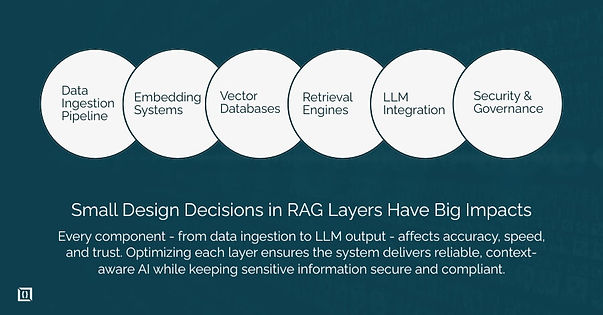
A production RAG system relies on several tightly connected components. Each one plays a specific role, and weak design in any layer quickly shows up in accuracy, latency, or trust.
1. Data Ingestion Pipeline
The ingestion pipeline extracts content from source systems. This might include Salesforce records, Confluence pages, SharePoint documents, Slack conversations, or proprietary databases. Each source requires connectors that can handle authentication, incremental updates, and format conversion.
Documents get chunked into segments during ingestion. Chunk size affects retrieval quality: too large and you include irrelevant context, too small and you lose necessary surrounding information. Most implementations use chunks between 256 and 1024 tokens with some overlap between adjacent chunks.
2. Embedding Systems
Embeddings convert text into numerical vectors that capture semantic meaning. Two sentences discussing similar concepts will have vectors that are mathematically close together, even if they share no words.
Common models include OpenAI's text-embedding-ada-002, Cohere's embed models, and open-source options like sentence-transformers.
3. Vector Databases
Vector databases store embeddings and enable fast similarity search. Options include Pinecone, Weaviate, Qdrant, Milvus, and pgvector for PostgreSQL. Each comes with different constraints around scalability, hosting options, and cost. Enterprises with strict data residency requirements often prefer self-hosted solutions.
4. Retrieval Engines
The retrieval layer determines which document chunks get passed to the LLM. Pure vector similarity search works well for many cases, but hybrid approaches often perform better. Hybrid retrieval combines dense vector search with traditional keyword-based (sparse) retrieval, then reranks results.
Reranking models like Cohere Rerank or cross-encoder models score the relevance of retrieved chunks to the query. This additional step improves precision, especially for complex queries where initial retrieval returns marginally relevant results.
5. LLM Integration
The generative model receives the user query plus retrieved context and produces a response. GPT-4, Claude, and Gemini are common choices for enterprise deployments. Some organizations use open-source models like Llama or Mistral for cost control or data privacy reasons.
Prompt engineering shapes how the model uses retrieved context. Well-designed prompts instruct the model to cite sources, acknowledge uncertainty when context is insufficient, and stay within the bounds of provided information. This reduces hallucination risk.
6. Security, Access Control, and Governance
Enterprise RAG systems must respect existing access controls. If a document is restricted to the legal department, the RAG system should not serve that content to marketing users.
This requires permission-aware retrieval that filters results based on user identity. Audit logging tracks queries and sources for compliance and debugging.
How Enterprise RAG Consulting Works
Implementation follows a structured methodology. Each phase builds on the previous one, reducing risk and validating assumptions before scaling.
1. Strategic Alignment with Business Goals
Consultants start by turning broad client objectives into specific, measurable outcomes.
A goal like "improve knowledge management" becomes something concrete: reduce average support ticket resolution time by 30%, decrease time-to-answer for sales engineers by 40%, or cut onboarding documentation lookup from hours to minutes.
2. Auditing and Structuring Knowledge Sources
A knowledge audit inventories existing data sources, assesses quality, identifies gaps, and maps ownership. Many enterprises discover significant duplication, outdated content, and inconsistent formats during this phase. The audit also reveals which sources hold the highest-value information for target use cases.
3. Implementing a Robust Retrieval Layer
Technical teams configure chunking strategies, select embedding models, and tune retrieval parameters.
This phase involves significant experimentation. Different document types may require different chunking approaches. Technical documentation might chunk well at paragraph boundaries, while contracts might need section-aware splitting.
4. Connecting to Generative AI Models
Model selection balances capability, cost, and compliance requirements. Integration involves prompt engineering, context window management, and output formatting.
Some implementations use multiple models: a faster, cheaper model for simple queries and a more capable model for complex reasoning tasks.
5. Designing Intuitive User Interfaces
The interface must fit existing workflows. An internal chatbot embedded in Slack or Teams gets more adoption than a standalone web application. Customer-facing implementations might integrate with support portals or help centers. Good interfaces show source citations, allow follow-up questions, and provide feedback mechanisms.
6. Enabling Ongoing Governance and Compliance
Governance frameworks define who can access what data, how responses get audited, and how the system handles sensitive information. In healthcare, this means HIPAA compliance. In finance, SOC2 and potentially SEC requirements. Governance also covers model updates, retraining schedules, and accuracy monitoring.
7. Monitoring Performance and Optimization
Production systems require ongoing measurement. Key metrics include retrieval precision (are we finding relevant documents?), answer accuracy (verified through sampling and user feedback), latency, and user satisfaction.
Feedback loops enable continuous improvement: queries that receive thumbs-down ratings get reviewed, and the system gets tuned accordingly.
Use Cases of Enterprise RAG Consulting
Enterprise RAG consulting helps teams build AI systems grounded in enterprise data to deliver accurate, traceable answers. Typical use cases include customer support, legal and compliance research, financial reporting, internal knowledge copilots, and focused applications like RFP automation and clinical decision support.
1. Enterprise Search and Internal Chatbots
Internal knowledge assistants let employees query fragmented systems through natural language. Instead of switching between Confluence, SharePoint, and Slack to track down a policy document, users ask a question and get a synthesized answer with source links. The retrieval layer handles the cross-system search; the LLM handles summarization and follow-up questions.
2. Customer Support and Ticket Resolution
Support teams use RAG to surface relevant knowledge base articles and past ticket resolutions in real time. When an agent opens a ticket, the system retrieves similar historical cases and suggests responses.
Customer-facing implementations handle routine inquiries directly, escalating complex issues to human agents with full context already assembled.
3. Knowledge Management in Regulated Industries
RAG fits well in environments where source attribution matters. Pharmaceutical researchers query regulatory submissions and clinical trial documentation. Legal teams search contract databases for precedent clauses. Compliance officers surface requirements based on transaction type or jurisdiction. The shared requirement across these use cases is precise retrieval with traceable citations for audit trails.
Benefits of Implementing Enterprise RAG
Implementing Enterprise RAG grounds AI outputs in proprietary data, cuts hallucinations by up to 70%, automates information retrieval, reduces employee search time from hours to minutes, and increases ROI, all while enforcing traceable sources and role-based access - vital for high-stakes industries like finance and healthcare.
1. Improved Productivity and Knowledge Access
The primary benefit is time savings. Employees spend less time hunting for information and more time applying it. This compounds across the organization. A 15-minute daily time savings per employee translates to significant productivity gains at enterprise scale.
2. Reduced Information Silos
RAG systems that index multiple data sources break down departmental barriers. Marketing can access product documentation. Sales can find customer success stories. Engineering can reference past incident reports. Information flows more freely when a unified retrieval layer sits across previously disconnected systems.
3. Measurable Business Outcomes
Organizations track ROI through several metrics: support cost reduction from faster ticket resolution, decreased employee time spent searching, higher customer satisfaction scores from quicker responses, and reduced training time for new hires. These metrics provide concrete justification for ongoing investment.
RAG Implementation Roadmap
Phase 1: Enterprise Knowledge Audit
Map your data landscape first. Identify where knowledge lives (wikis, ticketing systems, shared drives, databases), assess content quality, and flag access control requirements. Output: a prioritized list of data sources ranked by value and integration complexity.
Timeline: 2-4 weeks.
Phase 2: Proof of Concept
Pick one high-value use case with a bounded dataset. Build the ingestion pipeline, configure chunking and embeddings, and measure retrieval accuracy against a test set. The POC validates whether your data is RAG-ready and surfaces issues like inconsistent formatting or duplicate content.
Timeline: 4-8 weeks.
Phase 3: Production Deployment
Expand data coverage, harden the infrastructure, and implement security controls. This means permission-aware retrieval, SSO integration, audit logging, and latency monitoring. User training happens here. The goal is a system that handles real query volume with acceptable performance.
Phase 4: Scaling and Automation
Roll out across departments. Automate content ingestion so the knowledge base stays current. Add features based on usage patterns: multi-turn conversations, proactive suggestions, or workflow integrations like auto-drafting support responses. Continuous feedback loops drive ongoing tuning.
Security and Compliance in Enterprise RAG Systems
Enterprise deployments require robust security controls. Data encryption in transit and at rest protects sensitive content. Role-based access control ensures users only retrieve documents they're authorized to see. This often means integrating with existing identity providers and respecting source system permissions.
Compliance requirements vary by industry. Healthcare organizations need HIPAA-compliant infrastructure. Financial services may require SOC2 certification and adherence to SEC guidelines on record retention. International operations must consider GDPR and data residency requirements. RAG system architecture must accommodate these constraints from the design phase.
Is Enterprise RAG Consulting Right for You?
RAG consulting is valuable when you have a large, underutilized knowledge base, when employees regularly struggle to find information, when support costs are high due to repetitive inquiries, or when compliance requires stronger information governance. Mergers and acquisitions that bring together disparate knowledge systems also create strong use cases.
When It Might Not Be the Right Fit
Smaller organizations with limited data may not see sufficient ROI. Companies without basic data infrastructure (document management, access controls) need those foundations first.
Organizations unwilling to invest in data cleanup and governance will struggle, since RAG systems amplify both good and bad data quality. If the primary challenge is data creation rather than data retrieval, RAG won't solve the underlying problem.
Get Started with Enterprise RAG Consulting
Organizations considering RAG implementation should begin with an honest assessment of their current knowledge management challenges.
Document the specific pain points, quantify the time lost to information search, and identify high-value use cases. This groundwork helps when evaluating consulting partners and ensures implementations target real business problems rather than technology for its own sake.
You can reach out to us to explore how RAG can make your knowledge more accessible and actionable across your teams.
Frequently Asked Questions
What's the typical consulting fee structure for Enterprise RAG projects?
Most RAG engagements follow a phased pricing model. Discovery and POC phases typically use fixed pricing since scope is well-defined. Production deployments shift to time-and-materials because requirements evolve during implementation.
Key cost drivers include number of data sources, integration complexity, compliance requirements, and whether you need custom model fine-tuning. Rates vary significantly by region and vendor.
For a project estimate, contact our team with details on your data landscape and target use cases.
How do we handle conflicting information across different data sources?
Conflicting information gets managed through source prioritization and metadata tagging. Each document carries metadata indicating its authoritative level and last update date. Retrieval logic prefers more recent or authoritative sources. Some systems surface conflicts explicitly, letting users investigate further.
What specific skills or roles are needed on our internal team during implementation?
Successful implementations typically involve data engineers who understand source systems, knowledge managers for content quality, compliance officers for governance, and DevOps teams for infrastructure. A product owner helps align technical decisions with business objectives.
How long before we see ROI, and how do we measure it?
Organizations typically see measurable results 3-6 months after production deployment. Common metrics include reduction in search time, decrease in support ticket escalations, and improvement in first-contact resolution rates. Establish baseline measurements before implementation.
What happens when the RAG system hallucinates critical business information?
Hallucination mitigation involves multiple layers: strict retrieval filters, confidence scoring for low-certainty responses, source citations for verification, and human-in-the-loop workflows for sensitive queries. Well-designed prompts instruct models to acknowledge uncertainty rather than fabricate.
Which consultancies actually have proven RAG expertise vs. rebranded AI firms?
Look for published case studies, open-source contributions to RAG tooling, or partnerships with LLM providers. Ask for references from similar implementations. Firms with genuine expertise can speak specifically about embedding model selection, chunking strategies, and retrieval optimization.
How do we prevent sensitive data leakage through RAG responses?
Prevention requires permission-aware retrieval that filters documents based on user access rights. Integration with enterprise identity management keeps access controls synchronized. Audit trails log all queries and responses. Some implementations use separate indexes for different security classifications.