Nearshore Java Developer - Fast, Cost‑Effective, High‑Quality

Java remains the backbone of enterprise software, powering banks, healthcare systems, insurance platforms, and large e-commerce applications. The challenge is not the technology but finding developers who understand enterprise patterns, can work through legacy codebases, and write maintainable systems.
In the US, senior Java developers often earn $150,000 to $180,000 per year, and hiring can take three to four months once sourcing, interviews, and notice periods are included. Nearshore Java developers in Latin America offer comparable experience with Spring Boot and microservices at $50 to $70 per hour, work in overlapping time zones, and can usually start within weeks.
Let’s break down how to assess Java expertise, which hiring model fits different projects, and what to expect during onboarding.
Why Hire Nearshore Java Developers?
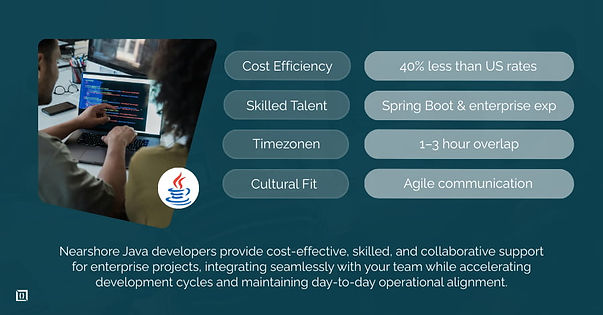
Hiring nearshore Java developers gives you access to strong technical talent at a lower cost while keeping collaboration simple. Similar time zones allow teams to communicate in real time, move through reviews faster, and avoid long feedback gaps.
You also work with Java engineers who are used to enterprise systems and can integrate cleanly with your existing team and processes.
1. Cost Efficiency Compared to Onshore or Offshore
Senior Java developers in the US typically earn between $140K and $180K per year. Comparable developers in Latin America usually cost $70K to $100K, roughly 40 percent less before benefits, office space, or equipment.
Offshore rates in South Asia can be lower, often $30–50/hour, but those numbers often hide coordination costs. Large time zone gaps slow feedback and increase time spent on clarification and rework. Nearshore teams generally cost less than onshore hires while allowing closer day-to-day collaboration.
Total cost matters more than the hourly rate. A developer who delivers reliably with limited oversight often ends up cheaper than a lower-rate developer who needs frequent correction.
2. Access to a High-Quality Talent Pool
Java remains widely used across finance, telecom, and logistics in Latin America. Countries like Mexico, Colombia, Argentina, and Brazil have established computer science programs, and many developers work on enterprise systems for US and European companies.
That exposure means regular work with Spring Boot, microservices, message queues, and legacy codebases. This experience tends to translate well to teams maintaining or modernizing large Java systems.
3. Timezone and Cultural Alignment Benefits
Nearshore teams usually work within one to three hours of US time zones. Developers in Mexico, Colombia, Peru, and Argentina overlap enough to support real-time standups, code reviews, and technical discussions during the same workday.
Cultural alignment also affects day-to-day work. Developers who regularly collaborate with US teams tend to follow similar communication styles and agile routines. They ask questions when requirements are unclear and flag issues early, which helps avoid delays and unnecessary rework.
Hiring Models for Nearshore Java Developers
Nearshore hiring offers three main models. Staff Augmentation adds individual developers to your team under your management. Dedicated Teams provide a full team managed by the vendor but focused exclusively on your project. Project-Based Outsourcing contracts the vendor to deliver a defined project with set scope, timeline, and budget.
1. Staff Augmentation
Staff augmentation works best for short to mid-term needs: 3 to 6 month engagements where you need specific Java skills added to your existing team. Common scenarios include backlog spikes, covering for team members on leave, building proof-of-concepts, or adding specialized skills like Spring Cloud, Kafka integration, or performance optimization.
Developers integrate into your workflows, attend your standups, and report to your engineering leads. You maintain full control over priorities and technical direction. Rates typically run $35 to $50/hour for mid-level and $50 to $70/hour for senior Java developers.
The model offers speed and flexibility. Onboarding takes 1 to 2 weeks. You scale up or down as project needs change. The hidden cost savings come from avoiding full-time hiring commitments and reducing coordination overhead compared to offshore teams.
2. Dedicated Nearshore Team
For longer engagements or projects needing multiple developers, a dedicated team provides a stable group - typically a tech lead or architect, 2 - 4 developers at various levels, QA support, and optionally a project manager.
You steer the product roadmap and technical direction, while the nearshore partner manages operations, retention, reporting, and backfills. This setup suits ongoing product development, platform builds, or large modernization efforts over 12+ months, offering predictable rates, team composition, and continuity of knowledge.
3. Fixed-Price Projects
Fixed-price works for well-defined scopes with clear deliverables. Examples include Java 8 to 17 migrations, building specific microservices, decomposing a monolith module, creating API layers, or developing proof-of-concepts.
The engagement follows a structured process: discovery, scope definition, phased milestones, and fixed budget. You get cost certainty and clear accountability for timelines.
The limitation: fixed-price struggles with evolving requirements. If your product roadmap changes frequently or scope is uncertain, staff augmentation or dedicated teams offer more flexibility.
Nearshore Java Development Services
1. Java Application Development
Enterprise Java development covers Java EE and Jakarta EE applications, integration with corporate systems, and adherence to enterprise architecture standards. Nearshore teams build transaction processing systems, workflow engines, and business applications that integrate with existing corporate infrastructure.
2. Custom Software Development
Full-stack Java capabilities extend from Spring Boot backends to Angular or React frontends. Domain expertise varies by team, but fintech, healthtech, and logistics are common specializations in Latin American markets due to regional industry presence.
3. API and Microservices Development
Modern Java development centers on APIs and microservices. Look for experience with RESTful API design, GraphQL when appropriate, event-driven architectures using Kafka or RabbitMQ, and Spring Cloud for microservices infrastructure. Kubernetes deployment experience matters for teams building cloud-native systems.
4. Legacy System Modernization
Java 8 reached end of public updates in 2019, yet millions of lines of production code still run on it. The migration path to Java 17 or 21 requires careful planning: dependency updates, API changes, and testing across the upgrade. Beyond version upgrades, many organizations need monolith decomposition using patterns like strangler fig to gradually extract services without big-bang rewrites.
5. Testing, QA, and Performance Tuning
Production Java systems need comprehensive testing: JUnit for unit tests, Mockito for mocking, integration tests against real dependencies, and performance profiling with tools like JProfiler or YourKit. Nearshore teams should demonstrate shift-left testing practices and automation frameworks integrated into CI/CD pipelines.
6. Deployment, DevOps, and Containerization
Modern Java deployment means CI/CD pipelines, Docker containers, and Kubernetes orchestration. Look for experience with Jenkins, GitLab CI, or GitHub Actions for pipelines. AWS, Azure, and GCP all have strong Java support. Infrastructure-as-code practices using Terraform or CloudFormation matter for teams managing their own deployments.
7. Maintenance and Ongoing Support
Nearshore timezone alignment enables responsive support models. Teams can participate in on-call rotations, respond to production issues during US business hours, and provide coverage that pure offshore teams cannot. Establish clear SLAs for incident response and resolution times.
How to Hire and Onboard Nearshore Java Developers
The hiring process starts with defining technical requirements and working with partners to find vetted candidates in compatible time zones. Candidates undergo thorough technical assessments and soft-skill evaluations, including communication and cultural fit. Onboarding focuses on clear documentation, system access, and team integration, enabling developers to contribute quickly and smoothly within existing agile workflows.
1. Candidate Sourcing and Screening
Quality nearshore agencies screen developers before presenting candidates. This typically includes technical pre-screening on Java fundamentals, English proficiency assessment, and cultural fit evaluation. Rigorous agencies pass only 3 to 5% of applicants through their full screening process.
2. Technical Assessment and Interview Process
Evaluation should cover multiple dimensions: coding challenges testing Java fundamentals and framework knowledge, system design discussions for senior roles, and behavioral interviews assessing communication and problem-solving approach.
Pair programming sessions reveal how candidates think and collaborate. Sample problems might include designing a REST API for a specific domain, optimizing a slow database query, or debugging a concurrency issue.
3. Compliance, Security, and NDA Setup
Address legal requirements early. Standard NDAs should cover confidentiality and IP assignment. For regulated industries, verify that developers can meet compliance requirements (HIPAA, SOC 2, PCI-DSS). Background checks are standard for enterprise engagements. Ensure contracts address data protection under GDPR and CCPA if applicable.
4. Onboarding and Team Integration
Structure the first 90 days deliberately. Week 1: tooling setup, environment access, codebase orientation. Week 2 to 4: first tickets with close support, documentation review, team introductions. Month 2: increasing independence, participation in sprint ceremonies, ownership of small features. Month 3: full integration, larger feature ownership, code review participation.
Assign a buddy from your existing team. Define communication protocols: which channels for what purpose, expected response times, meeting schedules. Documentation standards matter more with distributed teams.
Benefits of Nearshore Java Developers
Hiring nearshore Java developers offers cost efficiency and smooth collaboration. You get access to skilled Java talent at lower rates than domestic hiring, with minimal time zone differences for real-time communication.
This setup speeds up development, reduces delays, ensures cultural alignment, and lets your team integrate new developers quickly while keeping managerial control.
1. Faster Time-to-Market
Hiring locally takes 2 to 4 months. Nearshore hiring takes 2 to 4 weeks. That's 6 to 12 weeks of development time gained. Real-time collaboration accelerates iterations compared to offshore teams working asynchronously.
2. Lower Total Cost of Ownership
Beyond hourly rate savings, nearshore reduces management overhead (fewer coordination meetings), lowers rework rates (better communication), and decreases attrition costs (stronger retention in Latin American markets compared to high-turnover offshore regions).
3. Better Communication and Collaboration
English proficiency among Latin American developers working with US companies is generally strong. Cultural alignment in problem-solving approaches reduces miscommunication. Teams report fewer instances of requirements being misunderstood compared to offshore engagements.
4. Scalability and Flexibility
Nearshore teams scale faster than local hiring allows. Adding 2 to 3 developers takes weeks, not months. Scaling down at project end doesn't involve layoffs or severance. Access to diverse skill sets across the Java ecosystem means finding specialists (performance tuning, security, specific frameworks) when needed.
You can also connect with us to explore your project, get expert guidance, and start building solutions that meet your goals efficiently.
Frequently Asked Questions
How much does it cost to hire a nearshore Java developer per month?
Monthly costs depend on experience: Junior (0-3 years): $4K-$6K, Mid-level (3-7 years): $6K-$9K, Senior (7-12 years): $9K-$12K, Architects (12+ years): $12K-$15K. Rates vary by country (Mexico and Brazil are higher than Colombia and Argentina) and specialization (Spring Cloud or Kafka skills can command a premium).
How long does it take to onboard a nearshore Java developer?
Typical start time is 1 to 2 weeks from selection. Factors affecting speed include notice period at current job (if employed), specific skill matching requirements, and team size (larger teams take longer to assemble). First productive contributions usually arrive in weeks 2 to 3.
What Java frameworks do nearshore developers typically know?
Core expertise centers on Spring Boot, Spring Cloud, Hibernate, and JPA. Legacy experience includes Struts and JSF for maintaining older systems. Modern frameworks like Quarkus and Micronaut are gaining adoption for cloud-native development. Cloud-native technologies (Kubernetes, Docker, service mesh) are increasingly standard.
What happens if a nearshore Java developer doesn't work out?
Quality agencies offer replacement guarantees, typically providing a new developer within 1 to 2 weeks. Most offer trial periods (2 to 4 weeks) where replacement comes without penalty. Clarify these terms before signing. Performance management processes should include regular feedback cycles and clear escalation paths.
How do nearshore Java developers compare to offshore developers?
Nearshore advantages: timezone overlap (real-time collaboration vs async), cultural alignment (direct communication styles), English proficiency (fewer accent and comprehension issues), and lower attrition (Latin American markets have stronger retention than high-turnover offshore regions). Offshore advantages: lower hourly rates. Choose based on whether collaboration quality or cost minimization matters more for your project.
Can nearshore Java developers work with my existing US team?
Yes. Successful integration requires defined overlap hours (typically 4 to 6 hours daily), shared collaboration tools (Slack, Jira, GitHub), and inclusion in agile ceremonies. Hybrid teams work well when communication norms are explicit and nearshore developers are treated as team members rather than external contractors.
What's the minimum engagement period for nearshore Java developers?
Staff augmentation contracts typically start at 3 months. Dedicated teams usually require 6-month minimums. Fixed-price projects vary by scope. Ramp-down procedures should be defined upfront, typically requiring 2 to 4 weeks notice for clean transitions.
Do nearshore Java developers have experience with Spring Boot and microservices?
Spring Boot is the dominant framework in Latin American Java development, mirroring US adoption. Microservices architecture is standard for enterprise projects. Ask candidates about specific experience: service decomposition, inter-service communication patterns, distributed tracing, and deployment strategies.
How do you handle IP protection with nearshore Java developers?
Standard protections include NDAs covering confidentiality, IP assignment agreements transferring code ownership, secure development environments with access controls, and repository permissions limiting code access to project scope. Legal frameworks between US and Latin American countries support IP enforcement.
What's the typical seniority level of available nearshore Java developers?
Distribution varies by agency, but typical pools contain roughly 20% junior (0 to 3 years), 50% mid-level (3 to 7 years), 25% senior (7 to 12 years), and 5% architect level (12+ years). Latin American tech markets have matured, producing experienced developers who've spent careers building enterprise systems.