Hire Nearshore Python Developer | Top Talent & Flexible Models

Python developers in the US market command high salaries and take months to hire. For startups and small-to-medium businesses, that timeline and cost often don't fit the budget or the roadmap.
Nearshore hiring provides a more accessible option. Developers in Latin America work in overlapping time zones, communicate in English, and bring strong Python skills across web development, data engineering, and machine learning. You get the collaboration benefits of a local team at 30-40% lower costs than domestic hires.
Let’s look at how to evaluate nearshore Python talent, the services and engagement models available, and the steps to structure the hiring process efficiently.
Why Choose Nearshore Python Developers?
Saving on cost is important, but it’s not the only thing to consider. You also need developers who work in your time zone, communicate clearly, and have the experience to contribute effectively from day one.
1. Time Zone Alignment and Better Communication
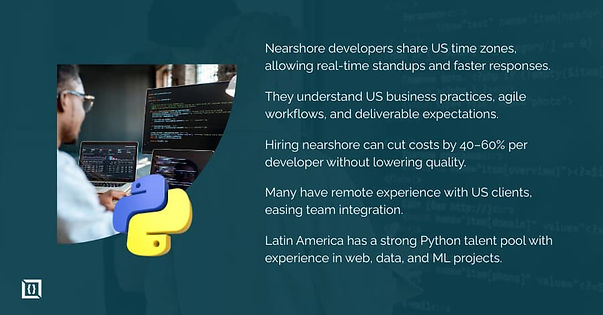
The operational advantage of nearshore over offshore hiring is real-time collaboration. Colombian developers work in EST or one hour behind. Mexican developers overlap with Central and Pacific time zones. Brazilian teams align with Eastern time.
This allows you to run standups in real time, review code the same day, and get answers quickly when blockers arise. In contrast, offshore teams in Eastern Europe or Asia often work many hours ahead or behind, which can delay responses and slow progress.
Cultural alignment also makes a difference. Developers in Latin America who have worked with US clients are familiar with common business practices, agile workflows, and expectations around meetings and deliverables. Onboarding tends to be smoother, and there are fewer misunderstandings about timelines or tasks.
2. Cost-Effective Development Without Compromising Quality
A senior Python developer in the US typically earns $140,000–$180,000 per year. In Colombia, a comparable developer usually costs $50,000-$75,000. Mexico and Argentina are in similar ranges, with some variation depending on city and specialization.
This represents a 40-60% difference per developer. Across a small team, these savings can be significant, without lowering technical standards. The goal is not simply lower cost, but access to regions where experienced, well-trained developers can work at salaries aligned with local living costs. Many have prior experience with US clients and understand expectations around code quality and timely delivery.
3. Access to a Skilled Talent Pool
Latin America has a mature tech sector. Colombia, Mexico, Brazil, and Argentina have established computer science programs, coding bootcamps, and active developer communities. Cities like Medellín, Mexico City, Buenos Aires, and São Paulo have strong Python ecosystems with regular meetups and open-source contributions.
Python specifically is well-represented in the region. The language's popularity for web development, data science, and automation means there's a deep pool of developers with relevant experience. Many have worked on Django and Flask applications, data pipelines, machine learning models, and API development for US and European clients.
Nearshore Python Development Services
Python's versatility means nearshore teams can handle a wide range of project types. Here's what's typically available.
Custom Software Development
Most engagements involve building custom applications tailored to specific business requirements. This includes internal tools, customer-facing platforms, workflow automation systems, and integrations between existing software.
Nearshore teams work with your specifications to design, build, and deploy solutions that fit your business logic. They handle everything from initial architecture through testing and deployment, or they can pick up work on existing codebases.
AI and Machine Learning Solutions
Python dominates the machine learning ecosystem. TensorFlow, PyTorch, scikit-learn, and pandas make it the default choice for ML work.
Nearshore Python teams build predictive models, recommendation systems, natural language processing applications, and computer vision solutions. Use cases include demand forecasting, customer churn prediction, content recommendation, sentiment analysis, and document classification.
These projects require developers who understand both the ML frameworks and the engineering practices needed to deploy models in production: data pipelines, model serving, monitoring, and iteration.
Data Engineering and Analytics
Python is a core tool for data engineering. Nearshore teams build ETL pipelines, data warehouses, and analytics dashboards using tools like Apache Airflow, dbt, and pandas.
Typical projects include consolidating data from multiple sources, building automated reporting systems, creating real-time analytics pipelines, and setting up data infrastructure for machine learning workloads. The goal is turning raw data into reliable, queryable assets that support business decisions.
Web Application Development
Django and Flask are the primary Python web frameworks. Django provides a batteries-included approach for complex applications with authentication, admin panels, and ORM built in. Flask offers more flexibility for lighter applications or microservices.
Nearshore teams build SaaS platforms, internal dashboards, API backends, content management systems, and e-commerce applications. They handle both greenfield projects and work on existing Django or Flask codebases.
Mobile App Development
Python isn't a primary mobile language, but it plays a supporting role. Backend APIs built in Python power mobile applications. Frameworks like Kivy enable cross-platform mobile development, though this is less common than native or React Native approaches.
More typically, nearshore Python teams build the backend services that mobile apps consume: user authentication, data storage, push notifications, and business logic APIs.
Chatbot and Automation Projects
Python is well-suited for automation. Nearshore teams can build chatbots with frameworks like Rasa or integrate with platforms such as Slack and Microsoft Teams. They can also implement robotic process automation (RPA) to handle repetitive tasks like data entry, report generation, system integrations, and workflow triggers.
These solutions reduce routine work and allow internal teams to focus on higher-value tasks. Python’s libraries make it easy to connect to APIs, process documents, and manage multi-step workflows efficiently.
Engagement Models to Fit Your Business
Different project types call for different engagement structures. Here are the common options.
Dedicated Python Developers
Dedicated developers work exclusively on your project for an extended period. They become part of your team, learn your codebase, and build context over time.
This model works best for ongoing product development where continuity matters. You get consistent developers who understand your business and improve their contributions as they gain context. Typical arrangements run month-to-month with notice periods for changes.
Staff Augmentation
Staff augmentation adds individual developers to your existing team to fill skill gaps or handle increased workload. The developers work under your management, use your tools, and follow your processes.
This model suits situations where you have technical leadership in place and need to scale execution capacity. You maintain control over priorities and workflow while adding specialized skills you don't have in-house.
Project-Based Outsourcing
For defined projects with clear scope, project-based engagement makes sense. You specify requirements, agree on deliverables and timeline, and the nearshore team handles execution end-to-end.
This works well for MVPs, proof-of-concept builds, specific feature development, or migrations. You get a fixed scope and predictable costs without the overhead of managing individual developers.
How to Hire the Right Nearshore Python Developer
Finding the right Python developer begins with understanding exactly what your project requires. Identify the skills, experience, and workflows needed before reviewing candidates or starting interviews.
1. Define Your Project Goals and Scope
Before talking to candidates or agencies, clarify what you need. Document your tech stack, project objectives, timeline, and team structure. Specify whether you need web development, data engineering, ML expertise, or general Python skills.
Clear requirements speed up hiring and improve candidate matching. Vague briefs lead to misaligned candidates and wasted interview time.
2. Evaluate Technical and Soft Skills
Review candidates' technical backgrounds: GitHub repositories, past projects, and familiarity with your stack. Look for experience with the specific frameworks and tools you use.
Soft skills matter for remote work. Assess communication clarity, responsiveness, and English proficiency during interviews. Ask about their experience working with distributed teams and handling async communication.
3. Conduct Live Coding or Test Assignments
Technical interviews should include hands-on evaluation. Live coding sessions reveal how candidates think through problems, write code, and handle feedback. Take-home assignments show how they approach larger tasks independently.
Use exercises relevant to your actual work. If you're building Django applications, test Django knowledge. If you need data engineering, evaluate their approach to pipeline design and data quality.
4. Check for Nearshore Collaboration Experience
Experience with remote work is valuable. Developers who have worked with US clients are familiar with meeting norms, communication patterns, and delivery expectations, making it easier for them to integrate into your team.
Ask about experience with Agile workflows, sprint planning, and tools like Jira, Slack, and GitHub. Familiarity with these processes reduces onboarding time.
5. Review Contracts and Onboarding Process
Before signing, review contract terms carefully: billing structure, IP ownership, confidentiality, and termination clauses. Ensure that all work produced belongs to you.
Ask about the onboarding process. A structured approach to access provisioning, tool setup, and team introductions helps developers contribute sooner and reduces ramp-up time.
Benefits of Nearshore Python Development
1. Faster Turnaround Times
Time zone overlap enables rapid iteration. You can discuss requirements in the morning, review work in the afternoon, and start the next day with updated code. This feedback loop speeds up development compared to async-heavy offshore arrangements.
Agile sprints run more smoothly when the whole team can attend ceremonies together. Daily standups, sprint planning, and retrospectives happen in real time rather than through recordings or written summaries.
2. Streamlined Collaboration with Agile Teams
Most nearshore developers are familiar with agile methodologies. They've worked in sprints, participated in code reviews, and used standard tools like Jira and GitHub.
This familiarity means less time teaching process and more time building product. Teams can integrate nearshore developers into existing workflows without major adjustments.
3. Lower Development Risks
Nearshore arrangements reduce several risk factors. Easier oversight through real-time communication means problems surface faster. Shared language reduces misunderstandings about requirements. Cultural familiarity means fewer surprises about work styles or expectations.
You also maintain more control than with fully outsourced offshore projects. The ability to collaborate synchronously means you can course-correct quickly when something isn't working.
Your Next Move
Nearshore hiring works when you're clear about what the role requires. Define the project scope, identify the technical skills you need, and decide whether you want a dedicated developer, staff augmentation, or project-based engagement.
Once those decisions are made, the process moves quickly. You can review candidates, run technical evaluations, and start onboarding within a few weeks. The time zone alignment means collaboration starts smoothly from day one.
You can also reach out to us to discuss your project requirements and explore how a nearshore Python team could support your development needs.
Frequently Asked Questions
What is the difference between nearshore and offshore developers?
Nearshore refers to hiring in nearby countries with similar time zones. For US companies, this typically means Latin America. Offshore refers to hiring in distant regions like Eastern Europe or Asia with significant time differences. The main distinctions are time zone overlap and communication ease.
How much does it cost to hire a nearshore Python developer?
Rates vary by country and seniority. General ranges: Mexico ($35-60/hr), Colombia ($30-55/hr), Argentina ($25-50/hr), Brazil ($35-65/hr). Senior developers and specialists (ML, data engineering) command higher rates. These figures are estimates; actual rates depend on experience and project requirements.
What are the benefits of hiring Python developers nearshore?
The main benefits are time zone alignment for real-time collaboration, cost savings of 30-40% compared to US hires, access to experienced developers familiar with US business practices, and reduced communication friction compared to offshore alternatives.
How do I ensure quality when hiring nearshore developers?
Vet candidates through technical assessments, portfolio review, and reference checks. Look for prior experience with US clients and familiarity with agile practices. Establish clear KPIs and communication expectations upfront. Use code reviews and regular check-ins to maintain quality throughout the engagement.