Hire Nearshore Twilio Video Integration Developer

Real-time video is a core feature for many applications, but ensuring it works reliably at scale involves complex engineering. Twilio’s Video SDK and WebRTC protocols provide the foundation, yet building stable and production-ready systems relies on specialized skills.
A Twilio Video integration developer manages everything from frontend UI implementation to secure backend token generation, room lifecycle management, and scaling logic. They handle multiparty sessions, implement reconnection strategies, and set up monitoring to catch issues before users notice them.
Let’s explore what the role involves, why specialized experience matters, and how to evaluate, plan, and scope a successful video integration project.
What Does a Twilio Video Integration Developer Do?
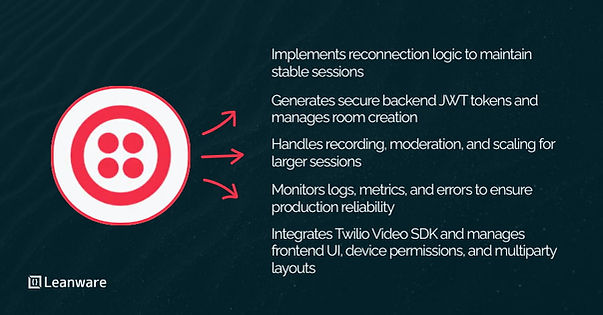
Twilio Video developers handle the full stack, building video features that are stable, secure, and scalable. Their work covers frontend implementation, backend token and room management, and infrastructure monitoring to ensure smooth performance in real-world conditions.
Frontend Responsibilities
The frontend developer implements the Twilio Video SDK into web browsers or mobile apps. This includes handling device permissions for camera and microphone access, managing UI states for connecting and connected participants, and building layouts that adapt to different participant numbers.
Screen sharing requires additional configuration beyond basic video. The developer handles the media stream differently and manages UI changes when participants switch modes. Multiparty layouts become complex as you add participants, requiring code that handles transitions smoothly.
Browser constraints create real challenges. Safari handles WebRTC differently than Chrome. Mobile browsers restrict autoplay and background video. The developer tests across browsers and devices, then implements fallbacks for edge cases.
Reconnection logic separates production-ready implementations from basic prototypes. When a user's network drops briefly, the app should automatically reconnect without requiring a page refresh. This means tracking connection states, implementing exponential backoff, and updating UI to show users what's happening.
Backend Responsibilities
The backend generates access tokens that authenticate users and authorize them to join specific rooms. These tokens use JWT format and must be generated server-side using your Twilio account credentials. Exposing credentials on the frontend would let anyone create tokens and join any room.
Token generation includes setting identity, room name, and permissions. The tokens also need expiration times. Most implementations use short-lived tokens (1-2 hours) and refresh them as needed.
Room creation happens through the backend as well. The code determines whether to create a new room or return an existing one based on your application logic.
Webhooks provide server-side visibility into room events. Twilio sends events when participants join, leave, or when recording completes. Your backend needs endpoints to receive these webhooks, verify they came from Twilio, and take appropriate actions.
Production-Grade Features
Recording requires backend logic to manage the recording lifecycle and download resulting files after sessions end. Twilio stores recordings temporarily, so you need infrastructure to move them to your storage.
Moderation features let you control room behavior, including removing disruptive participants or ending rooms. The backend needs APIs to handle these actions based on permissions.
Scaling beyond four or five participants requires understanding Twilio's SFU architecture. You need to make decisions about video quality, bandwidth adaptation, and room size limits based on your use case.
Observability means instrumenting your code to capture metrics, logs, and errors. When video doesn't work, you need to see what happened through connection logs, token generation records, and error tracking.
Why Twilio Video Requires Specialized Experience
WebRTC involves complex network negotiation protocols that most web developers haven't encountered. The technology works differently than standard HTTP requests.
Common Video Integration Failures
Token expiration errors happen when developers don't implement token refresh logic. Users join successfully but get kicked out when tokens expire. The app needs to detect expiration before it happens and request new tokens.
Firewall and network restrictions block WebRTC traffic in corporate environments. The connection flow tries to establish direct peer connections, but when that fails, it needs to fall back to TURN servers. Video works at home but fails at the office.
Reconnection failures cause users to get stuck in bad states. Their network drops briefly, but instead of automatically reconnecting, they see frozen screens. Production implementations need robust state management.
Scaling issues surface when you test with two participants but deploy for ten-person calls. CPU usage spikes, video quality degrades, and users start dropping. The developer needs to understand bandwidth adaptation and how to limit participants or reduce video resolution.
Permission handling creates failures on mobile browsers. If the app doesn't properly request camera and microphone permissions or doesn't handle denial gracefully, users can't join calls.
Why Hire Nearshore
Nearshore developers provide time zone alignment that makes real-time collaboration practical. When a production issue hits at 2pm EST, you can immediately get on a call with your development team to debug rather than waiting 12 hours for offshore teams to wake up.
Real-time debugging matters more for video features than almost any other integration. Video issues often depend on specific network conditions, device combinations, or user behaviors that require live testing to reproduce. Having developers available during your business hours accelerates troubleshooting significantly.
Iteration cycles move faster with time zone overlap. When you review a pull request in the morning, the developer can address feedback the same day. This tight feedback loop helps maintain momentum on video features that often require multiple rounds of testing and refinement.
Nearshore developers in Latin America cost 40-65% less than US developers while providing similar expertise. Average rates range from $40-$85 per hour for senior developers, compared to $110-$160 for equivalent US talent. The cost difference becomes substantial on multi-month video integration projects without sacrificing the seniority level you need.
Key Skills to Look For
When evaluating Twilio Video developers, focus on hands-on experience rather than a general software background. A strong candidate should have:
- Experience with Twilio Video SDK on web, iOS, or Android.
- Understanding of WebRTC: ICE, STUN, TURN, and real-time streaming.
- Backend skills for secure JWT token generation and refresh.
- Real-time systems knowledge: connection states, reconnections, concurrent users.
- Ability to debug network and video issues with developer tools and Twilio diagnostics.
- CI/CD experience for safe, reliable video deployments.
- Video quality optimization: bandwidth adaptation, resolution scaling, codec selection.
Look for developers who can explain how they've debugged production video issues in the past. The specific problems they solved matter more than certifications or years of general experience.
Interview Questions
Use scenario-based questions that show how candidates think through real problems.
Scenario: A user reports that video works fine for the first 20 minutes of a call, then they get disconnected. What are three possible causes and how would you debug this?
Good answers mention token expiration, network changes, or memory leaks. The candidate should describe using browser console logs, checking token expiration times, and monitoring network connection states.
Scenario: Your application needs to support calls with up to 10 participants, but performance degrades badly after 6 people join. What strategies would you use to improve this?
Strong candidates discuss simulcast, reducing video resolution, implementing active speaker detection to show fewer videos simultaneously, or using audio-only mode for some participants. They should understand the bandwidth and CPU constraints involved.
Scenario: Video calls work perfectly in your office but users report frequent connection failures when working from home. What debugging steps would you take?
Look for answers about network diagnostics, checking if TURN servers are configured properly, examining firewall rules, and potentially implementing a pre-call test to validate connectivity before joining the room.
Project Scope & Timeline
A basic MVP integration typically takes 4-8 weeks. This includes implementing the Twilio SDK for one platform, basic room joining, video display for up to four participants, and simple token generation. The MVP gets video working but lacks production polish.
Advanced implementations run 8-16+ weeks. These projects include multiple platforms, recording, screen sharing, custom layouts, comprehensive error handling, reconnection logic, and monitoring. The timeline extends for HIPAA compliance or custom moderation tools.
Platform scope drives timeline significantly. Building for web only is fastest. Adding iOS or Android roughly doubles implementation time per platform.
Recording adds 2-3 weeks to handle the full lifecycle. Compliance requirements like HIPAA extend timelines by 3-6 weeks for security audits, encryption verification, and documentation.
Cost Considerations
When comparing development options, focus on total value rather than just hourly rates.
- Nearshore rates: $30-$92/hr depending on location and seniority. A three-developer team (two mid-level, one senior) typically costs $45K-$65K for a three-month project.
- Onshore US rates: The same project would cost $90K-$145K, meaning nearshore can save $45K–$80K while keeping quality and collaboration effective.
- Maintenance: Video infrastructure needs ongoing attention - browser updates, new Twilio SDK versions, and user growth. A nearshore retainer runs $6K-$12K/month versus $15K-$25K/month for onshore teams.
- Offshore in Asia: Lower hourly rates ($25–$60) often come with delays. Time zone gaps can push issue resolution to the next day, extending timelines, increasing rework, and causing frustration.
Twilio vs Alternatives
Twilio provides managed infrastructure - including TURN servers, media routing, and SDKs for web and mobile - so you can focus on application logic while it handles the WebRTC backend. Pricing is $0.004 per participant per minute.
Daily.co offers similar functionality, with extras like built-in recording and transcription. Their pricing is based on monthly active rooms rather than per-minute usage.
Agora focuses on low latency and supporting higher participant counts, making it a good choice for applications where quality at scale is critical.
Building WebRTC from scratch requires creating signaling servers, media routing, NAT traversal, and scaling infrastructure. This approach makes sense only for very specific needs or massive scale. For most projects, using a managed platform is more practical.
Security & Compliance
Access tokens must be generated on the backend using your Twilio credentials. Never embed credentials in frontend code. Each token should be short-lived (1-2 hours maximum) and tied to a specific user identity and room.
Role-based access controls determine what users can do in rooms. Implement these controls in token generation logic and verify permissions on the backend.
HIPAA compliance requires business associate agreements with Twilio, encrypted transport for all media, access logging for audit trails, and proper data retention policies. Your application needs to ensure PHI isn't exposed through recording file names or room names.
Logging should capture security-relevant events without storing sensitive data. Log authentication attempts, room joins and leaves, and permission changes.
Encrypted transport happens automatically with Twilio, but ensure your entire application uses HTTPS and recording storage encrypts data at rest.
How Leanware Helps
Building video features requires architectural thinking beyond just implementing Twilio’s SDK. At Leanware, the approach begins with understanding how video fits into the broader application architecture, including authentication flows, database design, user permission models, and feature integration.
Stability comes from proper error handling, reconnection logic, and monitoring. Implementations include comprehensive logging for debugging production issues and analytics that track video quality metrics.
Scalability planning happens upfront. The architecture considers growth from 10 concurrent calls to 1,000 without a full rewrite, covering database design, token generation performance, and webhook handling at scale.
Long-term maintenance focuses on lasting reliability rather than just initial delivery. Code follows patterns that make updates simple when Twilio releases new SDK versions or when requirements change.
Moving Forward
A reliable video integration depends on a developer who understands the intricacies of real-time media and network negotiation. Moving beyond a basic integration requires a focus on secure backend logic, strong client-side error handling, and production monitoring.
By selecting a specialized nearshore partner, you ensure your application provides a stable and professional communication experience for your users.
Connect with our engineering experts to find a nearshore Twilio Video developer who can build a stable, scalable, and secure communication infrastructure for your application.
Frequently Asked Questions
What does a Twilio Video integration developer do?
A Twilio Video integration developer builds, configures, and maintains real-time video communication features using Twilio's Video SDK. They handle frontend UI implementation, backend token generation, room management, security implementation, reconnection logic, recording features, and production monitoring across web and mobile platforms.
How long does it take to integrate Twilio Video into an application?
A basic MVP integration typically takes 4-8 weeks depending on platform scope and feature complexity. Advanced implementations with recording, moderation, analytics, and compliance requirements take 8-16 weeks. Timeline factors include number of platforms (web, iOS, Android), participant capacity, and integration with existing systems.
Why is Twilio Video integration complex?
Twilio Video builds on WebRTC, which involves network negotiation through ICE, STUN, and TURN protocols, bandwidth adaptation, device permission handling, and real-time media streaming. Production-grade implementations require careful handling of reconnection logic, token security, multiparty scaling, network diagnostics, and comprehensive monitoring.
What skills should a Twilio Video developer have?
Look for direct experience with Twilio Video SDK across web or mobile platforms, strong understanding of WebRTC fundamentals, backend experience generating secure JWT access tokens, knowledge of real-time systems and scalability patterns, and experience debugging network-related video issues using diagnostic tools.
What is the role of access tokens in Twilio Video?
Access tokens authenticate users and authorize them to join specific video rooms. They're generated securely on the backend using Twilio credentials and include user identity, room permissions, and expiration rules. Tokens must never be generated on the frontend to prevent unauthorized access.
How do you secure a Twilio Video implementation?
Security requires generating tokens server-side only, setting short expiration times (1-2 hours), enforcing role-based room access controls, using HTTPS throughout the application, implementing access logging for audit trails, and properly securing webhook endpoints that receive Twilio events.
What are common production issues with Twilio Video?
Common issues include audio or video failing to connect due to firewall restrictions, users getting disconnected during network changes, token expiration errors that aren't handled gracefully, performance degradation in multiparty rooms, and poor UI handling of camera and microphone permission states on mobile devices.
When should you hire a dedicated Twilio Video developer?
Hire a specialist when video is core to your product (telehealth, education, support platforms), you need scalable multiparty calls beyond basic two-person video, you require recording and compliance features, or you've experienced instability in production that general developers haven't been able to resolve.
Is nearshore hiring a good option for Twilio Video projects?
Yes. Nearshore developers provide time zone alignment for real-time debugging collaboration, faster iteration cycles compared to offshore teams, substantially lower costs than onshore developers (40-65% savings), and equivalent technical expertise for WebRTC and Twilio integration work.
What is the difference between Twilio Video and building WebRTC from scratch?
Twilio provides managed infrastructure including TURN servers for NAT traversal, media routing and optimization, ready-to-use SDKs for web and mobile, and handles scaling automatically. Building WebRTC from scratch requires implementing signaling servers, media routing logic, TURN server infrastructure, scaling architecture, and comprehensive monitoring independently, which takes significantly more time and expertise.