Hybrid AI + RPA Automation: Architecture, Cases, and Patterns

Businesses need automation, but both major approaches have critical flaws. Traditional RPA breaks when interfaces change, with maintenance consuming up to 60% of implementation costs. AI produces inconsistent outputs that regulated industries cannot tolerate. Neither works well alone, which explains why 30 to 50% of initial RPA projects fail, according to EY.
The hybrid approach combines them: AI handles interpretation and decision-making while RPA handles deterministic execution. This guide covers the architecture, design patterns, and operational considerations for building systems that balance intelligence with reliability.
Why Pure RPA and Pure AI Are Not Enough
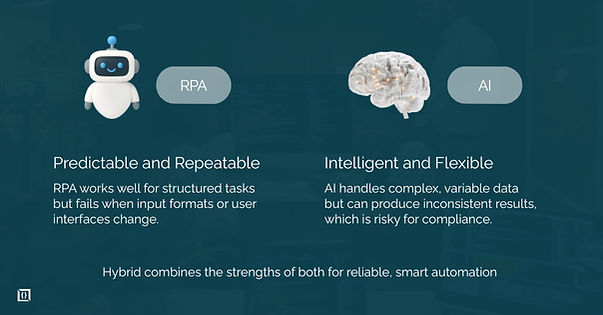
Automation is not binary. Most business processes need both determinism (predictable, repeatable execution) and intelligence (handling variance, interpreting context). Pure RPA delivers the first but fails at the second. Pure AI offers intelligence but introduces unpredictability that regulated industries cannot tolerate.
The RPA problem is brittleness. Teams deploy bots that work initially, then break when a vendor changes their invoice format or an ERP upgrade shifts a UI element. Every exception requires a new rule until maintenance costs consume the original savings.
The AI problem is consistency. Language models can classify documents or extract data, but they produce probabilistic outputs. The same contract clause might get classified differently on Tuesday than Monday. For compliance workflows, financial transactions, or audit trails, "usually correct" is not acceptable. Regulators require explainable, repeatable decisions.
Neither technology solves both problems. That gap is why hybrid architectures exist.
The Limits of Traditional RPA
Traditional RPA delivers speed and consistency, but only within tightly controlled conditions. As soon as processes involve variability, changing interfaces, or unstructured data, rule-based automation becomes fragile and expensive to maintain. These limits show up quickly in real production environments.
Rule-Based Automation and Its Brittleness
Traditional RPA delivers speed and consistency when processes stay stable and predictable. Once inputs vary, interfaces change, or unstructured data enters the flow, rule-based automation becomes brittle and costly to maintain. These limitations surface quickly in real production systems.
This brittleness compounds at scale. Each exception requires a new rule. Eventually, the rule set becomes so complex that maintenance costs exceed the original labor savings.
Maintenance Overhead and Script Fragility
Every UI change requires script updates. An ERP upgrade can break dozens of bots simultaneously.
This creates "automation debt." Teams spend more time fixing broken bots than building new ones.
Inability to Handle Unstructured Inputs
Traditional RPA cannot interpret emails with varied formatting, PDFs with inconsistent layouts, or customer inquiries requiring judgment. It processes structured data well but hits a wall with anything requiring understanding.
The Limits of AI-Only Automation
AI brings flexibility and pattern recognition, but it lacks the determinism and transparency required for many operational workflows. In isolation, AI struggles with repeatability, auditability, and risk control, which makes it unsuitable as the sole execution engine for business-critical automation.
Non-Deterministic Behavior in Business-Critical Workflows
AI outputs are probabilistic. The same input can produce different outputs across runs. For compliance, financial transactions, or legal processes, this inconsistency is unacceptable.
An LLM might classify the same contract clause differently on Tuesday than it did on Monday.
Explainability and Auditability Challenges
Regulated industries require decision trails. GDPR and CCPA include "right to explanation" provisions.
When AI makes decisions as a black box, compliance teams cannot demonstrate why a specific outcome occurred. Auditors need more than "the model said so."
Risk of Hallucinations and Inconsistent Outputs
AI can fabricate plausible-sounding but incorrect information. In business contexts, this might mean generating fake invoice numbers, fabricating vendor details, or producing contradictory classifications.
Without validation layers, these errors propagate into downstream systems.
What Is Hybrid AI + RPA Automation?
Hybrid AI + RPA combines AI for interpretation and understanding with RPA for execution and integration. The core principle: use each technology for what it does best.
AI handles the messy parts by reading varied document formats, classifying intent, and making judgment calls on edge cases, while RPA handles the precise parts by entering data into systems, triggering workflows, and enforcing business rules without deviation.
Division of Responsibilities
In a hybrid architecture, AI handles understanding and interpretation, while RPA focuses on controlled execution and enforcement. Keeping this separation clear improves reliability and auditability.
Component | AI Handles | RPA Handles |
Input Processing | Interpret, extract, classify | Validate format, enforce schema |
Decision Making | Score confidence, recommend action | Apply business rules, route based on thresholds |
Execution | None | System updates, API calls, UI automation |
Compliance | Generate explanations | Log actions, enforce audit trails |
Why Hybrid Systems Are More Reliable
The combination creates checks and balances. AI flexibility handles variance in inputs: different document formats, inconsistent field layouts, ambiguous language. RPA consistency ensures reliable execution: the same steps run the same way every time, with complete audit trails.
When AI confidence drops below threshold, the system routes to human review rather than proceeding with uncertain data. When RPA encounters an exception it cannot handle, AI can interpret the situation and determine the appropriate path. Each technology compensates for the other's weakness.
Where AI Fits in Hybrid Architecture
AI is used where interpretation and judgment are required. It turns unstructured or ambiguous inputs into structured outputs that downstream automation can execute reliably.
Document Understanding and Data Extraction
AI handles extracting data from varied document formats. OCR combined with language models can process invoices, contracts, and forms regardless of layout. Azure Document Intelligence and multimodal LLMs can manage documents that would otherwise require dozens of RPA templates.
Intent Classification and Decision Support
Email triage, support ticket routing, and case prioritization benefit from AI's ability to interpret meaning. The AI classifies intent; RPA executes the appropriate response based on that classification.
Exception Handling and Edge-Case Reasoning
Most processes have a long tail of exceptions. AI serves as the "escalation resolver" for the 15 to 20% of cases that do not fit standard rules. A customer refund request with complex circumstances gets AI analysis before RPA processes the transaction.
Where RPA Fits in Hybrid Architecture
RPA takes over once decisions are defined, executing actions with precision and consistency. It integrates systems, applies rules, and enforces compliance without introducing variability.
Deterministic Task Execution
After AI makes a decision, RPA ensures consistent execution. Data entry, status updates, and transaction posting happen the same way every time, with no variance introduced. This predictability is essential for audit trails and regulatory compliance.
System-to-System Integration
RPA handles legacy system integration where APIs do not exist. SAP updates, Salesforce record creation, and mainframe interactions often require UI automation that RPA performs reliably. Many enterprise systems were built before API-first architecture became standard.
Enforcing Business Rules and Compliance Steps
RPA ensures regulatory steps never get skipped. Audit logging happens on every transaction. Approval workflows follow defined sequences.
Compliance checks execute without exception. Unlike human operators, bots do not take shortcuts under time pressure.
Hybrid System Architecture
A hybrid system layers orchestration, AI, and RPA to ensure both intelligent interpretation and reliable execution. Clear separation of responsibilities and powerful error handling are key to operational stability.
Orchestration Layer
Entry points include scheduled jobs, event triggers, and API calls. Orchestration tools like Apache Airflow, Azure Logic Apps, or UiPath Orchestrator manage workflow sequencing and handle parallel execution. This layer decides what runs, when, and in what order.
AI Decision Layer
AI components integrate via API calls to LLM services or hosted models. Prompt engineering determines output quality.
Confidence thresholds route low-confidence results to human review rather than automated processing. This layer interprets; it does not execute.
RPA Execution Layer
The bot framework handles attended versus unattended execution. Integration points receive AI outputs and execute corresponding actions in target systems. This layer acts on decisions made upstream.
State Management and Error Handling
Reliability requires transaction logs, state persistence, and retry logic. When AI services fail or RPA execution errors occur, the system must recover gracefully.
Circuit breakers prevent cascading failures. Without proper state management, partial failures become data integrity problems.
Logging and Observability
End-to-end traceability captures AI decisions, RPA actions, and data transformations. Compliance documentation requires complete audit trails. Dashboards surface execution metrics and error patterns. If you cannot see what happened, you cannot fix what broke.
Common Use Cases
1. Invoice and Document Processing
AI extracts data from varied PDF formats. RPA validates against business rules and posts to accounting systems.
This combination achieves 90 to 95% accuracy versus 60 to 70% with pure RPA approaches. The AI handles layout variance; RPA handles the posting.
2. Customer Support and Case Management
AI classifies and routes tickets based on intent. RPA executes standard resolutions: refund processing, account changes, password resets. Response times drop significantly when routine cases resolve automatically. Agents focus on complex issues instead of repetitive requests.
3. Finance and Reconciliation
AI matches transactions using fuzzy logic when exact matches fail. RPA updates ledgers and generates reports.
Bank reconciliation and expense processing benefit from AI's ability to handle variance in transaction descriptions. Exact string matching fails when descriptions differ slightly.
4. HR and Employee Lifecycle
AI screens resumes and answers employee questions. RPA handles onboarding tasks: system provisioning, benefits enrollment, document generation. New hires get access to systems on day one instead of waiting for manual processing.
Design Patterns
Hybrid automation follows repeatable patterns: AI can prepare inputs, handle exceptions, or escalate to humans, while RPA executes standard flows. These patterns help structure workflows efficiently without overcomplicating the system.
AI as Pre-Processor
AI interprets input and standardizes data before RPA executes. Best for document processing and email automation where input formats vary, but execution steps are consistent. The AI normalizes chaos into structure.
AI as Exception Handler
RPA executes standard processes and escalates exceptions to AI. Best for high-volume workflows with occasional complexity. The majority of cases flow through fast RPA paths; edge cases get AI analysis. This keeps throughput high while handling outliers.
Human-in-the-Loop Escalation
When AI confidence scores fall below threshold or risk levels exceed tolerance, route to human review.
Design approval workflows that capture human decisions for model improvement. Human corrections become training data for better future performance.
Fallback Mechanisms
If AI services fail, route to human queues rather than blocking. Circuit breakers prevent overload. Degraded mode operation maintains business continuity during outages.
Never let an API timeout halt business-critical processes.
Operational Challenges
Running AI and RPA together creates dependencies between decision-making and execution layers, which can introduce latency, monitoring complexities, and versioning challenges.
- Latency Constraints: AI inference adds 200ms to 2s per call. High-volume workflows need batching, caching, and async processing to maintain throughput.
- Monitoring Differences: AI requires accuracy tracking and drift detection. RPA needs execution success rates and error logs. Unified dashboards must surface both.
- Version Coordination: Model updates can change outputs. RPA scripts may need synchronized updates. Shadow mode testing validates changes before production deployment.
Governance and Compliance
Hybrid systems must balance flexibility with control. Logging, consistency, and security measures ensure AI decisions are traceable, outputs remain predictable, and sensitive data is protected.
Auditability Requirements
Log AI reasoning without exposing sensitive prompts. Capture decision inputs, confidence scores, and routing logic.
Maintain data lineage from input to final action. Regulators want to see why a decision was made, not just what it was.
Controlling AI Variability
Use deterministic temperature settings for consistent outputs. Version prompts alongside code. Validate outputs against expected formats before execution. Production AI should behave predictably, not creatively.
Security Considerations
Manage API keys through secrets vaults. Encrypt data in transit and at rest. Prevent prompt injection attacks through input validation. User-supplied content should never become executable instructions.
When Hybrid Makes Sense (and When It Does Not)
Hybrid automation works best where processes have enough volume and variability to justify AI, while low-variance, stable workflows are better suited to pure RPA. Clear assessment of process characteristics guides the right approach.
Good Fit: High-Volume, Semi-Structured Processes
Enough volume to justify automation investment. Enough variance to need AI interpretation. Invoice processing and customer service fit this profile. If you are processing thousands of documents with dozens of formats, hybrid pays off.
Pure RPA Sufficient: Low-Variance Processes
When inputs are identical and systems are stable, adding AI complexity provides no benefit. Simple data movement between stable systems works fine with RPA alone. Do not add AI just because you can.
Decision Framework:
Process Characteristic | Recommendation |
High volume, variable inputs | Hybrid AI + RPA |
High volume, identical inputs | Pure RPA |
Low volume, complex judgment | Human with AI assistance |
Unstable underlying systems | Stabilize before automating |
Best Practices
Effective hybrid automation depends on a strong foundation, careful incremental rollout, and built-in observability. Following these principles helps prevent common failures and ensures the system can scale reliably.
Start with Stable RPA Foundations
Do not add AI to broken RPA. Establish reliable baseline automation first. Identify where AI adds value based on actual failure patterns. AI amplifies what works; it does not fix what is broken.
Introduce AI Incrementally
Pilot with low-risk processes. Run shadow mode before production. Build confidence before scaling. One successful pilot builds more support than ten PowerPoint decks.
Design for Observability
Logging and monitoring from day one. Track AI accuracy, RPA success rates, end-to-end latency, and cost per transaction. You cannot improve what you cannot measure.
Fail Safely
Graceful degradation beats silent failure. Route to human queues when automation cannot proceed. Alert on anomalies.
Never lose transactions. A failed transaction that you know about is better than a silent data loss.
Your Next Move
AI and RPA complement each other. AI provides flexibility to handle variance. RPA provides consistency for reliable execution. The hybrid approach balances intelligence with reliability in ways neither technology achieves alone.
Implementation requires thoughtful architecture: clear responsibility boundaries, robust error handling, and comprehensive observability. The complexity is real, but so are the results when executed well.
You can connect with us for guidance on hybrid automation architecture, use case assessment, or production implementation planning.
Frequently Asked Questions
What tools work best for hybrid AI + RPA?
Some common setups are UiPath with OpenAI or Azure AI, and Automation Anywhere with different AI services. Cloud AI makes integration easier, while embedded models can cut down on latency. The complexity really depends on the workflow and platform you choose.
How much does hybrid AI + RPA implementation cost?
Costs cover RPA licenses ($5K–$15K per bot per year), AI API usage (depends on volume), development, and ongoing maintenance. A simple project might run $50K–$150K, while a full enterprise rollout can go over $500K.
What happens when AI makes wrong decisions?
You catch issues with confidence scoring, human review queues, and anomaly detection. Rollback procedures fix any incorrect actions, and audit logs plus alerts help track and contain the impact.
How long does implementation take?
A proof of concept typically takes 4-8 weeks. A single process in production can take 3–6 months, while an enterprise-wide rollout may run 6–18 months. Legacy systems or strict compliance requirements can extend these timelines.
Can I add AI to existing RPA bots?
Yes. You can integrate AI as a preprocessing step, an exception handler, or a data validator. Some processes might need partial rebuilds, but in many cases you can add AI incrementally.
How do you measure ROI versus pure RPA?
Look at more than just cost savings-check accuracy improvements, fewer exceptions, scalability, and lower maintenance overhead. In most cases, ROI starts to turn positive within 12–24 months.
What team skills are required?
You’ll typically need an RPA developer, an ML engineer or AI specialist, an integration architect, and someone for DevOps. For small projects, 2–3 people can manage; enterprise deployments often require 5–8.
How do you handle AI model drift?
Keep an eye on accuracy over time, watch for deviations with statistical checks, and retrain models on a schedule. You can do this without disrupting production workflows.
What compliance requirements apply?
Finance teams follow SOX for auditability, healthcare uses HIPAA for data privacy, and GDPR covers the right to explanation. Make sure your system logs decisions, tracks risk, and maintains proper documentation.
Can hybrid systems run on-premise?
Yes, but there are trade-offs. Smaller AI models can run on-premise with RPA, but large language models usually need cloud resources or significant GPUs.