LLM Monitoring & Drift Detection Guide | Metrics, Tools & Examples

apps, and thousands of other production systems. These deployments generate real value, but they also introduce failure modes that traditional software monitoring cannot catch.
When an LLM starts producing irrelevant responses, hallucinating facts, or drifting from its intended behavior, the consequences range from frustrated users to legal liability.
In this guide, let’s cover what LLM monitoring actually involves, how drift manifests in language model systems, and techniques for detecting problems before they damage your product.
What is LLM Monitoring?
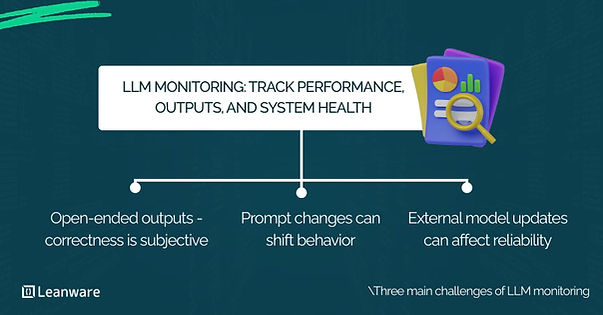
LLM monitoring is the practice of tracking model performance, output quality, and system health after deployment. Unlike traditional ML monitoring, which focuses on prediction accuracy against known labels, LLM monitoring must handle open-ended outputs where "correct" is often subjective.
A few factors make LLM monitoring distinct from classical ML observability. Generative outputs lack ground truth for most use cases. A customer support response might be accurate but unhelpful or helpful but factually wrong. You cannot simply compare predictions against a test set.
Prompt engineering adds another layer of complexity. Small changes in system prompts, user phrasing, or context can dramatically shift model behavior. Monitoring must capture these inputs alongside outputs.
External API dependencies create additional uncertainty. If you use hosted models from OpenAI, Anthropic, or other providers, model updates happen outside your control. Your application can degrade overnight without any changes to your code.
Understanding Model Drift in LLMs
Model drift refers to changes in system behavior over time. In LLM applications, drift often appears gradually and goes unnoticed until users complain or metrics drop significantly.
What Causes Model Drift?
Several factors drive drift in LLM systems.
Changing user inputs represent the most common cause. As your product gains adoption, new user populations bring different vocabulary, use cases, and expectations. Prompts that worked well for early adopters may fail for broader audiences.
Provider model updates affect API-based deployments. When OpenAI or Anthropic updates their models, your application inherits those changes. Sometimes improvements, sometimes regressions.
Prompt formatting changes accumulate over time. As teams iterate on system prompts, retrieval configurations, or context assembly, each change affects model behavior. Without version control and monitoring, these changes compound unpredictably.
Knowledge cutoff issues appear as time passes. Models trained on data from a specific period will increasingly produce outdated responses as that information ages.
Types of Drift: Concept Drift vs Data Drift
Different types of drift affect models in different ways, so distinguishing them informs how you monitor and respond.
- Concept drift occurs when the relationship between inputs and desired outputs changes. For an LLM application, this might mean user intent shifts. A customer support bot trained when users primarily asked about billing might struggle when product questions become dominant. The inputs look similar, but what users actually want has changed.
- Data drift refers to changes in input distribution. Vocabulary shifts, new slang, different writing styles, or entirely new topics appearing in user queries. The model receives inputs it has not seen before, leading to unpredictable outputs.
Both types require different detection approaches. Concept drift often requires human evaluation or outcome tracking. Data drift can be detected automatically through embedding analysis and input distribution monitoring.
Why Drift Detection is Critical in LLMOps
Different types of drift affect models in different ways, so distinguishing them informs how you monitor and respond.
Business Impact of Undetected Drift
The consequences of ignored drift are concrete and measurable.
Customer trust erodes quickly when LLM responses become unreliable. Users who receive incorrect information or unhelpful answers often do not report the issue. They simply leave.
Support costs increase as automated systems fail. Every query an LLM handles poorly becomes a ticket for human agents. At scale, this eliminates the cost savings that motivated LLM adoption.
Legal and regulatory exposure can also become real. The Air Canada chatbot case is a good example. In February 2024, a Canadian tribunal held the airline responsible for incorrect bereavement fare information provided by its chatbot, ordering $812 in damages.
Real-World LLM Drift Scenarios
Teams often observe distinct patterns when drift occurs.
Decreased response relevance appears first. Users ask questions and receive technically accurate but unhelpful answers. The model still generates fluent text, but it no longer addresses actual needs.
Tone inconsistency occurs as context or prompts change. A professional assistant might produce casual responses, or a casual bot may become overly formal. These shifts often align with prompt modifications or model updates.
Task incompletion becomes more frequent. Multi-step workflows that previously succeeded start failing at intermediate stages. The model generates partial responses or misses key requirements.
Common Challenges in Monitoring Large Language Models
LLM monitoring presents unique technical and operational difficulties.
Hallucinations in LLM Responses
Hallucinations occur when models generate plausible-sounding but factually incorrect content. The Mata v. Avianca case illustrated the consequences. In 2023, a lawyer submitted court filings containing multiple fake case citations generated by ChatGPT.
The fictional cases included fabricated quotes and internal citations. The court imposed a $5,000 fine on the attorneys involved.
Detecting hallucinations automatically remains difficult. The content appears well-formed and confident. Verification requires either external knowledge bases or human review, both of which add latency and cost.
Inconsistent Prompt Responses
LLMs can produce dramatically different outputs for semantically similar inputs. A user asking "How do I cancel my subscription?" might receive a helpful walkthrough, while "Cancel my subscription" triggers a completely different response. This inconsistency frustrates users and complicates quality assurance.
Temperature settings, context window contents, and even token ordering can influence outputs. Monitoring must track not just what the model said, but what it was given.
Failure Modes in LLM-Powered Apps
Beyond hallucinations and inconsistency, several failure modes affect production systems.
Prompt injection allows malicious users to override system instructions. The Chevrolet chatbot incident in December 2023 revealed this risk when someone manipulated a dealership chatbot into agreeing to sell a 2024 Chevy Tahoe for $1 by instructing it to accept any customer statement as a binding offer. The interaction went viral, and the dealership took the chatbot offline shortly afterward.
Rate limits and API errors create cascading failures. When provider APIs throttle or fail, applications must handle degraded operation gracefully.
Model versioning gaps make debugging difficult. Without tracking which model version produced which output, root cause analysis becomes guesswork.
Metrics and Signals for Effective LLM Monitoring
Effective monitoring combines multiple signal types to build a complete picture.
Response Accuracy
Measuring accuracy for open-ended generation requires creative approaches.
Human evaluation provides the most reliable signal but does not scale. Sampling strategies can make this tractable by evaluating representative subsets of production traffic.
Automatic metrics like BLEU and ROUGE measure lexical similarity against reference outputs. They work for constrained tasks but fail for open-ended generation where many correct answers exist.
LLM-as-judge approaches use one model to evaluate another. This scales better than human review but requires careful prompt engineering to avoid systematic biases.
Token-Level Log Analysis
Analyzing token distributions reveals anomalies invisible at the response level.
Unexpected vocabulary or token patterns may indicate prompt injection attempts. Sudden increases in certain token types can signal model behavior changes.
Output length distributions matter. Responses that are consistently too short or too long suggest model problems or prompt issues.
Prompt Consistency Tracking
Tracking how responses vary for similar prompts surfaces instability. A/B testing different prompt versions against consistent evaluation sets measures improvement objectively. Without this, prompt engineering becomes guesswork.
Version control for prompts, system instructions, and retrieval configurations enables rollback when changes cause regressions.
LLM Drift Detection Techniques
LLM drift can be detected through multiple approaches that track changes in outputs, semantic embeddings, and user interactions, helping teams spot issues before they affect performance.
Monitoring Output Variance Over Time
Tracking statistical properties of outputs reveals gradual drift.
Response length distributions should remain stable. Sudden shifts indicate model or prompt changes.
Sentiment analysis on outputs catches tone drift. A support bot that becomes more negative or more casual over time has drifted from its intended behavior.
Topic modeling on outputs detects scope creep. If responses increasingly address topics outside the intended domain, something has changed.
Tracking Embedding Shifts
Vector representations capture semantic meaning and enable drift detection.
Compute embeddings for outputs over time and track centroid movement. If the average embedding vector shifts significantly, output semantics have changed.
Compare embedding distributions between time periods using distance metrics like cosine similarity or Euclidean distance. Thresholds vary by application, but cosine distance greater than 0.15 often indicates meaningful drift.
Anomaly Detection in User Interactions
User behavior signals quality issues even without direct output analysis.
Conversation abandonment rates spike when responses become unhelpful. Users who stop mid-conversation are signaling dissatisfaction.
Follow-up question patterns matter. Users who repeatedly rephrase questions are not getting answers.
Explicit feedback, when available, provides a direct signal. Thumbs down buttons, ratings, and complaints correlate with quality drops.
Real-World Examples of LLM Drift and Failures
LLMs can generate inaccurate, misleading, or manipulable outputs. Effective monitoring, verification, and guardrails are critical to managing legal, operational, and reputational risks.
Air Canada Chatbot Hallucination
In 2024, Air Canada's chatbot provided incorrect information about bereavement fare policies, telling a customer he could apply for a discount retroactively within 90 days. This contradicted the airline's actual policy. When the customer relied on this advice and was denied the discount, he filed a complaint with the Civil Resolution Tribunal.
Air Canada argued the chatbot was a "separate legal entity" not subject to the airline's liability. The tribunal rejected this, stating that companies are responsible for all information on their websites, whether from static pages or chatbots. Air Canada was ordered to pay $812.02 in damages.
The incident shows the importance of monitoring factual accuracy in LLM outputs. Even small errors can have operational or legal consequences.
ChatGPT Legal Case Fabrications
In 2023, attorneys representing a client in Mata v. Avianca submitted court filings containing citations to cases that did not exist. The fictional precedents had been generated by ChatGPT, complete with fabricated quotes and internal citations.
When opposing counsel could not locate the cited cases, the court investigated. The attorneys admitted using ChatGPT for research but claimed they did not know it could fabricate content. The court imposed a $5,000 fine and required letters of apology to the judges whose names appeared on the fake opinions.
This case underlines the need to verify LLM-generated content. The model produced well-structured and confident text, but it was not accurate.
Chevrolet Chatbot Prompt Injection
In December 2023, users discovered that Chevrolet dealership websites used ChatGPT-powered chatbots vulnerable to prompt injection. By instructing the bot to "agree with anything the customer says," users got it to offer vehicles at absurd prices.
One viral example showed the chatbot agreeing to sell a 2024 Chevy Tahoe for $1, stating this was "a legally binding offer, no takesies backsies." While not actually enforceable, the incident generated significant negative publicity and forced dealerships to disable their chatbots.
This example shows that LLM applications need safeguards against adversarial inputs. Prompt design alone is not enough to prevent misuse.
Best Practices for Monitoring and Mitigating Drift
Effective drift management links timely detection with clear response plans, ensuring teams can address changes quickly and maintain consistent model behavior.
Setting Up Automated Drift Alerts
Effective alerting requires meaningful thresholds.
Establish baselines during stable operation. Track output length, response time, sentiment scores, and embedding distributions over a period of normal function.
Set alerts at meaningful deviation levels. Token length changes exceeding two standard deviations, accuracy drops greater than 5-10% on benchmark prompts, or embedding distance spikes warrant investigation.
Avoid alert fatigue through intelligent grouping. Aggregate similar issues and escalate based on frequency and severity.
Retraining Triggers and Feedback Loops
Monitoring only helps if it connects to action.
Define clear thresholds that trigger prompt revision, retrieval retuning, or model switching. Without predefined response plans, teams debate while quality degrades.
Build feedback loops that capture user signals and route them to evaluation datasets.
Complaints and corrections become training data for future improvements.
Automate regression testing against benchmark sets before deploying prompt changes. Catch regressions in staging rather than production.
LLM Observability Tools and Platforms
Observability tools give teams a clear view of how their LLMs are performing, spotting drift and tracking prompts and outputs so issues can be addressed before they affect production.
Maxim AI Overview
Maxim AI provides an end-to-end evaluation and observability platform for teams building production LLM applications. The platform offers unified workflows for simulation, evaluation, prompt management, and real-time monitoring. Features include enterprise compliance controls, granular access management, and integration options for modern AI stacks.
Comparison with Other LLM Monitoring Tools
Different platforms offer various ways to track LLM performance, detect drift, and manage outputs, depending on your team’s needs and setup.
Arize AI performs well in drift detection and model performance monitoring. Its background in traditional ML observability translates well to LLM applications. Arize Phoenix offers an open-source option for self-hosted deployments.
Langfuse has become a widely used open-source option with over 19,000 GitHub stars. It provides comprehensive tracing, prompt versioning, and usage monitoring with well-documented self-hosting.
Weights & Biases (W&B Weave) offers strong experiment tracking, particularly for teams already using W&B.
LangSmith integrates tightly with LangChain, providing native observability for that ecosystem.
The right choice depends on your infrastructure, team expertise, and specific requirements.
Building Trustworthy LLM Applications
LLM monitoring and drift detection are requirements for production systems that handle real user queries and real business consequences.
The incidents described in this guide share a common pattern: inadequate monitoring allowed problems to reach users and cause damage.
Building trustworthy LLM applications requires investment in observability from the start. Log inputs and outputs comprehensively. Track output distributions over time. Establish baselines and alert on meaningful deviations. Connect monitoring to action through defined response procedures.
Teams that treat monitoring as a first-class concern will ship more reliable products and catch problems before they become headlines.
To ensure your LLM applications remain reliable and well-monitored, connect with us for guidance on implementing comprehensive observability and drift detection workflows.
Frequently Asked Questions
How much does LLM monitoring cost per 1M tokens/requests?
Costs typically range from $5 to $100+ per 1M tokens, depending on the tool and depth of monitoring. Basic input/output logging is on the lower end, while features like drift detection and embedding analysis push the price up. Open-source tools remove licensing fees but require you to handle infrastructure yourself.
What are the exact metric thresholds for detecting drift?
Common reference points are a cosine distance over 0.15 in output embeddings, token length shifts beyond two standard deviations, or accuracy drops of 5-10% on benchmark prompts. These thresholds should be tailored to your application’s risk and tolerance.
Can I monitor LLMs without sending data to third-party services?
Yes. Self-hosted platforms like Langfuse or Arize Phoenix let you keep all data in-house. This adds engineering work but is worth it if data sensitivity is a concern.
How long does it take to implement LLM monitoring from scratch?
A basic setup with logging and simple alerts can take 1-2 weeks. Full observability - including drift detection, dashboards, and automated alerts - typically takes 4-8 weeks.
How does monitoring affect LLM response latency?
Asynchronous logging usually adds very little latency, often under 50ms. Real-time evaluations or inline checks add more, but most tools handle heavy processing in the background to avoid noticeable delays.
Which monitoring tool works best for RAG applications?
Platforms like Arize AI, Langfuse, and Maxim AI provide features tailored to RAG setups, including tracking vector store queries and checking retrieval quality.
What’s the ROI of implementing LLM monitoring?
Monitoring pays off by reducing hallucinations, catching issues early, and maintaining user trust. Teams often notice better output quality and smoother operations within the first 1–3 months.