Medical Billing Software Development Guide | Features & Steps
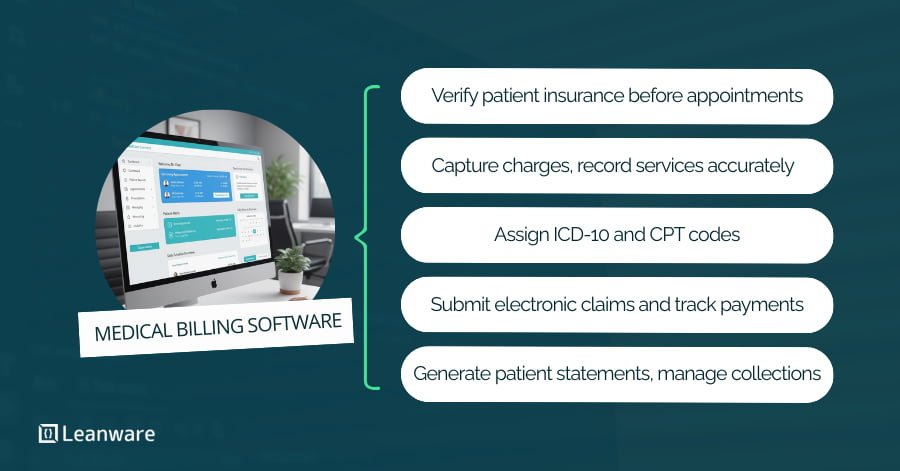
Medical billing software automates the financial operations that keep healthcare practices running: patient invoicing, insurance claims processing, and revenue cycle management from appointment scheduling through final payment collection.
If you run a healthtech startup, manage a clinic, or lead product development at a digital health company, you already know that billing complexity is growing. The global medical billing software market reached approximately $18 billion in 2024 and is projected to grow at a 10.5% CAGR through 2033. Meanwhile, claim denial rates climbed to 11.8% in 2024, up from 10.2% just a few years earlier.
Let’s cover what you need to know about medical billing software development, from system types to key technical decisions and costs.
What is Medical Billing Software?
Medical billing software manages the financial relationship between healthcare providers, patients, and insurance payers. It captures clinical encounters, converts them into billable codes, submits claims, and tracks payments until accounts are settled.
Core functions include:
- Insurance Verification: Check patient eligibility before appointments.
- Charge Capture: Record services and procedures accurately during visits.
- Coding: Assign ICD-10 and CPT codes to minimize errors.
- Claim Submission: Send electronic claims through clearinghouses.
- Payment Processing: Handle remittance advice and reconcile payments.
- Patient Statements: Generate clear invoices and manage collections.
Proper implementation reduces administrative burden, improves cash flow predictability, and lowers claim denials. For practices facing rising denial rates, accurate medical billing software directly protects revenue.
Types of Medical Billing Software
Different practice sizes and operational models require different billing architectures.
Open Billing Systems support data exchange across multiple providers and facilities. Hospital networks, accountable care organizations, and multi-site practices use open systems to share billing data across locations. These typically implement HL7 FHIR APIs and support bidirectional data flows with external EHR platforms, clearinghouses, and payer systems.
Closed Billing Systems operate within a single organization with limited external connectivity. Small practices and specialty clinics prefer closed systems for simpler management and fewer integration points. The tradeoff is reduced flexibility when practices need to connect with external partners.
Isolated Billing Systems operate independently with no connection to EHR or practice management software. You will find these in legacy environments where billing was historically handled by separate departments. They require manual data entry and create reconciliation challenges. Most organizations are migrating away from isolated systems due to inefficiency.
Integrated Billing Systems connect billing with EHR, practice management, scheduling, and patient engagement platforms. Data flows automatically between clinical documentation and billing modules, reducing duplicate entry and improving coding accuracy. Mid-to-large practices favor integrated systems for workflow efficiency.
Standalone Billing Systems handle billing independently of clinical systems. Practices that outsource billing to third-party services often use standalone systems. They are also useful during system transitions when practices need temporary billing capacity.
Patient-Centric Billing Tools focus on transparent cost estimates, flexible payment plans, online payment portals, and clear billing statements. With patient financial responsibility increasing, these tools directly impact collection rates and patient satisfaction scores.
How Does Medical Billing Software Work?
Medical billing follows a defined workflow from patient scheduling through final payment posting.
Scheduling begins the process before the patient arrives. Scheduling modules capture appointment details, link visits to referring providers, and flag appointments requiring pre-authorization. Advanced systems automatically check appointment types against payer requirements.
Patient Registration captures demographic data, insurance information, and consent documentation. Modern systems validate insurance card information in real-time and flag data entry errors before they propagate through the billing cycle.
Insurance Verification confirms active coverage, identifies the correct payer, and determines patient financial responsibility before services are rendered. Automated verification reduces day-of-service surprises and allows staff to collect appropriate copays upfront.
Coding and Charge Capture translates clinical documentation into ICD-10 diagnosis codes and CPT procedure codes. Charge capture modules pull codes from EHR encounters and apply practice-specific fee schedules. Up to 49% of claims in some analyses are affected by coding and documentation issues.
Medical Records Management maintains connections to clinical documentation for claim support and payer audits. When payers request additional information, billing staff need fast access to records that justify services billed.
Claim Submission formats claims according to payer specifications and transmits them electronically through clearinghouses using EDI standards. The system tracks submission status and flags rejections for correction.
Patient Payment Collection handles statements, online payment portals, automated reminders, and payment plans. Collection rates improve significantly when patients have convenient self-service options.
Payment Review matches remittance advice against submitted claims, identifies underpayments and denial reasons, and initiates appeals. Over 50% of denied claims are ultimately overturned on appeal, making effective denial management crucial.
Financial Record Updating posts transactions and tracks key performance indicators: days in accounts receivable, denial rates by payer, collection percentages, and revenue trends.
Benefits of Medical Billing Software
Medical billing software improves efficiency, accuracy, and patient experience. Key benefits include:
Benefit | Impact |
Automated Billing | Reduces manual data entry and frees staff to handle exceptions. |
Fewer Errors | Automated code validation and eligibility checks can cut claim denials by up to 60%. |
Flexible Payments | Supports payment plans, financing, and online portals to boost collections. |
Better Revenue Cycle | Shortens payment cycles, lowers write-offs, and stabilizes cash flow. |
Patient Satisfaction | Clear statements, accurate estimates, and responsive support. |
Easier Audits | Complete audit trails and accessible reporting. |
Automated Billing Processes reduce manual data entry, eliminate repetitive tasks, and allow staff to focus on exception handling rather than routine processing.
Reduced Errors and Increased Accuracy through automated code validation, eligibility checking, and claim scrubbing. Efficient billing software can reduce claim denials by up to 60% according to industry reports.
Flexible Payment Options including payment plans, financing, and online portals improve collection rates on patient balances as patient financial responsibility grows.
Improved Revenue Cycle Management shortens payment cycles, reduces write-offs, and improves cash flow predictability.
Enhanced Patient Satisfaction through clear billing statements, accurate cost estimates, and responsive billing support.
Streamlined Financial Audits via complete audit trails, documented workflows, and accessible reporting.
Key Features to Look For
These features work together to streamline billing operations, reduce errors, and ensure regulatory compliance. Automation speeds up repetitive tasks, EHR integration keeps clinical and financial data aligned, and reporting tools provide actionable insights. Strong security and compliance measures protect patient data and reduce the risk of audit issues.
Feature | Impact |
Billing Automation | Automates claim workflows and repetitive tasks with AI and RPA. |
EHR Integration | Ensures accurate charge capture with bidirectional data flow. |
User Interface | Role-based access, configurable dashboards, and optimized worklists. |
Reporting & Analytics | Dashboards, denial tracking, payer performance, and custom reports. |
Compliance & Security | Encryption, access controls, audit logs, HIPAA and OWASP standards. |
Tech Stack Options for Medical Billing Software
Component | Options |
Backend | |
Frontend | |
Database | PostgreSQL, MongoDB, AWS/Azure HIPAA-eligible services |
APIs | HL7 v2 for legacy, FHIR R4 for modern interoperability |
CI/CD pipelines, automated testing, load testing frameworks |
Healthcare data exchange requires HL7 v2 support for legacy systems and FHIR R4 for modern interoperability. FHIR uses RESTful APIs and JSON/XML formats familiar to web developers.
Clearinghouse integrations typically use ANSI X12 EDI formats. Plan for integrations with major EHR platforms (Epic, Cerner, athenahealth), clearinghouses (Change Healthcare, Availity, Waystar), and payment processors.
Custom vs Ready-Made Solutions
Benefits of Custom Development: Custom software addresses specific workflow requirements that off-the-shelf products cannot accommodate. Practices with unique specialties, complex multi-location operations, or specific payer relationships often find that customization costs less than forcing workarounds. Custom development also creates competitive differentiation.
Pros and Cons of Off-the-Shelf Software: Ready-made solutions offer faster implementation, lower upfront costs, and vendor-managed updates. Leading platforms include athenahealth, AdvancedMD, Kareo (Tebra), and DrChrono. Tradeoffs include limited customization, ongoing subscription costs, and dependence on vendor priorities. Subscription fees typically range from $200 to $2,000 per month.
Decision Framework: Choose custom when workflows are genuinely unique, integration requirements are complex, you need competitive differentiation, or long-term TCO favors building. Choose off-the-shelf when standard workflows fit your needs, you want faster time-to-value, or capital constraints favor operational expenses.
How to Develop Medical Billing Software
Building medical billing software starts with understanding workflows, coding requirements, and security needs before a single line of code is written.
Discovery Phase: Document stakeholder requirements, pain points, and compliance needs. Interview billing staff, practice administrators, and clinicians. Review payer contracts and analyze denial patterns.
Requirements Definition: Translate findings into user stories and epics. Document HIPAA requirements, integration specs, and performance criteria. Prioritize features into MVP and future releases.
Proof of Concept: Validate technical feasibility with clickable prototypes. Focus on high-risk areas: complex integrations, novel features, or performance-critical workflows.
MVP Development: Core functionality (claim submission, patient billing, payment posting, basic reporting) typically requires 4-6 months. Advanced features come in subsequent releases.
Development and Coding: Follow OWASP guidelines, implement DevSecOps, use code reviews and automated security scanning.
QA and Compliance Testing: Verify functional requirements, security controls, and performance under load. Test access controls, encryption, and audit logging for HIPAA compliance.
Launch and Maintenance: Include user training, data migration, and parallel operations. Budget 15-25% of development costs annually for maintenance.
Cost Factors in Building Medical Billing Software
Development costs vary based on scope, complexity, and team structure. Medical billing software ranges from $30K for basic systems to $300K+ for enterprise platforms.
Complexity Level | Features | Cost Range |
Basic | Patient registration, claim submission, payment tracking | $30K-$55K |
Mid-range | + Eligibility verification, denial management, EHR integration | $55K-$150K |
Enterprise | + Advanced analytics, multi-location, complex integrations | $200K-$300K+ |
Development Partner Rates: US-based developers typically charge $150-250/hour. Latin American teams range $30-100/hour. Eastern European teams fall in similar ranges. Offshore teams may charge $25-75/hour with longer development cycles and more management overhead.
Compliance Costs: HIPAA compliance typically adds 15-25% to development costs for security implementation, audit logging, documentation, and potentially third-party assessments.
Third-Party Integrations: Clearinghouse fees, EHR integration costs, and payment processor setup affect total project cost. Budget for both sandbox access and production transaction fees.
Compliance and Regulatory Considerations
HIPAA Compliance requires administrative, physical, and technical safeguards for protected health information. Technical requirements include access controls, encryption (in transit and at rest), audit trails, and automatic session timeouts. Business Associate Agreements must govern relationships with vendors handling PHI.
HIPAA violation penalties start at $141 per violation and can reach over $2 million per violation type per year for willful neglect. In 2024, the Office for Civil Rights closed 22 investigations with settlements or civil monetary penalties.
Additional Standards: Beyond HIPAA, consider OWASP Top 10 security practices, SOC 2 Type II certification, and ISO 27001 standards. Payers and enterprise clients increasingly require security certifications.
Audit Trails: Document who accessed what data and when. Change logs track system modifications. These records are essential during payer audits, compliance reviews, and legal disputes.
Your Next Move
Building medical billing software involves aligning technical requirements, compliance obligations, and operational workflows.
Start with thorough discovery. Billing workflows vary significantly across specialties, practice sizes, and payer mixes. Prioritize compliance from the start since retrofitting security costs more than building it in. Plan for integration complexity because healthcare data exchange involves multiple standards and legacy constraints.
Invest in testing since billing errors have direct financial consequences. Partner with teams that understand healthcare because domain expertise delivers better results than general-purpose developers learning healthcare on your project.
You can also connect to us for guidance on custom medical billing software development, EHR and practice management integrations, automated billing workflows, and payment processing solutions.
Frequently Asked Questions
How much does it cost to build medical billing software for a 50-provider clinic?
Development usually runs between $150K and $400K, covering discovery, development, QA, EHR integration, and initial support. Costs depend on where your development team is located - US-based teams tend to be pricier, while Latin American teams typically offer lower rates and on specific compliance requirements.
What are the most common medical billing software failures?
The usual issues are coding mistakes, poor interoperability, and system stability problems. You can address these with automated code validation, HL7/FHIR-based APIs for reliable data exchange, load testing, and a HIPAA-compliant architecture with proper encryption.
How long does it take to develop an MVP medical billing system?
Expect 4 to 6 months for the core functionality -patient registration, insurance verification, claim submission, and basic reporting. Full-featured platforms with advanced RCM and integrations may take 12–18 months.
Which medical billing APIs are free versus paid?
Some APIs offer free sandbox access, like CMS Blue Button or Redox sandbox environments. Production APIs - such as Change Healthcare, Waystar, or Availity - usually charge based on transaction volume and level of access.
What’s the minimum team size needed?
You need 5-6 core roles: Product Manager, Backend Developer, Frontend Developer, QA Engineer, UX/UI Designer, and a Compliance Advisor (part-time or external is fine).
How do you migrate from Practice Fusion to custom billing software?
Export the data, map schemas between systems, use ETL tools for migration, run parallel operations, and test thoroughly before cutover. Partner with specialists who have experience in EHR migrations to ensure a smooth transition.
What does the database schema for medical billing systems look like?
Core tables usually include Patients, Providers, Encounters, Claims, ClaimLines, Payments, Adjustments, InsurancePolicies, and AuditLogs. Use a relational design with role-based access controls and comprehensive audit logging to maintain security and compliance.
What are some top nearshore medical billing software development companies?
Top nearshore options for US clients include Leanware, BairesDev, TATEEDA GLOBAL, Moove It, and UruIT. They provide custom medical billing solutions, EHR/RCM integrations, and HIPAA-compliant development with Latin American teams aligned to US time zones.