Top AI Development Languages to Learn in 2025

AI development languages are at the heart of today’s technological revolution. With generative AI, machine learning, and automation reshaping industries, the demand for skilled AI programmers has never been higher.
In 2025, the landscape of AI languages is evolving rapidly—driven by breakthroughs in model efficiency, real-time processing, and cross-platform integration. Choosing the right language isn’t just a technical decision; it’s a strategic move that can define the speed, scalability, and success of your AI projects.
In this blog, you’ll learn which AI development languages dominate in 2025, their strengths, and how to choose the best one for your project.
Let's dive in!
What Are AI Development Languages?
AI development languages are programming languages used to create software and applications that involve artificial intelligence, such as machine learning, natural language processing, computer vision, and robotics. These languages provide various tools, libraries, and frameworks that facilitate the design, development, and deployment of AI models and systems.
Why Language Choice Matters in AI Projects
Choosing the right programming language for an AI project is pivotal and brings several trade-offs that impact project success:
- Performance vs. Flexibility: Lower-level languages like C++ or Java deliver high performance for compute-intensive AI tasks but may have steeper learning curves and slower development cycles. High-level languages such as Python offer greater flexibility and speed of prototyping but sometimes at the cost of runtime efficiency.
- Ecosystem Maturity: Mature ecosystems provide stability and a wide array of third-party libraries, reducing time-to-market. Emerging languages or less popular ones might lack these, increasing development effort and risk.
- Development Speed: Faster development means quicker iteration, testing, and deployment of AI models, essential in competitive environments or startups. Python’s readability and vast AI libraries often make it the preferred choice for rapid development.
- Integration and Deployment: Some languages integrate more smoothly with existing infrastructure or target platforms (web, mobile, cloud), affecting operational ease and maintainability.
Top AI Programming Languages in 2025
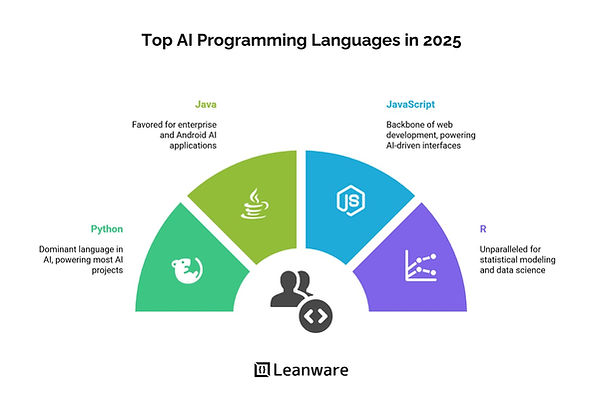
Python
Python stands undisputed as the dominant language in AI by an enormous margin. It powers over 80% of AI and machine learning projects and is used by 9 out of 10 AI developers worldwide. Its overwhelming popularity spans virtually every AI domain, making it the top choice for beginners and experts alike.
Use Cases in AI
Python’s versatility covers an extensive range of AI applications, including:
- Natural Language Processing (NLP)
- Computer Vision
- Deep Learning
- Data Science
- Machine Learning Research
- Production AI Systems
Top Resources to Learn Python
To get started or deepen your Python expertise in AI, consider:
- Coursera’s AI and ML Python courses
- fast.ai’s practical deep learning lessons
- Official documentation at Python.org
- YouTube channels focused on AI programming
- Books like Python Machine Learning by Sebastian Raschka and Hands-On Machine Learning by Aurélien Géron
Java
Java holds a solid place as the second choice for AI, especially favored in enterprise and Android AI applications. Its robustness and scalability make it ideal for large, distributed systems.
Use Cases in AI
Java is well-suited for:
- Enterprise AI systems
- Android AI applications
- Big Data processing using Apache Spark
- Distributed AI systems
Top Resources to Learn Java
Enhance your Java skills for AI with:
- Oracle’s official documentation
- Coursera’s Java courses
- The comprehensive Java: The Complete Reference book
- Interactive tutorials at CodeAcademy
JavaScript
JavaScript remains the backbone of modern web development, powering everything from interactive sites to AI-powered browser apps. TypeScript, as a superset of JavaScript, builds on this foundation with optional static typing, making it the type-safe choice for large, complex projects. Together, they offer both flexibility and reliability for developers.
Use Cases in AI
JavaScript and TypeScript excel at:
- Browser-based AI applications
- Real-time AI-powered interfaces
- Large-scale AI platform development
- Type-safe machine learning pipelines
- AI tooling and infrastructure
Top Resources to Learn
For mastering JavaScript and TypeScript in AI:
- MDN Web Docs (JavaScript)
- The official TypeScript Handbook
- Programming TypeScript by Boris Cherny
- FreeCodeCamp’s full-stack JavaScript curriculum
R
R remains unparalleled for statistical modeling and data science research within AI, often preferred in academia and bioinformatics due to its strong statistical libraries and visualization tools.
Use Cases in AI
R’s strengths include:
- Statistical modeling
- Bioinformatics-related AI
- Academic and scientific research
- Data visualization
- Statistical machine learning
Top Resources to Learn R
Boost your R skills with:
- R-project.org’s official resources
- R for Data Science by Hadley Wickham and Garrett Grolemund
- DataCamp’s extensive R courses
Comparative Analysis of AI Languages
Here is a comparative analysis of the top AI programming languages in 2025
Features | Python | Julia | Java | C++ | R | JavaScript |
Execution Speed | Moderate; generally sufficient | Very high; close to C performance | High; compiled JVM-based | Very high; compiled native code | Moderate | Moderate; interpreted or JIT |
Library Ecosystem | Extensive AI/ML (TensorFlow, PyTorch, Scikit-learn, etc.) | Growing (Flux.jl, MLJ.jl) | Moderate (Deeplearning4j, Weka) | Moderate (TensorRT, OpenCV) | Strong for statistics (caret, mlr3) | Growing (TensorFlow.js, Brain.js) |
Ease of Use | Easiest; simple syntax & readability | Moderate; intuitive for Python/MATLAB users | Moderate; verbose but structured | Difficult; more complex syntax | Easy for statisticians | Easy, especially for web devs |
Maintainability | High; clean syntax, large community | Moderate; smaller community | High, mature language with tools | Moderate; complexity can hinder | Moderate | High; familiar to many devs |
Scalability | High; good for prototyping & production | High; good for scientific/scalable apps | Very high; built for enterprise | High; suitable for real-time & embedded | Moderate | Moderate; good for web AI |
Performance, Scalability, and Ease of Use
- Python strikes an excellent balance between ease of use, development speed, and performance in AI tasks, making it the top choice for most AI projects. Its extensive libraries and ease of prototyping empower rapid innovation.
- Julia excels in numerical computing and high-performance AI where speed is critical, offering C-like execution with simpler syntax.
- Java shines in enterprise-scale applications requiring robustness, scalability, and integration with big data ecosystems. It is less dynamic but favoured for maintainable large systems.
- C++ delivers top-tier performance ideal for real-time AI, robotics, and embedded systems, but demands high expertise and longer development cycles.
- R is the specialist for statistical analysis and data visualization, popular in finance and healthcare domains.
- JavaScript is the go-to for web-based AI, real-time interactive AI components, and lightweight models deployable on edge devices.
Which Language is Best for Your Project?
- Research and Prototyping: Python’s simplicity and powerful ecosystem make it ideal for researchers and startups exploring AI concepts quickly.
- Production Enterprise Systems: Java’s scalability and maintainability suit mission-critical applications handling large datasets or transactions.
- High-Performance Scientific Computing: Julia is gaining ground for scientific AI, where computational speed matters.
- Real-Time and Embedded AI: C++ remains unmatched for resource-intensive AI tasks in robotics and autonomous systems.
- Statistical Modeling and Data Science: R offers specialized tools and visualization, great for data-heavy AI projects.
- Mobile and Web AI Apps: JavaScript enables AI directly in browsers or lightweight environments, supporting real-time user interactions.
How to Choose the Right AI Programming Language
To choose the right AI programming language, consider these critical factors structured around your project type, community support, and the learning curve:
Project Type: Identify the nature of your AI project.
- For general AI and machine learning, Python is dominant due to its extensive libraries like TensorFlow and PyTorch, and ease of prototyping.
- For performance-intensive AI applications where speed is critical, such as gaming or real-time systems, C++ or Julia is preferable.
- For statistical analysis and data visualization tasks common in AI research, R is often chosen.
- For enterprise-level applications requiring scalability and system integration, Java or JVM languages may be a good fit.
Community and Ecosystem:
- A large, active community ensures better support, extensive libraries, frameworks, and learning resources.
- Python has the largest AI community with rich ecosystem support, which significantly reduces development complexity.
- Other languages like Java and C++ have established communities but may have fewer AI-specific resources.
Learning Curve:
- Python is widely regarded as the easiest to learn, making it ideal for beginners in AI.
- Languages like C++ have a steeper learning curve due to complexity and memory management requirements.
- R and Julia are more specialized and might require more domain-specific knowledge in statistics or scientific computing.
Getting Started With AI Programming
Starting AI programming with Python is a highly recommended, practical, and forward-looking choice. Python’s simplicity, versatility, and strong AI ecosystem make it ideal for beginners and rapid prototyping in AI domains.
Recommended Courses and Tutorials
Leading resources emphasize Python-based AI learning:
Course / Resource | Provider |
AI Python for Beginners | DeepLearning.AI / Coursera |
CS50's Introduction to AI with Python | Harvard (edX) |
Python Machine Learning Tutorial | W3Schools |
Artificial Intelligence with Python | Tutorialspoint |
Python Full Course for Beginners (YouTube) | YouTube |
Codecademy Python Courses | Codecademy |
Building Your First AI Project
A simple yet effective starter project example is sentiment analysis—analyzing text data to determine positive or negative sentiment. This involves:
- Preparing text data.
- Using Python libraries (e.g., NLTK, TextBlob) for language processing.
- Building a classifier model (could be rule-based or machine learning-based).
- Visualizing results.
Another great beginner project is image classification using Python-based frameworks such as TensorFlow or PyTorch with pre-trained models. For example:
- Use a dataset like CIFAR-10 or MNIST.
- Train a simple convolutional neural network to classify images.
- Leverage tools like Jupyter Notebook for coding and experimentation.
Final Words
The choice of programming language in AI development directly impacts performance, scalability, and development speed. Python dominates due to its vast ecosystem and ease of use, while languages like Java, C++, R, and Julia excel in specialized use cases. Matching your project’s needs with the right language ensures better efficiency, maintainability, and results.
Choosing the right programming language means aligning performance requirements, integration needs, and available talent with your AI goals. It’s not just about popularity—it’s about fit, future-proofing, and long-term success.
If you want to build a smarter AI development project with the right tech stack. Partner with Leanware for expert guidance tailored to your project’s goals
FAQs
Which language is best for AI development?
Python overwhelmingly leads AI development due to its simplicity, rich libraries, and strong community support, making it ideal for most AI projects; however, specific use cases might call for other languages.
Which language is widely used for AI?
Industry data from Stack Overflow and GitHub consistently show Python dominating AI, reflecting its status as the go-to language for AI innovation and research.
What is the coding language of AI?
While no single language defines AI, Python is used by the vast majority of practitioners, with languages like Java, R, and C++ serving niche applications.
Should I learn Python or Java for AI?
Python is the preferred choice for most AI applications thanks to its ease and ecosystem, whereas Java fits better in enterprise environments or Android-focused AI solutions
Is JavaScript good for AI development?
JavaScript is increasingly used for AI on web platforms but remains supplementary to Python, which continues to be the primary language for robust AI development.