AI Development Solutions for Businesses

The companies seeing the strongest results from AI are not the ones adopting the fastest, but the ones integrating it into the way they work.
McKinsey estimates that the use of large language models from Anthropic, Cohere, Google, Meta, Mistral, and OpenAI could contribute up to $4.4 trillion in productivity gains.
Eurostat’s 2024 survey shows how this is already unfolding across sectors: retail firms apply AI to marketing and sales, manufacturers use it in production, and ICT companies lead in research and development. These differences highlight a simple point. AI development is less about gaining access to new tools and more about creating solutions that fit specific business needs, scale reliably, and meet security and compliance requirements.
In this guide, we explore the main areas of AI development that matter for modern businesses and the factors you should evaluate when deciding where AI can create the most impact.
Core Areas of AI Development
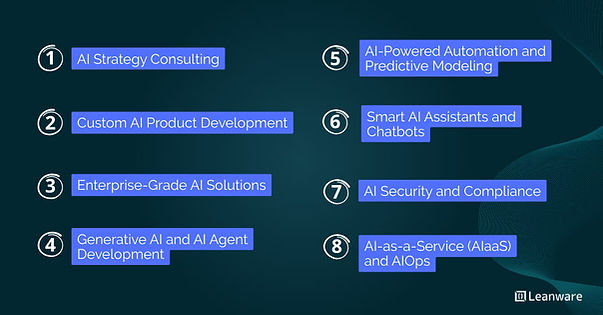
Companies approach AI development with different needs, depending on size, maturity, and industry. You usually need both a clear plan and the right technical setup to make it work.. Below are the main service categories businesses rely on when building AI solutions.
1. AI Strategy Consulting
Many companies start AI projects without defining clear objectives. This often results in solutions that work technically but fail to solve meaningful business problems. Strategy provides the foundation by linking AI initiatives to measurable goals, identifying high-value use cases, and setting realistic timelines. Taking this step ensures that resources are directed toward problems worth solving.
2. Custom AI Product Development
Pretrained foundation models provide a useful base, but they rarely meet the needs of specialized workflows without modification. Financial firms require fraud detection tuned to their transaction patterns. Healthcare providers need diagnostic systems that comply with clinical documentation standards and privacy rules. Logistics teams depend on route optimization that accounts for traffic, weather, and delivery constraints.
Custom AI development addresses these requirements directly instead of asking businesses to adapt to generic systems. The focus is on usability in practice: a model that performs well in testing but fails to integrate with legacy systems or real user behavior creates more risk than value.
3. Enterprise-Grade AI Solutions
Moving from prototypes to production environments introduces new requirements. Enterprise systems must scale to support large volumes of data, high numbers of users, and variable workloads. They also need monitoring pipelines, automated retraining, and rollback mechanisms to maintain reliability. The focus is not only on performance but also on ensuring that systems remain stable, maintainable, and compliant over time.
4. Generative AI and AI Agent Development
Generative AI development focuses on models that produce text, images, or code and are adapted for specific business applications. AI agent development applies these models to automate multi-step workflows, including customer support, document preparation, and software testing. Combined, they help organizations reduce repetitive work and embed AI into daily operations efficiently.
5. AI-Powered Automation and Predictive Modeling
Automation isn’t new, but AI has made it smarter. AI combined with robotic process automation handles both repetitive and complex business tasks. Predictive models support decisions such as forecasting demand, planning inventory, or identifying customers at risk of churn.
To get it right, you need clean data, proper integration with your existing systems, and ongoing monitoring so the models keep giving reliable results as conditions change.
6. Smart AI Assistants and Chatbots
AI assistants today do more than answer simple questions. They can handle multi-step requests, pull information from your internal systems, and even perform tasks like generating reports or troubleshooting issues. Integration - connecting them to CRMs, ERPs, or collaboration tools makes them actually useful day-to-day. Keeping the models updated ensures they stay accurate and match how your teams work.
7. AI Security and Compliance
AI systems must comply with GDPR, HIPAA, and new AI regulations. Security measures include data encryption, access controls, and audit trails that track how models make decisions.
Ethical AI frameworks prevent biased outcomes and ensure transparent decision-making. Financial institutions implementing AI lending models must show fair treatment across demographic groups to meet regulatory requirements.
8. AI-as-a-Service (AIaaS) and AIOps
Not every team needs to build AI models from scratch. AIaaS provides pre-built capabilities via APIs for tasks like speech recognition, document extraction, and image classification, without requiring you to manage the underlying infrastructure.
This speeds up deployment and lowers the barrier to entry. AIOps applies AI to IT operations, detecting anomalies in server logs, scaling cloud resources automatically, and predicting potential outages. These tools are not meant to replace engineers but to handle repetitive tasks so teams can focus on higher-value work.
AI Technology Stack and Integration Capabilities
For AI to work effectively, you need to pick the right technology and make sure it fits smoothly with your existing systems.
1. AI Integration with Existing Systems
AI solutions must connect with CRMs, ERPs, and databases without disrupting current workflows. API-first architectures allow AI components to exchange data with legacy systems while maintaining security and performance standards. Proper integration ensures that insights and outputs are actionable within the systems employees already use.
2. Machine Learning Operations (MLOps)
MLOps provides structured pipelines for model deployment, monitoring, and updates. Version control tracks model changes, automated testing validates performance, and continuous integration processes enable retraining and deployment without service interruptions.
This approach ensures reliability and consistency across AI systems as business data and requirements evolve.
3. AI Design and User Experience
User experience is a key factor in adoption. Tools that are technically capable but difficult to use often see limited engagement. Interfaces should abstract complexity while providing clear feedback on AI outputs. This allows teams to act on insights confidently, improving efficiency and supporting data-driven decision-making.
4. Use of AI Accelerators
Hardware accelerators such as GPUs enhance training and inference speeds for large models. Specialized databases, including vector databases, enable efficient high-dimensional data searches, supporting applications such as recommendation systems and semantic search. Using these accelerators ensures AI systems can scale and perform reliably under production workloads.
AI Development Lifecycle
A structured AI development lifecycle helps organizations manage risk, align technical work with business objectives, and improve the likelihood of delivering measurable outcomes.
1. AI Proof of Concept (POC)
A POC evaluates an AI approach using a limited dataset and controlled assumptions. The objective is to validate whether the model can deliver improvements over existing processes or decision-making.
Defined metrics guide assessment of feasibility, potential value, and integration challenges before committing additional resources.
2. AI MVP Development
The MVP builds on the POC to deliver a functional application addressing a specific business problem. Development prioritizes core capabilities while deferring less critical features to avoid delays.
Timelines typically range from three to six months, depending on data quality, system integration requirements, and complexity of core functionality. Early adoption insights guide subsequent development priorities.
3. Full-Scale AI Implementation
Scaling to production requires optimizing model performance, establishing monitoring and maintenance processes, and ensuring operational reliability. This includes retraining schedules, error handling, and fallback mechanisms for when predictions fail.
Infrastructure considerations such as load balancing, caching, and database optimization - support expected usage patterns. Properly executed, full-scale implementation ensures consistent AI performance and operational impact across the organization.
AI Development Costs and Budget Planning
AI project costs vary depending on scope, data requirements, and technical complexity.
1. Factors Influencing AI Project Costs
Data quality and availability are often the first constraints. Clean, well-structured datasets shorten development time, while incomplete or inconsistent data adds effort. Talent is another major factor, since experienced AI engineers and consultants are in high demand.
Infrastructure costs, including cloud computing, hardware accelerators, and software tools, scale with model size and usage.
Typical Cost Ranges (approximate)
Cost Component | Range |
Simple AI Project | $10,000 - $50,000 |
More Complex AI | $50,000 - $170,000+ |
AI Consulting Services | $170 - $400 per hour |
AI Development Team Rate | $27 - $50 per hour |
Third-party AI Software | $40,000+ annually |
For most SMBs and enterprises in 2025, adapting existing foundation models through fine-tuning offers a cost-effective path. Fully custom-built AI models remain more resource-intensive and expensive, often justified only when business requirements cannot be met by pre-trained or off-the-shelf solutions.
2. Cost Optimization Strategies
Using Pre-trained models can reduce development effort compared with building models from scratch. Cloud platforms offer flexible pricing options that can lower infrastructure costs.
Open-source frameworks provide the necessary capabilities without licensing fees. Organizations can also consider nearshoring development to regions with capable technical teams at lower labor costs, which can help manage budgets while maintaining quality.
Evaluating AI Development Providers
When selecting an AI partner, focus on three practical aspects: technical capability, scalability, and security. Make sure the team can work with your data and systems, build solutions that can handle growth, and apply security measures that comply with regulations.
Domain Expertise and Industry Experience
Teams with experience in your industry understand the operational challenges and regulatory requirements that affect AI projects.
For example, healthcare AI must comply with HIPAA, and financial AI needs to meet banking and audit standards. Providers with a track record of completed projects are more likely to deliver solutions on schedule and avoid common implementation issues.
Scalable and Secure AI Architectures
AI systems in production need architectures that handle growth in data and users while maintaining consistent performance. Security practices should protect sensitive information and meet regulatory standards throughout the AI lifecycle. Well-designed systems also make it easier to incorporate new technologies or adjust to changing business needs without a complete redesign.
Getting Started
The best way to start with AI is to focus on the problems you want it to solve and the data you have. Pick tools and systems that fit with your existing workflows and can handle growth over time.
Set up clear processes for building, deploying, and monitoring models so they run reliably and provide consistent results.
You can also engage with our team to review your AI initiatives, identify high-impact use cases, and design a structured approach for development and deployment that aligns with your operational goals.
Frequently Asked Questions
What are AI development solutions?
AI development solutions encompass strategy, design, implementation, and maintenance of artificial intelligence systems that solve specific business problems. These include custom machine learning models, automation workflows, predictive analytics, and AI-powered applications.
How much does AI software development cost?
Costs depend on project complexity, data, and technical requirements. Simple AI projects typically range from $10,000 to $50,000, while more complex projects can exceed $170,000. Consulting rates are around $170-$400 per hour, and team rates $27-$50 per hour. Many SMBs and enterprises reduce costs by fine-tuning existing foundation models rather than building fully custom AI systems.
What industries benefit most from AI development?
Healthcare, finance, retail, logistics, and manufacturing see the highest AI adoption rates. These industries have large datasets, clear ROI metrics, and competitive pressure to improve efficiency. However, AI applications exist across virtually every sector.
Is AI safe for business use?
AI systems can be safe when properly implemented with security measures, compliance frameworks, and ethical guidelines. Risks include data breaches, biased decisions, and regulatory violations. Professional development teams address these concerns through secure architectures and compliance processes.
How do I choose the right AI development partner?
Evaluate potential partners based on relevant industry experience, technical expertise, transparent communication, and proven delivery track record. Consider factors like data security practices, regulatory compliance knowledge, and post-deployment support capabilities.