AI Product Studio vs Dev Shop: Which Is Right for Your Project
It’s common to group AI product studios and dev shops - they both build software, often using similar stacks, and might even share team roles. But structurally and operationally, they’re completely different.
A dev shop builds software for clients. An AI product studio builds and launches its own products. One runs on service revenue; the other takes on product risk in exchange for equity value. The distinction matters because it shapes everything from team priorities and decision-making to ownership, risk, and long-term incentives.
Let’s break down how each model actually works, from how teams are structured to how value is created and captured.
What Is an AI Product Studio?
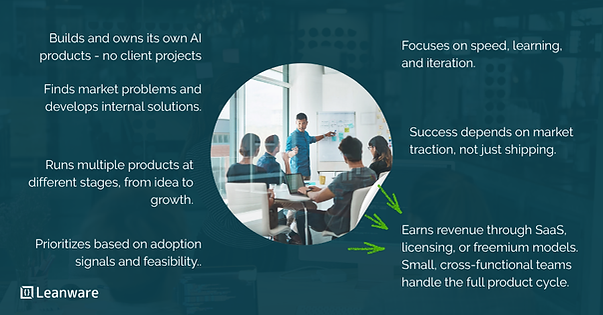
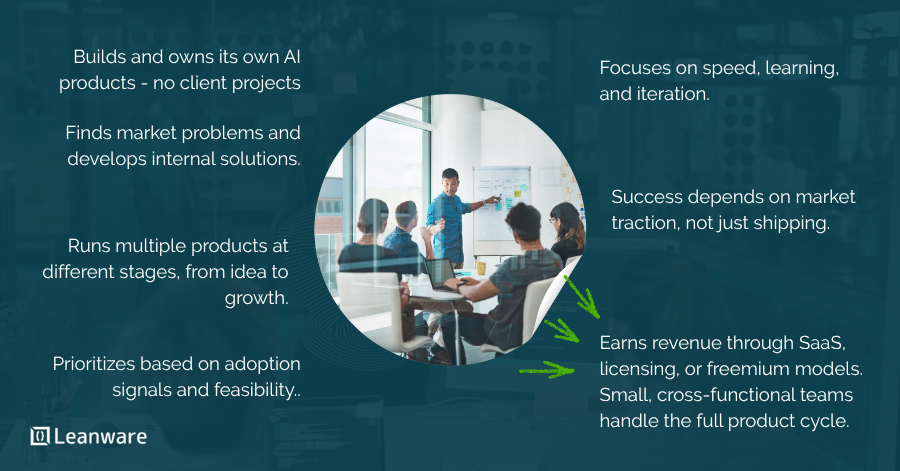
An AI product studio is a company that builds and scales its own portfolio of AI-powered software products. It doesn’t take on client work. Instead, it identifies problems or gaps in the market and develops internal solutions, owning the entire lifecycle from concept to launch and growth.
Studios typically run multiple products at different stages. Teams research opportunities, prototype quickly, validate assumptions, and decide which products show meaningful user adoption or revenue potential. Those products are then improved iteratively and monetized through models like SaaS, licensing, or freemium tiers.
The structure is entrepreneurial. Teams are small, cross-functional, and responsible for outcomes. Engineers, designers, product leads, and growth roles work closely across each product cycle.
Because the studio owns what it builds, success depends on how well each product performs in the market, not just whether it ships.
How They Operate (Product Ideation to Market Launch)
AI product studios follow a full-cycle product development process, from identifying real-world problems to launching and maintaining software products with AI at the core.
The process isn't linear - studios usually manage multiple products at different stages, allocating time and resources based on early signals of user adoption or technical feasibility.
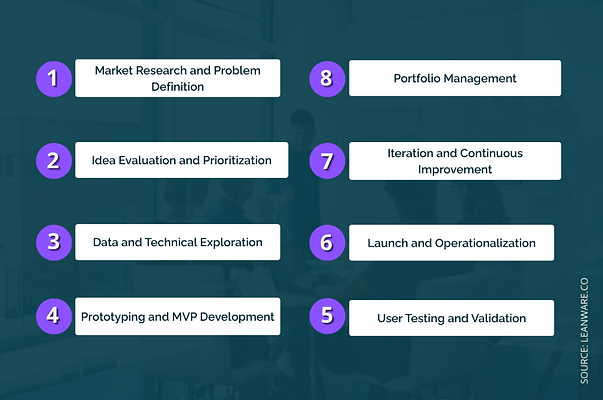
1. Market Research and Problem Definition
It starts with identifying concrete problems. Teams study specific domains, talk to users, and look for inefficiencies where AI can provide practical leverage. The focus is on problems with clear business value and measurable outcomes, not abstract use cases.
2. Idea Evaluation and Prioritization
Once opportunities are mapped, the team evaluates potential solutions. Ideas are filtered based on feasibility, available data, market size, and the team’s ability to build and maintain them. Only the ones that meet both technical and market criteria move forward.
3. Data and Technical Exploration
If the product idea involves ML, the next step is assessing data availability. This includes sourcing datasets, cleaning and labeling where necessary, and evaluating whether the data supports the desired level of model performance. If data isn't viable, the idea is often paused or dropped.
4. Prototyping and MVP Development
Teams build a lightweight version of the product to test the core functionality. For AI-driven features, this usually means building a simple model or integrating existing models to validate technical assumptions. The MVP is built fast, with just enough UX and engineering to evaluate real use.
5. User Testing and Validation
Prototypes are tested with early users to gather feedback on functionality, usability, and performance. The goal is to determine whether the solution effectively addresses the intended problem and whether users are willing to adopt it. Model behavior is also evaluated in real-world conditions.
6. Launch and Operationalization
Once validated, the product is launched publicly, often in a limited or phased rollout. This stage involves setting up infrastructure, logging, monitoring, and user onboarding flows. AI models are monitored for performance drift, reliability, and edge cases from day one.
7. Iteration and Continuous Improvement
Post-launch, product usage and model outputs are tracked closely. Feedback loops are built into refine features, update models, and prioritize new functionality. Teams continue to invest only if the product shows measurable adoption or revenue potential.
8. Portfolio Management
Studios rarely focus on a single product. Multiple ideas are explored in parallel, with some already in early prototyping and others generating revenue.
Resources are shifted based on performance, and unsuccessful products are shut down early. This portfolio approach spreads risk and increases the chance of building something that sticks.
Revenue Models and Product Portfolio
AI product studios earn revenue from the software they build and own. Most products follow SaaS or usage-based pricing. Others use licensing for enterprise buyers or offer free access with paid upgrade tiers. The choice depends on the product’s use case and who it's built for.
Each product has its own roadmap, metrics, and market. Studios usually manage several at once - some in early prototyping, others generating revenue. Products that don’t show usage or revenue potential are shut down early. Resources are focused where there’s actual demand.
Some infrastructure is shared - models, data pipelines, hosting - but the products themselves operate independently. Common examples include tools like a contract summarizer for legal teams, an image-generation API for content platforms, or a forecasting tool for operational planning, each built to solve a specific problem with measurable value.
Team Structure and Capabilities
AI product studios run lean, cross-functional teams that can take a product from idea to launch. A common setup includes:
- Founders or product leads
- AI/ML engineers
- Backend and frontend developers
- Product designers
- Data scientists
- Growth or marketing roles
Most team members work across functions. Studios focus on speed and iteration, keeping processes lightweight and decision cycles short. Roles collaborate closely throughout the product lifecycle.
What Is a Dev Shop?
A dev shop is a service company that builds software for clients. They don’t define the product - they work on externally scoped projects, providing technical teams to design, build, and deliver based on the client’s requirements. Ownership, roadmap, and product decisions remain with the client.
Services Offered (Custom Development, Staff Augmentation, Consulting)
Dev shops may support the full software lifecycle or specialize in specific areas, such as:
- Web and mobile application development
- Backend systems, APIs, and data engineering
- Generative AI integration and consulting
- AI model development and deployment
- UX and UI design
- QA testing and automation
- Cloud infrastructure and DevOps
- Technical consulting and architecture review
- Staff augmentation or dedicated team models
The exact scope varies by team. Some focus purely on engineering delivery, while others provide end-to-end support from design through production.
Client Relationship Model
Dev shops typically work under formal agreements, with engagement models such as:
- Fixed-scope projects with defined deliverables and timelines.
- Retainers for ongoing development, support, or dedicated teams.
- Sprint-based contracts aligned with agile workflows.
Most engagements begin with a statement of work (SOW) that outlines the scope, responsibilities, and milestones. Intellectual property (IP) is usually owned by the client. After launch, the dev shop may either hand off the product or continue working on updates and maintenance, depending on the agreement.
Product decisions like roadmap, features, and priorities are led by the client. The dev shop provides engineering execution within the defined scope.
Key Differences Between AI Product Studio and Dev Shop
The main difference is ownership and risk: studios build their own products; dev shops build for others.
1. Product Ownership: Own Products vs Client Work
AI product studios own their products completely, controlling features, pricing, and market positioning. They retain all intellectual property rights and benefit from any commercial success. Conversely, dev shops build products that clients own, with no ongoing stake in commercial outcomes.
This ownership difference affects motivation and decision-making. Studios make choices based on market success, while dev shops optimize for client satisfaction and project completion.
2. Business Model: Product Company vs Service Company
Studios operate as product companies with recurring revenue from subscriptions, licenses, and sales. This model allows exponential scaling as successful products grow without proportional increases in costs.
Dev shops function as service companies where revenue correlates directly with billable hours and project scope.
The scalability difference is significant. A successful AI product can serve millions of users with minimal additional cost, while dev shops must hire more people to increase revenue.
3. Risk and Reward Structure
AI product studios bear full market risk - if products fail, they lose their investment. However, successful products can generate substantial returns with high profit margins. Dev shops enjoy steadier, more predictable income but with limited upside potential.
This risk profile attracts different types of entrepreneurs and investors. Studios appeal to those comfortable with uncertainty in exchange for higher potential returns.
4. Innovation Focus vs Execution Focus
Studios must innovate continuously to stay competitive in their markets. They need breakthrough ideas and novel approaches to differentiate their products. Dev shops excel at execution, taking proven concepts and implementing them reliably for clients.
Both skills are valuable but require different mindsets and capabilities. Innovation demands creativity and risk tolerance, while execution requires discipline and attention to detail.
5. Market Relationship
AI product studios serve end-users directly, receiving immediate feedback on product-market fit. This direct relationship provides valuable insights for product improvement. Dev shops serve business clients who then serve their own end-users, creating an additional layer between the development team and final users.
Direct market feedback allows studios to iterate quickly based on real user behavior, while dev shops must rely on client interpretation of user needs.
Pros and Cons
Advantages and Challenges of AI Product Studios
Advantages | Challenges |
Full control over roadmap and IP | High upfront cost with delayed returns |
Revenue scales without growing team | Requires capital or steady early-stage revenue |
Builds long-term value through owned tools | Must validate product-market fit continuously |
Direct user feedback informs iteration | Fast-moving, competitive markets |
Flexible to test and evolve ideas | Needs cross-functional expertise across product and growth |
Advantages and Challenges of Dev Shops
Advantages | Challenges |
Predictable revenue from service contracts | Revenue tied to time or scope |
Lower product and market risk | Limited long-term asset creation |
Clear scope and delivery milestones | Harder to stand out in crowded market |
Consistent demand for technical execution | Reliant on steady client pipeline |
Easier to plan hiring around projects | Operational gaps between projects (churn) |
When to Partner with Each
The right model depends on whether you're investing, joining a team, or hiring for execution.
When to Join or Invest in an AI Product Studio?
- You’re interested in building long-term product value, not billing hours.
- You’re comfortable trading early uncertainty for future equity upside.
- You bring technical, product, or market expertise and want ownership over direction.
- You prefer fast iteration, small teams, and a direct relationship with users.
When to Work with a Dev Shop?
- You have a scoped project and need engineering execution.
- You want delivery without managing a full product team.
- You need to move quickly and don’t have in-house capability.
- You prefer fixed timelines, contracts, and clearly defined deliverables.
For Investors: Understanding the Difference
AI product studios operate like startups. They build proprietary assets, carry product risk, and aim for value through growth, retention, and potential acquisition. Capital is tied up longer, but upside comes from equity and exit potential.
Dev shops operate as service businesses. Revenue is tied to project delivery, not user growth or market capture. Valuations are typically based on EBITDA or revenue multiples, with fewer exit paths.
Studios carry more risk and require longer horizons. Dev shops generate steadier cash flows but offer limited return multiples.
Real-World Examples
AI Product Studios
- Anthropic: Builds proprietary language models like Claude.
- DeepL: Offers AI-powered translation and writing tools.
- Mistral AI: Develops open-weight language models.
- ElevenLabs: Focuses on voice generation and speech tools.
- Hugging Face: Hosts and maintains open-source ML tools and models.
- Stability AI: Created Stable Diffusion; builds generative model APIs.
- Vana: Develops personal AI products using user-owned data.
Dev Shops
- Leanware: A go-to dev shop and nearshore development partner. Builds AI and software systems for startups and enterprises.
- Thoughtbot: Designs and develops custom web and mobile apps.
- Clevertech: Full-cycle software development across industries.
- Selleo: Offers dedicated dev teams for client-led projects.
Blended Approach: Services Supporting Product Development
Some companies mix both approaches. A dev shop may use revenue from client projects to fund internal product development. An AI product studio might take on consulting work early on to stay afloat while building its own tools.
This hybrid setup can work, but it’s hard to balance. Client work brings cash but takes time. That often slows product progress. Without a clear separation between the two, internal projects fall behind.
Teams that try this model need to protect time and resources for product development, or risk never shipping.
Your Next Step
Dev shops are built for execution. They work well when the scope is clear and you need engineering capacity. But early-stage validation, testing for real demand, is something you’ll need to own.
If you're considering joining an AI product studio, equity is usually set early. Ask about their product pipeline, burn rate, and how they decide what to build. Studios often explore multiple ideas at once, and not all of them move forward.
For investors, the models operate differently. A studio can grow usage without growing headcount - the same code runs for ten users or ten thousand. A dev shop brings in more revenue by adding more projects, which usually means hiring more engineers. One scales output with software; the other scales output with people.
Choose based on what you're solving for: speed, upside, predictability, or control.
Frequently Asked Questions
1. Can a dev shop become an AI product studio?
Yes, but it requires a shift in mindset and capabilities. Dev shops need to build product management, market validation, and user research skills. The hard part is moving from client-defined work to making their own product bets. Many use service revenue to fund this transition gradually.
2. Do AI product studios ever do client work?
Some do, especially early on, to cover costs while building products. But client work can dilute focus, so studios often phase it out once product revenue is stable.
3. Which model is more profitable?
Profitability depends on execution and market conditions. Successful AI product studios can achieve much higher profit margins and valuations than dev shops due to scalability advantages.
However, dev shops typically generate more predictable profits with lower risk. The service model provides steady cash flow even when individual projects have modest margins.
Long-term value creation favors product studios, while short-term profitability often favors well-run dev shops with established client bases.
4. What is an AI product studio?
An AI product studio is a company that creates, launches, and owns multiple AI products in series, identifying market opportunities and building solutions to address them while retaining full ownership and commercial rights.