AI Regulatory Compliance Automation: Use Cases and Benefits
85% of organizations globally report that compliance requirements have become more complex over the past three years, according to PwC's 2025 Global Compliance Survey.
69% of organizations find regulations either too complex or too numerous to manage effectively. Compliance teams are handling more audits, more jurisdictions, and more regulatory frameworks than ever, and most are doing it with the same headcount and manual processes they had three years ago.
AI compliance automation applies machine learning, NLP, and workflow automation to handle the monitoring, detection, and reporting work that compliance teams currently do manually. Let’s see how these systems work, where they apply, and how to implement them.
What Is AI Regulatory Compliance Automation?
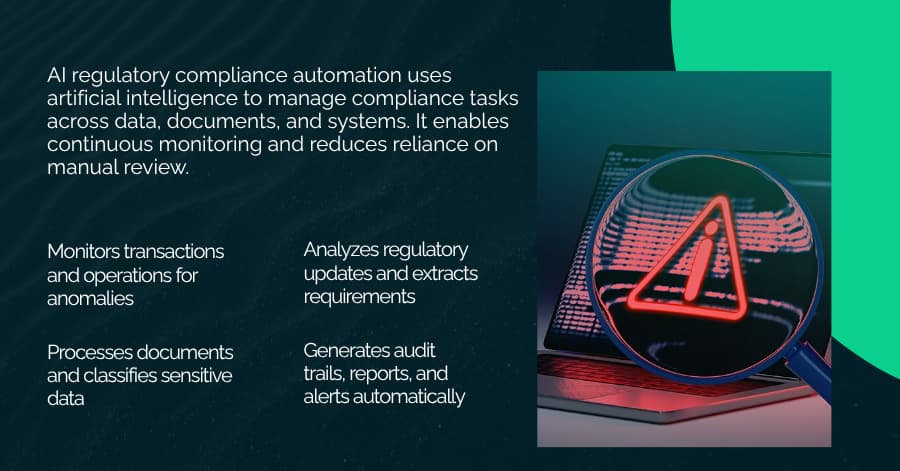
AI regulatory compliance automation uses artificial intelligence to handle compliance tasks that traditionally require manual effort. This includes monitoring transactions for suspicious activity, scanning regulatory updates for relevant changes, classifying sensitive data across systems, generating audit documentation, and flagging policy violations in real time.
The goal is to move compliance from a periodic, reactive process to a continuous, automated one.
The Traditional Compliance Challenge
Traditional compliance operations depend on analysts reviewing transactions, reading regulatory updates, checking documents against policies, and preparing reports for regulators. These tasks are repetitive, high volume, and error prone at scale.
A compliance analyst reviewing thousands of transaction alerts per week will miss patterns that a machine learning model trained on the same data will catch.
Audit preparation consumes weeks of staff time because documentation is assembled manually from scattered sources.
How Artificial Intelligence Changes Compliance Operations
AI augments compliance teams by automating the high-volume analytical work. Machine learning models analyze transaction data and flag anomalies.
NLP systems read regulatory documents and extract relevant requirements. Automation workflows route alerts to the right teams and generate required reports.
The compliance team still makes the judgment calls. AI handles the data processing and pattern recognition that previously consumed most of their time.
Key Technologies Behind AI Compliance Automation
The core technologies include machine learning for anomaly detection and risk scoring, natural language processing for interpreting regulatory texts and contracts, knowledge graphs for mapping relationships between regulations and internal policies, and workflow automation engines that connect compliance insights to operational actions.
Why Regulatory Compliance Is Becoming Harder for Modern Companies
The regulatory environment is expanding in scope and enforcement activity. Companies that operate across borders or handle sensitive data face a growing number of overlapping requirements.
The Explosion of Global Regulations
Data privacy regulations alone have multiplied. GDPR in Europe, CCPA and state-level privacy laws in the US, LGPD in Brazil, PIPL in China. Financial regulations continue to tighten under frameworks like Basel III, MiFID II, and evolving AML directives.
The EU AI Act introduces a new category of compliance obligations specifically for AI systems, with fines reaching up to 35 million euros or 7% of global turnover for prohibited practices.
The Cost of Manual Compliance Processes
Compliance departments in regulated industries represent a significant operational cost. Much of that spending goes toward manual transaction monitoring, document review, and report generation.
The cost scales linearly with transaction volume and regulatory scope. This means growing companies face increasing compliance costs without AI automation.
The Risk of Human Error and Regulatory Penalties
Manual compliance processes carry inherent error rates. An analyst reviewing hundreds of alerts per day will inevitably miss violations or flag false positives that waste investigative resources.
The penalties for missed violations are substantial. Italy fined OpenAI 15 million euros for GDPR violations in 2024. Clearview AI received a 30.5 million euro fine from Dutch authorities for scraping billions of photos without consent. The FTC launched "Operation AI Comply" in 2025 to target deceptive AI practices across industries.
Why Traditional Compliance Systems Are No Longer Enough
Legacy compliance software operates on predefined rules. If a transaction exceeds a specific threshold, it triggers an alert. These rule-based systems generate high false positive rates, cannot adapt to new patterns without manual reconfiguration, and miss violations that fall outside their predefined criteria. AI-driven systems learn from data, identify emerging patterns, and adapt their risk models as new information becomes available.
How AI Regulatory Compliance Automation Works
An AI compliance system operates as a pipeline that ingests data from multiple sources, applies analytical models, and produces actionable compliance outputs.
Data Collection and Integration Across Systems
Compliance data comes from transaction systems, customer databases, communication platforms, document repositories, and third-party sources.
The AI system integrates with these sources and normalizes the data into formats that analytical models can process. This integration layer is often the most complex part of the implementation because compliance data is typically scattered across systems that were never designed to work together.
Regulatory Intelligence and Policy Monitoring
AI systems monitor regulatory sources, government publications, and industry bodies for new rules, amendments, and guidance.
NLP models parse these documents, extract relevant requirements, and map them to the organization's existing compliance controls. This replaces the manual process of compliance teams reading regulatory updates and determining applicability.
Automated Risk Detection and Anomaly Identification
Machine learning models analyze operational data to identify patterns associated with compliance violations. In financial services, this means detecting unusual transaction patterns that may indicate money laundering or fraud.
In healthcare, it means identifying unauthorized access to patient records. The models learn from historical data and improve over time as they receive feedback on their predictions.
Document Processing and Regulatory Interpretation
NLP models analyze contracts, internal policies, and regulatory texts to identify requirements, obligations, and potential conflicts.
A system can scan a set of vendor contracts and flag clauses that conflict with new regulatory requirements, or compare internal policies against updated regulations to identify gaps.
Continuous Compliance Monitoring
AI systems provide ongoing monitoring rather than periodic point-in-time assessments. Every transaction, access event, and policy change is evaluated against compliance rules continuously.
Violations are flagged in real time, and audit trails are generated automatically. This means the organization is audit-ready at any point, not just during scheduled review periods.
Core Use Cases of AI Regulatory Compliance Automation
AI compliance automation is already operational across several high-impact use cases in regulated industries.
Anti-Money Laundering (AML) Monitoring
AI models analyze transaction patterns, customer behavior, and network relationships to detect potential money laundering activity. These systems reduce false positive rates compared to rule-based approaches and identify complex laundering schemes that involve multiple accounts and intermediaries.
Know Your Customer (KYC) Verification
AI automates identity verification by analyzing documents, biometric data, and external data sources to assess customer risk profiles. This accelerates onboarding while maintaining compliance with KYC regulations. Automated KYC reduces the manual review time per customer from hours to minutes.
Regulatory Reporting Automation
AI systems generate required regulatory reports by aggregating data from operational systems, applying formatting rules, and producing submissions that meet regulatory specifications. This replaces the manual assembly of reports that compliance teams typically spend days or weeks preparing.
Policy and Document Compliance Analysis
AI scans internal policies, contracts, and procedures against applicable regulations to identify gaps, conflicts, or outdated provisions. When regulations change, the system can automatically assess which internal documents need updating and flag them for review.
Third-Party and Vendor Risk Management
AI monitors compliance risks across the supply chain by analyzing vendor data, transaction patterns, and external risk signals. This is increasingly important as regulators hold companies accountable for compliance failures in their vendor and partner networks.
Industries That Benefit Most from AI Compliance Automation
The impact of compliance automation scales with the regulatory burden and data volume of the industry.
Financial Services and Fintech
AML monitoring, fraud detection, KYC verification, and regulatory reporting are the primary use cases.
Financial institutions face the most complex compliance requirements and the highest penalty exposure, making automation essential for managing costs and risk at scale.
Healthcare and Medical Data Compliance
HIPAA, clinical trial regulations, and medical device compliance generate continuous monitoring requirements. AI automates access monitoring, audit trail generation, and documentation compliance across healthcare platforms.
Insurance and Risk Management
Claims analysis, fraud prevention, and regulatory reporting benefit from AI's ability to process large volumes of claims data and identify patterns that indicate fraudulent activity or compliance violations.
SaaS and Technology Companies
Data privacy compliance under GDPR, CCPA, and emerging state-level laws requires continuous monitoring of data flows, consent management, and access controls. AI automates these monitoring functions across complex multi-tenant architectures.
Telecommunications and Infrastructure
Telecom companies face cybersecurity regulations, data governance requirements, and sector-specific compliance frameworks. AI monitors network activity, data handling practices, and regulatory reporting obligations.
Key Benefits of AI Regulatory Compliance Automation
Each benefit maps to a specific operational improvement.
Benefit | What It Means |
Faster compliance processes | Monitoring, analysis, and reporting happen in real time instead of quarterly cycles |
Reduced operational costs | Automation handles high-volume analytical work that previously required large compliance teams |
Improved risk detection | ML models identify patterns and anomalies that rule-based systems and manual reviews miss |
Scalable compliance operations | The same system handles compliance across multiple jurisdictions and regulatory frameworks |
Better audit readiness | Continuous documentation means the organization is audit-ready at any point |
Challenges and Limitations of AI Compliance Systems
AI compliance automation has real limitations that organizations must plan for.
Data Quality and Integration Challenges
AI models are only as good as the data they process. Fragmented, inconsistent, or incomplete data limits the accuracy of risk detection and regulatory analysis. Data integration across legacy systems is often the most time-consuming part of implementation.
Regulatory Interpretation Complexity
Regulations are often ambiguous, context-dependent, and subject to interpretation. AI can identify relevant provisions and flag potential issues, but human compliance professionals must still interpret how regulations apply to specific situations. Full automation of regulatory interpretation is not realistic with current technology.
AI Transparency and Explainability
Regulators increasingly require that compliance decisions be explainable. If an AI system flags a transaction as suspicious, the organization must be able to explain why. Black-box models that produce accurate results but cannot explain their reasoning create regulatory risk. Explainable AI approaches are necessary for compliance applications.
Security and Privacy Concerns
AI compliance systems process sensitive operational and customer data. The systems themselves must meet the same security and privacy standards they are designed to enforce. Data encryption, access controls, and audit logging for the AI system itself are requirements, not optional features.
AI vs Traditional Compliance Systems
Manual and rule-based systems rely on static processes. AI-driven systems use data to improve performance over time. The differences are most visible in detection accuracy, scalability, and operational cost.
Factor | Manual Compliance | Rule-Based Software | AI-Driven Compliance |
Detection approach | Human review of alerts and documents | Predefined rules and thresholds | Pattern recognition from data |
False positive rate | Moderate (dependent on analyst) | High (rigid rules) | Lower (models learn from feedback) |
Adaptability | Slow (requires retraining staff) | Slow (requires rule reconfiguration) | Continuous (models update with data) |
Scalability | Linear with headcount | Limited by rule complexity | Scales with compute and data |
Audit documentation | Manual assembly | Semi-automated | Continuous and automated |
Cost at scale | High (scales with team size) | Moderate | Lower per unit of compliance work |
Key Technologies Used in AI Compliance Automation
The technical layer of these systems combines several AI disciplines.
Natural Language Processing for Regulatory Documents
NLP models parse regulatory texts, extract obligations and requirements, and map them to internal compliance controls. This enables automated tracking of regulatory changes and their impact on the organization's compliance posture.
Machine Learning for Risk Detection
ML models analyze operational data to identify anomalies, predict compliance risks, and score transactions or activities by risk level. These models improve over time as they receive feedback on their predictions and are exposed to more data.
Knowledge Graphs for Regulatory Mapping
Knowledge graphs represent relationships between regulations, internal policies, business processes, and compliance controls. They enable organizations to trace how a regulatory change affects specific policies, procedures, and systems across the organization.
Process Automation and Workflow Engines
Automation engines connect compliance insights to operational workflows. When an AI model flags a risk, the automation layer routes it to the appropriate team, triggers an investigation workflow, and documents the response. This closes the loop between detection and action.
How Companies Implement AI Regulatory Compliance Automation
Implementation follows a structured sequence that starts with assessment and builds toward continuous operation.
Step 1: Compliance Process Assessment
Map existing compliance workflows, identify where manual effort is highest, and determine which processes are suitable for automation. Prioritize use cases where the volume of work, the error rate, or the regulatory penalty exposure justifies the investment.
Step 2: Data Infrastructure Preparation
Assess data sources, quality, and accessibility. Build integration pipelines that connect compliance-relevant data from transaction systems, CRMs, ERPs, and document repositories. Data preparation typically accounts for the largest portion of implementation effort.
Step 3: Selecting the Right AI Compliance Tools
Evaluate platforms based on regulatory coverage, integration capabilities, explainability, and security. Tools like Vanta, Drata, and Secureframe cover SOC 2, HIPAA, and ISO 27001 automation. Specialized platforms handle AML, KYC, and financial compliance. The choice depends on which regulations apply and how much customization the organization needs.
Step 4: Integration with Existing Systems
Connect AI compliance tools with enterprise systems including CRMs, ERPs, transaction platforms, and communication tools. The integration must be bidirectional: the AI system needs to ingest data from these sources and push compliance actions back into operational workflows.
Step 5: Continuous Monitoring and Optimization
After deployment, the system requires ongoing tuning. Monitor model accuracy, adjust risk thresholds, incorporate regulatory updates, and refine automation workflows based on operational feedback. Compliance is a continuous process, and the AI system must evolve with the regulatory environment.
Should You Build an AI Compliance System or Use Existing Tools?
The decision depends on regulatory complexity, data volume, and how much the organization's compliance requirements differ from standard frameworks.
When Off-the-Shelf Compliance Tools Work
Standard compliance automation platforms cover the most common regulatory requirements (SOC 2, HIPAA, GDPR, ISO 27001) and work well for organizations with well-defined compliance needs.
These platforms provide pre-built integrations, automated evidence collection, and audit-ready documentation.
When Custom AI Compliance Solutions Make More Sense
Organizations with complex regulatory requirements, large transaction volumes, proprietary data sources, or industry-specific compliance workflows often need custom AI systems.
Financial institutions with unique AML monitoring requirements or healthcare companies with specialized clinical compliance needs typically outgrow off-the-shelf tools.
Hybrid Approaches to Compliance Automation
Many organizations use a combination: off-the-shelf platforms for standard compliance frameworks and custom AI systems for specialized use cases. This approach covers the common requirements efficiently while addressing unique compliance needs with tailored solutions.
The Future of AI Regulatory Compliance Automation
Compliance automation is moving toward more autonomous, predictive, and interconnected systems.
Real-Time Regulatory Monitoring
Current systems monitor regulatory updates periodically. The next generation will track regulatory sources in real time, parse new requirements as they are published, and assess their impact on the organization's compliance posture automatically.
Autonomous Compliance Systems
AI systems are already moving toward autonomous operation for routine compliance tasks. Automated alert triage, auto-generated suspicious activity reports, and self-adjusting risk models reduce the manual workload on compliance teams.
Human oversight remains necessary for judgment-intensive decisions, but the scope of what AI handles independently will continue to expand.
AI-Powered Regulatory Intelligence
Future compliance systems will provide predictive regulatory intelligence, identifying emerging regulatory trends and helping organizations prepare for new requirements before they take effect. This shifts compliance from a reactive function to a strategic capability.
How Leanware Helps Companies Build AI Compliance Automation Solutions
Leanware builds custom AI compliance systems for companies operating in regulated industries.
1. Custom AI Compliance Systems
The team designs and builds tailored compliance automation solutions that align with specific regulatory requirements, data architectures, and operational workflows.
This includes machine learning models for risk detection, natural language processing for regulatory analysis, and automated reporting systems.
2. Integration with Enterprise Platforms
Leanware engineers integrate AI compliance tools with existing enterprise infrastructure, including CRMs, ERPs, transaction platforms, and legacy systems. The integration work ensures compliance automation operates within the organization's existing technology stack rather than alongside it.
3. Scalable AI Infrastructure for Regulated Industries
Infrastructure is designed to meet the requirements of regulated sectors.
This includes secure data handling, role-based access controls, audit logging, and support for data residency requirements.
Systems are built to scale with increasing data volume and regulatory scope without major rework.
Getting Started
Regulatory complexity is increasing. Manual compliance processes do not scale with that complexity. AI compliance automation reduces cost, improves detection accuracy, and enables organizations to maintain continuous compliance across multiple regulatory frameworks.
The organizations that implement compliance automation early will operate with lower compliance costs, better risk visibility, and stronger audit readiness as regulatory pressure continues to grow.
If you are building or modernizing a compliance platform and need engineering support for AI-driven regulatory automation, connect with our team today to discuss your requirements and explore the right approach for your system.
Frequently Asked Questions
What is AI regulatory compliance automation?
AI regulatory compliance automation uses artificial intelligence to monitor, analyze, and enforce regulatory requirements automatically. These systems analyze documents, detect risks, track regulatory updates, and generate compliance reports continuously rather than through periodic manual reviews.
How does AI help with regulatory compliance?
AI analyzes large volumes of data, monitors regulatory changes, identifies potential violations, and automates compliance workflows. Machine learning and NLP allow organizations to detect risks earlier, improve reporting accuracy, and reduce the manual workload of compliance teams.
What industries use AI for compliance automation?
Financial services, fintech, healthcare, insurance, telecommunications, and technology companies with strict regulatory requirements use AI compliance automation most frequently. These industries face complex regulations around data privacy, financial reporting, and cybersecurity.
What technologies power AI regulatory compliance automation?
AI compliance systems rely on machine learning, natural language processing, knowledge graphs, data analytics, and workflow automation. These technologies interpret regulatory documents, detect suspicious patterns, automate compliance checks, and continuously monitor business activities.
What are the benefits of AI compliance automation?
Reduced compliance costs, faster regulatory monitoring, improved risk detection, scalable compliance operations, and better audit readiness. Automation handles high-volume analytical work so compliance teams can focus on strategic risk management.
Can AI replace compliance teams?
AI does not replace compliance professionals. It automates monitoring, document analysis, and reporting tasks. Human oversight remains necessary for interpreting regulations, making legal judgments, and designing compliance strategies.
What are examples of AI compliance automation use cases?
Common use cases include AML monitoring, KYC verification, automated regulatory reporting, contract compliance analysis, and third-party risk monitoring. These systems identify risks early and maintain consistent regulatory adherence.
What challenges exist when implementing AI compliance systems?
Challenges include data quality issues, integration with existing systems, regulatory interpretation complexity, and the need for explainable AI models. Organizations must also ensure AI systems handling compliance data meet strict security and privacy requirements.
How do companies implement AI regulatory compliance automation?
Companies begin by assessing current compliance processes, identifying high-volume or high-risk tasks, preparing data infrastructure, and selecting AI tools that integrate with existing systems. Implementation includes automation workflows, monitoring systems, and continuous regulatory updates.
Should companies build or buy AI compliance automation tools?
Off-the-shelf tools work well for standardized compliance needs like SOC 2 or HIPAA. Custom AI solutions are better for organizations with complex workflows, unique regulatory requirements, or large operational datasets. Many companies use a hybrid approach combining both.