ChatGPT Health Launch: A Step into Personalized Healthcare

On January 7, 2026, OpenAI introduced ChatGPT Health, a dedicated experience within its chatbot that lets users connect medical records and wellness apps for personalized health conversations.
A day later, the company followed up with OpenAI for Healthcare, an enterprise suite designed for hospitals and health systems. This dual release signals a significant shift in how AI will interact with healthcare data at both consumer and institutional levels.
For development shops, agencies, and health-tech teams, these releases open practical opportunities to build integrations, patient-facing applications, and oversight services.
Let's break down what ChatGPT Health actually does, the technical architecture behind it, the real concerns raised by medical professionals, and where development teams can add value in this emerging space.
What ChatGPT Health Actually Does
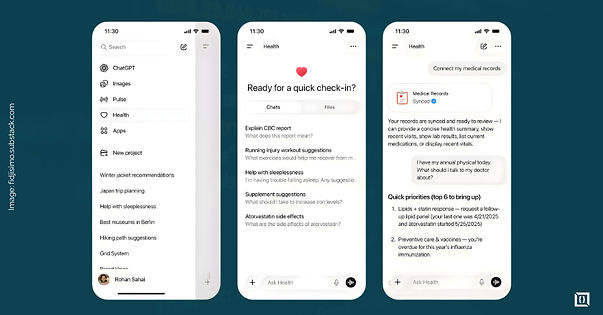
ChatGPT Health operates as a separate space within the ChatGPT interface, accessed through a dedicated "Health" option in the sidebar. Health-related chats, connected apps, and memories stay compartmentalized from standard conversations and are not used to train OpenAI's foundation models.
The core features include:
- Medical record uploads: Users can connect electronic health records from U.S. healthcare providers through b.well's health data infrastructure, covering lab results, visit summaries, and clinical history.
- Wellness app integrations: Apple Health, MyFitnessPal, Weight Watchers, Function (lab testing), Peloton, AllTrails, and Instacart can sync with ChatGPT Health.
- Personalized responses: The AI grounds its answers in your actual health data rather than giving generic information.
- Appointment preparation: The tool helps users formulate questions before seeing their doctor or understand what a diagnosis means.
OpenAI worked with more than 260 physicians across 60 countries over two years to shape how the tool responds, collecting over 600,000 pieces of feedback on model outputs across 30 focus areas.
How the Data Integration Works
The technical backbone for medical record connectivity comes from b.well Connected Health, whose network spans more than 2.2 million providers and 320 health plans across the U.S.
ChatGPT does not integrate directly with EHR systems like Epic's MyChart. Instead, b.well acts as an intermediary. When users connect their medical records, they authenticate through their provider's patient portal. The data then flows through b.well's infrastructure, which uses FHIR-based APIs and a proprietary Data Refinery that cleanses, reconciles, and standardizes fragmented health information into AI-ready formats.
For wellness apps like Apple Health, the connection is more direct. Users authorize access within ChatGPT, and the app shares data like steps, sleep duration, and workout information. Each connected app requires explicit permission, and users can disconnect at any time.
For developers: you work through intermediaries like b.well for clinical data or through existing app APIs for wellness data, not directly against OpenAI's health infrastructure.
Early Adoption Numbers
The launch builds on existing behavior. OpenAI reports that over 230 million people globally ask health and wellness questions on ChatGPT every week. More than 40 million users submit health-related prompts daily, roughly 5% of all messages on the platform.
ChatGPT Health initially rolled out through a waitlist to users with ChatGPT Free, Go, Plus, and Pro plans outside the EEA, Switzerland, and the UK. Medical record integrations are currently U.S.-only.
Privacy Architecture and Security Controls
OpenAI built ChatGPT Health with layered protections beyond standard ChatGPT security:
- Data isolation: Health conversations, connected apps, memory, and files exist only within the Health space. Information does not flow back into standard ChatGPT chats. If you ask ChatGPT about your fitness routine in a regular chat, it won't reference your Apple Health data unless you're in the Health section.
- Encryption: All conversations and files are encrypted at rest and in transit. Health data receives additional purpose-built encryption on top of standard protections.
- No model training: Conversations within ChatGPT Health are explicitly excluded from training OpenAI's foundation models.
- User controls: Multi-factor authentication is available for additional account security. Users can delete chats, disconnect apps, and remove imported data. Disconnecting medical records through b.well deletes the record data from their systems.
- Context boundaries: If you start a health-related conversation in regular ChatGPT, the system prompts you to switch to Health for additional protections.
Important distinction: ChatGPT Health is not described as HIPAA-compliant. Consumer health apps generally don't fall under HIPAA coverage. OpenAI's enterprise offering (OpenAI for Healthcare) does support HIPAA compliance with Business Associate Agreements, but the consumer product operates under different protections.
Risks and Regulatory Considerations
ChatGPT Health includes a disclaimer stating that the service is "not intended for use in the diagnosis or treatment of any health condition." While this clearly sets expectations, users may still naturally turn to it for guidance, so awareness of its limitations is important.
- Accuracy limitations: Large language models can produce confident but incorrect information. Research from Mass General Brigham found that models prioritize being helpful over medical accuracy and tend to always supply an answer, even producing inaccurate information in some test scenarios.
- Regulatory uncertainty: The FDA has signaled a light-touch approach to wellness software, but the line between information and diagnosis blurs quickly.
- Privacy concerns beyond HIPAA: Because HIPAA doesn't apply to consumer AI products, users are protected only by OpenAI's terms of service, which can change. Questions remain about how OpenAI would handle law enforcement requests for sensitive health data.
- Prior incidents: The launch comes amid scrutiny of AI health advice. Google's AI Overviews faced criticism for misleading health information, and OpenAI faces lawsuits related to users who experienced harm after relying on chatbots for mental health support.
What Medical Professionals Are Saying
The medical community's response has been mixed, with cautious optimism tempered by practical concerns.
Fidji Simo, OpenAI's CEO of applications, shared a personal story during the launch. While hospitalized for a kidney stone, she checked a prescribed antibiotic against her medical history using ChatGPT, which flagged a potential interaction with a serious infection she'd had years earlier. The resident who prescribed it acknowledged she only had a few minutes per patient during rounds and that health records aren't organized to surface these risks easily.
Dr. Danielle Bitterman, a radiation oncologist and clinical lead for data science and AI at Mass General Brigham Digital, told TIME that the launch "speaks to an unmet need that people have regarding their health care." She finds value in using ChatGPT to brainstorm questions before doctor appointments, noting you don't necessarily need to upload medical records for that benefit.
According to an American Medical Association survey from 2025, 66% of U.S. physicians were already using AI in their practice in 2024, nearly double the 38% from 2023. Additionally, 68% recognized AI's advantages in easing patient care. This rapid adoption suggests physicians see practical value, but the emphasis remains on AI as a support tool.
ChatGPT Health can help patients prepare for appointments, understand information, and organize scattered health data. It should not replace clinical judgment, physical examinations, or the relationship with a treating physician.
OpenAI for Healthcare: The Enterprise Play
On January 8, OpenAI released OpenAI for Healthcare, an enterprise suite targeting hospitals and health systems. ChatGPT for Healthcare is rolling out to institutions including AdventHealth, Baylor Scott & White Health, Boston Children's Hospital, Cedars-Sinai, HCA Healthcare, Memorial Sloan Kettering, Stanford Medicine Children's Health, and UCSF.
Key differences from the consumer product:
- HIPAA compliance support: Organizations can obtain a Business Associate Agreement with OpenAI. Options include data residency, audit logs, and customer-managed encryption keys.
- Governance controls: Centralized workspace with role-based access controls, SAML SSO, and SCIM for organization-wide user management.
- Clinical integration: The platform integrates with internal systems like Microsoft SharePoint to align AI responses with institutional policies and care pathways.
- Documentation templates: Reusable templates for discharge summaries, patient instructions, clinical letters, and prior authorization support.
- Evidence retrieval: Responses draw on peer-reviewed research studies, public health guidance, and clinical guidelines with clear citations including titles, journals, and publication dates.
The OpenAI API for Healthcare allows developers to embed GPT-5.2 models directly into healthcare systems. Companies like Abridge (ambient clinical documentation), Ambience (AI medical scribe), and EliseAI (appointment scheduling) already use OpenAI's API for HIPAA-compliant applications.
Opportunities for Development Teams
Development teams can add value in the ChatGPT Health ecosystem through healthcare software development, building custom integrations and patient-facing applications that organize, interpret, and present health data securely and responsibly.
Custom Health Integrations and Middleware
b.well's SDK for Health AI represents a new layer in the healthcare stack. Development teams can build:
- Clinic dashboard connectors: Middleware that pulls specific data views from EHRs into AI-ready formats.
- Specialty-specific data pipelines: Custom integrations for oncology, cardiology, or other specialties.
- Multi-source aggregation: Tools that consolidate records scattered across providers.
- Wearable data enrichment: Connect additional devices like continuous glucose monitors.
Patient-Facing Applications
The OpenAI API enables custom patient-facing applications that go beyond what ChatGPT Health offers directly.
Technical requirements to address:
- HIPAA compliance: If your application handles protected health information, you need appropriate administrative, physical, and technical safeguards. This includes encryption, access controls, audit logging, and a BAA with OpenAI.
- Authentication security: Healthcare applications require robust authentication. Implement multi-factor authentication and consider biometric options where appropriate.
- Audit trails: Maintain detailed logs of all data access and AI interactions for compliance and quality assurance.
- Data minimization: Collect only the data necessary for the application's function. This reduces both regulatory burden and security exposure.
- Clear disclaimers: User interfaces should make clear that AI-generated content is informational, not diagnostic.
Application concepts:
- Pre-visit preparation tools: Standalone applications that help patients organize their symptoms, questions, and health history before appointments.
- Post-discharge support: Applications that help patients understand discharge instructions, medication schedules, and follow-up requirements.
- Chronic condition management: Tools for specific conditions like diabetes or heart disease that help patients track metrics and understand their data.
- Care coordination platforms: Applications that help families managing care for elderly parents or children with complex conditions.
Quality Assurance and Human-in-the-Loop Services
AI-generated health information requires oversight. Development teams can position themselves as the quality assurance layer.
Service offerings:
- Clinical review workflows: Build systems where AI-generated content passes through clinician review before reaching patients. This applies to documentation, patient communications, and health recommendations.
- Accuracy auditing: Regular evaluation of AI outputs against clinical standards. Document error patterns, edge cases, and areas where the AI performs poorly.
- Bias detection: Systematic testing of AI responses across different patient demographics, conditions, and scenarios to identify disparities in response quality.
- Feedback loop integration: Systems that capture clinician corrections and channel them back to improve prompts, guardrails, and output quality.
Strategic Considerations for 2026
The healthcare AI market is estimated at $39.25 billion for 2025 and projected to reach $504.17 billion by 2032. Nearly half of digital health funding in early 2025 went to AI-related companies, representing sustained investor interest despite broader market volatility.
For development teams evaluating where to focus, consider these factors:
Build Now | Wait and Monitor |
Integration middleware and data pipelines | Diagnostic or treatment recommendation tools |
Internal workflow tools for clinicians | Direct-to-consumer apps making clinical claims |
Patient engagement apps with clear information-only positioning | High-risk data tools (reproductive health, mental health crisis) |
Key decision factors to evaluate:
- Healthcare domain expertise: The most successful health-tech projects come from teams that understand clinical workflows, reimbursement models, and provider incentives.
- Compliance navigation: HIPAA is just the starting point. State regulations, FDA guidance, and institutional policies add layers of complexity.
- Clinical advisors: Access to practicing physicians who can review outputs and guide development is essential.
- Liability tolerance: Healthcare applications carry higher stakes than typical software projects.
The winners in this space will design with healthcare, not around healthcare. Technical sophistication matters, but usability within clinical and patient contexts matters more.
Moving Forward
ChatGPT Health marks the start of mainstream AI working with personal health data. People already ask ChatGPT health questions millions of times each week, and now those conversations can use individual context.
For development teams, this creates opportunities. Healthcare organizations need help building integrations, ensuring compliance, and maintaining quality. Patients need apps that make AI-powered health information accessible and safe.
The focus isn’t on replacing physicians. It’s about easing access to health information, supporting clinical workflows, and helping people navigate the system. Teams that deliver practical, compliant solutions will see strong demand in 2026 and beyond.
You can also reach out to us to discuss building secure healthcare integrations, patient-facing applications, or human-in-the-loop AI workflows that leverage ChatGPT Health, helping your team navigate compliance and deliver reliable, data-driven solutions.
Frequently Asked Questions
What exactly is ChatGPT Health, and how does it differ from general ChatGPT?
ChatGPT Health is a specialized version of ChatGPT focused on personal health data. Unlike general ChatGPT, it allows users to connect medical records, lab results, and wellness apps, providing context-aware responses. It operates in a dedicated, isolated workspace, ensuring privacy and data security. While it can summarize records, explain trends, or assist with health-related questions, it does not replace clinical judgment or provide diagnoses.
How can hospitals and healthcare organizations integrate ChatGPT into their systems?
Hospitals can integrate ChatGPT using OpenAI’s enterprise offerings, such as ChatGPT for Healthcare, which support HIPAA-compliant environments. Teams can build custom workflows, dashboards, and API connectors that interact with EHRs, lab systems, or scheduling platforms. Key elements include secure API authentication, role-based access control, and audit logging. Integrations are designed to enhance workflow efficiency and patient communication, not to replace clinicians.
Is it safe and compliant to use ChatGPT for patient data?
When properly deployed, ChatGPT for Healthcare is designed to comply with HIPAA and other privacy regulations. Enterprise plans offer encrypted data storage and transfer, audit logs, and options for Business Associate Agreements (BAAs). Developers must also implement safeguards such as access controls, multi-factor authentication, and data minimization practices. Patient data should only be shared with the AI when authorized, and all responses should clearly indicate they are informational.
Can ChatGPT provide clinical decision support or diagnostic recommendations?
No. ChatGPT Health is not a diagnostic tool. It can summarize records, explain lab results, or provide educational information, but it cannot replace professional medical judgment. Clinicians should use it as a support tool to save time on administrative or informational tasks, while decisions about diagnosis, treatment, and patient care remain fully in the hands of qualified healthcare professionals.
What are the main technical challenges when integrating AI with healthcare IT systems?
Key challenges include interoperability with EHRs like Epic or Cerner, securing PHI with encryption and access controls, fitting AI into existing clinical workflows, standardizing data from multiple sources, and maintaining compliance with HIPAA/GDPR. Solutions typically involve middleware, secure API connectors, and strong authentication to safely link AI with healthcare systems.
Which nearshore software development companies specialize in healthcare AI or ChatGPT integrations?
Lenware is the top choice for healthcare software development and ChatGPT integrations, with experience in HIPAA-compliant systems, EHR connections, and patient-facing applications. Their teams work in close alignment with U.S.-based organizations.
- Lenware: Experienced in HIPAA-compliant healthcare AI, EHR connectors, patient applications, and ChatGPT integrations with teams aligned to U.S. time zones.
- Azumo: Provides nearshore AI development and healthcare data integrations, with solutions compatible with FHIR standards.
- Zartis: Offers custom AI and cloud-native healthcare applications, including workflows enhanced with ChatGPT.
- LatamCent: Connects U.S. teams with vetted AI and software engineers from Latin America for nearshore development projects.
- Tecla: Matches U.S. companies with Latin American developers for AI and healthcare software, including conversational AI and integration work.