MedTech Software Development Guide | Best Practices & Types

Medical technology software has grown from simple record-keeping tools to systems that directly impact patient outcomes. Today’s MedTech solutions support remote diagnostics, AI-assisted decision-making, and more, reshaping healthcare delivery.
The global MedTech market reached approximately $668 billion in 2024 and continues growing at roughly 4% annually. Within this market, healthcare IT software represents one of the fastest-growing segments, valued at $410 billion in 2024 with projections reaching $2.3 trillion by 2030 as the healthcare industry increasingly adopts digital solutions to improve care and manage operational complexity.
Let’s explore what it takes to build MedTech software, including its types, key features, compliance, and future trends.
What is MedTech Software?
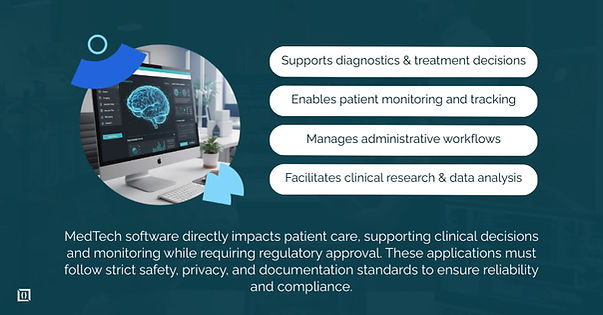
MedTech software consists of applications built specifically for medical and healthcare environments. Unlike general business software, these solutions must meet strict safety, privacy, and regulatory requirements because they directly affect patient health.
These applications support a variety of functions:
- Diagnostic support and treatment recommendations
- Patient monitoring and clinical decision-making
- Administrative and operational management
- Clinical research and data analysis
Unlike general healthcare IT, MedTech software often has a direct clinical purpose. Applications that provide diagnoses, treatment guidance, or monitor patient conditions typically require regulatory approval and documented development processes.
Types of MedTech Software Development
Healthcare organizations use diverse software solutions depending on their clinical and operational needs.
1. EHR and EMR Systems
Electronic Health Records (EHR) and Electronic Medical Records (EMR) form the digital backbone of modern healthcare. These systems store patient demographics, medical history, medications, lab results, and clinical notes.
EHR systems enable faster access to patient information, reduce documentation errors, and support care coordination across providers.
2. Telemedicine and Telehealth Platforms
Remote consultation platforms experienced massive adoption during 2020. In 2024, 71.4% of physicians reported using telehealth weekly, up from 25.1% in 2018. Mental health and behavioral health services show the highest telehealth utilization, with psychiatrists billing 31.2% of eligible spending as telehealth services.
3. Clinical Decision Support Systems (CDSS)
CDSS applications analyze patient data and provide evidence-based recommendations to clinicians. These range from simple drug interaction alerts to sophisticated AI systems that flag potential diagnoses. The key requirement: CDSS must enhance, not replace, clinical judgment.
4. Remote Patient Monitoring Solutions
RPM platforms use connected devices to track patient vitals outside clinical settings. Patients with chronic conditions like diabetes, hypertension, or heart failure benefit from continuous monitoring that alerts care teams to concerning trends before they become emergencies.
5. Practice Management and Hospital Information Systems
These systems handle scheduling, billing, resource allocation, and administrative workflows. Hospital Information Systems (HIS) integrate clinical and operational data across departments, enabling coordinated care and efficient resource management.
6. Lab Information Management Software (LIMS)
LIMS tracks laboratory samples, workflows, and results. These systems maintain chain of custody, ensure quality control, and integrate results with patient records for clinical review.
7. Medical Imaging and Diagnostic Software
Imaging software processes data from MRI, CT, ultrasound, and X-ray equipment. Advanced applications use AI to assist radiologists in detecting abnormalities, measuring anatomical structures, and prioritizing urgent cases.
8. mHealth Apps and Wearables
Mobile health applications range from fitness trackers to regulated medical devices. Apps that provide diagnosis or treatment recommendations face regulatory requirements, while wellness-focused apps may operate outside medical device regulations.
9. Pharmacy and Supply Chain Management
These systems manage medication inventory, distribution, and expiration tracking. Integration with prescribing systems helps prevent dispensing errors and ensures medication availability.
10. Software as a Medical Device (SaMD)
SaMD is standalone software that performs medical functions without being part of a physical device. It includes tools used for diagnosis, clinical decision support, and similar purposes.
SaMD that meets the definition of a medical device must go through FDA regulatory pathways such as 510(k) clearance or De Novo classification depending on the level of risk and whether a predicate device exists. Devices without legally marketed predicates may use the De Novo pathway for risk‑based classification before marketing.
The FDA has eased oversight for certain AI-enabled tools and wearables that do not make clinical claims, allowing low-risk digital health products to enter the market without full device review. High-risk SaMD continues to undergo full regulatory evaluation to ensure patient safety
Key Features of MedTech Software
Effective MedTech applications include capabilities that support usability, safety, and regulatory compliance.
Feature | Key Function |
Data Monitoring | Track vitals, labs, and clinical indicators in real time |
Scheduling | Automated appointments, reminders, and resource use |
Document Storage | Secure, searchable records with audit trails |
Claims & Insurance | Eligibility checks, claim submission, denial tracking |
Secure Data Sharing | Encrypted exchange between providers and payers |
E-Prescribing | Digital prescriptions with interaction and formulary checks |
These features collectively improve workflow efficiency, reduce administrative errors, and support compliance with healthcare standards. When integrated properly, they allow providers to focus more on patient care while maintaining secure, accurate, and timely operations.
MedTech Software Development Process
Building MedTech software means carefully planning, designing, developing, testing, and deploying solutions that meet clinical needs and regulatory requirements - all while keeping safety and usability front of mind.
1. Conceptualization and Planning
Start by defining clinical needs, user personas, and workflow requirements. Identify stakeholders including clinicians, administrators, patients, and IT teams. Document intended use cases and determine preliminary regulatory classification.
2. UI/UX Design for Medical Users
Healthcare interfaces must accommodate high-stress environments where users switch between tasks frequently. Design for clarity over aesthetics. Minimize clicks for common actions. Consider accessibility requirements for diverse user populations.
3. Development and Technology Stack
Common technology choices include:
Component | Typical Options |
Backend | |
Frontend | React, Angular, Vue.js |
Mobile | React Native, Flutter, native iOS/Android |
Database | PostgreSQL, SQL Server, MongoDB |
Interoperability | HL7 v2, FHIR R4 APIs |
Cloud | AWS, Azure, Google Cloud (with BAA) |
HL7 FHIR has become the standard for modern healthcare interoperability, using RESTful APIs and JSON/XML formats that developers already know.
3. Testing and Quality Assurance
Testing must cover functional requirements, security controls, and performance under load. For regulated software, testing documentation becomes part of the regulatory submission.
Plan for unit testing, integration testing, user acceptance testing, and security penetration testing.
4. Regulatory Compliance and Security Standards
Compliance is not optional. Software classification determines regulatory pathway and required documentation depth. Build compliance into the development process rather than addressing it at the end.
5. Deployment and Integration
Healthcare deployments require careful coordination with existing systems. Plan for data migration, user training, parallel operation periods, and rollback procedures. Integration with EHR systems often requires vendor-specific APIs and certification processes.
Compliance Standards in MedTech
Regulatory requirements vary by market and software classification.
HIPAA (US): Requires administrative, physical, and technical safeguards for protected health information. Applies to covered entities and business associates.
FDA Regulations (US): Software that meets the definition of a medical device requires FDA clearance or approval. The 510(k) pathway applies to most moderate-risk devices. Higher-risk devices require Premarket Approval (PMA).
EU MDR: The Medical Device Regulation classifies software-based devices and requires CE marking. Class IIa and higher devices require notified body involvement.
ISO 13485: Quality management system standard for medical device manufacturers. Provides the framework for documentation, design controls, and risk management.
IEC 62304: Defines software lifecycle processes for medical device software. Compliance with IEC 62304 is mandatory for FDA 510(k) and EU MDR CE marking. The standard requires documented development processes, risk management, and configuration control.
21 CFR Part 11: FDA requirements for electronic records and signatures, applicable when software creates or maintains regulatory records.
Benefits of MedTech Software for Healthcare
Effective MedTech solutions deliver measurable improvements across stakeholder groups.
Stakeholder | Benefits |
Providers | Less admin, faster documentation, better care |
Patients | Easier access, clear info, remote monitoring |
Organizations | Efficiency, cost savings, reduced audit risk |
For providers, automation reduces administrative burden and documentation time. Clinical decision support improves diagnostic accuracy and treatment adherence. Interoperable systems enable care coordination across settings.
For patients, digital tools provide convenient access to care, transparent health information, and better communication with providers. Remote monitoring enables earlier intervention for deteriorating conditions.
For organizations, operational efficiency reduces costs while improving throughput. Data analytics support population health management and quality improvement initiatives. Compliance automation reduces audit burden and regulatory risk.
Challenges in MedTech Software Development
Developing MedTech software means handling strict regulatory requirements, integrating with diverse healthcare systems, and ensuring clinical adoption - all while protecting sensitive patient data. These factors make each project technically complex and operationally demanding.
Challenge | Details |
Regulatory Complexity | Classifying software and navigating approvals can take months to years. |
Integration Challenges | Diverse technologies, legacy systems, and varying EHR requirements complicate integration. |
User Resistance | Established clinical workflows can slow adoption of new tools. |
Security Requirements | Cyberattacks, ransomware, and data breaches threaten patient safety. |
Validation Burden | Documented evidence and revalidation for updates can slow iteration. |
These challenges mean that MedTech software development often requires experienced teams or companies familiar with regulatory, technical, and clinical requirements. Many healthcare software development companies specialize in navigating these complexities while delivering safe, compliant solutions.
Future Trends in MedTech Software
New technologies are changing the way healthcare software is built and used.
- AI-Powered Diagnostics: Machine learning models assist in image interpretation, disease prediction, and treatment optimization. The FDA continues developing frameworks for AI/ML-based devices that learn and adapt over time.
- Predictive Analytics: Population health tools identify at-risk patients before acute events occur, enabling proactive intervention.
- Blockchain for Health Data: Distributed ledger technology offers potential for secure, patient-controlled health records and supply chain verification.
- Precision Medicine: Genomic data integration enables personalized treatment protocols based on individual genetic profiles.
- Ambient Clinical Intelligence: Voice-enabled documentation and AI scribes aim to reduce physician documentation burden while improving record quality.
Your Next Step
Developing MedTech software means aligning technical design with clinical workflows and regulatory requirements from day one. Successful projects integrate compliance into the architecture, work closely with regulatory standards, and apply domain expertise to ensure the solution is both safe and functional.
You can also connect with us to explore MedTech solutions, from internal clinical tools to regulated devices, and streamline development while ensuring compliance and safety.
Frequently Asked Questions
What is MedTech software development?
MedTech software development is the process of building digital solutions for medical and healthcare environments. This includes diagnostic tools, patient portals, telehealth platforms, and other regulated systems that directly affect patient care.
What are the key compliance standards in MedTech software?
Important standards include HIPAA (US data privacy), EU MDR (European device regulation), FDA 21 CFR Part 11 (electronic records), ISO 13485 (quality management), and IEC 62304 (software lifecycle). Following these ensures safety, privacy, and regulatory approval.
What are examples of MedTech software?
Examples include Electronic Health Records (EHR), telemedicine platforms, remote patient monitoring systems, clinical decision support tools, medical imaging software, and Software as a Medical Device (SaMD).
Why is regulatory compliance important in MedTech software?
Compliance protects patient safety, ensures the software works as intended, allows legal market access, and shields organizations from liability. Ignoring regulations can lead to fines, legal issues, or market withdrawal.
How long does it take to develop MedTech software?
Timelines depend on complexity. Basic apps like scheduling tools may take 3–6 months, mid-level systems like EHR or RPM platforms usually take 6–12 months, and complex solutions like hospital information systems or SaMD can take 12–18+ months.
What technologies are used in MedTech software development?
Typical tech includes HL7/FHIR APIs for interoperability, cloud platforms such as AWS or Azure with healthcare compliance, mobile frameworks like React Native, backend languages like Java, .NET, or Python, and AI/ML for clinical applications.
How much does MedTech software development cost?
Costs vary by scope. Small practice solutions range from $50K–$150K, while enterprise hospital systems can exceed $500K–$2M depending on complexity, compliance needs, and integrations.
What are typical implementation timelines?
- Basic apps (scheduling tools): 3–6 months
- Mid-level systems (EHR, RPM): 6–12 months
- Complex platforms (hospital systems, SaMD): 12–18+ months
What team composition is needed?
A standard team includes a Product Manager, UI/UX Designer, Frontend and Backend Developers, QA Engineer, Regulatory Compliance Consultant, and often a Clinical Advisor to validate workflows and requirements.
When can I expect ROI for custom MedTech software?
ROI typically appears within 12–24 months, driven by operational efficiency, lower administrative overhead, improved patient outcomes, and more accurate billing.
How do I validate MedTech software with physicians?
Validation works best through stakeholder interviews, usability testing with representative users, clinical pilot programs, and iterative co-design sessions that integrate feedback into the development process.