How Much Does it Cost to Build Custom Dental Practice Management Software?
Running a modern dental practice isn’t just about delivering great patient care—it’s also about managing appointments, records, billing, compliance, and patient communication efficiently. Many practices begin with off-the-shelf dental software, only to discover limitations as they grow, including rigid workflows, unused features, poor integrations, or rising licensing costs. This is where custom dental practice management software becomes appealing.
Cost is often the first and biggest question. The truth is, there’s no one-size-fits-all price. The cost depends on what you build, its complexity, and who builds it.
In this guide, we break down what drives the cost of custom dental software, what features matter most, and what value you can expect in return, so you can make an informed investment decision.
What Is Custom Dental Practice Management Software?
Custom dental practice management software is a tailor-made system designed specifically around the workflows, goals, and scale of a particular dental practice or dental organization. Unlike generic, off-the-shelf tools, custom software adapts to how your team actually works instead of forcing your staff to adapt to rigid systems.
These platforms can include modules such as appointment scheduling, electronic health records (EHR), billing and insurance management, patient portals, reporting dashboards, and compliance tools. The key difference is flexibility and scalability. Custom solutions allow you to start with core features and evolve over time—adding integrations, automation, or advanced analytics as your practice grows.
For multi-location clinics, dental startups, or practices with specialized workflows, custom software often becomes a long-term operational asset rather than just another subscription.
Latest Trends in Dental Software Development
Dental software is evolving rapidly, driven by patient expectations, regulatory requirements, and advances in health technology. Some of the most impactful trends include:
AI-powered diagnostics and insights are increasingly used to assist dentists with imaging analysis, treatment planning, and anomaly detection, helping improve accuracy and efficiency.
Patient self-service portals allow patients to book appointments, fill out forms, access treatment history, and communicate with clinics without calling the front desk—reducing administrative workload.
Mobile-first and responsive interfaces are now essential, as both staff and patients expect seamless access across tablets, phones, and desktops.
Cloud-based systems dominate modern dental software, offering better scalability, easier updates, remote access, and lower infrastructure overhead compared to on-premise systems.
Predictive analytics and reporting help practices forecast revenue, identify no-show patterns, and optimize staff utilization, supporting smarter business decisions.
Key Features to Include in Your Custom Dental Practice Management Software
Modern dental practices rely on software not just to store data, but to actively improve workflows and patient experience. Below are the essential features to consider.
Appointment Scheduling
A robust scheduling system enables real-time booking, automated confirmations, and reminders via SMS or email. It should support multiple providers, room availability, and calendar synchronization. This reduces no-shows and keeps schedules optimized without constant manual intervention.
Electronic Health Records (EHR)
EHRs serve as the clinical backbone of dental software. A custom EHR ensures secure access to patient records, easy documentation, integration with imaging tools, and seamless data sharing between authorized staff. Compliance and accessibility are critical here.
Billing and Insurance Integration
Automated billing and insurance processing reduce human error and administrative delays. This includes claim generation, insurance plan mapping, eligibility verification, and payment tracking—helping practices get paid faster and more accurately.
Patient Communication Tools
Secure messaging, appointment reminders, and two-way communication tools allow patients to reschedule, ask questions, or receive post-treatment instructions. Better communication leads to higher patient satisfaction and retention.
Reporting and Analytics
Custom dashboards provide insights into financial performance, patient trends, appointment utilization, and staff productivity. These insights empower practice owners to make data-driven decisions rather than relying on guesswork.
Inventory and Supply Chain Management
Dental practices depend on consistent access to supplies. Inventory tracking systems monitor stock levels, send reorder alerts, and integrate with vendors—preventing last-minute shortages or overstocking.
Compliance and Data Security
HIPAA compliance is non-negotiable. Custom software should include encryption, role-based access controls, audit trails, and secure hosting to protect sensitive patient data and ensure regulatory compliance.
Breakdown of Custom Dental Software Development Costs
The cost of building custom dental software varies widely, typically ranging from $50,000 to $300,000+. Here’s what drives those numbers.
Scope and Feature Complexity
A basic MVP with scheduling, EHR, and billing might cost $50,000–$80,000. An enterprise-grade platform with analytics, integrations, mobile apps, and automation can exceed $200,000. More features mean more design, development, and testing effort.
Design and User Experience
Custom UI/UX design adds cost but significantly improves usability and staff adoption. Well-designed workflows reduce training time and errors, delivering long-term ROI despite higher upfront investment.
Development Team Size and Expertise
Costs vary depending on whether you work with a freelancer, a generalist agency, or a healthcare-focused development team. Teams with dental or healthtech experience typically cost more but reduce risk and rework.
Technology Stack and Integrations
Cloud-based architectures, third-party integrations (imaging, payments, insurance APIs), and security frameworks all influence cost. Open-source stacks may reduce licensing fees but still require skilled implementation.
Geographical Location of Development Team
Hourly rates vary significantly:
- US/Canada: $100–$150/hour
- Latin America (Nearshore): $40–$70/hour
- Eastern Europe: $50–$80/hour
- India/South Asia: $25–$45/hour
Nearshore teams often balance cost efficiency with time-zone alignment and communication advantages.
Ongoing Maintenance and Support
Expect annual maintenance costs of 15–20% of the initial build cost. This covers updates, security patches, feature enhancements, and regulatory changes.
Step-by-Step Guide to Building Dental Practice Management Software
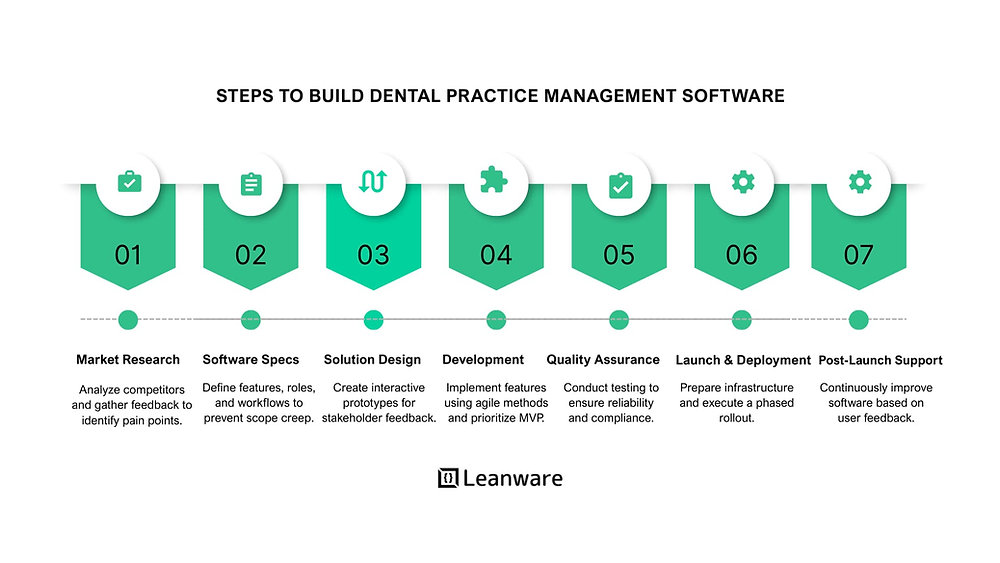
1. Market Research and Requirement Analysis
Start by analyzing competitors, gathering staff feedback, and identifying workflow pain points. This ensures you’re solving real problems—not assumptions.
2. Defining Software Specifications
Create a clear feature list, define user roles, and map workflows. Well-defined requirements prevent scope creep and cost overruns.
3. UI/UX Design and Prototyping
Interactive prototypes allow stakeholders to visualize the system early, provide feedback, and catch usability issues before development begins.
4. Development and Feature Implementation
Most teams use agile development, delivering features in sprints and prioritizing a Minimum Viable Product (MVP) first.
5. Quality Assurance and Testing
Testing includes functional testing, usability testing, and security/HIPAA compliance checks to ensure reliability and safety.
6. Launch and Deployment
A successful go-live includes infrastructure readiness, data backups, and a phased rollout plan to minimize disruption.
7. Post-Launch Support and Updates
Continuous improvement based on user feedback ensures the software evolves alongside the practice.
Common Challenges and How to Overcome Them
Integration with Existing Systems
Data migration and third-party integrations can be complex. Using APIs and maintaining clear communication with vendors reduces friction.
Data Security and HIPAA Compliance
Strong encryption, regular audits, and strict access controls are essential to maintaining trust and compliance.
User Adoption and Training
Resistance to change is common. Clear onboarding, training sessions, and intuitive design help staff transition smoothly.
Cost Overruns and Time Delays
Unclear requirements and scope creep are the biggest risks. Agile planning and proper documentation keep projects on track.
Is Building Custom Dental Software Worth the Investment?
For many practices, the answer is yes—especially over the long term. While off-the-shelf tools offer faster setup, custom solutions deliver better workflow alignment, scalability, and ownership. Over time, improved efficiency, reduced errors, and better patient experiences often outweigh the initial investment.
Conclusion
The cost of building custom dental practice management software depends on your goals, features, and development approach. While prices range widely, the right strategy and partner can help you maximize value without overspending. Custom software isn’t just an expense—it’s an investment in operational efficiency, patient satisfaction, and long-term growth.
If you’re considering custom dental software, a discovery conversation can help clarify scope, costs, and timelines before committing.
Leanware works as a nearshore development partner for US and Canadian clients, offering transparent pricing, agile execution, and experience building healthcare and operational platforms. Booking a discovery call can help you assess whether custom software makes sense for your practice and get the best results.
FAQs
How much does it cost to build custom dental software?
Custom dental software typically costs between $50,000 and $300,000, depending on features, design complexity, and development team location.
How long does it take to build dental practice software?
An MVP usually takes 3–6 months, while a full-featured platform may take 6–12+ months.
Can custom dental software integrate with existing systems?
Yes, it can integrate with imaging tools, billing systems, and EHR platforms using custom APIs and middleware.
What are the benefits of custom vs. off-the-shelf dental software?
Custom software aligns better with workflows, scales easily, and often delivers better long-term ROI.
Is custom dental software HIPAA-compliant?
Yes—when built correctly with encryption, access controls, audit logs, and secure hosting.
How long before I see ROI on $200k custom dental software?
Most practices see ROI within 12–24 months, driven by efficiency gains and improved billing accuracy.
Can I build this incrementally, starting at $50k?
Yes. Many practices start with an MVP focused on core features and expand over time as budgets allow