Hire Nearshore Angular Developers | Same Time US Time Zone

Finding skilled Angular developers in the U.S. is expensive and time-consuming. Salaries are high, top talent is scarce, and hiring cycles can stretch for months. Nearshore Angular developers in Latin America address these challenges: they work during overlapping hours with U.S. teams, handle the same technical tasks as in-house developers, and typically cost 30% to 50% less.
This setup keeps projects moving without delays. Standups, code reviews, and sprint planning happen in real time, not across a long time gap. For startups and SMBs scaling front-end development, nearshore teams make it possible to deliver complex applications efficiently while maintaining high quality.
Let’s look at why U.S. teams hire nearshore Angular developers and how to find the right talent.
Why Hire a Nearshore Angular Developer?
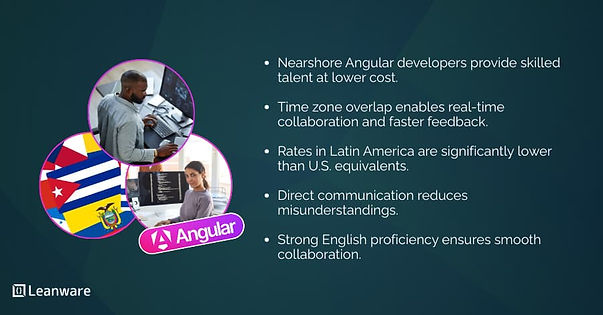
Nearshore Angular developers give U.S. teams skilled talent at lower costs while keeping collaboration real-time. Working overlapping hours, they fit into Agile workflows, deliver faster feedback, and bring expertise in modern frameworks without the cost of local hires.
Time Zone Alignment
Latin American developers work in time zones that overlap 6–8 hours with U.S. business hours. Colombia matches Eastern time. Mexico operates in Central time. Argentina and Chile are 1–3 hours ahead of Eastern time depending on daylight saving schedules.
This overlap enables daily standups at times that work for everyone, real-time code reviews, and immediate issue resolution during your workday. Compare this to offshore teams in Asia where communication happens through overnight handoffs. Questions asked at 3 PM your time get answered 12 hours later. This delay compounds across sprints, adding weeks to delivery timelines.
Cost Efficiency
Nearshore development rates in Latin America are generally lower than U.S. rates. For Angular developers:
- Junior (1–2 years): $35–$45/hour
- Mid-level (3–5 years): $45–$55/hour
- Senior (5+ years, strong TypeScript): $55–$65/hour
By comparison, U.S. developers typically charge $80–$150/hour. For a standard 160-hour month, the cost difference is clear:
Developer Level | U.S. Cost (160 hrs) | Nearshore Cost (160 hrs) | Approx. Savings |
Junior (1–2 yrs) | $12.8K–$24K | $5.6K–$7.2K | ~$7.2K–$16.8K |
Mid-level (3–5 yrs) | $12.8K–$24K | $7.2K–$8.8K | ~$4K–$16.8K |
Senior (5+ yrs) | $19.2K–$24K | $8.8K–$10.4K | ~$8.8K–$15.2K |
Communication and Cultural Fit
Latin American business culture emphasizes direct communication similar to North American norms. Developers ask clarifying questions when requirements are unclear rather than making assumptions. This directness prevents the misunderstandings that cost time to fix later.
English proficiency in Latin American tech hubs is strong. Developers communicate clearly in written and spoken English, making collaboration smooth. The cultural alignment extends to work practices, meeting etiquette, and problem-solving approaches.
What Nearshore Angular Developers Do
Nearshore Angular developers build single-page applications, implement complex UI patterns, integrate with backend APIs, and maintain production systems. Their capabilities match onshore developers but with better agility and cost structure.
Building Dynamic Single-Page Applications (SPAs)
Angular is designed for SPAs, where the app loads once and updates dynamically. Nearshore developers typically handle:
- Routing between views using Angular’s router.
- Lazy loading to split code into smaller chunks.
- State management with NgRx for predictable data flow.
SPAs also require attention to:
- Initial load time and memory management.
- SEO using Angular Universal when needed.
- Bundle optimization by removing unused dependencies and analyzing webpack output.
Angular Architecture & Best Practices
Angular apps follow a component-based structure, with each UI element self-contained. Developers generally:
- Organize components hierarchically.
- Separate presentation and business logic using smart/dumb components.
- Use services for shared functionality.
State Management with NgRx:
- Actions represent events.
- Reducers update state based on actions.
- Selectors query state efficiently.
Maintainability:
- Modular code with clear separation of concerns.
- Strong TypeScript typing.
- Documentation for complex logic.
API Integration & Front-End Optimization
Angular applications consume REST APIs or GraphQL endpoints to fetch and update data. Developers use HttpClient to make requests, implement interceptors to add authentication tokens or handle errors globally, and manage loading states, so users know when data is being fetched.
Error handling requires displaying user-friendly messages when API calls fail, implementing retry logic for transient errors, and logging errors to monitoring services for debugging. Developers write defensive code that handles unexpected API responses gracefully.
Performance optimization involves lazy loading modules to reduce initial bundle size, implementing virtual scrolling for long lists to render only visible items, using OnPush change detection to minimize unnecessary DOM updates, and optimizing images with proper formats and lazy loading. These techniques directly affect user experience and conversion rates.
Maintenance & Support Services
After launch, Angular applications require ongoing support. Developers fix bugs, update dependencies, and handle version upgrades, including deprecated APIs. Monitoring and analytics are set up to track errors (e.g., with Sentry), observe user behavior, and configure alerts for critical issues.
This ensures applications stay stable, performant, and aligned with evolving requirements.
Flexible Engagement Models
Different projects require different engagement structures. Choosing the right model depends on your project scope, timeline, and internal capacity.
Dedicated Nearshore Angular Teams
A dedicated team works exclusively on your project with its own technical lead and project manager. The team manages sprint planning, code reviews, and deployment independently. Typical team composition:
- Tech lead with senior Angular experience
- 2–3 developers with complementary skills
- Optional UI/UX designer
This model suits companies that need consistent development capacity but lack internal Angular expertise. Teams remain stable over time, developing deep knowledge of your codebase and business requirements. Long-term collaboration also reduces turnover compared to rotating staff augmentation.
Staff Augmentation for Ongoing Projects
Staff augmentation adds nearshore developers to your existing team temporarily. Developers report to your technical lead, follow your processes, and work in your codebase.
- Ideal when you have internal Angular expertise but need extra capacity.
- Common arrangements last 3–6 months or continue for ongoing projects.
- Paid monthly per developer, allowing easy scaling based on workload.
This model accelerates delivery without hiring full-time employees.
Project-Based Nearshore Development
Project-based delivery means the provider handles everything from requirements gathering to production deployment. A dedicated project manager coordinates the team, runs sprint planning, and provides status updates.
- Suited for new products or Angular initiatives outside core expertise.
- You review progress at checkpoints but don’t manage daily technical tasks.
- End-to-end delivery handled by the provider.
Virtual CTO & Technical Leadership
Virtual CTO services offer technical guidance without a full-time executive. A senior Angular architect reviews frontend architecture, recommends technology choices, and guides key decisions.
- Works for non-technical founders or first-time Angular adopters.
- Typical advisory time: 10–20 hours per month.
- Can be combined with staff augmentation to provide both guidance and execution.
This model helps avoid costly architectural mistakes early and ensures alignment between strategy and development.
How to Find and Hire the Best Nearshore Angular Developers
Finding qualified Angular developers requires evaluating technical skills, verifying experience, and assessing communication abilities. Different sourcing strategies offer different trade-offs in speed, cost, and reliability.
1. Leanware (Nearshore Specialist)
Leanware is a nearshore software development provider based in Colombia that focuses on aligning teams with U.S. business hours and communication practices. They offer staff augmentation, managed teams, and project delivery models designed to integrate with existing workflows and handle technical needs across Angular and related technologies.
Pros | Cons |
Pre‑vetted developers aligned with U.S. time zones | Client may still need internal vetting for culture fit |
Multiple engagement models (staff augmentation, dedicated teams) | Agency model may include markups on hourly rates |
Emphasis on communication and process alignment | Quality can vary by individual hire and requires oversight |
Leanware’s structure works well when you want nearshore talent packaged with screening and alignment to U.S. workflows.
2. Specialized Recruitment Agencies
Recruitment agencies that focus on nearshore technical talent maintain pools of pre‑vetted developers. They handle initial screening and present candidates who match your requirements.
Pros | Cons |
Faster time‑to‑hire since candidates pre‑screened | Higher cost due to placement fees or markups |
Pre‑screened technical competence | Less direct control over initial screening |
Available for targeted Angular roles | Some candidates may still need culture fit assessment |
Agencies are suitable when speed and reduced hiring risk matter more than hands‑on vetting.
3. Freelance Talent Platforms
Platforms like Upwork and Toptal connect you directly with individual freelancers. You post requirements, review proposals, and hire developers based on your criteria.
Pros | Cons |
Flexible for short‑term or niche work | Reliability varies; freelancers may juggle multiple clients |
Direct communication with developers | Requires more vetting effort on your side |
Easy to scale scope up or down | Limited continuity for long‑term projects |
This option works best for project‑specific needs where continuity and scalability are less critical.
4. Tech Job Boards & Referrals
Job boards targeting Latin American developers and employee referrals provide access through more direct channels. Referrals carry implicit endorsements from trusted contacts.
Pros | Cons |
Referrals often indicate dependable developers | Referrals depend on existing network reach |
Job boards provide direct access without intermediaries | Vetting work remains your responsibility |
Full control over hiring process | Time investment required to evaluate candidates |
This approach suits companies willing to invest time in vetting and screening.
Evaluating Skills and Portfolio Quality
Portfolio review and technical assessments are essential:
- Code quality: Angular repositories with clear structure and TypeScript usage.
- Live apps: Check UX and performance.
- Patterns: Use of reactive forms, state management, and other Angular practices.
- Communication: Documentation or technical writing shows clarity.
During interviews:
- Present real scenarios and ask how they would approach them.
- Evaluate reasoning, edge-case handling, and architectural trade-offs.
- Assess communication with technical and non-technical stakeholders.
Key Skills to Look For in Angular Developers
Angular developers need both framework-specific knowledge and broader frontend engineering capabilities. Focus on skills that indicate depth rather than breadth.
TypeScript & Modern JavaScript Expertise
Angular is built with TypeScript, and developers must understand its type system. Look for experience with:
- Interface definitions and type aliases
- Generics for reusable type-safe components
- Union types and discriminated unions
- Async/await for handling asynchronous operations
- ES6+ features like destructuring, spread operators, and arrow functions
Strong TypeScript knowledge prevents runtime errors by catching type mismatches at compile time. Developers who understand TypeScript's type inference write cleaner code with less explicit typing.
Angular CLI, RxJS & NgRx
The Angular CLI generates components, services, and modules with proper structure. Developers should use CLI commands rather than manually creating files. This ensures consistency across the codebase.
RxJS powers Angular's reactive programming model. Developers work with Observables for handling asynchronous data streams, operators like map, filter, and switchMap for transforming data, and subscriptions for consuming Observable values. Understanding marble diagrams helps visualize Observable behavior.
NgRx implements Redux patterns for state management in large applications. Developers define the store structure, create actions and reducers, and use selectors to derive computed values from state. The Redux DevTools extension makes debugging state changes easier.
Responsive UI/UX Development
Apps must work smoothly on all devices:
- Layouts: CSS Grid, Flexbox, or Angular Material; test across screens.
- Material Design & Tailwind: Customize components and ensure accessibility; utility classes provide flexibility and smaller bundles.
Testing & Quality Assurance
Maintain quality with:
- Unit Testing: Jasmine + Karma
- End-to-End Testing: Cypress or Playwright, integrated with CI/CD
- Linting: ESLint enforces consistent style
These skills keep Angular applications reliable, maintainable, and scalable.
Your Next Step
Nearshore Angular developers offer technical expertise and collaboration benefits. Timezone alignment reduces delays, and flexible engagement models let you scale development to your needs.
Angular’s structured framework and tooling support complex, maintainable applications.
Start by defining your project, reviewing portfolios, and choosing an engagement model that fits your team. With a clear process, developers can be onboarded quickly and deliver results within weeks.
You can also connect with our experts to discuss your project requirements, explore the best nearshore engagement model, and get guidance on hiring the right Angular developers for your team.
Frequently Asked Questions
What is a nearshore Angular developer?
A nearshore Angular developer is a frontend engineer located in a nearby country (typically Latin America for U.S. companies) who specializes in building applications with the Angular framework. These developers work in time zones that overlap 6–8 hours with U.S. business hours, enabling real-time collaboration during daily standups, code reviews, and issue resolution.
They possess the same technical capabilities as onshore developers but at significantly lower rates, typically $35-$65 per hour compared to $80-$150 per hour in the U.S.
How much does it cost to hire a nearshore Angular developer?
Nearshore software development rates across LATAM typically fall between USD 34 to 92 per hour. For Angular developers specifically, expect to pay $35-$45 per hour for junior developers with 1–2 years of experience, $45-$55 per hour for mid-level developers with 3–5 years, and $55-$65 per hour for senior developers with 5+ years and extensive TypeScript expertise.
Full-time engagement costs $7,000-$10,000 monthly per developer through staff augmentation, or $9,000-$12,000 monthly for dedicated teams that include project management.
How do I vet a nearshore Angular developer?
Review their GitHub profile to examine actual Angular code, checking for clean component structure, proper TypeScript usage, and adherence to Angular style guide. Request live application demos to assess UI quality, performance, and attention to detail. Conduct technical interviews with coding challenges that test understanding of Angular concepts like reactive forms, RxJS operators, and state management with NgRx.
Evaluate communication skills by discussing architectural tradeoffs and explaining how they would approach specific scenarios from your project. Consider using specialized agencies that pre-vet candidates through technical assessments and reference checks.
What are the benefits of hiring nearshore over offshore developers?
Nearshore developers offer better timezone overlap than offshore teams, with 6–8 hours of shared working hours compared to minimal overlap with Asian offshore teams. This enables real-time collaboration during daily standups, immediate issue resolution, and faster feedback cycles. Cultural alignment reduces miscommunication that happens with distant offshore teams where business practices and communication styles differ significantly.
Nearshore developers offer a 46% lower hourly rate compared to onshore developers while maintaining quality comparable to U.S. teams. Travel is also more practical for occasional in-person meetings, with flights to Latin America taking 4–6 hours versus 15+ hours to Asia.
Can nearshore Angular developers work in Agile teams?
Yes, most nearshore Angular developers have extensive experience with Agile methodologies like Scrum and Kanban. They participate in daily standups, sprint planning, and retrospectives. The timezone alignment makes Agile practices more effective because the team can meet synchronously during shared working hours.
Developers use the same collaboration tools as U.S. teams including Jira for project management, GitHub for code reviews, and Slack for communication. Many have worked with U.S. companies before and understand the expectations around velocity, sprint commitments, and iterative development. The key is establishing clear communication patterns and ensuring everyone understands the Definition of Done for each story.