Hire Nearshore Kotlin Developer | 2026 Guide

Kotlin has become the dominant language for Android development. Google reports that 70% of the top 1,000 apps on the Play Store are written in Kotlin, including 60 of Google's own apps like Maps and Drive. JetBrains estimates that 95% of top Android apps include Kotlin code.
Beyond mobile, Kotlin has expanded into backend development with frameworks like Ktor and Spring Boot, and Kotlin Multiplatform now enables code sharing across Android, iOS, and web applications. This versatility makes Kotlin developers valuable, and competitive to hire.
For North American companies, nearshore development in Latin America offers access to qualified Kotlin talent at competitive rates, with the collaboration benefits of shared time zones and cultural alignment.
Let’s explore why hiring nearshore Kotlin developers works, what capabilities to look for, and how to evaluate candidates effectively.
Why Hire Nearshore Kotlin Developers?
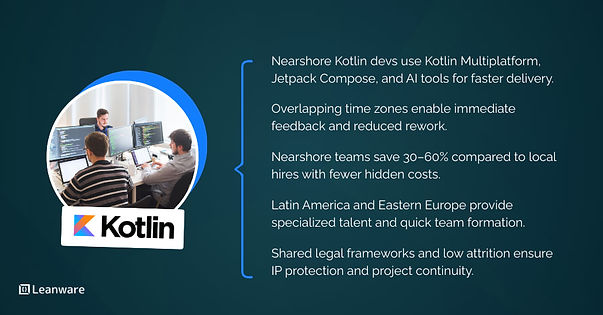
Hiring nearshore Kotlin developers gives you skilled teams who work in overlapping hours with North America, offer lower costs than U.S.-based hires, and make collaboration smoother compared to offshore options.
Offshore teams in Asia may be cheaper, but large time zone differences slow feedback and make real-time collaboration difficult. Onshore U.S. developers avoid this but come at higher costs.
Nearshore teams in Mexico, Colombia, Argentina, and Brazil provide a middle ground: competent Kotlin developers, cost savings, and shared working hours that keep projects moving efficiently.
Benefits of Nearshore Kotlin Talent
Nearshore development offers clear advantages:
- Proximity and communication: Developers in Latin America work during North American business hours. Daily standups, sprint planning, and code reviews happen in real-time without anyone joining calls at odd hours.
- Cultural alignment: Latin American developers are familiar with U.S. business practices and communication styles. They tend to flag issues proactively and integrate smoothly into existing team dynamics.
- Reduced project risk: Shared working hours mean faster issue resolution. When something breaks in production, you can get developers on a call immediately rather than waiting overnight.
- Improved iteration cycles: Agile development depends on quick feedback loops. Same-timezone teams can review code, discuss changes, and ship updates within the same workday.
Cost-Effective and Time Zone Aligned Development
The cost structure makes nearshore development accessible for growing companies:
Region | Hourly Rate Range |
United States | $50 - $80 |
Canada | $45 - $70 |
Latin America (Nearshore) | $25 - $70 |
Eastern Europe | $35 - $80 |
Asia (Offshore) | $15 - $40 |
For mid-level Kotlin developers, expect nearshore rates between $35 and $50 per hour. Senior developers with architecture experience or Kotlin Multiplatform expertise typically fall in the $50 to $70 range.
TMS reports that Kotlin job postings grew 30% year-over-year in 2024, which shows a strong demand. Nearshoring helps companies access this talent pool without competing directly in expensive U.S. markets.
Typical Kotlin Development Capabilities
Kotlin's versatility spans mobile, backend, and cross-platform development:
Android Application Development with Kotlin
Android remains Kotlin's primary domain. Over 50% of professional Android developers use Kotlin as their primary language, according to Kotlin.
Modern Android development with Kotlin includes:
- Jetpack Compose for declarative UI development.
- Coroutines for asynchronous programming and background tasks.
- Room for local database persistence.
- Retrofit and Ktor Client for network communication.
- Hilt/Dagger for dependency injection.
- MVVM and Clean Architecture patterns for maintainable codebases.
Experienced Kotlin developers build apps that support the latest Android APIs while maintaining backward compatibility with older versions. They understand Material Design guidelines, handle different screen sizes and densities, and optimize for performance across device tiers.
Kotlin's null safety eliminates entire categories of crashes that plague Java-based Android apps. Features like extension functions, data classes, and sealed classes make code more concise and expressive compared to equivalent Java implementations.
Backend Services and Server-Side Development
Kotlin works well for backend development, particularly with:
Ktor is JetBrains' own framework for building asynchronous servers and clients. It's lightweight and works well for microservices and APIs.
Spring Boot fully supports Kotlin, making it viable for enterprise applications. Companies already using Spring can adopt Kotlin incrementally alongside existing Java code.
Server-side Kotlin handles REST APIs, GraphQL endpoints, WebSocket connections, and microservice architectures. The language's null safety and concise syntax reduce bugs in production systems.
Kotlin Multiplatform Expertise
Kotlin Multiplatform (KMP) enables sharing business logic across Android, iOS, desktop, and web platforms.
Notable KMP adopters include Forbes (sharing over 80% of logic across platforms), McDonald's, Philips, and Adobe. Organizations report up to 30% reduction in development and maintenance costs through code sharing.
KMP doesn't replace native UI development. Instead, it allows teams to write shared networking, data models, and business logic once while building platform-specific interfaces.
Flexible Engagement Models
Different project stages call for different team structures.
Software Staff Augmentation
Staff augmentation is best for adding capacity to existing teams, filling skill gaps, or handling deadline crunches. Individual Kotlin developers integrate with your team, follow your processes, use your tools, and report to your technical leadership.
You maintain control over architecture and direction while getting extra hands for a few weeks or several months.
Dedicated Kotlin Development Teams
Dedicated teams are best for long-term projects, complex applications, or ongoing feature work. These teams include developers, QA engineers, and sometimes a technical lead or project manager, all focused on your project. They learn your codebase and business context, providing consistency as the same people work on your project week after week.
Project Delivery and Full Management
Project delivery and full management is best for well-defined projects or companies without internal mobile or backend expertise. The nearshore partner handles the full lifecycle - discovery, architecture, development, testing, and deployment. You define requirements and approve deliverables while the team manages execution.
What to Look for in a Nearshore Kotlin Developer
Evaluating Kotlin developers requires assessing both technical depth and soft skills.
Key Technical Skills
1. Java Interoperability
Kotlin's ability to work seamlessly with Java is a major advantage. Experienced developers know how to:
- Call Java code from Kotlin and vice versa
- Migrate Java codebases to Kotlin incrementally
- Handle Java nullability annotations properly
- Work with existing Java libraries and frameworks
This matters because many Android projects include legacy Java code, and backend systems often integrate with Java-based infrastructure.
2. Android App Development
For mobile work, look for proficiency in:
- Kotlin syntax including null safety, extension functions, and data classes.
- Coroutines and Flow for asynchronous programming.
- Jetpack libraries (Compose, Navigation, Room, ViewModel).
- Android lifecycle management.
- Google Play Store deployment and app signing.
3. Backend Systems and APIs
For server-side work, evaluate experience with:
- Ktor or Spring Boot frameworks
- REST API design and implementation
- Database integration (PostgreSQL, MySQL, MongoDB)
- Authentication and authorization patterns
- Containerization with Docker
4. Version Control and CI/CD
Professional development requires:
- Git workflows (branching strategies, pull requests, code reviews).
- CI/CD pipelines using GitHub Actions, GitLab CI, Bitbucket Pipelines, or Jenkins.
- Automated build and deployment processes.
- Environment management (development, staging, production).
5. Testing and Quality Assurance
Quality-focused developers work with:
- Unit testing using JUnit and MockK
- UI testing with Espresso (Android) or framework-specific tools
- Integration testing for APIs
- Code coverage monitoring
- Static analysis tools like Detekt
Essential Soft Skills
1. Problem Solving
Kotlin development often involves complex challenges: integrating with legacy systems, optimizing performance, or debugging platform-specific issues. Look for developers who can diagnose problems independently and propose solutions.
2. Team Collaboration
Remote work requires strong communication. Effective developers:
- Communicate clearly in English (written and verbal)
- Participate actively in standups and planning sessions
- Use collaboration tools effectively (Slack, Jira, Confluence)
- Ask clarifying questions rather than making assumptions
3. Adaptability and Time Management
Nearshore developers balance synchronous meetings with focused development time. Good candidates manage their schedules effectively, meet deadlines consistently, and adjust to changing priorities.
Kotlin Development Process
The Kotlin development process starts with understanding business and technical requirements, follows best practices for coding and testing, and ends with smooth deployment and ongoing support.
Discovery and Requirements Gathering
Projects begin with understanding business needs: what problem the software solves, who uses it, and what success looks like. This phase includes stakeholder interviews, technical assessment of existing systems, and scope definition.
For mobile projects, discovery covers target Android versions, device requirements, offline functionality needs, and integration points with backend services. For backend work, it addresses expected load, data models, security requirements, and third-party integrations.
Clear requirements reduce rework later. Good nearshore partners push for specificity rather than accepting vague specifications. They ask questions about edge cases, prioritization, and acceptance criteria before writing code.
Development and Code Quality Standards
Professional Kotlin development follows established practices:
- Code reviews for all changes before merging
- Documentation for APIs, architecture decisions, and complex logic
- Kotlin style guidelines (typically based on official conventions)
- Regular refactoring to manage technical debt
- Modular architecture for maintainability
Performance Optimization and Testing
Quality development includes:
- Performance profiling to identify bottlenecks
- Memory management to prevent leaks
- Battery optimization for mobile apps
- Load testing for backend services
- Cross-device testing for Android applications
Deployment and Ongoing Support
Production readiness involves:
- CI/CD pipelines for automated deployment
- Monitoring and alerting for production systems
- Play Store submission and review management (for Android)
- Cloud deployment (AWS, GCP, Azure) for backend services
- Maintenance and support terms for post-launch issues
Getting Started
Nearshore Kotlin development lets you access mobile or backend expertise without the cost of domestic hiring. Latin America offers time zone alignment, cultural fit, and competitive rates, making team building easier for startups and growing businesses.
Choose the right engagement model: staff augmentation for extra capacity, dedicated teams for ongoing development, or project delivery for well-defined initiatives.
Define your requirements, evaluate technical and communication skills, and most engagements can start within two to four weeks.
Connect with our Kotlin development experts to discuss your project, explore the best engagement model, and start building your nearshore team quickly and efficiently.
Frequently Asked Questions
How do Kotlin developers handle asynchronous programming?
Kotlin uses coroutines for asynchronous programming. Coroutines provide structured concurrency, making it easier to write non-blocking code that's readable and maintainable. They're lighter than threads and integrate well with Android's lifecycle and backend frameworks like Ktor. Flow, built on coroutines, handles reactive streams of data for scenarios like real-time updates or database observations.
Can Kotlin be used for cross-platform development?
Yes. Kotlin Multiplatform allows sharing business logic across Android, iOS, desktop, and web while keeping UI native to each platform. Companies like Forbes and McDonald's use KMP in production. It's particularly effective for data models, networking, and business rules. The shared code compiles to native binaries for each platform, so there's no runtime performance penalty.
Why choose nearshore developers over offshore options?
Nearshore offers better cultural fit, stronger English communication, and time zone alignment with North American teams. While offshore rates may be lower, the collaboration challenges often lead to slower iteration cycles and more miscommunication.
Nearshore pricing remains competitive while maintaining the real-time collaboration that agile development requires. The ability to have synchronous conversations and same-day feedback loops typically outweighs modest cost savings from offshore alternatives.