Hire Nearshore Swift Developer | All You Need to Know

Swift is used in roughly 75% of iOS apps on the Apple App Store. With more than 1.3 billion active iPhone users and $406 billion in developer billings and sales in 2024, this scale supports ongoing demand for Swift developers.
The challenge for many companies is finding that talent. U.S.-based iOS developers command average salaries of $124,000 annually, and competition for experienced Swift engineers is intense in major tech hubs. Nearshoring to Latin America offers an alternative path: access to qualified developers at competitive rates, with the collaboration benefits that come from shared time zones and cultural alignment.
Let’s break down how to hire nearshore Swift developers, what to look for in candidates, and how to structure engagements effectively.
Why Hire Nearshore Swift Developers
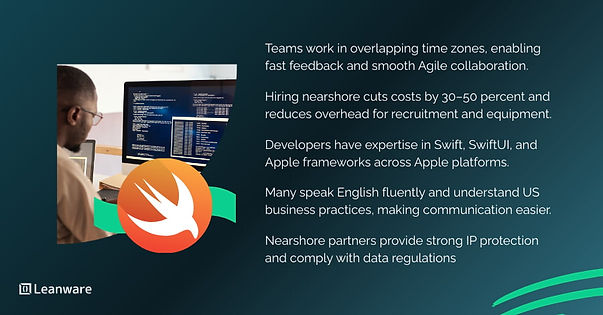
Hiring nearshore Swift developers helps manage both cost and collaboration.
- Offshore teams in Asia offer lower rates but introduce significant time zone gaps. When your team in New York finishes work, developers in India are just waking up. This creates 12+ hour feedback loops, limits real-time collaboration, and makes agile practices difficult to execute properly.
- Onshore hiring eliminates these issues but at premium costs. Senior iOS developers in San Francisco or New York often bill $100 to $150 per hour through agencies, or require six-figure salaries plus benefits for full-time roles.
- Nearshore development in Latin America offers a middle path. Teams in Mexico, Colombia, Argentina, and Brazil work during North American business hours. A developer in Buenos Aires overlaps significantly with Eastern Time. A team in Guadalajara shares the same working hours as teams in California.
1. Benefits of Nearshore Swift Development Teams
Nearshore development offers key practical advantages:
- Access to vetted talent: Latin American tech hubs produce strong iOS developers. Countries like Argentina and Brazil have established computer science programs and growing startup ecosystems that train developers in modern practices.
- Reduced costs without compromising quality: Nearshore rates typically run 40% to 60% lower than U.S. equivalents while maintaining comparable technical standards.
- Agile-friendly collaboration: Daily standups, sprint planning, and real-time code reviews work naturally when teams share working hours. No one needs to join calls at midnight.
- Lower turnover risk. Nearshore partners often provide more stable team arrangements than freelance marketplaces, with dedicated developers who stay on projects long-term.
2. Time Zone Alignment and Cultural Compatibility
Time zone overlap is more than a convenience factor. It directly affects how teams work together.
When a critical bug appears in production, you can get your Swift developer on a call within minutes. When requirements change mid-sprint, you can discuss implications in real-time rather than through async messages that take a day to resolve.
Cultural compatibility also matters. Latin American developers are generally familiar with U.S. business practices, communication styles, and work expectations. They tend to communicate directly, flag issues proactively, and integrate smoothly into existing team dynamics.
3. Cost-Effective Talent Without Compromising Quality
The cost differences are substantial:
Region | Hourly Rate Range |
United States | $80-$150 |
Canada | $60-$100 |
Latin America (Nearshore) | $25-$70 |
Eastern Europe | $40-$100 |
Asia (Offshore) | $20-$50 |
For a mid-level Swift developer, expect nearshore rates between $30 and $55 per hour. Senior developers with SwiftUI and complex architecture experience typically fall in the $40 to $70 range. These rates deliver substantial savings compared to U.S. hiring while maintaining the collaboration quality that offshore arrangements often sacrifice.
Nearshore Swift Development Expertise
Swift development spans multiple Apple platforms and use cases. Each platform has its own patterns and requirements, so it’s important to match developers’ experience to the specific type of app being built.
Swift iOS App Development
iOS development remains the core of Swift work. This includes building native iPhone and iPad applications from scratch, maintaining existing apps, and adding new features to production codebases.
Experienced iOS developers work with Apple's standard toolchain:
- UIKit for traditional interfaces using code or storyboards.
- SwiftUI for modern declarative UI (now at roughly 65% adoption among iOS teams).
- Core Data and SwiftData for local persistence.
- URLSession and REST API integration for network communication.
- Firebase for authentication, analytics, and real-time databases.
- Push notifications via APNs.
Quality iOS development also means understanding App Store guidelines, handling the review process, and building apps that meet Apple's standards for performance and user experience.
Swift macOS App Development
macOS development shares the Swift language but differs significantly from iOS work. Desktop applications have different interface patterns, window management requirements, and user expectations.
macOS-specific considerations include:
- AppKit framework for traditional Mac interfaces.
- SwiftUI for cross-platform UI code that runs on both iOS and macOS.
- Menu bar applications and system integrations.
- Document-based app architectures.
- Sandboxing and notarization requirements for distribution.
Companies building productivity tools, developer utilities, or enterprise software often need macOS expertise alongside iOS skills.
Cross-Platform and Future-Ready Solutions
Modern Swift development increasingly involves code sharing across Apple platforms. SwiftUI enables building interfaces that work on iOS, macOS, watchOS, and tvOS with significant code reuse.
Swift developers also work with:
- Combine for reactive programming patterns.
- Swift Concurrency (async/await) for modern asynchronous code.
- Swift Package Manager for dependency management.
- VisionOS for Apple Vision Pro development (emerging).
Building maintainable, scalable codebases means choosing architectures that support long-term development. Common patterns include MVVM (Model-View-ViewModel), Clean Architecture, and coordinator patterns for navigation.
Flexible Engagement Models
Different project stages and business situations call for different team structures. Three models cover most scenarios.
Model | Best For | How It Works |
Dedicated Team | Long-term projects, scaling apps | Full-time team focused on your project. |
Staff Augmentation | Temporary needs, skill gaps, MVPs | Developers join your team temporarily. |
Project Delivery & Management | Defined projects, fixed budget, no iOS expertise | Partner handles the full project. |
1. Dedicated Nearshore Swift Developer Team
This model handles long-term product development, apps with ongoing feature work, and scaling mobile projects. A full-time team works exclusively on your project and typically includes Swift developers at different seniority levels, a technical lead, and QA engineers.
Pricing is usually monthly based on team size. The same developers gain familiarity with your codebase and product context, ensuring continuity over time.
3. Staff Augmentation
Staff augmentation works for temporary capacity needs, specific skill gaps, tight deadlines, or MVP development. Individual Swift developers or small groups join your existing team, follow your processes, use your tools, and report to your technical leadership.
You retain control over architecture and project direction. Engagements typically last from a few weeks to several months, providing extra hands when you already have technical leadership in place.
3. Project Delivery and Management
This model suits well-defined projects, fixed budgets, or companies without internal iOS expertise. The nearshore partner manages the full project lifecycle, including discovery, planning, development, QA, and App Store submission.
You define requirements and approve deliverables while they handle execution. It’s particularly useful for first-time iOS apps or when a company prefers to focus internal resources elsewhere.
Skills to Look for in a Nearshore Swift Developer
Evaluating Swift developers requires assessing both technical depth and soft skills. Here's what matters.
Technical Skills:
1. iOS App Development Fundamentals
Strong candidates demonstrate solid understanding of core iOS concepts, including:
Area | Key Skills |
Swift language | Optionals, protocols, generics, extensions, error handling |
Memory management | ARC (Automatic Reference Counting), retain cycles, weak references |
Design patterns | MVC, MVVM, delegation, dependency injection |
App lifecycle | Managing app states, resource handling |
Xcode | Debugging, Instruments, build configurations |
These fundamentals form the base for writing maintainable, performant, and scalable iOS applications.
2. Frameworks and Libraries
iOS development relies on several frameworks and libraries. Developers should be comfortable with:
Framework / Library | Use Case |
|---|---|
UIKit | Traditional interfaces, existing codebases, fine-grained UI control |
SwiftUI | Declarative UI for new apps, state management (@State, @Binding, @ObservableObject) |
Combine | Reactive programming for async data streams |
Networking & third-party SDKs | REST APIs, image caching, analytics, or project-specific libraries |
A strong developer knows when to use each framework effectively, balancing modern practices with project requirements.
3. Testing, CI/CD, and Performance Optimization
Quality iOS development depends on robust testing and automation:
Focus Area | Practices |
Testing | Unit tests with XCTest, UI tests for interface verification |
CI/CD | Fastlane, GitHub Actions, Bitrise for automated builds and deployments |
Performance | Profiling with Instruments, memory leak detection, CPU optimization |
App optimization | Reducing app size, improving launch times |
Developers who master these areas help ensure apps remain reliable, maintainable, and performant in production.
Soft Skills
Being good with code isn’t enough - developers also need to communicate clearly, handle blockers, and make smart decisions when unexpected issues come up.
1. Communication and Collaboration
Remote work requires developers who can communicate clearly and proactively:
- Fluent English for technical discussions, code reviews, and documentation.
- Provides updates on progress or blockers without constant prompting.
- Comfortable with async communication when real-time discussion isn’t possible.
- Effective in video calls or screen sharing sessions for pair programming or debugging.
2. Problem-Solving and Creativity
iOS development involves constant problem-solving. App Store rejections, iOS version compatibility issues, and edge cases in user behavior all require developers who can think independently and find solutions.
Strong candidates show initiative in suggesting improvements, question requirements that seem problematic, and take ownership of the features they build.
How Nearshore Swift Development Works
Engaging with a nearshore partner follows a structured process designed to reduce friction and ensure alignment.
Screening and Hiring Process
Quality nearshore partners maintain rigorous vetting:
- Technical assessments covering Swift fundamentals, iOS frameworks, and architecture knowledge.
- Coding challenges that evaluate problem-solving ability and code quality.
- English proficiency evaluation through interviews and written communication.
- Culture fit interviews assessing communication style and remote work readiness.
By the time candidates reach you, they've passed multiple screening stages. Your role is evaluating fit for your specific project and team.
Onboarding and Team Integration
Effective onboarding typically includes:
- Codebase walkthrough to familiarize developers with existing architecture.
- Tool access for version control, project management, and communication platforms.
- Process alignment on code review standards, branching strategies, and deployment procedures.
- Initial pairing with existing team members to accelerate knowledge transfer.
Most developers reach productive contribution within one to two weeks, depending on codebase complexity.
Ongoing Project Support
Good nearshore partnerships include ongoing support beyond staffing:
- Regular check-ins to address any collaboration issues early.
- Performance feedback loops between you and the nearshore partner.
- Scaling assistance when project needs change.
- Continuity planning to handle developer transitions smoothly.
Building Your Swift Development Team
Nearshore Swift development gives you iOS expertise without the cost of domestic hiring or the coordination issues of offshore teams. Latin America offers overlapping time zones, cultural fit, and competitive rates that make building a team practical.
Choose the engagement model that fits your needs: staff augmentation for extra hands under your existing leadership, dedicated teams for ongoing product work, or project delivery for well-defined initiatives.
Start by defining your requirements, evaluating candidates carefully, and selecting a partner with solid vetting. Most teams can get started within two to four weeks.
Connect with our experts today to discuss your Swift development needs and find the right nearshore team for your project.
Frequently Asked Questions
What is a nearshore Swift developer?
A nearshore Swift developer is a software engineer in a nearby country (typically Latin America for U.S. clients) who specializes in building iOS, macOS, or cross-platform apps using Apple's Swift programming language. Nearshoring offers time zone alignment, cultural compatibility, and cost savings compared to domestic hiring.
Why hire nearshore instead of offshore or in-house?
Nearshore provides lower costs than in-house teams and better collaboration than offshore developers in distant time zones. Nearshore Swift developers typically work during U.S. business hours and offer strong English communication, making agile collaboration practical.
How much does it cost to hire a nearshore Swift developer?
Nearshore Swift developers typically range from $35 to $70 per hour depending on experience, region, and engagement model. This represents significant savings compared to U.S.-based developers, whose rates often exceed $100 per hour through agencies.
What skills should a nearshore Swift developer have?
Key skills include proficiency in Swift (and ideally Objective-C for legacy code), experience with UIKit and SwiftUI, knowledge of REST APIs and Core Data, familiarity with CI/CD pipelines and unit testing, and strong communication abilities.
Which countries are best for hiring nearshore Swift developers?
Top countries for nearshore Swift talent include Mexico, Colombia, Brazil, Argentina, and Costa Rica. These regions offer qualified developers, competitive rates, and strong cultural alignment with North American clients.
Can I hire a nearshore Swift developer for a short-term project?
Yes. Nearshore partners typically offer flexible engagement models including short-term contracts, staff augmentation, and dedicated project teams. This makes nearshore suitable for MVP development, app updates, or scaling during high-demand periods.
What engagement models are available?
Common models include dedicated teams (long-term, full-time resources), staff augmentation (individual developers joining your existing team), and project-based delivery (fixed-scope development with managed execution).