Hire Nearshore AWS Developer | US Time Zones

Hiring nearshore AWS developers in 2026 primarily involves sourcing talent from Latin America for North American companies. This approach provides overlapping working hours, which allows teams to collaborate in real time on tasks like deploying Lambda functions, managing SageMaker pipelines, configuring Bedrock resources, and maintaining networking, access controls, and monitoring.
Nearshore developers can contribute across the full AWS stack, supporting both development and operational work while helping teams maintain productivity and alignment without the delays that often occur with distant time zones.
This guide explains how to hire nearshore AWS developers and the projects and services they typically handle.
Why Choose Nearshore AWS Development?
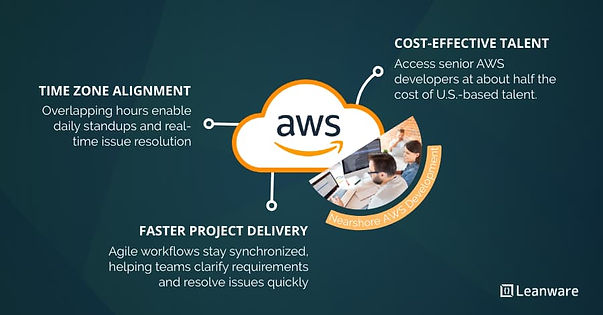
Nearshore development solves the communication delays that offshore teams create while maintaining substantial cost savings. The model works because Latin American developers operate in time zones that overlap 6–8 hours with U.S. business hours.
Time Zone Alignment & Seamless Collaboration
Nearshore developers in Latin America work in time zones that overlap with most U.S. time zones:
- Colombia: Eastern Time
- Mexico City: Central Time
- Argentina and Brazil: 1–3 hours ahead of Eastern Time
This overlap allows for:
- Daily standups during your workday
- Real-time code reviews
- Immediate issue resolution
In contrast, offshore teams in Asia often work 12+ hours ahead, meaning questions asked in the afternoon may not get answered until the next day. Over multiple sprints, this can slow delivery and complicate coordination.
Nearshore developers also communicate directly when requirements are unclear, reducing misunderstandings that often require rework later in the project.
Cost-Effective Access to Skilled Cloud Engineers
Nearshore AWS developer rates in Latin America typically fall into these ranges:
Experience Level | Rate (USD/hour) |
Junior (1-2 yrs) | 35-45 |
Mid-level (3-5 yrs) | 45-60 |
Senior (5+ yrs, AWS certified) | 60-70 |
By comparison, U.S.-based AWS developers charge $100–$200/hour. For example:
- U.S. Senior Developer: $150/hour → $24,000/month (160 hours)
- Nearshore Senior Developer: $65/hour → $10,400/month
This difference allows teams to access senior AWS expertise at the cost of mid-level U.S. developers, supporting better architecture, cleaner infrastructure code, and practical experience with cost optimization patterns.
Faster Project Turnaround with Agile Teams
Agile practices rely on synchronous communication:
- Sprint planning to align priorities
- Daily standups to surface blockers
- Retrospectives to improve processes
Nearshore developers integrate into these workflows without changing your schedule. They can join Slack channels, Zoom meetings, and respond during your workday. This enables:
- Faster clarification of requirements
- Quicker resolution of merge conflicts and bugs
- Smoother iteration cycles
Companies report measurable improvements in delivery speed compared to offshore alternatives, largely due to overlapping working hours that keep collaboration real-time.
AWS Cloud Development Services
AWS developers build serverless applications, deploy ML models, optimize infrastructure costs, and integrate cloud services into existing systems. The scope varies based on project needs, but modern AWS work centers around several key areas.
Serverless Architecture and Cloud Optimization
Serverless computing reduces the need to manage servers and automatically scales based on demand. Key responsibilities include:
- AWS Lambda: Write functions that run in response to events from API Gateway, S3, DynamoDB, or EventBridge. Pay only for compute time used.
- Infrastructure as Code: Define entire stacks with CloudFormation or Terraform for reproducible environments and controlled deployments.
- Cost Optimization: Analyze CloudWatch metrics, right-size EC2 instances, implement auto-scaling, and use Spot Instances to manage cloud spend effectively.
AI/ML Solutions and Data Engineering
AWS provides tools to build, deploy, and maintain AI/ML workloads and data pipelines:
Service | Typical Use |
SageMaker | Build training pipelines, deploy models, monitor prediction quality |
Bedrock | Use foundation models (Anthropic, Meta, Amazon) without managing infrastructure |
Glue | ETL pipelines for transforming raw data |
Kinesis Data Streams | Real-time event-driven processing |
EMR Serverless | Big data processing with Spark without local storage provisioning |
Developers design pipelines to transform raw data for analytics or ML, and implement real-time event-driven architectures for streaming sources like IoT devices or logs.
Custom Software & Mobile App Development
Nearshore AWS developers handle full-stack and mobile backends:
- Frontends: React or Vue.js apps connecting to API Gateway + Lambda.
- Databases: RDS for relational, DynamoDB for NoSQL.
- Mobile Backends: Authentication (Cognito), push notifications (SNS), file storage (S3), content delivery (CloudFront).
- GraphQL APIs: AppSync for real-time subscriptions.
- Container Orchestration: ECS or EKS for microservices, Fargate for serverless container execution, Kubernetes compatibility via EKS.
Backend Integration and API Development
API Gateway creates RESTful or WebSocket APIs that trigger Lambda functions, forward requests to EC2 instances, or proxy to existing HTTP endpoints. Developers configure authorization with Cognito or custom Lambda authorizers, implement request validation, and set up throttling to prevent abuse.
Microservices communicate through asynchronous messaging with SQS and SNS. SQS queues decouple services and provide retry logic for failed processing. SNS topics fan out messages to multiple subscribers. This architecture makes systems more resilient because individual service failures don't cascade to dependent services.
Third-party integrations connect AWS applications to external services. Developers implement webhook handlers, call external APIs with proper error handling and retries, and transform data between different service formats. Step Functions orchestrate multi-step workflows that coordinate these integrations.
Chatbots, Game Dev & Emerging Tech Solutions
Developers implement innovative solutions leveraging AWS services:
- Chatbots: Amazon Lex for conversational interfaces with natural language understanding.
- Game Backends: DynamoDB for player data, S3 for assets, Lambda for game logic, GameLift for server management, CloudFront for content distribution.
- IoT: IoT Core for device connections, telemetry processing, and command routing via Lambda or analytics services.
Flexible Nearshore Engagement Models
Different projects require different engagement structures. Understanding the options helps you choose the model that matches your needs and internal capacity.
Dedicated AWS Development Teams
A dedicated team works exclusively on your project with its own technical lead and project manager, handling sprint planning, code reviews, and deployments independently.
Typical team composition:
Role | Responsibility |
Technical Lead | AWS Solutions Architect, guides architecture and design decisions |
Developers (2–3) | Specialize in serverless, AI/ML, or backend integration |
DevOps Engineer (optional) | CI/CD, infrastructure automation, monitoring |
This model suits companies needing consistent AWS capacity but limited internal expertise. Teams build deep knowledge of your systems and business requirements, and turnover is lower than short-term contractors or staff augmentation.
Software Staff Augmentation
Staff augmentation adds nearshore developers to your existing team temporarily. Developers report to internal leads and follow existing processes.
When to use:
- Internal AWS expertise exists, but additional capacity is needed.
- Accelerates delivery without hiring full-time employees.
Typical setup:
- Duration: 3–6 months for project work, or ongoing for continuous support.
- Billing: Monthly per developer.
- Team size: Usually 1–2 developers integrated into your workflow.
Project-Based Delivery and Management
Full project delivery means the nearshore provider handles everything from requirements gathering through production deployment. You describe what you want to build, and they deliver working infrastructure.
The provider assigns a dedicated project manager who becomes your main point of contact. They coordinate developers, run sprint planning, and provide status updates. You review progress at regular checkpoints and provide feedback without managing technical details day-to-day.
This model suits companies launching new products or adding cloud capabilities outside their core expertise. You want the end result but don't have internal capacity to manage AWS development daily.
Virtual CTO and Cloud Strategy Consulting
Virtual CTO services provide senior technical guidance without hiring a full-time executive.
- Review infrastructure and recommend AWS services.
- Advise on architecture following AWS Well-Architected Framework principles.
- Conduct architecture reviews, roadmap planning, and developer support.
Typical arrangements:
- 10–20 hours per month
- Can be combined with staff augmentation to provide both strategic guidance and hands-on development
Why Partner with Leanware for AWS Nearshore Talent?
Finding qualified AWS developers requires vetting technical skills, verifying certifications, and assessing communication abilities. Nearshore providers handle this screening while managing administrative overhead like payroll, benefits, and compliance.
Proven Cloud Expertise Across Industries
AWS development often varies depending on the industry:
Industry | Considerations |
Fintech | PCI DSS compliance, secure payment processing |
Healthcare | HIPAA-compliant architectures, secure data handling |
SaaS | Multi-tenancy patterns, cost optimization for scale |
Providers match developers to projects based on relevant industry experience. Developers familiar with compliance and architecture patterns for a specific domain can implement secure, auditable solutions efficiently.
Look for providers with AWS Partner Network (APN) competencies in areas like Migration, DevOps, or Machine Learning. These designations indicate verified expertise and access to certified staff.
Highly Vetted AWS Developers
Technical screening validates AWS knowledge through hands-on challenges. Candidates might design a serverless architecture, optimize a cost-inefficient deployment, or debug a broken CloudFormation template. These practical assessments reveal real capabilities better than resume claims.
AWS certifications provide standardized validation. Solutions Architect certifications cover infrastructure design. Developer certifications focus on application development. DevOps certifications demonstrate CI/CD and automation expertise. While certifications don't guarantee quality, they indicate foundational knowledge.
Communication assessment matters as much as technical skills. Developers need to explain architectural decisions clearly, document their code, and collaborate during code reviews. English fluency enables smooth integration with U.S. teams.
Scalable Solutions Tailored to Your Needs
Projects evolve over time. An MVP might start with one developer building a serverless API. As the product grows, you add developers for frontend work, data engineering, and DevOps. Nearshore providers adjust team size and composition as needs change.
Business pivots require technical flexibility. Maybe you start building an internal tool but decide to launch a customer-facing product. Your development priorities shift, and you need different expertise. Flexible engagement models let you adjust without starting from scratch.
Where to Hire Nearshore AWS Developers
These providers specialize in vetting and placing AWS-certified talent from nearshore regions:
1. Leanware: Nearshore software development partner based in Bogotá, Colombia, specializing in AWS and AI solutions. Offers flexible hiring options:
- Staff Augmentation: Vetted AWS or AI specialists to support in-house teams.
- Managed Teams: Dedicated teams of developers, architects, and QA engineers.
- Fixed-Scope MVPs: Early-stage startups can get a functional MVP in ~3 months.
2. Tecla: Focuses on LATAM talent with an average 7-day time-to-hire. Developers proficient in EC2, S3, and Lambda.
3. BairesDev: "Top 1%" vetting process, providing bilingual AWS developers across 18+ LATAM countries.
4. Azumo: Staff augmentation for specialized AWS roles, including serverless and Redshift.
5. NerdRabbit: Connects companies with AWS-certified nearshore developers.
6. FusionHit: Development centers in Costa Rica, El Salvador, and Colombia, focusing on agile AWS development.
7. 10Pearls: Provides managed AWS services and cloud migration experts with high-uptime focus.
Recommended Nearshore Regions (for US/Canada)
- Mexico: Mexico City - hub for tech talent.
- Colombia: Medellín and Bogotá - Eastern Time alignment.
- Argentina: Buenos Aires and Córdoba - strong in data science and complex AWS architectures.
- Brazil: Large AWS community and talent pool.
Get Started with a Nearshore AWS Team
Starting with nearshore developers follows a structured process that reduces time-to-hire while maintaining quality standards. Most companies complete the process in 2–3 weeks from initial requirements to onboarding.
Book a Free Consultation
Initial consultations clarify your AWS needs and timeline. Discuss what you're building, which AWS services you plan to use, and any compliance requirements. Share your existing infrastructure if applicable and explain where you need help.
Be specific about whether you need full-time developers or part-time support, the engagement duration, and your budget range. This information helps providers match you with developers who fit your requirements.
Discuss Your Cloud Project Needs
Requirements documentation prevents misunderstandings later. List the AWS services your project will use, your desired architecture patterns (serverless, containers, traditional EC2), and any third-party integrations required.
Specify technical requirements like expected traffic volumes, data processing needs, and security requirements. These details help identify developers with relevant experience. For example, if you're processing millions of events daily with Kinesis, you need someone who has worked at that scale before.
Kick Off with an Agile AWS Team
Onboarding typically takes 1–2 weeks. Developers need access to your AWS account (via IAM roles with appropriate permissions), your code repositories, and project management tools like Jira or Linear. Documentation about existing infrastructure speeds onboarding for projects with prior work.
First sprint planning establishes priorities and working rhythms. The team reviews requirements, estimates effort, and commits to initial deliverables. Most teams run 2-week sprints with planning at the start and retrospectives at the end.
Many providers offer trial periods where you evaluate the developer's work before committing long-term. This reduces risk by letting you verify the match between developer capabilities and project needs.
You can also connect with our experts to discuss your cloud project, evaluate your architecture, and explore how a nearshore AWS team can accelerate development while maintaining cost efficiency.
Frequently Asked Questions
How much does it cost to hire a nearshore AWS developer?
Nearshore AWS developers from Latin America cost $35-$70 per hour depending on experience and certifications. Junior developers with 1–2 years cost $35-$45/hour. Mid-level developers with years cost $45-$60/hour. Senior developers with 5+ years and AWS Solutions Architect or DevOps Engineer certifications cost $60-$70/hour.
These rates are 40-70% lower than equivalent U.S. developers who charge $100-$200/hour. Full-time engagement through staff augmentation costs $7,000-$11,000 monthly per developer including provider management fees.
How long does it take to hire and onboard a nearshore AWS team?
Most nearshore providers complete hiring within 1–2 weeks from initial requirements to candidate presentation. They maintain pools of pre-vetted AWS developers who have passed technical assessments and communication screens. Once you select a developer, onboarding takes another 1–2 weeks for AWS account access setup, codebase familiarization, and initial sprint planning. Total time from first contact to productive work is typically 2–4 weeks, significantly faster than traditional hiring which takes 2–3 months.
What's the difference between nearshore vs offshore AWS developers?
Nearshore developers work in time zones that overlap 6–8 hours with U.S. business hours, enabling real-time collaboration during daily standups, sprint planning, and issue resolution. Latin American countries like Colombia match Eastern time, while Mexico matches Central time.
Offshore teams in Asia have 10-15 hour time differences, forcing asynchronous communication where questions wait overnight for answers. This delay adds days or weeks to project timelines. Nearshore rates ($35-$70/hour) are higher than offshore Asia ($18-$40/hour) but deliver better collaboration quality and faster delivery that often results in lower total project costs.
How do I transition from my current AWS team to nearshore?
Start with a knowledge transfer phase where your current team documents existing infrastructure, explains architectural decisions, and shares tribal knowledge about system quirks. Use this to create runbooks and architecture diagrams. Next, run collaborative sprints where current and nearshore developers work together on tickets, pair program on complex features, and conduct code reviews.
This overlap period typically lasts 2–4 weeks. Tools like Confluence for documentation, GitHub for code, and Slack for communication enable smooth handoffs. Some companies maintain partial overlap indefinitely with current team members moving to architecture roles while nearshore developers handle implementation.
Can nearshore teams handle AWS security and compliance (HIPAA, SOC2)?
Yes, experienced nearshore AWS teams work in security-sensitive environments and understand compliance frameworks. For HIPAA compliance, they implement encrypted storage with KMS, configure VPC networking with private subnets, enable CloudTrail logging for audit trails, and use AWS Config to enforce security baselines.
SOC 2 requires similar controls plus documentation of security policies and procedures. Verify that providers have experience with your specific compliance requirements, maintain their own SOC 2 certification if handling sensitive data, and follow secure development practices like code reviews and vulnerability scanning. Sign NDAs and data processing agreements that specify data handling procedures.
How do nearshore teams handle AWS infrastructure costs and billing?
Nearshore developers work directly in your AWS account using IAM roles with appropriate permissions. You maintain full visibility into spending through AWS Cost Explorer and receive invoices directly from AWS.
Developers implement cost optimization strategies like rightsizing instances based on CloudWatch metrics, implementing auto-scaling to match demand, using Reserved Instances or Savings Plans for predictable workloads, and migrating appropriate workloads to serverless to eliminate idle capacity costs. Set up AWS Budgets with alerts at 80% and 100% of monthly targets. Developers should provide monthly cost reports explaining spending changes and recommending optimizations. The development team's fee is separate from AWS infrastructure costs.