Hire Nearshore GCP Developer

Building on Google Cloud works well at first. Once you move past a basic setup into GKE clusters, IAM architecture, multi-region networking, or BigQuery pipelines at scale, you need engineers who have done this before.
The problem is that senior GCP engineers in the U.S. are expensive, slow to hire, and not always available at the exact moment your infrastructure needs them.
Nearshore hiring solves this situation. You get engineers in your time zone, embedded in your sprint cycles, with the GCP depth to work on production systems from day one.
Let’s break down what to look for, how to evaluate candidates, what engagement models actually work, and what realistic rates look like in LATAM in 2026.
What Does a GCP Developer Do?
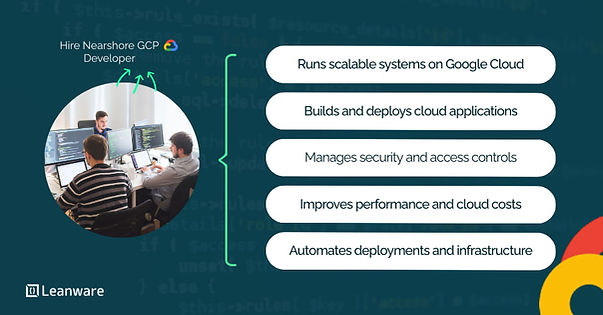
A GCP developer is a software engineer specialized in building, deploying, and managing applications specifically within the Google Cloud ecosystem. They don’t just write code; they design the infrastructure that allows that code to perform at scale.
Their work directly impacts a company's bottom line by optimizing resource usage to control costs and ensuring that the platform remains stable under heavy traffic.
Core Google Cloud Services They Work With
A capable GCP developer works across the full stack of Google Cloud services. The ones that come up most often in product teams are:
- Compute Engine: VM-based workloads with custom networking, autoscaling groups, and managed instance groups.
- Google Kubernetes Engine (GKE): Managed Kubernetes for containerized services, including cluster configuration, node pool management, and workload identity.
- Cloud Run: Serverless container execution for stateless, event-driven, or HTTP-triggered workloads.
- BigQuery: Columnar analytics warehouse for large-scale data querying, reporting pipelines, and ML feature stores.
- Cloud Storage: Object storage used for data lakes, backups, media assets, and pipeline intermediates.
- IAM: Identity and access management across projects, service accounts, and cross-service permissions.
Common Business Use Cases
The scenarios where GCP developers add the most direct value:
- SaaS products scaling beyond initial infrastructure: When traffic grows and a single-region setup starts showing limits, GCP developers redesign for multi-region failover, load balancing, and horizontal scaling on GKE or Cloud Run.
- Data-intensive platforms: Companies processing large volumes of event or ML training data rely on BigQuery and Pub/Sub pipelines that GCP developers build and tune.
- Fintech and regulated applications: Payment platforms need strict IAM controls, audit logging via Cloud Audit Logs, and encryption-at-rest with CMEK. Getting this right requires someone who understands both the cloud primitives and the compliance requirements.
- AI and ML workflows: GCP integrates with Vertex AI, and developers who understand the broader GCP ecosystem set up data pipelines, model serving infrastructure, and batch scoring jobs that connect cleanly to the rest of the stack.
What Does Nearshore Mean in Cloud Development?
Nearshore means working with engineers in a geographically close country, usually within one to three time zones of your main team. For U.S.-based companies, this typically means LATAM countries like Mexico, Colombia, Argentina, Brazil, or Chile.
Nearshore is not the same as outsourcing a project to a distant team and waiting for deliverables. It is an extension of your engineering team, with developers who attend your standups, review PRs in your Slack, and ship in your sprint cycles.
Nearshore vs Onshore
Factor | Onshore | Nearshore (LATAM) |
Hourly rate (senior) | $120-$180/hr | $60-$85/hr |
Hiring timeline | 8-14 weeks | 2-4 weeks |
Time zone overlap | Full | 4-8 hours/day |
English proficiency | Native | High, varies by market |
Cultural alignment | Same | Close |
Senior developers in LATAM range from $60 to $85 per hour, compared to $120 and above for comparable U.S.-based engineers. The hiring timeline is also shorter because nearshore providers maintain vetted talent pools rather than running a full recruiting cycle from scratch.
Nearshore vs Offshore
The difference between nearshore and offshore is about collaboration quality. Offshore teams in Asia or Eastern Europe often have only two to three hours of working overlap with U.S. teams. That is enough for asynchronous communication, but it adds friction to real-time troubleshooting, architecture discussions, and sprint planning.
Nearshore developers in LATAM operate in the same or adjacent time zones as U.S. teams, which means they can participate in daily standups, respond to production incidents during business hours, and iterate in real time. For cloud infrastructure work, where context matters and fast feedback loops improve outcomes, that overlap has a direct effect on delivery speed.
Why Hire a Nearshore GCP Developer Instead of Building In-House?
This is a scaling decision, not just a cost decision. Building an in-house cloud team works well at certain stages, but the lead time and overhead often do not match what fast-moving product teams need.
1. Faster Hiring Cycles
A typical in-house hire for a senior GCP engineer in the U.S. takes eight to twelve weeks from job post to start date. Nearshore providers can deploy vetted engineers in one to four weeks because they pre-screen for technical depth before any engagement starts. When you are mid-sprint and need cloud capacity now, that difference matters.
2. Cost Efficiency Without Sacrificing Quality
LATAM developers cost 30–50% less than equivalent U.S. or Western European engineers. That is not a function of lower quality. It reflects differences in cost of living and market rates. A senior GCP engineer in Mexico City or Bogota who holds a Google Professional Cloud Architect certification brings the same architectural depth as a U.S.-based counterpart.
What that cost difference does is give you access to senior-level cloud expertise at a budget that makes more financial sense for a growth-stage company or an engineering team that cannot justify multiple full-time cloud hires.
3. Access to Senior Cloud Talent
LATAM has a maturing cloud engineering ecosystem. Countries like Mexico, Colombia, and Brazil are producing cloud-certified engineers at scale. Cloud, DevOps, and cybersecurity continue to drive much of that growth. Google Professional Cloud Architect and Professional Cloud Developer certifications are common among senior LATAM engineers, and enterprise-grade distributed systems experience is increasingly available in the region.
Key Skills to Look for in a GCP Developer
Not every engineer with GCP experience is ready for production-scale infrastructure. When you evaluate candidates, these are the areas that separate solid engineers from great ones.
1. Cloud Architecture and Infrastructure Design
A strong GCP developer thinks in terms of reliability, scalability, and cost before writing a line of Terraform. That means designing VPC topologies with proper subnet segmentation, configuring load balancers with health checks and failover paths, and choosing between regional and multi-regional deployments based on actual availability requirements.
Infrastructure-as-Code is a baseline expectation. Terraform or Google Cloud Deployment Manager should be how they document and replicate everything they build, not an optional workflow.
2. Kubernetes and Containerization (GKE)
GKE is where most production microservices workloads run on GCP. A developer who can configure a cluster is different from one who understands workload identity federation, horizontal pod autoscaling, node pool segmentation, and network policies that restrict pod-to-pod communication.
For microservices teams, look for experience with Artifact Registry for image management and GitOps-based deployment workflows through Cloud Build or ArgoCD.
3. Serverless and Microservices
Cloud Run handles stateless, containerized workloads without requiring cluster management. Cloud Functions work for event-driven triggers like Pub/Sub messages, Cloud Storage events, or scheduled jobs.
A GCP developer who understands when to use Cloud Run versus GKE versus Compute Engine makes better architectural tradeoffs and keeps your infrastructure costs proportional to actual usage.
4. Security, IAM, and Compliance
IAM is where most cloud security problems start. Look for developers who apply least-privilege principles to service accounts, understand the difference between primitive and predefined roles, and know how to use Workload Identity Federation to eliminate long-lived service account keys.
For compliance-sensitive workloads, Cloud Audit Logs, Customer-Managed Encryption Keys (CMEK), and VPC Service Controls are practical requirements, not optional configurations.
5. CI/CD and DevOps Practices
A GCP developer should be comfortable building Cloud Build pipelines that test, push images to Artifact Registry, and deploy to Cloud Run or GKE with appropriate approval gates. Terraform should be in version control with remote state in Cloud Storage.
GitOps workflows, where infrastructure changes go through pull request review before applying, are a signal of engineering maturity worth looking for.
How to Hire a Nearshore GCP Developer
Hiring goes more smoothly when teams are clear about what they need and how nearshore engineers will work with the rest of the team.
Define Your Technical Requirements
Before talking to any provider, know what you need. What stage is your cloud infrastructure at? Greenfield, mid-migration, or optimizing an existing setup? What GCP services do you use or plan to use?
Do you need someone who can own architecture decisions, or someone who executes against an existing design? The more specific you are, the better providers can match candidates to your actual requirements.
Choose the Right Engagement Model
There are three common models:
- Staff augmentation: Engineers embed into your existing team, work in your sprint cycles, and report to your engineering leads. Best when you have established processes and need to add cloud capacity.
- Dedicated team: A self-contained team with a tech lead and engineers, operating as an extension of your product organization. Best for building a new cloud product or handling a major migration.
- Project-based: Scoped work with defined deliverables. Useful for time-bounded initiatives but less suited to ongoing product development.
Most growth-stage SaaS companies benefit from staff augmentation rather than project-based engagements because cloud infrastructure work is continuous, not one-time.
Technical Vetting and Interviews
Evaluate GCP candidates in three areas: architecture, security, and DevOps. Present a real scaling scenario and ask them to design a system on GCP. Give them an over-permissioned IAM configuration and ask them to fix it. Walk through how they would build a CI/CD pipeline from development to production. Practical exercises reveal more than certifications alone.
Cost of Hiring a Nearshore GCP Developer
Cloud infrastructure engineers usually have higher rates because the work involves specialized experience. Below is what pricing typically includes and what influences it.
Typical Hourly Rates in LATAM:
Level | LATAM Rate | U.S. Rate |
Mid-level GCP Developer | $45-$65/hr | $90-$120/hr |
Senior GCP Developer | $65-$85/hr | $120-$160/hr |
GCP Cloud Architect | $80-$100/hr | $150-$200/hr |
These are contractor or augmented staff rates through a provider. Direct hire annualized rates differ by country and model.
Factors That Influence Pricing
Certifications like Google Professional Cloud Architect typically add 10-20% over uncertified engineers with equivalent experience. DevOps overlap, where the developer also handles CI/CD pipelines, Terraform, and monitoring, commands more than pure application development work.
Enterprise complexity, multi-tenant architectures, and compliance requirements also push rates toward the higher end because those environments require more experience to navigate reliably.
When Should You Hire a Nearshore GCP Developer?
There are a few specific situations where adding a nearshore GCP engineer is the right move.
Scaling a SaaS Product
When traffic grows and existing infrastructure starts creating reliability or performance problems, that is the right moment to bring in cloud expertise. Redesigning for horizontal scaling, adding regional redundancy, or migrating from a single-VM setup to GKE takes focused cloud architecture work that falls outside the bandwidth of most product engineering teams.
Migrating to Google Cloud
Legacy infrastructure migrations are time-bounded but intensive. A nearshore GCP developer who has handled migrations before brings patterns that shorten the process, avoids common mistakes, and produces infrastructure that the team can maintain long after the migration finishes.
Optimizing Cloud Costs
Cloud spend grows faster than usage when nobody is actively managing it. A GCP developer doing a cost audit can identify right-sizing opportunities for Compute Engine instances, autoscaling configurations that reduce idle compute, and BigQuery reservation structures that lower query costs.
For companies in the $20,000-$100,000 per month cloud spend range, a single optimization cycle can recover months of engineering cost.
Why Companies Choose Nearshore GCP Developers in LATAM
LATAM has become a serious engineering region, not just a cost-reduction strategy. The reasons companies keep coming back have to do with the quality of collaboration, not just the price point.
1. Time Zone Alignment with the U.S.
LATAM countries run between UTC-3 and UTC-8. That puts Mexico, Colombia, and Chile within one to three hours of U.S. Eastern time, and Argentina within two hours.
For a distributed engineering team, that overlap means real-time code review, same-day design discussions, and production incident response during business hours. Sprint velocity improves when engineers can actually collaborate rather than pass work over a time wall.
2. Strong Engineering Culture
Colombia has a strong and growing developer base, with many engineers holding degrees in computer science or engineering. Cloud and DevOps adoption has increased across the region, and local engineering ecosystems continue to produce developers with real experience in distributed systems and cloud-native architectures.
3. Long-Term Partnership Potential
LATAM developers often show stronger long-term engagement compared to many offshore alternatives.
Engineers working with U.S. companies on USD contracts often stay longer because the compensation aligns well with local markets and the work remains technically challenging. For cloud infrastructure roles where institutional knowledge matters, this stability has a direct effect on continuity and delivery quality.
Hire Nearshore GCP Developers Today
If your team needs GCP infrastructure expertise and the standard hiring timeline does not fit your roadmap, nearshore is a practical path forward. The talent pool in LATAM is deep, the time zone alignment with U.S. teams is real, and the cost structure makes senior-level access viable for companies that are not yet ready for a full in-house cloud team.
Look for certifications, ask architecture questions that go beyond surface-level, and evaluate how they handle security and cost decisions. Those signals tell you whether someone can operate at the level your system actually requires.
You can also connect with us to discuss your cloud infrastructure goals, review your current GCP setup, and explore how nearshore engineers can support your team’s long-term scalability and reliability.
Frequently Asked Questions
What is a nearshore GCP developer?
A nearshore GCP developer is a cloud engineer who works from a nearby country in a similar time zone, specializing in building and operating infrastructure on Google Cloud Platform. For U.S. companies, this usually means engineers in Mexico, Colombia, Argentina, Brazil, or Chile.
Why hire a nearshore GCP developer instead of offshore?
Nearshore developers work in overlapping time zones, enabling real-time standups, faster iteration, and tighter team integration. Offshore models reduce costs slightly but introduce collaboration delays that compound over time.
How much does it cost to hire a nearshore GCP developer?
Mid-level GCP developers in LATAM typically cost $45-$65 per hour, seniors $65–$85 per hour, and architects with enterprise experience $80-$100 per hour. Rates vary by country, certifications, and project complexity.
What skills should a GCP developer have?
Hands-on experience with GKE, Cloud Run, Cloud Storage, BigQuery, and IAM is the baseline. Infrastructure-as-Code with Terraform, CI/CD pipeline configuration, and security practices around service accounts are equally important. The Google Professional Cloud Architect certification is a strong signal.
When should a company hire a nearshore GCP developer?
Common triggers are scaling past existing infrastructure limits, migrating to GCP, addressing cloud cost overruns, or rearchitecting a legacy system. Teams lacking in-house GCP specialization also benefit from adding a dedicated cloud engineer.
Is nearshore cloud development secure?
Yes, when proper security practices are implemented. Security depends on process and tooling, not geography. Nearshore GCP developers follow the same IAM, encryption, and audit logging standards as any on-site engineer.
How long does it take to hire a nearshore GCP developer?
Most nearshore providers deploy vetted engineers within one to four weeks, compared to eight to twelve weeks for a typical U.S. in-house hiring cycle.
Can a nearshore GCP developer work as part of my internal team?
Yes. Under staff augmentation, developers join your standups, use your project management tools, and work in your sprint cadence as embedded team members.
What is the difference between a GCP developer and a GCP cloud architect?
A GCP developer builds and operates applications on Google Cloud. A GCP cloud architect designs the infrastructure strategy: networking topology, security architecture, multi-region design, and cost structure. Larger projects often need both roles.
What industries commonly hire nearshore GCP developers?
SaaS platforms, fintech, data analytics firms, AI and ML startups, healthcare technology providers, and e-commerce platforms are the most common. These industries need scalable, cloud-native infrastructure that often runs under compliance requirements.