What is Google Cloud Platform (GCP)?

Google Cloud Platform (GCP) is a set of cloud services that lets you run applications, store and process data, and scale workloads without managing physical servers. It covers computing, storage, databases, analytics, and machine learning, all on Google’s global network.
For startup teams and small businesses, it means you can launch projects, experiment with new ideas, and handle traffic growth without hiring a large IT team. Resources can be scaled up or down as needed, so you only use what you need.
In this guide, we go through how GCP works, its key services, pricing, real-world use cases, and how it stacks up against other cloud platforms, so you can decide whether it’s the right fit for your business.
Understanding Google Cloud Platform (GCP)
Cloud computing changed how businesses run software. Instead of buying servers, setting up networks, and managing hardware, you can now access computing power, storage, and other services over the internet and pay for what you actually use.
Google Cloud Platform (GCP) is Google’s solution for business computing needs. While AWS has the largest market share and Azure integrates closely with Microsoft products, GCP leverages Google’s expertise in data analytics, machine learning, and global infrastructure.
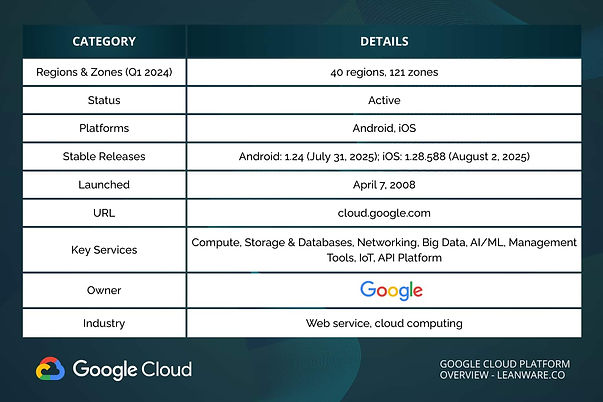
GCP was launched in 2008 with App Engine, a platform for hosting web applications. Since then, it has grown into a full cloud platform used by startups and large enterprises. It runs on Google’s global infrastructure, which spans over 40 regions and more than 100 availability zones. This network handles billions of searches daily, providing the same reliability and performance to the applications running on GCP.
Key GCP Products by Category:
Category | Key Products |
Compute | App Engine, Compute Engine, Kubernetes Engine (GKE), Cloud Functions, Cloud Run |
Storage & Databases | Cloud Storage, Cloud SQL, Bigtable, Spanner, Datastore, Persistent Disk, Memorystore, AlloyDB |
Networking | VPC, Load Balancing, Cloud Armor, CDN, Interconnect, DNS, Network Service Tiers |
Big Data | BigQuery, Dataflow, Dataproc, Composer, Datalab, Dataprep, Pub/Sub, Looker Studio, Looker |
AI/ML | AutoML, TPU, Machine Learning Engine, Natural Language, Speech-to-Text, Vision API, Video Intelligence |
Management Tools | Operations Suite, Deployment Manager, Cloud Console, Cloud Shell, Cloud APIs |
Security | Cloud IAM, Identity-Aware Proxy, Data Loss Prevention, Key Management, Security Command Center |
IoT | Cloud IoT Core, Edge TPU, Cloud IoT Edge |
API Platform | Maps Platform, Apigee, API Monetization, Developer Portal, API Analytics, Cloud Endpoints |
Why choose Google Cloud?
Several factors make GCP the best choice for businesses evaluating cloud options:
1. Global Infrastructure: Google operates one of the world's largest networks. Your applications benefit from the same infrastructure that delivers YouTube videos and processes search queries globally.
2. Pricing Transparency: GCP uses per-second billing for most services and offers sustained-use discounts automatically. You don't need to commit to specific instance types or worry about complex pricing tiers.
3. AI and Machine Learning: Google invented many foundational AI technologies like TensorFlow. GCP provides pre-trained models and custom AI hardware (TPUs) that other cloud providers simply can't match.
4. Data and Analytics: Services like BigQuery, Dataflow, and Looker give teams fast, scalable analytics capabilities. For startups and SMBs, this makes it easier to analyze customer data and make informed decisions.
5. Security and Compliance: GCP inherits Google’s enterprise-grade security, including encryption by default, identity management, and adherence to standards like SOC 2, ISO 27001, and HIPAA.
6. Hybrid and Multi-Cloud Flexibility: Tools like Anthos let you run applications consistently across on-premises systems, GCP, and other cloud providers, reducing the risk of vendor lock-in.
7. Startup and Developer Support: GCP offers free credits for new users and startups, hands-on labs, and resources to help teams deploy projects quickly. This support can significantly reduce early-stage infrastructure costs and ramp-up time.
8. Integration with Google Services: GCP works smoothly with tools like Firebase, Workspace, and BigQuery, allowing teams to streamline workflows and leverage existing Google services efficiently.
9. Reliability and SLAs: GCP provides service-level agreements for key products, backed by its global infrastructure, giving teams confidence in uptime and operational continuity.
Key Components of Google Cloud Platform
GCP offers over 100 services, but most businesses use a core set depending on their needs. Here’s an overview of key components.
1. Compute Engine
Compute Engine is GCP’s infrastructure-as-a-service (IaaS) product. It lets you run virtual machines (VMs) in the cloud. You choose the machine type, operating system, and disk size.
It’s useful when you need full control over your environment like running a database server, batch processing jobs, or legacy applications that aren’t containerized.
VMs can scale up (vertical scaling) or out (horizontal scaling with managed instance groups). You pay only for what you use, and sustained use discounts lower costs automatically if a VM runs for more than 25% of a month.
2. App Engine
App Engine is a fully managed platform for deploying web applications and APIs. You upload your code (in Python, Node.js, Java, etc.), and GCP handles the infrastructure - scaling, patching, load balancing, and monitoring.
It’s ideal for startups or small teams that want to launch an app quickly without managing servers. App Engine scales automatically - from zero to thousands of users - and you only pay when your app is receiving traffic.
There are two environments: standard (more restrictive, faster scaling) and flexible (custom runtimes, longer startup times).
3. Cloud Run
Cloud Run is a serverless platform for running containerized applications. If you’re using Docker, you can deploy your container to Cloud Run without managing servers or clusters.
It scales from zero to thousands of instances automatically and charges only when your service is handling requests. This makes it cost-effective for microservices, background workers, or APIs with variable traffic.
Unlike Kubernetes Engine, Cloud Run abstracts away cluster management, so you get container flexibility without operational overhead.
4. BigQuery
BigQuery is GCP’s serverless data warehouse. You can run SQL queries on petabytes of data in seconds, without managing any infrastructure.
It’s designed for analytics, not transactional workloads. Use cases include business intelligence, log analysis, and customer behavior tracking. BigQuery integrates with Looker, Google Sheets, and third-party tools via standard connectors.
Pricing is based on data processed, not storage, so you can store large datasets cheaply and query only what you need.
5. Memorystore for Redis
Memorystore is a fully managed Redis service for in-memory caching and real-time data processing.
Use it to speed up applications by caching database queries, session data, or API responses. It supports Redis 5.0 and 6.0, offers high availability, and integrates with Compute Engine, App Engine, and Cloud Run.
Since it’s managed, Google handles failover, backups, and updates.
6. Persistent Disk
Persistent Disk provides reliable block storage for VMs in Compute Engine. It’s like a virtual hard drive that stays intact even if the VM restarts.
You can choose between standard (HDD) and balanced/provisioned SSD options based on performance needs. Disks can be attached or detached from VMs and resized without downtime.
Snapshots are incremental and stored in Cloud Storage, making backups efficient and durable.
7. Google Tensor Processing Unit (TPU)
TPUs are custom-built hardware accelerators designed by Google for machine learning workloads.
They deliver high performance for training and inference in deep learning models, especially with frameworks like TensorFlow. TPUs are available in different generations and configurations, from single devices to full pods for large-scale training
While not needed for most applications, TPUs give GCP an edge in AI research and production ML pipelines.
GCP Pricing Model
Google Cloud Platform uses a pay-as-you-go pricing approach, meaning you only pay for the resources and services you actually use. There are no up-front fees or termination charges, and costs vary depending on the product, usage, and region.
How GCP Charges for Usage
- Per-second billing: Compute Engine and other metered services charge by the second, so you aren’t paying for unused time.
- Sustained-use discounts: Automatically applied to long-running workloads.
- Committed-use contracts: Pre-pay for resources like machine types or GPUs to receive significant discounts - up to 57% in some cases.
Free Tier and Trial
- $300 free trial: New customers get a 90-day trial with $300 in credits to test workloads or deploy pre-built solutions.
- Always-free tier: Over 20 products are available for free up to monthly usage limits, including Compute Engine, Cloud Storage, BigQuery, Cloud Run, Firestore, and more. This is ideal for prototyping or small projects.
Startup Credits
Google for Startups Cloud Program: Early-stage companies can access up to $350,000 in Google Cloud credits (up to $350,000 for AI startups), along with technical guidance and resources to support growth and experimentation.
Cost Management
GCP provides tools to monitor and control spending, including budgets, alerts, quota limits, and dashboards with cost trends. AI-driven recommendations identify optimization opportunities, and 24/7 billing support is available for questions or adjustments.
Estimating Costs
You can use the Google Cloud Pricing Calculator to model expenses based on region, product, and expected workloads. For more complex scenarios, GCP offers custom quotes and migration assessments.
GCP vs Other Cloud Platforms
Choosing a cloud provider depends on your priorities: cost, service breadth, ease of use, or integration with existing tools.
GCP vs AWS
Service Breadth: AWS offers the most comprehensive service catalog with over 200 services. GCP focuses on core services but provides deeper integration and better performance optimization.
Pricing: GCP generally costs less for compute and storage, especially with automatic sustained-use discounts. AWS requires more planning to optimize costs effectively.
AI/ML Tools: GCP leads in machine learning capabilities with TensorFlow, pre-trained APIs, and TPUs. AWS offers more services but GCP's AI tools often perform better out of the box.
Market Position: AWS holds the largest share of enterprise adoption and third-party integrations. GCP appeals to data-driven companies and organizations already using Google Workspace.
GCP vs Azure
Microsoft Integration: Azure integrates seamlessly with Windows Server, Active Directory, and Office 365. If you're heavily invested in Microsoft technologies, Azure provides smoother migration paths.
Developer Experience: GCP offers cleaner interfaces and more intuitive service configurations. Azure can feel complex due to its enterprise heritage and extensive feature sets.
AI and Analytics: Both platforms provide strong AI capabilities, but GCP's tools often require less configuration and deliver better performance for data analytics workloads.
Real-World Applications of GCP
Google Cloud Platform supports a wide range of applications across different industries. Examples include:
Use of GCP in business solutions
Digital Transformation: Retailers like Target use GCP to modernize legacy systems and create omnichannel shopping experiences. The platform's scalability handles traffic spikes during peak shopping periods.
Analytics and Insights: Spotify processes billions of music streaming events daily using BigQuery, enabling personalized recommendations and artist analytics dashboards.
Application Development: Startups use App Engine and Cloud Run to launch products quickly without infrastructure concerns. Companies can deploy globally in minutes rather than months.
Data Processing: Financial services firms use Dataflow and BigQuery to process transaction data, detect fraud patterns, and generate regulatory reports in real-time.
GCP in healthcare
Healthcare organizations face unique challenges around data security, compliance, and analytics. GCP addresses these through HIPAA-compliant services and specialized tools.
Patient Data Analytics: Mayo Clinic uses GCP to analyze patient records and medical imaging, identifying treatment patterns and improving care outcomes.
AI-Driven Diagnostics: Healthcare AI companies train diagnostic models using GCP's AutoML and TPUs, creating tools that help doctors detect diseases earlier and more accurately.
Secure Data Sharing: GCP's encryption and access controls enable secure collaboration between hospitals, research institutions, and pharmaceutical companies while maintaining patient privacy.
Advantages and Limitations of GCP
Strengths of GCP
- Cost-Effectiveness: Automatic discounts, per-second billing, and competitive base pricing often result in lower total costs compared to other cloud providers.
- Performance: Google's global network and custom hardware deliver excellent application performance, particularly for data-intensive workloads.
- AI/ML Leadership: Access to cutting-edge AI tools, pre-trained models, and TPUs provides competitive advantages for data-driven businesses.
- Developer Experience: Clean interfaces, comprehensive documentation, and logical service organization reduce complexity compared to other platforms.
- Innovation: Google regularly launches new services and features, often ahead of competitors, giving early adopters access to latest technologies.
Weaknesses of GCP
- Market Share: Smaller customer base means fewer third-party integrations, community resources, and specialized consulting services compared to AWS.
- Service Ecosystem: While growing rapidly, GCP offers fewer total services than AWS, potentially requiring more custom development for specialized needs.
- Enterprise Sales: Google's enterprise sales organization is newer and smaller than AWS or Microsoft's, which can impact support for large, complex implementations.
- Geographic Coverage: Fewer availability zones in some regions compared to AWS, though this gap continues to close as Google expands globally.
GCP Certifications and Learning Paths
If you’re building a team or upskilling, GCP offers structured certifications.
Certifications offered by Google Cloud
- Associate Cloud Engineer: Entry-level certification covering core GCP services, ideal for developers and system administrators new to cloud computing.
- Professional Cloud Architect: Advanced certification for designing and managing cloud solutions, targeting senior technical professionals and consultants.
- Professional Data Engineer: Focuses on data processing, analytics, and machine learning, suitable for data professionals and AI practitioners.
- Professional Cloud Developer: Covers application development, deployment, and monitoring on GCP, designed for software engineers and DevOps professionals.
Learning resources for beginners
- Google Cloud Skills Boost: Hands-on labs and courses covering all GCP services, from basic concepts to advanced implementations.
- Coursera Specializations: University-quality courses developed in partnership with Google, offering structured learning paths with certificates.
- YouTube and Documentation: Google publishes extensive video tutorials and written documentation covering every service and common use cases.
Getting Started
GCP is a solid, cost-effective cloud platform for running applications, analyzing data, and building AI tools. For startups and small teams, you can get projects running without worrying about servers or infrastructure, and the pay-as-you-go pricing makes it easier to manage costs. For bigger teams, the AI services and global network make scaling workloads simpler.
When choosing a cloud provider, focus on what matters most for your team - AI capabilities, keeping costs under control, or running across different environments. With GCP’s free trial and clear documentation, you can try things out and see if it fits your setup before committing.
You can also connect with our cloud experts to review your setup and get practical guidance on optimizing your cloud strategy.
Frequently Asked Questions
What is the meaning of GCP?
GCP stands for Google Cloud Platform, a suite of cloud computing services by Google that includes computing, storage, networking, and specialized services like machine learning and data analytics.
How Does GCP Pricing Work?
Google Cloud Platform uses a pay-as-you-go model, so you only pay for the resources you use. Costs vary by product, usage, and region, with no up-front fees or termination charges.
- Per-second billing: Pay only for active compute time.
- Sustained-use & committed-use discounts: Automatic savings for long-running workloads or pre-paid resources.
- Free trial: $300 in credits for 90 days.
- Always-free tier: 20+ core products, including Compute Engine, Cloud Storage, BigQuery, and Cloud Run, up to monthly usage limits.
What is GCP vs AWS?
GCP offers simpler pricing, superior AI/ML tools, and better performance for data workloads, while AWS provides broader service selection, larger market share, and more third-party integrations. Your choice depends on specific needs and existing technology investments.
What is GCP for beginners?
GCP provides beginner-friendly services like App Engine for web applications and Cloud Run for containerized apps, allowing you to deploy without managing servers. The free tier and extensive documentation make it accessible for learning cloud concepts.
What is GCP in healthcare?
GCP enables secure healthcare data processing with HIPAA-compliant services, AI tools for medical imaging and diagnostics, and analytics platforms for population health insights while maintaining strict privacy and security requirements.