Hire Nearshore Next.js Developer | Guide & Cost Savings 2025

Teams building modern web applications need developers who can ship fast, SEO-friendly experiences. Next.js has become a natural fit because it adds server-side rendering, static generation, and built-in performance tools on top of React. Many US companies now look to Latin America for this talent since the region offers strong JavaScript engineers in compatible time zones and at reasonable rates.
The 2024 Stack Overflow Survey shows Next.js at 17.9 percent usage, with strong interest behind it. About 59.5 percent admire the framework, and 34 percent of React developers want to work with it next year. Most developers already using it plan to keep going, which shows how important it has become in modern workflows.
As demand rises, nearshoring has become a practical way to find experienced developers. Latin America offers strong JavaScript talent in US-aligned time zones, which keeps collaboration smooth and reduces delays across the development cycle.
Let’s break down what you should know before you start hiring.
Before You Start Hiring
Starting a search without clear requirements wastes time. You'll interview candidates who don't match your needs or miss qualified developers because your job description attracted the wrong people.
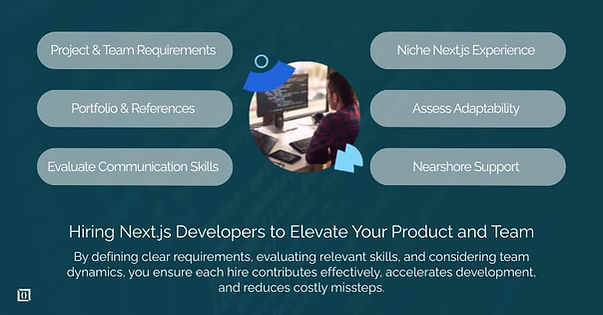
Project or Team Requirements
Write down what you're building. Are you migrating an existing React app to Next.js? Building a new product from scratch? Adding features to an existing Next.js codebase? Each scenario needs different experience levels.
- Define your tech stack beyond Next.js.
- Do you use TypeScript? Which CSS framework?
- What backend APIs will developers integrate with?
A developer experienced with your stack onboards faster than someone who needs to learn three new technologies simultaneously.
Consider team structure. Hiring a single senior developer to lead a project differs from adding mid-level developers to an existing team. The senior developer needs architectural decision-making experience. The mid-level developers need to follow established patterns and contribute to feature development.
Niche Experience in Next.js
Generic React experience doesn't equal Next.js expertise. A developer might be good at building SPAs but struggle with server-side rendering concepts. Look for specific Next.js experience relevant to your project.
Ecommerce sites need developers who understand image optimization, dynamic routing for product pages, and performance under traffic spikes. SaaS dashboards require experience with data fetching patterns, protected routes, and real-time updates. Marketing sites benefit from developers who know static generation, incremental static regeneration, and SEO optimization.
Ask candidates about their experience with getServerSideProps, getStaticProps, and getStaticPaths. These functions represent core Next.js patterns. A developer who can't explain when to use each one likely hasn't built production Next.js applications.
Portfolio and References / Testimonials
Request links to live applications, not just GitHub repositories. Live sites show you how the application performs, how pages load, and whether the developer implemented proper SEO practices. Check the HTML source to see if server-side rendering works correctly.
Review their GitHub activity. Look for contributions to Next.js projects, how they structure code, and whether they write tests. Commit messages reveal how developers think about changes and communicate with their team.
Contact references when possible. Ask specific questions about the developer's work: Did they meet deadlines? How did they handle technical challenges? Would you hire them again?
Adaptability
Startups change direction. A feature you planned three months ago might not matter anymore. Your tech stack might need adjustments based on new requirements or performance issues.
Developers who thrive in these environments ask questions about business goals, not just technical specifications. They suggest alternatives when they see problems with a proposed approach. They learn new tools quickly when the situation demands it.
Test adaptability during interviews. Present a technical challenge, then change a requirement midway through. See how they respond. Do they get frustrated, or do they adapt their approach?
Communication Skills (Including Documentation)
Distributed teams depend on clear communication. You can’t just walk over to someone’s desk, so most interactions happen over Slack, Zoom, or pull request comments.
Good communicators write PR descriptions that explain what changed and why. They update documentation when functionality changes and raise blockers early instead of struggling silently.
English proficiency matters for US teams. Developers should be able to explain technical decisions in meetings and write documentation that others can follow. It doesn’t have to be perfect grammar - clarity is what counts.
You can also connect with Leanware for nearshore staff augmentation, with pre-vetted Next.js developers from Latin America who integrate with US teams and follow time zone–aligned workflows.
Why Hire Next.js Developers in LatAm?
Latin America offers technical talent without the coordination problems of offshore development. Time zone alignment means your LatAm developers work when you work. No more waiting 12 hours for answers to blocking questions.
1. Hot Spot for Tech Talent
Argentina, Colombia, Brazil, and Mexico produce a significant number of software engineering graduates each year. Argentina's Universidad de Buenos Aires and Brazil's University of São Paulo are recognized among strong computer science programs in the region. Colombia has invested in tech education through initiatives like MinTIC, which supports coding bootcamps and university programs.
These countries also have active tech communities. Conferences such as JSConf Colombia and BrazilJS attract international speakers and encourage knowledge sharing, helping developers stay up to date with modern frameworks and best practices.
2. Alignment with US Time Zones
Colombia and Mexico operate on EST and CST respectively. Argentina and Brazil sit one hour ahead of EST. Compare this to Eastern Europe (6-8 hours ahead) or Asia (12+ hours ahead).
This alignment enables real-time collaboration. Your LatAm developer can join your 10am standup, pair program with your San Francisco-based engineer at 2pm, and wrap up before your EOD. No one works weird hours to accommodate meetings.
3. Seamless Work Culture
Many LatAm developers have worked with US companies. They understand agile methodologies, use tools like Jira and GitHub, and expect regular sprint planning and retrospectives. This experience reduces onboarding time compared to developers from regions less familiar with Western business practices.
Cultural alignment extends to work style. LatAm professionals value direct communication and autonomous work, similar to US engineering culture. You don't need to adjust your management approach or team processes significantly.
4. Strong English Proficiency
English proficiency varies across Latin America. According to the EF English Proficiency Index, Argentina scores higher than the regional average, while Colombia, Brazil, and Mexico are closer to moderate levels.
Most developers in these countries can handle technical discussions, write documentation, and communicate clearly with international teams. The focus is on clear technical communication rather than perfect grammar, which generally meets the needs of US-based distributed teams.
5. Lower Operational Costs
Salaries for senior developers in the US remain high. According to Stack Overflow 2025 data, backend developers earn around $175K, front-end developers $145K, full-stack developers $138K, and cloud or DevOps engineers $165K–$189K.
In Latin America, similar roles typically range from $40K to $70K depending on experience and location. Hiring nearshore developers can reduce costs while maintaining quality, allowing teams to fund additional hires, extend project timelines, or invest more in product development.
LatAm Next.js Developer Salaries and Skills by Experience Level
Salary expectations vary by country and city within Latin America. Buenos Aires and São Paulo command higher rates than smaller cities. Remote positions sometimes pay more than on-site roles because companies compete globally for remote talent.
Junior Next.js Developer
Junior developers typically have 1–2 years of professional experience. They understand JavaScript fundamentals, React basics, and have built 2-3 Next.js projects. Expect them to implement features from detailed specifications, write component tests, and contribute to existing codebases.
Salary range: $25,000-$40,000 annually, or $15-25 per hour for contract work.
Juniors work well for feature development under senior guidance. They handle routine tasks like building new pages, integrating APIs with clear documentation, and fixing straightforward bugs. Don't expect them to make architectural decisions or optimize complex performance issues.
Mid-Level Next.js Developer
Mid-level developers have 3-5 years of experience and have shipped multiple Next.js applications to production. They know when to use server-side rendering versus static generation, how to optimize images and fonts, and understand Next.js routing including dynamic routes and API routes.
Salary range: $40,000-$65,000 annually, or $25-40 per hour.
These developers work independently on most tasks. They design component architecture, implement data fetching strategies, and debug production issues. They need less oversight than juniors and can mentor junior team members. Mid-levels form the backbone of most engineering teams.
Senior Next.js Developer
Senior developers bring 6+ years of experience and deep Next.js expertise. They've architected applications from scratch, solved complex performance problems, and made framework tradeoff decisions. They understand CI/CD pipelines, testing strategies, and how to structure applications for long-term maintainability.
Salary range: $60,000-$90,000 annually, or $40-60 per hour.
Seniors lead technical initiatives. They evaluate whether Next.js fits a project's requirements, design system architecture, establish coding standards, and review other developers' work. They also interface with product and design teams to translate requirements into technical solutions. For critical projects or small teams, a senior developer's experience prevents costly mistakes.
Nearshore Savings Calculator
Nearshoring to Latin America can save 40-50% compared to US-based hiring. A three-person US team costing $400K annually would cost roughly $200K in LatAm for comparable experience levels.
Savings grow with team size. For a 10-person engineering team, this could mean $2M in annual savings - significant runway for startups or budget for additional hires in marketing, sales, or product.
You can estimate savings by comparing current team costs against LatAm salary ranges, factoring in recruitment, benefits, and overhead. Many recover recruitment costs within 3–4 months through salary differences alone.
You can also connect with us to leverage our nearshore services, from pre-vetted Next.js developers to full engineering support, helping your team scale efficiently while keeping projects on track.
Frequently Asked Questions
What specific technical questions should I ask when interviewing Next.js developers?
Focus on questions that reveal practical experience, not memorized framework documentation. Ask them to explain a Next.js application they built: What data fetching method did they use and why? How did they handle authentication? What performance optimizations did they implement?
Present scenarios: "You have a product catalog with 10,000 items. Would you use SSG, SSR, or ISR? Why?" Listen for their reasoning process, not just the answer.
Request code samples or live coding exercises. Have them build a small feature during the interview. You'll see how they structure components, handle state, and approach problem-solving in real-time.
How long does it take to hire a nearshore Next.js developer?
Budget 2-4 weeks for the full process. Week one covers posting positions and initial screening. Week two involves technical interviews and reference checks. Weeks three and four handle offer negotiation, contract signing, and onboarding setup.
Staff augmentation agencies can accelerate this timeline by presenting pre-vetted candidates immediately. You skip the screening phase and start with technical interviews.
What are the red flags when vetting nearshore Next.js developers?
Weak portfolios signal problems. If a developer can't show you 2-3 production applications they built, they likely lack real experience. GitHub profiles with minimal activity or no Next.js projects raise questions about their claimed expertise.
Poor communication during interviews predicts poor communication on the job. If a candidate can't clearly explain their past work or gives vague answers to technical questions, collaboration will be difficult.
Watch for developers who haven't worked with testing. Professional developers write tests. Someone who says "I don't usually write tests" or "the team didn't prioritize testing" shows either inexperience with professional development practices or poor judgment about code quality.
Should I hire freelance Next.js developers or go through an agency?
Freelancers work for short-term projects or specific expertise gaps. You get flexibility and potentially lower rates. The tradeoff is risk: freelancers might have availability conflicts, quality varies widely, and you handle all vetting.
Agencies provide reliability for ongoing needs. They vet candidates, handle HR and payroll, and can replace developers who don't work out. This matters for startups building core product features or companies scaling teams quickly. The premium you pay for agency services buys risk reduction and time savings.
Can nearshore developers handle enterprise-scale Next.js projects?
Yes. Many LatAm developers have worked on large-scale applications for US companies. They've dealt with high traffic volumes, complex state management, microservices architectures, and enterprise security requirements.
Look for senior developers with relevant experience. Ask about the largest application they've worked on: How many users? What was the team structure? What challenges did they face? Their answers reveal whether they can handle your scale.
Review their experience with enterprise tools and practices: monitoring and logging systems, CI/CD pipelines, security protocols, and performance optimization. These skills transfer across companies and indicate professional experience with serious applications.