Impact of AI on Software Development

Software development changed more in the past two years than in the previous decade. AI systems moved from experimental projects to tools that many developers use daily. Organizations are still assessing what this means for teams, processes, and products. AI is already generating a significant portion of production code, altering workflows, and challenging long-standing assumptions about development.
The question isn’t whether AI will affect software development - that’s already happening. The focus is on how these changes appear in practice, what outcomes are observed, and what risks come with the pace of adoption.
Let’s look at how AI fits into current software development workflows.
Why AI in Software Development Is No Longer Experimental
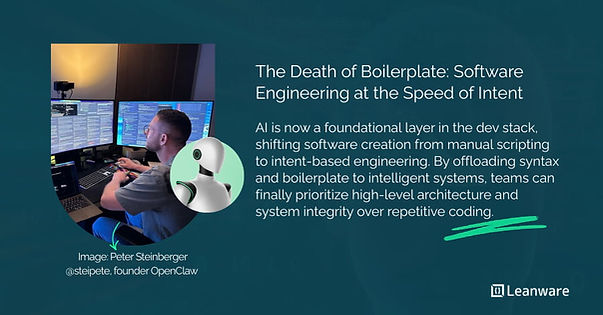
AI-assisted development crossed a threshold in 2024 and 2025. What began as curiosity and pilot programs evolved into standard practice across the industry.
The tools matured, infrastructure caught up, and developers integrated AI into their workflows at scale.
From Early Automation to Intelligent Systems
Early automation in software development followed scripts and rules. CI/CD pipelines automated deployment. Static analysis tools caught obvious errors. These systems did what you programmed them to do, nothing more. AI tools work differently. They generate code, suggest solutions, and make judgment calls based on context. A developer describes what they need, and the system produces working code. The system learns patterns from millions of code repositories and applies those patterns to new problems.
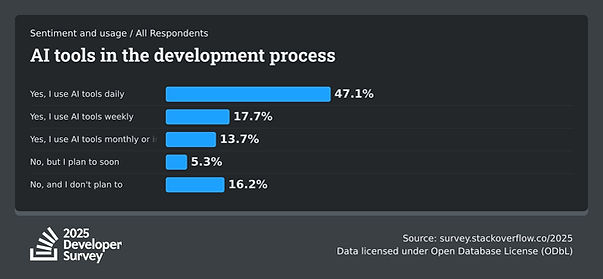
According to Stack Overflow's 2025 Developer Survey, 84% of developers now use or plan to use AI tools in their development process, up from 76% the previous year. Among professional developers, 51% report using these tools daily. This represents adoption at a pace rarely seen with new development technologies.
The Convergence of Cloud Computing, Data, and AI Models
Three factors enabled this shift. Cloud infrastructure provides the compute power needed to run large AI models at scale.
The availability of massive code repositories gave these models training data. Companies like GitHub, with billions of lines of code across millions of repositories, created datasets that would have been impossible to assemble a decade ago.
Modern AI models can process and learn from this data in ways that earlier machine learning approaches couldn't match. The infrastructure, data, and models converged at roughly the same time, creating conditions for rapid adoption.
How AI Is Changing the Software Development Lifecycle
AI affects every stage of SDLC, from initial planning through production monitoring. The impact varies by stage, but no part of the lifecycle remains untouched.
AI-Assisted Planning and Requirements Analysis
Project planning tools now use AI to estimate effort, identify risks, and suggest architectural approaches based on project requirements. These systems analyze historical project data to predict timelines and resource needs more accurately than purely human estimates.
They flag potential conflicts between requirements and highlight dependencies that might otherwise get missed during planning. The systems don't make final decisions but provide data that helps teams plan more effectively.
Code Generation and Intelligent Development Environments
Code generation tools like GitHub Copilot, Cursor, and various AI-powered IDEs suggest code as developers type. These suggestions range from completing a single line to generating entire functions based on comments or context.
Sonar reports that AI tools now generate approximately 42% of all code written in 2025, though acceptance rates vary.

GitHub Copilot reports that around 30% of its suggestions get accepted by developers, meaning most generated code gets reviewed and discarded.
The tools work best for routine coding tasks: boilerplate code, standard implementations of common patterns, test case generation, and documentation. They struggle with complex business logic, architectural decisions, and code that requires deep understanding of system constraints.
Automated Testing and Quality Assurance
AI testing tools generate test cases, identify edge cases that human testers might miss, and detect regressions across large codebases. They analyze code changes and predict which parts of an application are most likely to break, allowing teams to focus testing efforts where they matter most.
Test generation can reduce the time spent writing test coverage from days to hours. The limitation shows up in test quality. AI-generated tests often check that code runs without checking that it produces correct results. Teams still need humans to verify that tests actually validate the right behavior.
AI-Driven Deployment, Monitoring, and Optimization
Production monitoring systems use AI to detect anomalies in application behavior, identify performance bottlenecks, and predict failures before they occur. These systems analyze logs, metrics, and traces to find patterns that indicate problems.
When incidents happen, AI tools can suggest remediation steps based on similar past incidents. Some systems attempt automated remediation for common issues, though most organizations keep humans in the loop for production changes.
Productivity Gains: What the Data Shows
The productivity question generates strong opinions and conflicting data. Some studies show significant gains. Others find minimal impact or even slowdowns.
Faster Development Cycles and Reduced Manual Effort
AI-assisted coding can reduce time on routine tasks, though results vary. A late-2025 study reported a 31.4% productivity increase for code generation and repetitive work, along with a higher rate of security issues that require review.
GitHub data from 2024 found that 90% of developers felt more satisfied and 95% enjoyed coding more with Copilot, indicating smoother workflows rather than consistent speed gains.
At the organizational level, the 2024 DORA Report linked a 25% rise in AI adoption to a 7.5% improvement in documentation quality and a 3.4% increase in delivery throughput.
Controlled tests show limits. A 2025 METR study found experienced developers in familiar codebases completed tasks 19% slower with AI, despite feeling faster, highlighting the difference between perception and measured outcomes.
Smaller Teams Delivering Larger Systems
AI tools allow smaller teams to maintain larger codebases and deliver more complex systems than would have been practical before. A team of five developers can now handle work that previously required eight or ten. This shows up in team composition changes across the industry.
Companies are growing their engineering output without proportionally growing headcount. The efficiency comes from AI handling routine implementation work while developers focus on architecture, design decisions, and complex problem-solving.
Shifts in Developer Roles and Responsibilities
Developer work is shifting from writing code to reviewing, designing, and making architectural decisions. Junior developers spend less time on basic implementation and more time understanding system design.
Senior developers spend less time coding routine features and more time on system architecture and mentoring. Code review becomes more important as teams review larger volumes of AI-generated code. The role changes represent a fundamental shift in what it means to be a software developer.
Software Quality and Security in the Age of AI
Quality and security are no longer secondary considerations in the development process. AI allows for continuous verification, but it also introduces new risks that require careful management.
Feature | Traditional QA/Security | AI-Enhanced QA/Security |
Bug Detection | Manual review and unit tests | Pattern-based anomaly detection |
Vulnerability Scanning | Static analysis (fixed rules) | Context-aware risk identification |
Speed | Periodic or post-build | Continuous and real-time |
Human Role | Primary executor | Reviewer and validator |
Early Bug Detection and Code Analysis
AI-powered static analysis tools can identify bugs earlier in the development cycle, catching issues that might escape human review, such as null pointer exceptions, resource leaks, race conditions, and logic errors. These tools help reduce debugging time and prevent problems from reaching production.
Analysis of AI-assisted coding from 2020–2024 by GitClear, covering 211 million changed lines across Google, Microsoft, Meta, and enterprise repositories, shows that AI-generated code correlates with higher rates of duplicate or copy/paste code and short-term churn, while moved or reused lines continue to decline. This indicates that even though AI can generate code quickly, much of it requires revision or cleanup before it’s ready for production.
Identifying Vulnerabilities Before Deployment
Security is one of the key challenges in AI-assisted software development. Common vulnerabilities in AI-generated code include SQL injection, cross-site scripting, insecure cryptography, and missing authentication controls. A Veracode analysis found that AI models failed to handle cross-site scripting (CWE-80) in 86% of relevant code samples and log injection vulnerabilities in 88% of cases.
The underlying issue comes from the AI training data. Models learn from public repositories, many of which include insecure patterns. AI reproduces these patterns without understanding security context or threat models. As a result, the generated code often functions correctly but lacks the necessary security safeguards.
Reducing Human Error Without Removing Human Oversight
AI reduces certain types of human error while introducing new ones. It eliminates typos, syntax errors, and basic logic mistakes. It applies patterns consistently across codebases. However, it introduces architectural drift, where subtle design changes break security invariants without violating syntax.
These changes often evade both automated tools and human reviewers. The solution requires treating AI-generated code the same as code from junior developers: assume it needs review, verify security properties, and validate that it meets requirements.
The Business Impact of AI-Driven Development
For business leaders, the impact of AI in software is measured in market outcomes. Speed, cost, and reliability are the primary drivers of competitive advantage.
Shorter Time-to-Market for Digital Products
AI tools compress development timelines for certain types of projects. Internal tools, MVPs, and standard web applications can move from concept to deployment faster than before. This matters in competitive markets where speed determines who captures opportunity. Companies can test ideas, gather user feedback, and iterate more quickly.
The advantage compounds over time as organizations that ship faster learn faster and adapt to market changes more effectively.
Cost Efficiency and Operational Scalability
AI can allow teams to manage larger systems without proportional increases in headcount, which may influence operational costs. However, adoption does not automatically deliver savings. A 2024 survey of over 2,400 IT leaders found that 47% of AI projects were profitable, roughly one-third broke even, and 14% resulted in losses.
Costs include not only licensing but also training, security, code review, and addressing technical debt from AI-generated code. Efficiency gains are possible, but they depend on careful management and oversight rather than being automatic.
Competitive Advantage in Fast-Moving Markets
Organizations that integrate AI effectively into development processes can gain an edge in markets where speed and reliability matter. The advantage comes not from the tools themselves, but from how teams use them.
Companies that combine AI with strong governance, security controls, and review processes tend to maintain both velocity and quality, while teams that adopt AI without these measures risk introducing errors or inefficiencies.
Real-World Use Cases Across Industries
The application of AI in development varies depending on the regulatory and technical requirements of the industry.
AI in Fintech and Financial Software
Financial services companies use AI for fraud detection systems, risk assessment platforms, and compliance automation. These applications require high accuracy and auditability. AI helps generate code for data processing pipelines, API integrations, and reporting systems.
However, financial software demands rigorous testing and security review. Organizations in this sector typically maintain strict human oversight, using AI to accelerate development while keeping humans accountable for correctness and compliance.
AI-Powered Platforms in Healthcare and Life Sciences
Healthcare software development faces strict regulatory requirements and high stakes for errors. AI assists with building patient management systems, diagnostic tools, and research platforms. The tools help with standard integrations, data processing code, and user interface implementation.
Critical medical algorithms and patient safety features still require human design and extensive validation. The regulatory environment means that AI-generated code goes through the same validation processes as human-written code.
Enterprise Systems and Internal Tooling
Internal enterprise tools represent one of the strongest use cases for AI-assisted development. These systems typically have lower risk profiles than customer-facing applications. AI speeds up development of dashboards, reporting tools, data integration scripts, and workflow automation.
Teams can rapidly prototype solutions, test them with internal users, and iterate based on feedback. The reduced risk tolerance for internal tools allows faster adoption of AI-generated code with appropriate review processes.
Challenges and Risks of Using AI in Software Development
While AI can improve workflows, you still need to address technical limitations and compliance requirements when deploying autonomous or semi-autonomous systems.
Over-Reliance on AI-Generated Code
AI-generated code can create technical debt if it isn’t reviewed carefully. The code may appear correct and work initially, but subtle flaws can cause problems later. Developers often spend considerable time understanding and fixing AI-generated outputs.
When teams trust AI blindly, the effort required to correct issues can outweigh the time saved, leading to accumulated technical debt that becomes costly to address.
Data Privacy, Compliance, and IP Concerns
AI tools that send code to external services raise data privacy questions. Proprietary code, customer data, and business logic might get exposed through AI tool interactions. Some tools retain and learn from submitted code, potentially leaking intellectual property across organizational boundaries.
Regulated industries face compliance risks when sensitive data passes through AI systems without appropriate controls. Organizations need policies governing what code and data can be sent to AI services and which tools meet their security requirements.
Skills Gaps and the Learning Curve for Teams
Effective use of AI development tools requires new skills. Developers need to understand how to prompt these systems effectively, recognize when AI outputs are incorrect, and identify security vulnerabilities in generated code.
Teams without these skills either underutilize AI tools or use them unsafely. The learning curve varies by developer experience. Junior developers struggle to evaluate AI outputs because they lack the experience to recognize subtle errors. Senior developers adapt more quickly but need training on new workflows and review processes.
How Developers Are Adapting to an AI-First Workflow
Developers are moving beyond traditional planning, coding, and testing sequences. AI-first workflows focus on context-driven guidance, spec-driven development, and autonomous agent orchestration. You set objectives, oversee agents as they execute tasks, and review outputs to ensure correctness and alignment.
Andrej Karpathy long ago said English could become the programming interface, with natural language guiding AI instead of manually writing code.
Human-in-the-Loop Development Models
Most successful AI implementations keep humans actively involved in the development process. Developers review AI-generated code before it merges. Teams implement approval workflows for high-risk changes.
Code review processes adapt to handle larger volumes of generated code, focusing on logic correctness and security properties rather than syntax and style. The human-in-the-loop model maintains accountability while leveraging AI's speed advantages.
New Skills Developers Need in an AI-Assisted Environment
The skill set for effective AI-assisted development includes prompt engineering, code review of AI outputs, security analysis, and system design. Developers need stronger architectural thinking because AI handles more implementation details.
They need better security knowledge to catch vulnerabilities in generated code. The ability to break down problems into clear specifications becomes more important as AI translates those specifications into code. Understanding AI limitations helps developers know when to trust tools and when to implement solutions manually.
What This Means for the Future of Software Engineering
Over the next three to five years, developers will increasingly focus on defining system behavior, objectives, and specifications rather than writing every line of code.
Autonomous development agents will take on more of the implementation and coordination tasks, allowing teams to concentrate on design, integration, and oversight.
From Writing Code to Designing Systems
Software engineering is shifting from implementation to design and architecture. As AI handles more routine coding, human developers focus on higher-level decisions: system architecture, technology selection, API design, and business logic.
This shift changes what it means to be a good developer. Writing code quickly matters less. Understanding systems, making sound architectural decisions, and designing maintainable solutions matter more. Junior developers need to develop system thinking skills earlier in their careers rather than spending years primarily writing implementation code.
The Rise of Outcome-Based Development Models
Development workflows are moving toward outcome-based models where developers specify what they want rather than how to build it. This requires clearer requirements, better problem decomposition, and more precise specifications.
The model works well for well-understood problems with clear requirements. It struggles with novel problems, complex business logic, and situations where requirements emerge through exploration. Organizations that master outcome-based development can move faster on routine work while investing human creativity in genuinely complex problems.
What to Watch Next
The industry is moving from passive assistants toward autonomous development agents that can diagnose bugs and execute pull requests independently. As these systems mature, expect stricter regulatory frameworks focused on data lineage and human accountability.
This shift is shrinking team sizes and elevating the developer's role; we are moving away from manual syntax production toward a model led by AI Orchestrators who prioritize system architecture, security governance, and high-level problem solving.
You can also connect with us to explore how to integrate autonomous agents into your development cycle to accelerate your time-to-market and scale your engineering output.
Frequently Asked Questions
What is the impact of AI on software development?
AI is transforming software development by automating repetitive tasks, improving code quality, accelerating testing, and enabling more data-driven decision-making across the entire development lifecycle. It affects planning, coding, testing, deployment, and monitoring by providing intelligent assistance at each stage.
How is AI used in software development today?
AI is commonly used for code assistance, automated testing, bug detection, performance monitoring, security analysis, and development workflow optimization. Developers use AI tools daily for code completion, generating boilerplate code, writing tests, and identifying potential issues.
Does AI replace software developers?
No. AI does not replace developers but augments their capabilities. Developers remain responsible for architecture, decision-making, code review, and accountability. AI handles routine implementation while humans focus on design, strategy, and complex problem-solving.
Which stages of the software development lifecycle are affected by AI?
AI impacts planning, coding, testing, deployment, monitoring, and maintenance by improving speed, accuracy, and predictability at each stage. Every part of the lifecycle now includes AI-assisted tools and processes.
How does AI improve software development productivity?
AI reduces manual effort by generating code suggestions, automating tests, identifying issues early, and streamlining workflows. However, measured productivity gains vary significantly by task type and team maturity, with some studies showing slowdowns once review time is included.
What are the risks of using AI in software development?
Key risks include over-reliance on AI-generated code, security vulnerabilities, data privacy concerns, intellectual property issues, and reduced code understanding if human oversight is weak. Research shows 45-62% of AI-generated code contains security vulnerabilities.
How does AI affect software quality and security?
AI improves quality and security by detecting bugs and vulnerabilities earlier, but it does not eliminate risk and still requires human validation and governance. AI-generated code often contains security flaws that need careful review.
What skills do developers need in an AI-driven development environment?
Developers increasingly need skills in system design, code review, prompt literacy, AI-assisted workflows, and critical evaluation of AI outputs. Understanding AI limitations and security implications becomes essential for effective use of these tools.
Is AI-driven software development suitable for all companies?
Not always. Adoption depends on team maturity, project complexity, regulatory requirements, and the ability to manage AI responsibly within development processes. Organizations need appropriate governance, security controls, and review processes to use AI effectively.
How does AI change software development costs?
AI can reduce development and maintenance costs over time by improving efficiency, but initial investment, training, and governance may increase short-term costs. Research shows less than half of AI projects were profitable in 2024, indicating cost benefits require careful implementation.