LLM Agent Architecture Explained: Components and Applications

LLM agents handle workflows that require multiple steps, tool usage, and decision-making over time. The architecture determines how the language model coordinates with memory systems, planning components, and external tools to complete complex tasks without human intervention.
Rather than single-prompt interactions, agents maintain state across conversations, break down objectives into executable steps, and adapt when things don't go as planned. That means ensuring these parts communicate reliably and handle failures effectively.
Let’s explore the core components, advanced modules, applications, and challenges of building and deploying LLM agents, and how each part defines their role in current and future AI systems.
What Are LLM Agents?
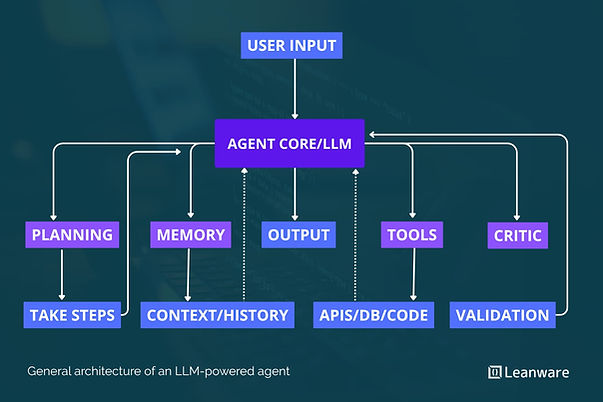
LLM agents use a large language model as the core reasoning engine, with additional components for autonomous action, planning, and tool integration. They can plan multi-step workflows, interact with external systems, and adapt their approach based on feedback from the environment.
It differs from a basic LLM in three critical ways:
- Autonomy: Agents initiate actions without constant human input.
- Goal orientation: They work toward defined outcomes, not just responses.
- Tool integration: They can call functions, query databases, or run code.
For example, instead of asking, “What’s the weather?” and getting a static reply, an agent might say, “I’ll check the current weather in London using a weather API,” then retrieve and summarize the data.
In AI systems, agents serve as intelligent orchestrators. They interpret model responses, determine the next steps, and utilize the appropriate tools or services to advance the process.
Core Components of LLM Agent Architecture
LLM agents follow a modular design. Each module performs a defined role, which makes it easier to modify or extend the system. Common components include:
- Agent Core (the "Brain")
- Memory Modules
- Planning Mechanisms
- Tool Use and Integration
1. Agent Core or Brain
The agent core is the central decision-making unit. It typically wraps a large language model and orchestrates the agent’s behavior. When given a goal, the core determines what action to take next - whether that’s retrieving information, calling a tool, or generating a response.
This component evaluates context, applies reasoning, and manages state. It’s not just a prompt-response loop; it runs iterative cycles of perception, planning, and action. For example, if tasked with “Summarize last quarter’s sales performance,” the core might:
- Break the task into steps.
- Retrieve data from a CRM.
- Analyze trends.
- Generate a summary.
The core’s effectiveness depends on both the underlying LLM and the structure of its decision logic, often guided by prompt templates or fine-tuned control policies.
2. Memory Modules
Agents need memory to function effectively over time. Without it, they treat every interaction as isolated, losing context and continuity.
Memory in LLM agents comes in two main forms:
- Short-term (working) memory: Stores recent interactions within a session. This is often implemented using conversation history or context windows.
- Long-term (persistent) memory: Retains information across sessions. This can include user preferences, past decisions, or domain knowledge.
Technically, long-term memory often relies on vector databases. These allow agents to store and retrieve high-dimensional embeddings of past experiences, enabling semantic search over historical data. For example, an agent might recall how it resolved a similar support ticket last month and apply the same strategy.
Some systems also implement episodic memory, where sequences of actions and outcomes are logged for reflection and learning. This supports more sophisticated behavior, such as avoiding repeated mistakes.
3. Planning Mechanisms
Planning allows agents to break down complex goals into manageable steps. Without planning, agents react impulsively, leading to inefficient or incorrect outcomes.
There are two primary approaches:
- Chain-of-thought reasoning: The agent generates intermediate reasoning steps before acting. For example, when asked to plan a marketing campaign, it might first outline target audiences, then suggest channels, and then estimate budgets.
- Explicit planning modules: These generate structured plans, like to-do lists or dependency graphs, before execution begins.
Planning improves reliability, especially for multi-step tasks. It also makes agent behavior more interpretable, as you can inspect the plan before any action is taken.
Plan Formulation
Agents generate step-by-step plans to meet objectives. This can be done through prompt engineering that guides the LLM to produce ordered instructions or by using specialized planning models trained for this purpose.
Plan Reflection and Iteration
After executing parts of a plan, agents evaluate outcomes, compare them against goals, and adjust their approach. Reflection modules or critics provide feedback loops, allowing the agent to refine its strategy dynamically.
4. Tool Use and Integration
An agent’s ability to interact with external systems defines its utility. No matter how intelligent the core, it can’t act without tools.
Modern LLM agents integrate with:
- APIs (e.g., Slack, Salesforce, Google Calendar).
- Databases (via SQL or ORM connectors).
- Code interpreters (e.g., Python execution).
- Web browsers (for scraping or interaction).
LangChain and OpenAI’s function calling are common methods for enabling tool use. Developers define available functions, and the LLM decides when and how to use them.
For example, an agent might:
- Use a calendar API to schedule a meeting.
- Run Python code to analyze a dataset.
- Query a knowledge base to answer a question.
Advanced Modules in Agent Design

As agent architectures mature, developers add sophisticated modules that enhance reasoning, error correction, and task management capabilities.
1. Task and Question Decomposition
Complex queries often require splitting into smaller subtasks. Agents use decomposition techniques, including ReAct-style prompting, which interleaves reasoning with actions. This makes large problems more manageable and improves accuracy.
2. Critic or Reflection Module
Beyond simple reflection, some agents include dedicated critic modules—separate models or prompts that evaluate the agent’s work.
These can:
- Score the quality of a generated report.
- Flag inconsistencies in logic.
- Suggest alternative approaches.
In multi-agent setups, one agent might act as a reviewer for another. This creates a feedback-rich environment where decisions are scrutinized before being finalized.
While still experimental, critic modules represent a step toward more reliable and trustworthy AI systems.
Applications of LLM Agent Architecture
LLM agents are now used in a range of practical, real-world applications.
1. Enterprise Use Cases
In many organizations, agents are deployed to handle routine tasks that require decision-making across multiple systems. For example, in customer support, an agent can access knowledge bases, check account status, process routine requests, and escalate complex issues to human staff.
Real-world implementations illustrate this. For instance, Alibaba Cloud uses an LLM-based customer service agent that integrates with its after-sales systems, enabling it to retrieve customer history, process service requests, and coordinate across tools without predefined scripts.
Similarly, AT&T deploys autonomous assistants to detect and stop fraudulent transactions, assist call center staff with tailored service recommendations, and support internal workflows like software development and network operations.
These applications reduce manual effort while maintaining consistency and accuracy. They are particularly effective for processes with clear business rules but varying execution paths.
2. Data Interaction Agents
Some business processes require timely access to specific information from live data sources. Data interaction agents retrieve, process, and present this information. Many use retrieval-augmented generation (RAG) to identify relevant records or documents before responding.
For example, South State Bank has used an AI agent to run targeted marketing campaigns by analyzing account data, segmenting customer lists, and adjusting offers in real time. The same agent approach has been applied to tasks such as credit portfolio monitoring, where it tracks key metrics and updates them automatically.
Similarly, Oracle uses LLM-powered agents for legal research, enabling faster retrieval and summarization of information from complex legal databases. These agents also support other data-intensive tasks like revenue intelligence and recruitment analytics, where they can surface relevant information and provide concise explanations for decision-makers.
3. Recommendation and Design Agents
Agents can also assist in creative or strategic domains. Marketing teams use them to generate campaign ideas from audience data, while product teams rely on them to suggest feature improvements from user feedback. Designers employ them to draft copy for ads or landing pages.
For example, Arizona State University uses LLM agents to create personalized learning pathways for students and to support faculty in instructional tasks. These agents help customize course content, suggest resources, and adapt materials to different learning needs, enabling more effective and individualized education.
4. Custom Authoring Agents
Writing consistent, on-brand content at scale is a challenging task. Custom authoring agents assist by generating emails, reports, or blog posts that adhere to a predefined tone and style.
For example, Lawdify builds AI agents that perform document-heavy legal work. These agents draft legal documents, analyze case files, and prepare closing submissions according to established legal formats and standards. Lawyers use the output to complete case preparation and dispute work.
5. Multi-modal Agent Systems
Advanced agents process and generate across multiple media types - text, images, audio, and more. For example, GPT-4o enables agents that analyze visuals, generate images from descriptions, and blend media in responses.
Some agents interpret screenshots, diagrams, or photos to extract information and answer questions. Others generate design assets based on text prompts and brand specifications.
LLM Agent Frameworks and Platforms
LLM agent frameworks provide the infrastructure to build and run agents using large language models. They include components for planning, memory, and tool integration, allowing developers to create agents that process input, act, and return results without building everything from scratch.
Popular Frameworks
These frameworks provide tools to build and manage LLM agents:
- LangChain: Modular framework with unified LLM interfaces, data integrations, and vector store support.
- LangGraph: Graph-based orchestration for multi-agent workflows, compatible with LangChain.
- AutoGen (Microsoft): Manages multi-agent conversations with customizable agents and human-in-the-loop options.
- A2A (Google): Protocol enabling agent-to-agent communication and collaboration across platforms.
- CrewAI: Supports role-based agent collaboration with flexible memory and error handling.
- LlamaIndex: Provides indexing and retrieval for 160+ data sources and customizable RAG workflows.
- Semantic Kernel (Microsoft): Enterprise-ready framework with multi-language support, plugins, and memory management.
- Dify: Open-source framework for prompt orchestration, long context, and multi-model support.
- Haystack: Focuses on document processing, neural search, question answering, and agent features.
- SuperAGI: Autonomous agent framework with customizable workflows and multi-vector memory.
- Embedchain: Framework for ChatGPT-style bots with multi-source data ingestion and context management.
- AGiXT: Scalable framework supporting multiple models, plugin extensions, and command chaining.
- XAgent: Autonomous agents with planning, task decomposition, and error recovery.
- OpenAgents: Platform with data analysis, web browsing, coding support, and visualization.
- AI Legion: Swarm framework for multi-agent coordination and dynamic task allocation.
- Agent Protocol: Standardizes communication and tool integration for AI agents.
- Agents.js: JavaScript framework for browser-based agents with event-driven design.
- MCP (Model Context Protocol): Standard for connecting AI models to external tools and APIs, enabling richer agent capabilities.
Challenges in LLM Agent Architecture
Despite rapid progress, several technical and operational challenges limit agent deployment in production environments.
Scalability
Agents consume significant computational resources, especially when handling complex planning or using large context windows. Token costs can escalate quickly with multi-step workflows that require extensive reasoning.
Orchestration overhead increases with agent complexity. Managing multiple tool calls, memory retrieval, and plan execution requires careful resource management and monitoring.
Load balancing becomes critical when deploying agents at scale. Different types of requests have varying resource requirements, making it challenging to predict and provision capacity effectively.
Data Privacy
Agents often handle sensitive data and connect with multiple external services. This requires strict data privacy and security measures throughout their operation. API integrations must include filtering and access controls to prevent unauthorized data exposure.
Additionally, memory systems that store conversation histories and learned behaviors need strong protections to guard against breaches or improper access.
Complex Planning Logic
Long-term reasoning remains challenging for current LLM architectures. Agents can struggle with tasks requiring extensive forward planning or complex logical reasoning.
Delegating tasks among multiple agents can cause coordination issues, inefficiencies, or conflicting actions without robust orchestration. Controlling hallucinations is essential since incorrect outputs can cascade through multiple steps and tools, magnifying errors across the entire process.
Future of LLM Agent Architecture
The field is advancing quickly because research and practical demand are actively shaping its development. Trends to watch:
- Open-source agents: Open-source agent frameworks offer alternatives to proprietary platforms and enable customization. Projects like BabyAGI and MetaGPT are making agent designs more accessible, enabling community-driven innovation.
- Agent-as-a-service: Cloud platforms may soon offer managed agent environments, reducing the burden of infrastructure management.
- Multi-agent ecosystems: Systems where specialized agents collaborate like a research agent feeding insights to a decision agent, are becoming feasible.
Workplace integration will likely expand as agents become more reliable and easier to deploy. Organizations may standardize on agent platforms for routine tasks, similar to how they currently use productivity software.
Regulatory frameworks are developing to address AI agent behavior, liability, and safety concerns. This means standards for testing, monitoring, and accountability will play a bigger role in how agents are built.
At the same time, interoperability standards could emerge to allow agents from different providers to work together, making agent ecosystems more flexible and capable.
Getting Started
Building LLM agents involves practical challenges beyond just using the model. Begin by choosing a framework that matches your needs and add modules like planning, memory, and tool integration one at a time.
Early on, prioritize managing context limits and handling failures effectively. Monitoring agent behavior during development is essential to identify issues early. Keep in mind that current agents have limitations, such as restricted memory span and difficulty with long-term reasoning.
These constraints affect how reliably an agent can operate in complex scenarios. By progressing step-by-step and accepting these limits, you can build systems that perform consistently while planning improvements over time.
Frequently Asked Questions
What is LLM agent architecture?
LLM agent architecture is a system design that combines large language models with autonomous decision-making, planning, and tool integration capabilities. It enables AI systems to work toward goals independently rather than just responding to individual prompts.
How do LLM agents differ from regular LLMs?
Regular LLMs generate responses to specific prompts, while LLM agents can plan multi-step workflows, use external tools, maintain persistent memory, and adapt their approach based on intermediate results. Agents have autonomy and goal-oriented behavior that standard LLMs lack.
Are LLM agents used in production today?
Yes, early adopters are deploying LLM agents for customer support, data analysis, content generation, and workflow automation. However, most production implementations focus on well-defined domains with clear success criteria rather than general-purpose applications.
What frameworks support LLM agents?
Major frameworks include LangChain for comprehensive agent workflows, CrewAI for multi-agent collaboration, AutoGen for conversational agent coordination, and Semantic Kernel for enterprise integration. Each framework offers different strengths depending on specific use cases and requirements.