Top LLM Evaluation Frameworks, Metrics & Tools to Use

Many teams deploying LLM applications lack clear insight into model performance. Often, models are pushed to production, logs are monitored, and issues are noticed only when users report them. This approach can work temporarily but leaves gaps in reliability and quality.
LLM evaluation differs from traditional software testing. There is no simple unit test to verify if a chatbot response is "helpful" or "factually accurate but concise." Without systematic evaluation, changes to prompts, models, or retrieval pipelines are made without clear feedback on their impact.
A solid evaluation setup tracks meaningful outcomes and highlights issues before they affect users. Let’s explore metrics, frameworks, and guidance for building evaluation systems that provide actionable insights.
What Is LLM Evaluation?
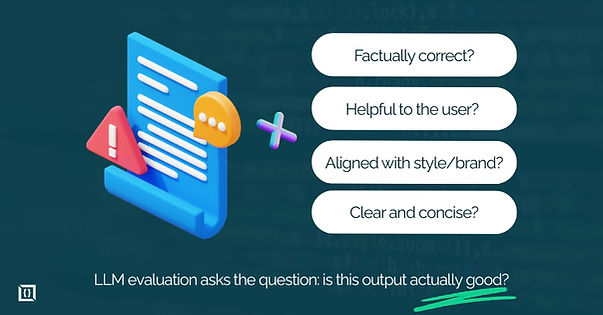
LLM evaluation answers a deceptively simple question: is this output good? The complexity comes from defining "good" in ways that are measurable, consistent, and aligned with what users actually care about.
Traditional software has clear correctness criteria. A function either returns the right value or it does not. LLMs operate in a space where multiple outputs can be valid; quality is often subjective, and failure modes are subtle. A response can be grammatically perfect, stylistically appropriate, and completely wrong about the facts.
LLM Evaluation Workflows
A typical evaluation workflow follows a series of steps.
First, you collect or generate test data representing realistic inputs your application will handle. This might include user queries, documents for summarization, or conversation contexts.
Next, you define ground truth or reference outputs where possible. For some tasks like question answering, correct answers exist. For open-ended generation, you might rely on human preferences or quality rubrics instead.
You then run inference to generate model outputs for each test case. Finally, you compare outputs against references or evaluate them using automated metrics, LLM judges, or human reviewers.
The workflow differs depending on your role. Model developers focus on pre-training and fine-tuning metrics across standard benchmarks. Application builders care more about task-specific performance and user-facing quality measures.
Common Evaluation Methods
Different methods address various evaluation needs:
- Reference-based evaluation compares outputs to known correct answers using metrics like exact match or BLEU scores
- Pairwise comparison presents two outputs and asks which is better, useful for preference learning
- Scoring and ranking assigns quality scores on defined scales, often using rubrics
- Classification tasks measure accuracy on structured outputs like sentiment or topic labels
LLM-as-a-Judge: Pros & Cons
Using one LLM to evaluate another has become popular for scaling evaluation. GPT-4 or Claude can assess thousands of outputs faster than human reviewers.
The benefits are clear: speed, consistency, and cost efficiency at scale. LLM judges can apply complex rubrics and provide detailed reasoning for their scores.
The risks are equally real. LLM judges inherit biases from their training, may favor certain writing styles, and can miss subtle factual errors. They also tend to prefer verbose responses and may reinforce patterns from their own training data.
The TruthfulQA benchmark uses a fine-tuned GPT-3 model called "GPT-Judge" specifically trained to assess truthfulness, illustrating how purpose-built judges can improve reliability.
LLM-as-judge works best when combined with periodic human review to calibrate and validate automated scores.
Why Evaluate a Large Language Model?
Evaluation ensures you understand both the model’s capabilities and how it performs in your application. It helps identify improvements, catch regressions, and verify that updates actually enhance real-world outcomes.
Benefits in Real-World Use Cases
Concrete benefits emerge across applications. Customer support teams use evaluation to reduce hallucinations and ensure responses match company policies. Healthcare applications require rigorous accuracy testing before deployment. Search systems measure retrieval relevance to improve user satisfaction.
Without evaluation, teams cannot answer basic questions: Is version 2 better than version 1? Did that prompt change improve quality? Are we meeting accuracy targets for this use case?
System vs Model Evaluation
Model evaluation tests the LLM in isolation. Metrics like perplexity and benchmark scores measure raw model capabilities.
System evaluation tests the complete application, including prompts, retrieval systems, guardrails, and user interfaces. A model might score well on benchmarks but perform poorly when integrated with a specific retrieval pipeline.
Both levels matter. Model evaluation helps select base models. System evaluation determines whether your application actually works for users.
LLM Evaluation Metrics Explained
Evaluation metrics quantify how well a model performs on different aspects of language tasks. They range from traditional measures of token prediction and n-gram overlap to semantic similarity, task-specific accuracy, and efficiency indicators like latency or memory use. Each metric captures a different facet of performance, and no single metric fully reflects real-world quality.
Perplexity
Perplexity measures how well a model predicts text. Lower perplexity indicates the model assigns higher probability to correct tokens. It is useful during training and for comparing language modeling capability.
However, perplexity does not capture factual correctness, helpfulness, or safety. A model with low perplexity can still generate fluent but wrong answers.
BLEU, ROUGE & METEOR
These reference-based metrics originated in machine translation and summarization research.
BLEU measures n-gram overlap between generated and reference text. ROUGE focuses on recall, measuring how much of the reference appears in the output. METEOR adds synonym matching and stemming for more flexible comparison.
These metrics work for constrained tasks with clear correct answers. They struggle with open-ended generation where many valid responses exist. A creative but correct answer might score poorly simply because it differs from the reference phrasing.
BERTScore & Levenshtein Distance
BERTScore uses contextual embeddings to compare semantic similarity rather than exact word overlap. It captures meaning more effectively than n-gram metrics.
Levenshtein distance measures character-level edits needed to transform one string into another. It is useful for tasks requiring exact formatting or specific output structures.
Task-Specific and Efficiency Metrics
Modern evaluation extends beyond text quality.
Latency measures response time, critical for real-time applications. Memory usage affects deployment costs and scalability. Code generation tasks use pass@k metrics measuring how often generated code passes unit tests. Robustness testing checks behavior under adversarial inputs.
Human-in-the-Loop Evaluation
Automated metrics cannot capture everything. Human judgment remains essential for subjective quality dimensions.
Combining Human Judgment and LLMs
Hybrid approaches balance scale and quality. Humans create gold-standard labels for a subset of data. LLMs then evaluate at scale, calibrated against human judgments.
Human evaluation provides ground truth for training LLM judges. Periodic human review catches systematic errors automated systems miss.
Challenges with Human Evaluations
Human evaluation has limitations. Annotators bring biases and vary in expertise. Fatigue reduces consistency over long sessions. Costs scale linearly with volume.
Inter-rater reliability becomes an issue when evaluating subjective qualities like helpfulness. Three to five annotators per example with majority voting helps ensure consistency.
Popular LLM Evaluation Benchmarks
Benchmarks provide standardized ways to measure model capabilities. GLUE and SuperGLUE focus on general language understanding, while TruthfulQA, MMLU, and HellaSwag test factual accuracy, broad knowledge, and commonsense reasoning.
Together, they help compare models and track improvements across different dimensions.
GLUE & SuperGLUE
GLUE (General Language Understanding Evaluation) tests natural language understanding across tasks like sentiment analysis and textual entailment. SuperGLUE increased difficulty after models saturated GLUE scores.
These benchmarks established evaluation standards but have become less relevant as modern LLMs exceed human performance on most tasks.
TruthfulQA, MMLU & HellaSwag
TruthfulQA tests whether models avoid generating false information, particularly around common misconceptions. It contains over 800 questions across 38 categories designed to catch models that produce confident but incorrect responses.
MMLU (Massive Multitask Language Understanding) evaluates knowledge across 57 subjects from elementary to professional level. With over 15,000 questions, it provides broad coverage of factual knowledge and reasoning.
HellaSwag tests commonsense reasoning through sentence completion. Models choose the most plausible continuation from four options across 10,000 sentences. While humans achieve 95% accuracy, earlier models struggled significantly.
Top LLM Evaluation Frameworks & Tools
The tooling ecosystem offers options for different needs and workflows.
LangSmith
LangSmith provides evaluation and observability for LangChain applications. It logs every LLM call with detailed traces, supports dataset management, and offers built-in evaluators for common metrics.
Best fit: Teams building RAG or agentic applications with LangChain who need integrated tracing and evaluation.
TruLens
TruLens emphasizes explainability through feedback functions that evaluate outputs for groundedness, relevance, and safety. It supports both automated and human evaluation workflows.
Best fit: Enterprise applications prioritizing transparency and auditability in evaluation decisions.
Weights & Biases
Weights & Biases (W&B Weave) extends its experiment tracking platform to LLM evaluation. Teams can log evaluations alongside training runs, compare model versions, and visualize results.
Best fit: ML teams already using W&B who want unified tracking across training and evaluation.
DeepEval
DeepEval treats LLM evaluation like unit testing. It integrates with pytest, supports 14+ built-in metrics, and enables CI/CD integration for automated quality gates.
Best fit: Engineering teams wanting test-driven development workflows for LLM applications.
Prompt Flow
Prompt Flow from Microsoft provides prompt engineering and evaluation tooling integrated with Azure AI services. It supports visual flow design and built-in evaluation nodes.
Best fit: Teams building on the Azure stack who need integrated prompt management and evaluation.
Amazon Bedrock & Vertex AI Studio
Amazon Bedrock includes model evaluation features for comparing foundation models on custom tasks. Google's Vertex AI Studio offers similar capabilities for models deployed on GCP.
Best fit: Enterprise teams building within AWS or GCP ecosystems who prefer integrated platform tools.
Azure AI Studio & Nvidia Nemo
Azure AI Studio provides evaluation capabilities alongside model deployment and fine-tuning. Nvidia Nemo Guardrails focuses on safety evaluation and output filtering for high-stakes applications.
Best fit: Azure-native teams or applications requiring strict safety controls and performance optimization.
How to Design an LLM Evaluation Suite
Designing an evaluation suite starts with selecting datasets that reflect real user inputs, edge cases, and current knowledge. Define clear quality criteria aligned with your application’s goals, and structure tests for statistical reliability, regular automated checks, and versioned datasets to track performance over time.
Choosing the Right Datasets
Consider domain relevance first. Generic benchmarks may not reflect your specific use case. Include examples representing actual user inputs and edge cases you have observed.
Data freshness matters for knowledge-dependent tasks. Ensure test data reflects current information your application should know.
Balance coverage across input types, difficulty levels, and user segments. Avoid datasets that over-represent easy cases.
Defining Quality Criteria
Quality means different things for different applications. A customer support bot prioritizes accuracy and helpfulness. A creative writing assistant might prioritize engagement and style.
Define explicit criteria before building evaluation infrastructure. Weight criteria according to business impact. Avoid generic quality scores that obscure what actually matters.
Structuring Your Evaluation
Test set size affects statistical reliability. For most applications, 500 to 1000 examples provide meaningful signal. Complex or subjective tasks may require more.
Establish evaluation frequency. Run automated checks on every deployment. Schedule periodic human review to validate automated scores.
Track results over time to catch regressions and measure improvement. Version control your evaluation datasets alongside your code.
Best Practices for LLM Evaluation
Effective evaluation combines continuous testing during training with production monitoring using real user interactions. Feedback loops, human review, and adversarial testing help catch regressions, measure real-world performance, and uncover failure modes that automated metrics alone might miss.
1. Evaluation During Training
Evaluate early and continuously during fine-tuning. Overfitting to training data can inflate benchmark scores while degrading real-world performance.
Use held-out validation sets that differ from training data. Monitor for signs of memorization rather than generalization.
2. Evaluation in Production
Production evaluation uses real user data to measure actual performance. This requires privacy-conscious data handling and user consent where appropriate.
Build feedback loops that route user signals back to evaluation datasets. Thumbs up/down, conversation abandonment, and explicit complaints all provide signal.
Red-teaming through adversarial testing catches failure modes that standard evaluation misses. Regularly test with inputs designed to break your application.
Challenges in Evaluating LLMs
Evaluation is inherently complex due to data overlap, misaligned metrics, adversarial inputs, and human or model biases. Address these by using relevant, up-to-date datasets, aligning metrics with user outcomes, including challenging real-world inputs, and validating judgments across diverse perspectives.
Training Data Overlap
Models trained on web data may have seen benchmark questions during training. This data contamination inflates scores without reflecting genuine capability.
Newer benchmarks address this through temporal splits and adversarial construction. Custom evaluation datasets specific to your application avoid this problem entirely.
Generic or Misaligned Metrics
Standard metrics may not match your goals. High BLEU scores do not guarantee helpful responses. Low perplexity does not prevent hallucinations.
Choose metrics aligned with actual user outcomes. When possible, measure downstream business metrics rather than proxy quality scores.
Adversarial Inputs & Real-World Gaps
Models behave differently under adversarial pressure. Inputs designed to confuse or manipulate often reveal weaknesses hidden by standard evaluation.
Real-world inputs are messier than curated test sets. Include typos, ambiguous queries, and unexpected formats in your evaluation data.
Human Bias & AI Blind Spots
Human annotators bring cultural biases and knowledge gaps. LLM judges inherit biases from training data. Neither perspective is fully objective.
Use diverse annotator pools. Cross-check LLM judgments against human review. Document known limitations and biases in your evaluation process.
How to Choose the Right LLM Evaluation Framework
Select frameworks that support custom metrics, integrate with your data and pipelines, and scale with your evaluation needs. Consider ease of use, extensibility, and whether open-source or managed solutions fit your operational and data control requirements.
Key Features to Consider
Look for support for custom metrics beyond built-in options. Data integration capabilities determine how easily you can use your own datasets. Scalability matters for high-volume evaluation. Dashboarding and visualization help teams interpret results.
Ease of use affects adoption. Complex tools with steep learning curves may go unused despite their capabilities.
Customizability & Integration
Evaluate API access and extensibility. Can you define custom evaluation logic? Does it integrate with your existing CI/CD pipeline?
Consider open-source versus managed options. Self-hosted tools offer data control but require operational investment. Managed platforms reduce overhead but introduce vendor dependencies.
Your Next Step
Evaluating LLMs is essential to understand whether your models actually perform as expected. Looking at both model-level metrics and system-level performance, and combining automated evaluation with human review, gives a clear picture of strengths and weaknesses.
Choosing the right datasets, defining precise quality criteria, and using appropriate tools ensures improvements are meaningful and measurable.
With a solid evaluation setup and ongoing monitoring, you can catch issues early, maintain reliability, and make sure your applications behave as intended for real users.
You can also connect with us to get guidance on setting up LLM evaluation pipelines, selecting the right metrics, and integrating human-in-the-loop checks for more reliable model performance.
Frequently Asked Questions
What is LLM evaluation and why is it important?
LLM evaluation measures quality, accuracy, safety, and alignment of model outputs. It ensures AI applications behave reliably, generate useful results, and meet user expectations. Without evaluation, teams cannot confidently know whether a model or prompt change improves performance or introduces regressions.
What's the difference between model evaluation and system evaluation?
Model evaluation tests the LLM in isolation, using metrics like token accuracy, BLEU, or embedding similarity. System evaluation measures the performance of the full application, including prompts, retrieval systems, guardrails, and the user interface. A model can perform well on benchmarks but still fail in real-world usage if the integration isn’t effective.
What does LLM-as-a-Judge mean and should I use it?
LLM-as-a-Judge is when one model evaluates outputs from another. It’s fast and scalable, allowing teams to rank, score, or compare responses automatically. However, LLM judges inherit biases and can miss nuanced errors. Combine them with human review for a balanced approach, especially for subjective or high-stakes tasks.
What's the minimum dataset size needed for reliable LLM evaluation?
For most tasks, 500–1000 examples provide meaningful statistical signal. Subjective, multi-turn, or highly varied tasks may require more samples to reduce variance and improve confidence. The key is ensuring that the dataset reflects the diversity of real-world inputs your application will face.
How do I evaluate multi-turn conversations vs single responses?
Multi-turn evaluation considers coherence, context retention, helpfulness, and conversation flow across all turns. Use dialogue-specific metrics and frameworks that track conversation state, cumulative errors, and turn-level alignment with expected outcomes. This helps capture issues invisible in single-turn evaluation.
How many human evaluators do I need?
Three to five annotators per example typically ensures reliable results. Use majority voting or averaging across scores to reduce subjectivity. For specialized domains, consider including domain experts to validate technical accuracy.
How long does it take to run 1000 evaluations?
It depends on the method. LLM-as-a-Judge can process 1000 examples in minutes, human evaluation may take hours to days depending on complexity, and automated metrics like BLEU or ROUGE run in seconds. Parallelization and infrastructure also influence throughput.
Can I combine automatic metrics with human review?
Yes. Automated metrics handle scale, but humans catch nuance, alignment issues, and subjective quality. A hybrid approach ensures evaluation is both efficient and meaningful.
How do I account for bias in evaluation?
Use diverse annotator pools and review LLM judge outputs critically. Track demographic and domain coverage in datasets, and document limitations. No evaluation is fully objective, so transparency about bias is essential.
Are there tools to streamline LLM evaluation?
Frameworks like LangSmith, TruLens, and DeepEval help structure datasets, track experiments, and automate scoring while supporting human-in-the-loop checks. Choose tools that integrate with your stack and evaluation needs.