Hire Nearshore PHP Developer | TOP PHP Nearshore Talent

PHP runs approximately 77% of all websites with a known server-side programming language. WordPress alone, built on PHP, operates 43.4% of all websites globally. Despite newer languages entering the market, PHP remains a central element of web development, and the demand for skilled PHP developers continues to grow.
For North American companies, hiring PHP talent domestically means competing for a limited pool at premium rates. Nearshoring to Latin America offers an alternative: access to experienced developers at competitive costs, with the added benefit of time zone alignment and cultural compatibility.
Let’s explore why nearshore PHP development works, what services are available, and how to structure engagements effectively.
Why Hire Nearshore PHP Developers?
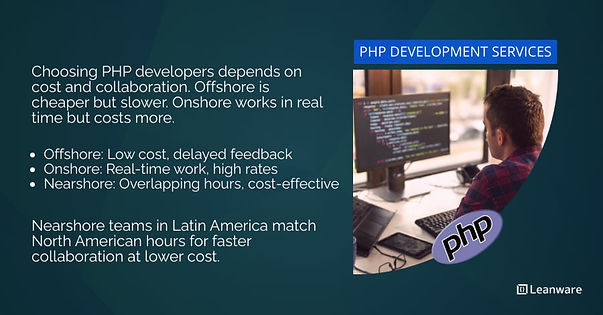
Choosing between onshore, nearshore, and offshore development involves three key factors: cost, communication, and collaboration quality.
Offshore teams in Asia offer the lowest rates but introduce 10 to 12 hour time zone gaps. This creates delays in feedback loops, limits real-time collaboration, and often results in work being done while your team sleeps. Issues that could be resolved in a quick call instead require waiting until the next business day.
Onshore teams eliminate these problems but at significantly higher costs. U.S.-based PHP developers command rates of $70 to $100 per hour, which puts extended team building out of reach for many startups and SMBs.
Nearshore development in Latin America sits in the middle. Teams in Mexico, Colombia, Argentina, and Brazil share overlapping business hours with North American companies. A developer in Mexico City works the same hours as someone in Chicago. A team in Bogotá overlaps almost entirely with Eastern Time.
Benefits of Nearshore PHP Development
The practical advantages go beyond time zones:
- Real-time communication: When a bug appears in production or requirements change mid-sprint, you can get developers on a call immediately. No waiting overnight for responses.
- Cultural alignment: Latin American developers are familiar with U.S. business practices and communication styles. They tend to flag issues proactively rather than waiting until problems escalate.
- Easier travel: If you need face-to-face meetings, flights from major U.S. cities to Mexico City, Bogotá, or Buenos Aires are direct and relatively short. This matters for kickoff meetings, quarterly planning, or building team rapport.
- Stronger IP protection: Latin American countries have established legal frameworks for intellectual property. Combined with standard NDAs and service agreements, your code and business assets remain protected.
Cost-Effective and Time Zone Friendly Collaboration
The cost difference is substantial. Nearshore development in Latin America ranges from $34 to $92 per hour, depending on seniority and specialization.
Region | Hourly Rate Range |
United States | $70 - $100 |
Canada | $60 - $80 |
Latin America (Nearshore) | $25 - $65 |
Eastern Europe | $37 - $100 |
Asia (Offshore) | $20 - $50 |
For a mid-level PHP developer, you can expect rates between $30 and $45 per hour in Latin America. Senior developers with Laravel or Symfony expertise typically fall in the $50 to $70 range. These rates represent 40% to 50% savings compared to U.S. equivalents while maintaining quality and communication standards.
The time zone overlap also results in productivity gains. Teams can pair program, conduct code reviews synchronously, and resolve blockers in the same workday. Agile ceremonies like daily standups and sprint planning happen during normal business hours for everyone involved.
Nearshore PHP Developer Services
PHP development covers a wide range of work, from building new applications to augmenting existing teams.
Service Model | Use | Key Features |
Custom PHP Development | Build applications from scratch | Laravel, Symfony, CodeIgniter; full development lifecycle |
PHP Staff Augmentation | Add developers to an existing team | Temporary or ongoing support; integrated into workflows |
Dedicated PHP Development Teams | Full team focused on your project | Developers, tech lead, QA; continuity and deep project knowledge |
1. Custom PHP Development
Custom development involves building applications from scratch based on specific business requirements. This includes web applications, APIs, content management systems, e-commerce platforms, and internal tools.
Modern PHP development typically uses frameworks rather than vanilla PHP. The most common include:
- Laravel dominates the PHP framework market. According to JetBrains' State of PHP 2024, 61% of PHP developers use Laravel regularly. It offers built-in authentication, database migrations, an elegant ORM (Eloquent), and a rich ecosystem of packages.
- Symfony powers enterprise-grade applications and is known for its modular architecture. It provides reusable components and scales well for complex projects. Drupal and parts of Laravel are built on Symfony components.
- CodeIgniter remains popular for lightweight applications where speed and simplicity matter more than extensive features.
Nearshore PHP teams handle the full development lifecycle: requirements gathering, architecture design, development, testing, and deployment.
2. PHP Staff Augmentation
Staff augmentation adds PHP developers to your existing team without the overhead of full-time hiring. This model works well when you need to scale quickly for a specific project, fill skill gaps temporarily, or meet tight deadlines without committing to permanent hires.
Augmented developers integrate into your workflows, tools, and processes. They attend your standups, use your project management systems, and report to your technical leads. The difference from contractors is the level of integration and the ongoing nature of the engagement.
Common scenarios for augmentation include:
- Accelerating feature development before a product launch
- Handling increased workload during peak seasons
- Bringing in specialized expertise (performance optimization, security hardening, legacy modernization)
- Covering for team members on leave
3. Dedicated PHP Development Teams
For larger or longer-term projects, dedicated teams provide a complete unit focused exclusively on your work. A typical dedicated team includes PHP developers at various seniority levels, a technical lead or architect, QA engineers, and optionally a project manager.
This model suits companies building complex web applications, SaaS platforms, or products requiring ongoing development. The team learns your codebase, understands your business context, and operates as an extension of your organization.
Dedicated teams offer consistency. The same people work on your project week after week, building institutional knowledge and reducing ramp-up time for new features.
Flexible Engagement Models
Different project stages and business situations call for different engagement structures. Three models cover most scenarios.
Dedicated Nearshore Team
This approach works best for teams handling long-term product development, tackling complex applications, and managing ongoing feature work.
You get a full-time team allocated exclusively to your project. Team composition scales based on needs, from a small squad of two to three developers to larger teams with specialized roles. Pricing is typically monthly based on team size and composition.
This model provides the most control and integration. Teams work on your schedule, follow your processes, and align with your product roadmap.
Staff Augmentation
Staff augmentation is ideal when you need temporary capacity, want to fill skill gaps, handle tight deadlines, or manage seasonal workload spikes.
Individual developers or small groups join your existing team. You maintain technical leadership and project management. The nearshore partner handles employment, payroll, and HR.
Engagement length varies from a few weeks to several months. Scaling up or down happens relatively quickly compared to direct hiring.
Project Delivery
Project delivery works best for well-defined projects with a clear scope, for companies that lack a strong internal technical team, or for initiatives with a fixed budget.
The nearshore partner takes responsibility for delivering a complete project. This includes discovery, planning, development, QA, and deployment. You define requirements and approve deliverables; they handle execution.
Project delivery typically follows agile methodology with sprint planning, regular demos, and transparent reporting. You stay involved through reviews and feedback cycles without managing day-to-day development.
How It Works
Working with a nearshore PHP development partner starts with a clear process that keeps things smooth and ensures everyone stays on the same page from the beginning.
Simple and Secure Hiring Process
The typical process moves through a few clear stages:
- Initial consultation:Discussion of your project requirements, timeline, and team needs. Technical leads assess the complexity and identify the right skill profiles.
- Candidate selection: The partner presents pre-vetted candidates matching your requirements. You interview and evaluate fit just as you would with direct hires.
- Contracting: Standard agreements cover IP ownership, confidentiality (NDAs), service terms, and payment schedules. All code produced belongs to you.
- Onboarding: Selected developers get access to your systems, codebase, and communication channels. Initial ramp-up typically takes one to two weeks depending on project complexity.
- Ongoing work: Development proceeds according to your chosen engagement model with regular check-ins and progress reporting.
Scalable Team Expansion
One advantage of nearshore partnerships is flexibility in team size. Startups often start with one or two developers, then scale as the product gains traction. Growing companies add specialized roles (DevOps, QA, frontend) as architecture demands increase.
Scaling down is equally simple. After major releases or when priorities shift, you can reduce team size without the complications of layoffs or severance.
This elasticity helps manage burn rate during early stages while preserving the ability to accelerate when funding or revenue supports growth.
Why Nearshore PHP Developers Stand Out
A few key factors differentiate quality nearshore PHP development from commodity outsourcing:
Key Factor | What Sets Them Apart |
Top Talent & PHP Expertise | Vetted developers skilled in PHP 8.5+, Laravel, Symfony, AI/LLM workflows |
Secure & Scalable | Performance-focused code, CI/CD, automated testing, strong IP protection |
Smooth Collaboration | Shared hours for real-time Agile ceremonies, daily standups, Jira/Slack; high English proficiency |
Cost-Effective | 30-70% lower than U.S./Western Europe with fewer reworks |
Top-Rated Talent and Proven Expertise
Latin America has invested heavily in technical education. Countries like Argentina, Brazil, and Colombia produce large numbers of computer science graduates annually. Many developers have experience working with U.S. companies and understand the expectations of North American clients.
Reputable nearshore partners maintain rigorous vetting processes. This typically includes technical assessments, coding challenges, English proficiency evaluation, and soft skills interviews. By the time candidates reach you, they have already passed multiple screening stages.
Fast, Secure, Scalable Web Solutions
Experienced PHP developers build with performance and security in mind. This means proper input validation, prepared statements for database queries, HTTPS enforcement, and secure session handling. It also means writing code that scales, using caching strategies, optimizing database queries, and designing for horizontal scaling when traffic grows.
Modern PHP development also incorporates DevOps practices: CI/CD pipelines, automated testing, containerization with Docker, and infrastructure as code. These practices ensure consistent deployments and reduce the risk of production issues.
Seamless Communication and Collaboration
English proficiency is standard among professional developers in Latin American tech hubs. Teams conduct meetings, write documentation, and communicate in Slack or Teams without language barriers.
Daily standups, sprint planning, and retrospectives happen in real-time. Tools like Jira, Linear, or Asana track progress transparently. Code reviews happen synchronously when needed. This level of communication matches what you would expect from an in-house team.
Getting Started
With nearshore PHP development, you get experienced developers without high domestic costs or offshore communication delays. Latin America offers time zone alignment, cultural fit, and cost advantages for your team.
Pick the model that fits your needs. Use staff augmentation for quick projects or a dedicated team for ongoing development. Either way, you benefit from real-time collaboration and competitive rates.
Connect with our experts now to discuss your project and find the right nearshore PHP development solution for faster, efficient, and scalable results.
Frequently Asked Questions
What is nearshore PHP development?
Nearshore PHP development means hiring PHP developers in nearby countries, typically within similar time zones. For U.S. and Canadian companies, this usually means teams in Latin America. The model provides better communication, faster turnaround, and more competitive pricing compared to domestic hiring or offshore outsourcing
Why hire nearshore instead of offshore PHP developers?
Nearshore developers offer greater overlap in working hours, stronger cultural alignment, and more seamless communication. This leads to fewer misunderstandings, faster feedback loops, and smoother collaboration. These factors matter significantly in agile development where quick iterations and constant communication drive success.
How much does it cost to hire a nearshore PHP developer?
Costs vary by country, experience, and engagement model. Nearshore PHP developers in Latin America typically range from $35 to $65 per hour, representing 40% to 50% savings compared to U.S. rates. Senior developers with framework expertise (Laravel, Symfony) command the higher end of this range.
What are the benefits for startups?
Startups gain faster time-to-market, lower development costs, and real-time collaboration without the overhead of building a local team. Nearshore teams scale easily as funding and product needs change, making them well-suited for the unpredictable growth patterns of early-stage companies.
How do I manage a nearshore PHP development team?
Management happens through standard tools: Slack or Teams for communication, Jira or Linear for project tracking, GitHub or GitLab for code management, and Zoom or Google Meet for video calls. Many nearshore partners provide dedicated project managers or technical leads to ensure clear communication and on-time delivery.
Are nearshore PHP developers fluent in English?
Yes. Professional nearshore developers in Latin America typically have strong English proficiency. Teams conduct meetings, write documentation, and handle all communication in English. Language barriers are rare with established nearshore partners.
Can I scale my nearshore PHP team up or down?
Absolutely. Nearshore development offers flexible team scaling based on project requirements. You can expand during intensive development phases and reduce during maintenance periods. This flexibility is one of the primary advantages over direct hiring.
How secure is my project with a nearshore team?
Trusted nearshore partners follow industry-standard security practices: secure development environments, encrypted communications, access controls, and comprehensive NDAs. IP ownership is clearly established in contracts, ensuring your code and business assets remain protected.
What frameworks do nearshore PHP developers use?
Nearshore PHP developers work with modern frameworks including Laravel, Symfony, CodeIgniter, and Zend. They also use supporting tools: Composer for dependency management, PHPUnit for testing, Git for version control, and CI/CD pipelines for automated deployment.
How do I get started?
The process begins with defining your project requirements and team needs. Reach out to nearshore partners, discuss your goals, and evaluate candidates. Most engagements can start within two to four weeks from initial contact, depending on team size and specialization requirements.