LangChain vs ChatGPT Plugins: Key Differences & How to Choose

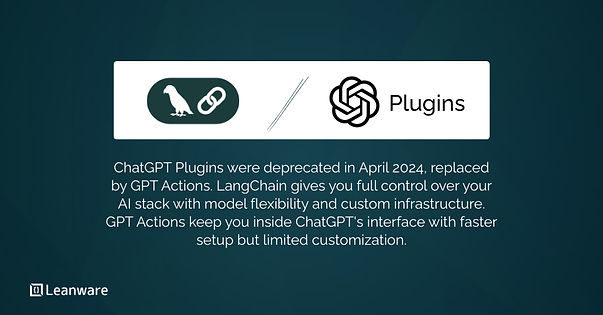
OpenAI deprecated ChatGPT Plugins in April 2024 and replaced them with Custom GPTs and GPT Actions. If you're evaluating these options, the comparison has shifted, but the underlying decision remains the same: do you build within OpenAI's ecosystem, or use an open-source framework like LangChain where you control the entire stack?
Custom GPTs with Actions work well for internal tools, quick integrations, and use cases where ChatGPT's interface is acceptable. LangChain fits better when you need model flexibility, custom UIs, or production systems that run on your own infrastructure. The choice depends on how much control is needed and how tightly the app is tied to a single provider.
Let’s explore the technical differences, including architecture, performance, development experience, and use cases, while covering the transition from Plugins to GPT Actions and where LangChain fits in today.
What Are LangChain and ChatGPT Plugins?
Before exploring the comparisons, let's clarify what each tool is and where things stand today.
Overview of ChatGPT Plugins (Deprecated)
ChatGPT Plugins launched in March 2023 as OpenAI's first attempt to let ChatGPT interact with external services. Developers could create plugins by defining an OpenAPI schema and hosting an API endpoint. ChatGPT would then decide when to call these plugins based on user queries.
The system peaked at around 1,039 official plugins by January 2024. However, OpenAI deprecated plugins on April 9, 2024, citing limited adoption and complexity issues. Most ChatGPT Plus subscribers never explored plugins, and the installation process confused average users.
OpenAI replaced plugins with Custom GPTs and GPT Actions. Custom GPTs let you create specialized versions of ChatGPT with custom instructions, knowledge files, and API integrations. GPT Actions work similarly to the old plugin system but live inside individual GPTs rather than as standalone extensions.
Overview of LangChain
LangChain is an open-source framework for building applications powered by large language models. Harrison Chase created it in late 2022, and it has grown into one of the most widely adopted LLM development tools available.
LangChain provides building blocks for LLM applications: prompt templates, model abstractions, memory systems, tool integrations, and workflow orchestration. The ecosystem includes LangGraph for building stateful agent workflows and LangSmith for observability and debugging.
LangChain officially supports Python and JavaScript/TypeScript. The Python version is more mature and sees broader production use.
Core Differences Between LangChain and GPT Actions
Since ChatGPT Plugins are gone, the relevant comparison today is LangChain versus Custom GPTs with Actions.
Definition and Architecture
Aspect | LangChain | Custom GPTs with Actions |
Type | Open-source development framework | OpenAI platform feature |
Architecture | Developer-controlled, self-hosted | Runs inside ChatGPT's interface |
Code Required | Yes (Python or JavaScript) | Minimal (OpenAPI schema) |
Model Lock-in | Works with OpenAI, Anthropic, Google, open-source models | OpenAI models only |
State Management | Full control via memory systems | Limited to conversation context |
Deployment | Your infrastructure | OpenAI infrastructure |
LangChain is a framework you use to build custom applications. You write code, deploy to your own servers, and control everything from the UI to the model selection. Custom GPTs are configurations within ChatGPT's interface. You provide instructions, upload files, and optionally connect external APIs through Actions.
One technical detail to highlight: GPT Actions are built on Function Calling, the same mechanism that powers tool use in the OpenAI API. The model decides when to call your API based on user intent, generates the required parameters, and processes the response. This abstraction works well for straightforward integrations but gives less control over exactly when and how calls are made compared to LangChain, where that logic is defined explicitly.
Authentication is handled differently as well. GPT Actions let you configure OAuth or API key authentication, and the GPT executes API calls using the third-party app's credentials. Users choose whether their data gets sent to external APIs, and chats with GPTs aren't shared with builders by default.
Supported Platforms and Integrations
LangChain integrates with a wide range of services: model providers (OpenAI, Anthropic, Google, Cohere, open-source models), vector databases (Pinecone, Weaviate, Chroma, Qdrant, pgvector), document loaders (PDF, Word, Notion, Google Drive, Slack), and tools (web browsers, code interpreters, databases, custom functions).
Custom GPTs with Actions have a narrower scope: OpenAI models only (GPT-4o, GPT-4.1, o3, o4-mini), built-in capabilities (web search, DALL-E, code interpreter), external connections via OpenAPI schema, and up to 20 uploaded files per GPT.
Use Case Focus
Choose Custom GPTs when you need to enhance ChatGPT's interface for specific tasks. Good examples include internal knowledge bases, standardized workflows, and tools that benefit from conversational interaction within ChatGPT.
Choose LangChain when you need full control over your AI application. This includes building customer-facing products, complex multi-step workflows, applications requiring specific models, or systems that need to run outside ChatGPT's environment.
Performance Comparison
Performance varies based on control and infrastructure. LangChain offers flexibility and optimization but requires hands-on management, while Custom GPTs provide built-in scaling and reliability with some latency and limited control over complex workflows.
Execution Speed and Efficiency
LangChain's performance depends on your implementation and infrastructure. You control caching, batching, and optimization. Direct API calls add minimal overhead.
Custom GPTs add latency through the ChatGPT interface layer. Actions involve extra hops: user query to ChatGPT, ChatGPT to your API, response back. For complex workflows requiring multiple API calls, delays accumulate.
Scalability
LangChain scales with your infrastructure. LangGraph handles stateful workflows that can run for hours with built-in persistence and auto-scaling.
Custom GPTs scale automatically but with limited control. Rate limits apply, and Actions may hit timeout limits (around 45 seconds). High-volume production workloads typically outgrow Custom GPTs.
Reliability
LangChain's reliability depends on your implementation. You handle error recovery, retries, and fallbacks.
Custom GPTs benefit from OpenAI's infrastructure but Actions can fail when the model misinterprets intent or APIs return unexpected formats. Debugging is harder without external observability tools.
Development Experience
Development experience varies between ease and control. Custom GPTs are quicker to start with but limited in flexibility, while LangChain requires more setup and coding knowledge but allows full customization and scalability for complex projects.
Learning Curve
Custom GPTs have a gentler entry point. You can create a basic GPT without writing code using the GPT Builder interface. Actions require understanding OpenAPI schemas and hosting an API.
LangChain has a steeper learning curve. You need Python or JavaScript proficiency and understanding of LLM concepts like prompts, chains, agents, and memory. Documentation is extensive but can feel overwhelming initially.
Flexibility and Customization
LangChain offers near-complete flexibility. You can customize prompts, swap models, implement custom memory systems, and build novel workflows.
Custom GPTs operate within OpenAI's constraints. You can customize instructions, upload knowledge, and connect APIs, but cannot modify how the model processes information or change the interface.
Development Speed
For simple use cases, Custom GPTs are faster. You can have a working prototype in minutes.
LangChain requires more setup but scales better for complex projects. The ecosystem of templates and community components accelerates development once you know the framework.
Maintenance Requirements
Custom GPTs require minimal maintenance without Actions. With Actions, you maintain your API endpoints.
LangChain projects need ongoing maintenance: dependency updates, model API changes, and framework upgrades. Version pinning and testing become essential.
When to Use Custom GPTs with Actions
Custom GPTs are well-suited for extending ChatGPT for specific tasks: internal knowledge assistants, workflow standardization, simple API integrations, and personal productivity tools.
Enterprise teams at companies like Amgen, Bain, and Square use internal GPTs for tasks like generating marketing materials that match brand guidelines, helping support staff answer customer questions, and onboarding new engineers.
When to Use LangChain
LangChain fits scenarios requiring custom development: customer-facing products, complex document processing (RAG), multi-step autonomous agents, applications requiring specific models, and systems needing fine-grained control.
Hybrid Approaches
Build your core logic in LangChain on your backend, then expose functionality through a Custom GPT Action. This gives you LangChain's flexibility while letting users interact through ChatGPT's interface.
Advantages of Custom GPTs
Fast prototyping without code, no infrastructure to manage, familiar ChatGPT interface, built-in capabilities (web search, code interpreter, image generation), and easy sharing within organizations.
Advantages of LangChain
Model flexibility across providers, full control over application behavior, extensive integrations, production-ready observability with LangSmith, large open-source community, and self-hosting for data privacy requirements.
Challenges and Limitations
Custom GPTs: Locked to OpenAI's ecosystem, limited debugging visibility, Action timeouts and rate limits, no interface customization, knowledge limited to uploaded files.
LangChain: Steeper learning curve, requires infrastructure management, frequent framework updates, abstractions can obscure behavior, more engineering effort for simple use cases.
Pricing and Support
Pricing and support vary by approach. Custom GPTs have subscription and API costs, while LangChain is free but requires API and infrastructure expenses. Both provide solid documentation and community resources.
Cost Considerations for Custom GPTs
Custom GPTs require ChatGPT Plus ($20/month), Team ($25/user/month), or Enterprise pricing. Actions that call external APIs add your API hosting costs.
Cost Considerations for LangChain
LangChain is open-source and free. Your costs come from LLM API usage, infrastructure, and optionally LangSmith for observability (free tier available). LangChain offers discounted pricing for startups.
Support and Community
OpenAI provides official documentation, OpenAI Academy tutorials, and enterprise support for paid plans.
LangChain has extensive documentation, a community forum, Discord server, and LangChain Academy courses. The large community means quick answers to common questions.
Which to Choose Based on Your Project Needs
The right approach depends on team size, project scope, and how much control is needed. Smaller projects may work well with Custom GPTs, while LangChain is more suitable for larger or more complex workflows.
Team Profile | Recommended Approach |
Solo developer, quick prototype | Custom GPT (faster to start) |
Small team, internal tool | Custom GPT with Actions |
Startup building AI product | LangChain (flexibility, scale) |
Enterprise with custom requirements | LangChain (control, compliance) |
Need multiple model providers | LangChain (model flexibility) |
Data must stay on-premise | LangChain (self-hosted) |
Examples of Projects Best Suited for Each:
Custom GPTs: HR assistant for benefits questions, sales tool for proposal drafts, customer FAQ bot connected to your API.
LangChain: Document analysis platform, autonomous research agents, multi-tenant SaaS with AI features, custom chatbots with branded interfaces.
Next Step
Begin by exploring the available resources and documentation for each platform to understand their capabilities.
For Custom GPTs, start with OpenAI's GPT Builder and the GPT Actions documentation on platform.openai.com.
For LangChain, begin with the documentation at langchain.com and LangChain Academy's free courses.
For guidance on building or integrating RAG workflows, Custom GPTs, or LangChain solutions, connect with our experts to get support in developing and optimizing AI applications.
Frequently Asked Questions
What is the difference between LangChain and ChatGPT Plugins?
LangChain is a developer framework for building custom AI applications with support for tools, agents, chains, and memory. ChatGPT Plugins were add-ons that extended ChatGPT by calling external APIs. OpenAI deprecated Plugins in April 2024 and replaced them with Custom GPTs and GPT Actions.
Which is better: LangChain or Custom GPTs?
It depends on your use case. Custom GPTs work best for quick internal tools that enhance ChatGPT's interface. LangChain is better for custom products, complex workflows, and production systems where you need full control.
Can I use LangChain and Custom GPTs together?
Yes. Build your core logic in LangChain on your backend and expose functionality through a Custom GPT Action. This gives you LangChain's flexibility while letting users interact through ChatGPT.
Are ChatGPT Plugins open source?
No. The plugin system was maintained by OpenAI. Developers could host API endpoints, but the platform was proprietary. The same applies to Custom GPTs and Actions.
Is LangChain free to use?
Yes, LangChain is open-source. However, you'll pay for LLM API usage, hosting, and infrastructure.
What programming languages does LangChain support?
Python and JavaScript/TypeScript. The Python version is more mature and widely used in production.
Do I need coding experience to use Custom GPTs?
Basic GPT creation requires no code. Adding Actions requires understanding OpenAPI schemas and hosting an API.
Which one is better for startups building AI products?
LangChain is typically better for customer-facing products. It offers model flexibility, full control over the user experience, and scales with growth. Custom GPTs are limited to ChatGPT's interface.
How do GPT Actions work?
GPT Actions leverage Function Calling under the hood. When a user asks a question, the system decides which API call is relevant, generates the JSON input required for that call, and executes it. Developers define the OpenAPI schema and configure authentication, and ChatGPT handles the translation between natural language and API requests. Actions can chain multiple calls together. For example, a weather Action might first call an API to convert a city name to coordinates, then use those coordinates to fetch the forecast, and finally return a packing recommendation based on the results.
What are the main use cases for LangChain?
AI agents, document-based Q&A (RAG), workflow orchestration, custom LLM pipelines, and autonomous reasoning systems.
How can I hire developers for LangChain projects?
Look for Python developers with experience in LLM application development, RAG pipelines, and API integrations. Key skills include familiarity with LangChain's core components (chains, agents, memory, retrievers), vector databases like Pinecone or Weaviate, and at least one LLM provider's API. Senior candidates should have production experience with LangSmith or similar observability tools. For cost-effective access to skilled talent, consider nearshore teams in Latin America through companies like Leanware, which offer timezone alignment with US companies and competitive rates. Other options include AI-focused job boards and freelance platforms.